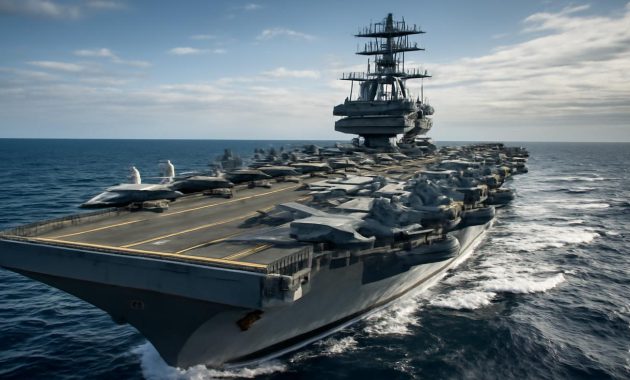
The first thing you notice is the wind. It rolls in across the Atlantic, heavy with salt and the distant breath of rain, and it snatches at hats and camera straps as a gray shape swells on the horizon. At first it seems like a low cloud clinging to the sea. Then the shape sharpens, hardens into steel lines and a flat, improbable runway that seems to float above the water. Someone on the pier whistles under their breath. Even the gulls pull back, wheeling higher, as if instinctively giving way. The United States Navy’s newest giant—able to carry 5,000 sailors and an air wing powerful enough to change the weather in any war zone it enters—is coming home.
The Day the Giant Came Into View
There’s a particular hum to a busy naval base, a kind of low, industrial heartbeat. Forklifts beep, boots clack on metal gangways, radios murmur. But when an aircraft carrier arrives, the entire soundscape bends toward it, like iron to a magnet. Conversations trail off. People turn to the sea. Phones rise in unison.
The carrier’s island—its tall, angular command tower—is stacked with radar domes and antennae that gleam like wet stone. Lines of sailors in crisp dress whites line the massive flight deck, tiny white stitches against a slab of war-gray fabric. Below decks, unseen, thousands more move through a steel labyrinth that smells of jet fuel, coffee, and machine oil, each space labeled with cryptic stencils and glowing red exit signs.
To the casual observer, it’s just another big ship. But this one represents something more—a declaration in steel and steam and silicon. A reminder, to China and to anyone else watching the world’s sea lanes, that the United States still knows how to build floating cities that can fight, endure, and dominate the oceans for decades.
The New Breed of Floating City
Step through one of the carrier’s side hatches and the outside world narrows instantly. You’re in a passage barely wide enough for two people to pass without turning sideways, pipes and cables snaking overhead in red, blue, and yellow. The air is cool but close, tinged with paint and metal and the faint tang of the sea.
Somewhere deep inside this steel hive, a chief petty officer grins and slaps a hand against the bulkhead. “This is a small town,” he says. “Actually, scratch that. This is a small city that just happens to move at over 30 knots.”
He’s not exaggerating. Carriers like this next-generation American giant—the kind sliding steadily into service now—are designed to bring roughly 5,000 souls to sea: sailors, aviators, engineers, doctors, cooks, and a dizzying array of specialists whose job descriptions read like a cross between a power plant crew, a tech startup, and a small hospital staff.
What makes this new giant different is what lies beneath its skin. The United States has been quietly revolutionizing what an aircraft carrier is: more automation; electromagnetic aircraft launch systems instead of the old steam catapults; advanced arresting gear to snatch landing jets out of the sky with smooth, computer-controlled precision. Its nuclear reactors generate enough electricity to power a mid-sized American city, and a thick slice of that power is funneled into sensors, command networks, and the complex choreography of flight operations that can launch and recover aircraft around the clock.
Walk through its hangar bay—a cavernous space high enough to swallow a three-story house—and you can almost taste the potential. Helicopters hunker under tarps. Fighters gleam under bright white lights. A faint sheen of hydraulic fluid gives the deck its particular, metallic smell. This is the carrier’s beating heart, where metal birds rest between sorties, where Chinese satellite operators and intelligence officers measure, re-measure, and note with quiet concern every new hull number that appears on America’s giant decks.
The Numbers That Tell the Story
From the pier, it’s easy to be awed by size. But numbers bring that awe into focus. The table below gives a sense—simplified, but stark—of what this one ship represents when it slips its moorings and turns toward open water.
| Feature | Approximate Value | What It Means at Sea |
|---|---|---|
| Crew & Air Wing | Up to 5,000 personnel | A self-contained community with military, medical, and logistical depth |
| Displacement | ~100,000 tons | Stability in rough seas; space for fuel, aircraft, and systems |
| Propulsion | Nuclear reactors | Years at sea without refueling; global reach |
| Air Wing Capacity | 60–75 aircraft | Fighters, early-warning, and helicopters form a mobile air force |
| Flight Deck Length | Over 1,000 feet | Enough runway for continuous operations day and night |
From Beijing’s perspective, that table might as well be a list of worries. Each row represents not just capability but something more stubborn: experience. That’s the part that can’t be simply designed, purchased, or decreed into existence.
Why This Matters to China
On the other side of the Pacific, China has been building its own carriers—fast. Hulls rise from dry docks with a kind of deliberate urgency; new classes appear almost as soon as analysts finish diagramming the last one. China’s newest carrier bristles with catapults and a flat deck that looks more and more like a cousin to American designs. On paper, the gap appears to narrow.
But paper is calm. The sea is not.
Carrier operations are a ballet performed on a rolling, pitching stage. Planes don’t just take off and land; they do so in crosswinds, in darkness, with decks slick from rain or spray, with the sudden turbulence of another jet’s exhaust curling unseen in the night air. Ordnance crews roll thousand-pound bombs inches from the edge. Fuel hoses snake between jets like black vines. A moment’s lapse can be fatal.
The United States has been rehearsing this ballet continuously since World War II, through Korea, Vietnam, the Cold War, the Gulf, and into the foggy, asymmetrical conflicts of the 21st century. That experience is embedded not only in procedures but in muscle memory—passed from one generation of sailors and aviators to the next as stories told in wardrooms, as habits drilled into recruits, as instincts formed under the scream of afterburners.
China is catching up, but it is still new to this theater. Its captains and deck crews are learning under the eyes of satellites and foreign intelligence, testing the limits of their machines and people in real time. Every arresting wire failure, every sortie pattern, every maintenance cycle writes a new line in a manual that America has been updating for nearly eight decades.
So when this new American giant prepares to enter service, China doesn’t just see hull steel and radar profiles. It sees a fresh platform plugged into an old, finely tuned machine—a machine that spans shipyards, training squadrons, logistics hubs, and the quiet offices where admirals think not in miles but in oceans.
The Message in Plain Sight
The message isn’t subtle. It doesn’t have to be. When an American carrier strike group deploys—this new ship at its center, surrounded by cruisers, destroyers, submarines, and supply ships—it paints a moving circle of influence on the map, one that stretches hundreds of miles from its hull in every direction.
Inside that circle, the carrier can do more than fight. It can watch, listen, and reassure. Diplomats talk about alliances and treaties; the carrier speaks in presence. It can appear off the coast of a nervous ally and suddenly the air feels a little thicker with security. It can cruise through contested waters and silently press a question: How badly do you want to test us?
China has invested heavily in ways to answer that question—long-range missiles designed to threaten big ships, sensors to find them, submarines to stalk them. Its strategy reflects a fundamental reality: building carriers is only half the story; building a way to counter them is the other half. Yet even these “carrier killers” are chasing a moving target. Every new generation of American carrier folds in lessons about how to hide, how to defend, how to fight through.
Life Aboard the Giant
For all the grand strategy talk, life aboard this ship is intensely human and surprisingly mundane. A young sailor will remember not the geopolitics but the taste of over-brewed coffee at 0300, the feel of a steel ladder under tired hands, the way the ship’s gentle sway rocks her to sleep after a brutal, twelve-hour watch.
At midday, the mess decks fill with a roar of voices and the clatter of trays. It smells like french fries, disinfectant, and hot sauce. The line snakes around corners. You might pass a fighter pilot in a green flight suit, a nuclear technician in a stained coverall, a corpsman with a stethoscope looped through his pocket. Out on the flight deck, a faint thunder persists as engines spool up, rotors spin, and the air shivers with controlled violence.
Far below, near the waterline, the world narrows again. In an engine monitoring room, screens glow dimly, displaying pressures, temperatures, power flows. The people here might never see the flight deck during a long watch; their universe is the rhythm of the reactors, the steady promise of thrust. In the carrier’s hospital spaces, doctors and nurses keep a quiet vigil, prepared to treat everything from sprained ankles to serious trauma. There is even a dentist, because a toothache in the middle of the Pacific can grind readiness as surely as a busted catapult.
This is what it means to carry 5,000 souls to sea: not just a tally of bodies, but an ecology of skills. China’s planners know that behind the hulls and headlines lies this web of human systems, each one requiring years to train, refine, and sustain. A single American carrier is a reminder that the United States hasn’t only built ships—it has built a culture of operating them.
The Ritual of Readiness
Before the ship officially joins the fleet, it endures a gauntlet of tests. Sailors call it “working up,” and it’s part trial by fire, part dress rehearsal. Alarms will scream through the passageways as fire drills play out in controlled chaos. Pilots will fly endless patterns, testing the new launch and recovery systems under every condition the weather and commanders can throw at them.
Inspectors roam the ship with clipboards, opening panels, testing valves, checking logs. On the bridge, junior officers learn the feel of the ship through the helm—how many degrees of rudder it takes to answer a turn, how she handles in heavy seas. Tiny details add up to the kind of instinct that saves time and lives when the horizon suddenly fills with trouble.
Beyond the hardware checks lies something subtler: trust. The Navy is teaching itself to trust this new hull, this new set of systems, this new team. Until that happens, the carrier is an impressive object. Once it does, the carrier becomes a weapon.
Oceans as Theater, Carriers as Actors
Maps flatten the world into neat colors and borders, but the seas blur those lines. On a globe, the Pacific doesn’t look like a barrier between the United States and China; it looks like a shared stage. On that stage, ships are not just tools but characters in an ongoing, wordless conversation.
China’s new carriers say: We are here now. We can project power beyond our coastline. We, too, can launch fighters far from home. American carriers, especially this latest giant, reply with a different, slower statement: We’ve been here. We know these waters. We understand the script.
And the script keeps evolving. Hypersonic weapons, cyber warfare, satellites, autonomous drones—the future is rushing in, and no ship, however large, can escape its pull. Yet within that rush, the sheer presence of a carrier still matters. Stand on its deck at dusk, when the sun burns low and red over the ocean, and you can feel why. The horizon curves in every direction. The sea seems endless, but the steel under your boots is steady, defiant. Somewhere out there, eyes are watching, radars are sweeping, decisions are being made based on the silhouette you cut against that fading light.
In that moment, the carrier is more than a machine. It’s a statement of national will, of industrial capacity, of people trained to operate at the edge of what’s physically possible. China understands this, which is why it is racing to build its own versions. The United States understands it too, and with every new giant that slides from dry dock into the deep, it is reminding the world—and particularly Beijing—that dominance at sea isn’t just about who shows up. It’s about who can stay, who can adapt, and who has spent generations learning how to fight where there are no landmarks but stars and waves.
Looking Ahead Across a Crowded Sea
As the new American carrier edges closer to full service, small boats dart around its hull like pilot fish, tugboats nudging it into place, lines snaking out toward bollards on the pier. The spectacle feels both ancient and cutting-edge: ropes and diesel fumes in the shadow of a nuclear-powered fortress.
Somewhere ashore, an analyst will slide a fresh photo of the ship into a briefing deck. Chinese officers will study it in a quiet room, noting the arrangement of radar arrays, the subtle differences in the island’s profile, the span of the flight deck. They will talk through scenarios, calculations, contingencies.
But out on the weather decks, the conversation is simpler. A sailor takes one last look at the horizon before turning back inside. Another shipmate leans on the rail, squinting into the stiff wind. To them, this is home for months at a time—a maze of compartments, a place of friendships and frustrations, a floating world stitched together by routine and ritual.
As the sun drops and the pier lights flicker on, the carrier’s bulk turns into a looming, man-made cliff of light and shadow. It’s hard not to feel that the Earth has tipped slightly, as if rebalancing around this new mass of steel. Across the ocean, in offices far from the smell of salt and diesel, someone in Beijing can likely feel it too, in numbers and projections and lines on charts.
Because this is how the United States reminds China—and everyone else—that, for now, it still dominates the seas: not through speeches, not through slogans, but with a living, breathing giant that will soon leave the pier, turn its bow toward the open water, and vanish over the horizon, carrying 5,000 lives and a vast, quiet power into the restless blue.
FAQ
Why is this new U.S. aircraft carrier so significant?
It combines cutting-edge technology—like electromagnetic launch systems and advanced radar—with the ability to carry around 5,000 personnel and a large, versatile air wing. It’s not just a single ship, but the centerpiece of a carrier strike group, symbolizing sustained American ability to project power across the globe.
How does it compare to China’s aircraft carriers?
China is rapidly improving its carrier fleet, but the United States still holds a major edge in experience, global support infrastructure, and the sheer number of fully operational carriers. This new giant plugs into a mature system of training, logistics, and combat doctrine that China is still developing.
What does “able to carry 5,000 sailors” really mean in practice?
It means the ship is a floating city, with everything from power plant operators and pilots to doctors, cooks, IT specialists, and mechanics. That breadth of skills allows it to operate independently for long periods, far from home ports.
Are aircraft carriers becoming obsolete because of long-range missiles?
They are becoming more vulnerable, but not obsolete. As threats evolve, carriers adapt with new defensive systems, tactics, and technologies. Their flexibility, mobility, and ability to carry diverse aircraft still make them central to modern naval strategy.
When will this new carrier fully enter service?
After construction, a carrier goes through extensive sea trials, testing, and crew training before it is formally commissioned and achieves full operational capability. For this new giant, that moment is close—soon it will move from test platform to fully integrated member of the fleet.