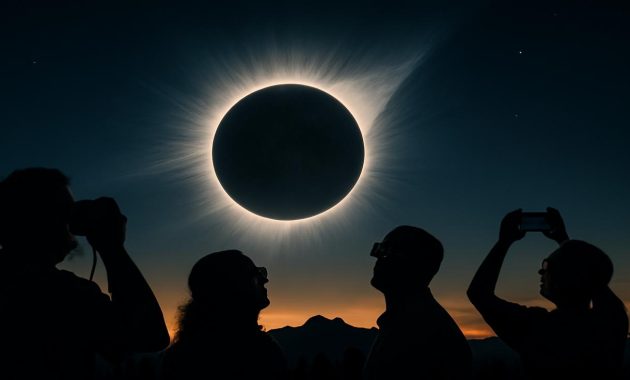
The first thing you notice is the quiet. Birds that were chattering in the trees a moment ago fall silent. The breeze stills, as if the air itself is holding its breath. Shadows sharpen, stretching long and strange, and a silvery dusk begins to pour over the landscape in the middle of the day. You glance at your watch—it’s barely noon—yet the horizon is blushing with an eerie, 360-degree sunset. Above you, the sky is transforming. The bright, familiar disc of the Sun is being neatly bitten away, as though an invisible mouth has taken a careful, perfect bite. People around you murmur, some laugh nervously, some simply stare, and then someone says it, half awe and half disbelief: “This is really happening.”
The Day the Sun Pauses: What Makes This Eclipse So Extraordinary
Total solar eclipses are always a bit of celestial theater, but this one has been nicknamed “the eclipse of the century” for a reason. Not because total eclipses are particularly rare—on average, one happens somewhere on Earth every 18 months or so—but because this one will linger. Instead of a fleeting moment of totality, it will grant nearly six full minutes of midday darkness to parts of the world. In the language of eclipse chasers, that’s an eternity.
A total solar eclipse happens when the Moon passes precisely between the Earth and the Sun, casting a narrow, racing shadow on our planet’s surface. Most of the time, this shadow—called the umbra—only stays in any one spot for a handful of seconds to maybe two or three minutes. Just long enough for an astonished gasp, a few hurried photos, and a sense of “Wait, that’s it?” This upcoming eclipse, however, is different. Its path, timing, and cosmic geometry all line up to stretch out the experience into something wholly immersive.
The secret lies in delicate cosmic balances: how close the Moon is to the Earth, how near the Earth is to the Sun in its orbit, and where exactly you are along the eclipse path. When the Moon is closer to us—near perigee in its orbit—it appears slightly larger in the sky, big enough to block the Sun more completely. When Earth is near aphelion, farthest from the Sun, the solar disc looks a tiny bit smaller. Stack those conditions together just right, let the Moon’s shadow slide over the right swath of the planet at the right angle, and totality stretches out for long, luxurious minutes.
This “eclipse of the century” does precisely that. It’s not the absolute longest possible eclipse (that theoretical maximum hovers around seven minutes and a half), but in a human lifetime, eclipses offering six tidy minutes of totality are rare treasures. If you decide to go after this one, you’re chasing not just darkness, but time: time to look, to feel, to notice, to remember.
When the Six Minutes of Darkness Will Fall
Astronomers have already charted the exact moment the Moon’s shadow will first kiss Earth and when it will finally slip away. For observers along the path of totality, the show will unfold over the course of a late morning or afternoon, depending on where you stand on the globe. Outside that narrow ribbon of shadow, you’ll still see a partial eclipse—an impressive bite out of the Sun—but you won’t sink into full, surreal twilight.
The most dramatic part of the event—the stretch of totality approaching six minutes—will occur near the middle of the eclipse path, where the geometry is most favorable. There, the Moon will seem to hang in front of the Sun, still and perfect, for a span of time that will feel both impossibly brief and strangely long. Long enough for the sky to darken, for stars and planets to blink into view, for streetlights to flicker on, and for your brain to whisper that something very ancient and very powerful is happening.
On the day itself, the sequence is precise and predictable. First contact: a tiny notch appears on the Sun’s edge, barely visible behind eclipse glasses. Over the next hour or so, the Sun becomes a narrowing crescent, its light dimming but still too bright to look at directly. The world takes on a high-contrast look, as if someone tweaked the saturation of reality. Shadows sharpen. The temperature begins to fall, subtly at first.
Then, within the last minute before totality, time seems to accelerate. The Moon’s shadow races toward you at supersonic speed—though you’ll experience it less as motion, more as a fast-falling veil. The light drops suddenly, like someone sliding a dimmer switch straight down. Shadow bands—rippling, ghostly lines—may dance across pale walls or the ground. A final bead of sunlight, the “diamond ring,” dazzles on the limb of the Moon.
And then: darkness. Totality begins. Depending on where you are, it will last a minute or two, or—if you’ve chosen your spot carefully—nearly six rapturous minutes. Time enough to look up, remove your eclipse glasses, and drink in the impossible sight of the Sun’s corona: shimmering white tendrils of plasma stretching far out into space, a delicate, structured halo etched onto a purple-black sky.
The Shadow’s Path Across the Planet
To witness those six minutes of darkness, you’ll need to be somewhere along the narrow central line of the Moon’s umbra. This line—often only about 100 to 200 kilometers wide—snakes across continents and oceans, a dark river projected by celestial mechanics. Every city, pasture, beach, or mountain along that path will experience its own unique version of the event: a slightly different duration, a slightly different Sun-Moon alignment, a different horizon and weather story.
If you’ve ever watched time-lapse maps of eclipses, you’ve seen this path as a moving dark spot sliding over a spinning Earth. For this eclipse of the century, that spot will cross land and sea in a way that feels generous to travelers. It won’t hide solely over remote ocean or uninhabited tundra; it will pass over places reachable by road, rail, and air, inviting a global pilgrimage.
The Best Places on Earth to Witness the Eclipse of the Century
If an eclipse is a performance, then your location is your front-row seat. Not all seats are equal. Some offer longer totality, clearer skies, or more dramatic landscapes. For this eclipse, a handful of regions stand out—not just for their geometry, but for their character, their climate, and the stories they’ll help you tell.
1. A Coastal Oasis: Watching the Shadow Arrive from the Sea
Along parts of the eclipse path, the Moon’s shadow will thunder in from over the open ocean, claiming the coastline like a moving storm of darkness. Imagine standing on a beach where waves glitter under a midday Sun, feeling the warmth on your skin. As the eclipse deepens, that light softens to a ghostly silver. Gulls wheel and complain, then fall quiet. The ocean, somehow, looks more metallic than blue.
Here, you’ll be able to look in one direction and see daylight clinging to the horizon over the sea; in the other, a creeping twilight spilling over land. When totality hits, the line where the Sun used to be will explode into a crown of pale fire. If clouds cooperate, the reflection of the darkened sky against the water sets the stage for some of the most cinematic eclipse photography you can imagine.
2. High Country Silence: A Mountain Pass in the Moon’s Shadow
Higher elevation often means clearer skies, thinner air, and a horizon that drops away in all directions. A mountain pass along the path of totality can give you a front-row view not just upward, but outward—toward the advancing shadow and the ring of sunset-colored light around the edge of the world.
In thin, cool mountain air, the temperature drop during the eclipse feels sharper. The wind can shift suddenly, sliding from warm valley currents to chill, shadowed gusts. At totality, peaks that were sunlit just moments before turn into serrated silhouettes against a strange twilight glow. If you’re lucky, you might see planets sparkling above a ridge, or the delicate arch of the Milky Way hinting through the dim.
This is where the eclipse becomes not just a spectacle, but a deeply felt experience. The silence, the vastness, the way the world’s textures are rearranged by temporary night—they all conspire to make those minutes stretch wider in memory. Your companions might whisper, or simply stand with hands stuffed into pockets, eyes wide, breath fogging in the cool eclipse air.
3. Cities Under Suddenly Starry Skies
Many people will see this eclipse not from deserted beaches or high alpine meadows, but from cities: crowded rooftops, riverside parks, sports fields, and downtown plazas. There is something unforgettable about watching the machinery of the cosmos flex above skyscrapers and traffic lights.
Imagine a bustling afternoon: car horns, snippets of conversation, the occasional siren. Office workers step out with cardboard eclipse glasses. Children tilt their heads upward, their teachers holding onto elbows. As the world dims, the city’s noise softens. Streetlights flicker on, fooled by the darkness. Neon signs glow brighter. For a few minutes, people who might otherwise never meet share the same sky-bound astonishment.
In dense urban areas, the contrast is especially stark. The Sun’s corona framed by buildings, reflections of the eclipse in glass towers, the ring of soft twilight around the horizon competing with the artificial glow of billboards—these juxtapositions can make the event feel extra surreal. It’s the universe, reminding a human-built world that it runs on a much older schedule.
4. Quiet Countryside and Wide-Open Sky
Far from city lights, in open fields or rolling farm country, the eclipse of the century will unfold against simpler, softer surroundings. A farmhouse porch. A gravel road lined with grasses and wildflowers. A cluster of folding chairs in a pasture where cows lift their heads, confused by the sudden dusk.
In the countryside, the approaching shadow can be seen more clearly as a shifting mood across the landscape. The colors drain from the world—greens turn muted, blues become steel. Birds go to roost; crickets begin their nighttime chorus too early. Your own sense of orientation slips for a moment as you glance around and realize you’ve seen this exact place at sunrise, at midday, at sunset, and at midnight—but never like this, all at once.
Here, you can spread out, lie on your back in the grass, and watch the Moon eat the Sun surrounded by nothing more than the hum of insects and the collective gasp of a small group of friends and strangers. There’s a kind of intimacy to a rural eclipse. You are not just an observer; you feel like a participant in some quiet, ancient ritual.
5. Offshore Adventures: Chasing the Shadow by Sea
For a certain kind of eclipse chaser, the best view is from water. Ships and boats positioned under the path of totality can ferry groups into the narrow line where totality lasts longest, far from coastal cloud patterns and urban haze. At sea, horizons are clean and uninterrupted, and the change in light sweeps over the water in an almost cinematic way.
Standing on deck, you watch as the Sun is reduced to a shrinking crescent above an otherwise flawless blue sky. The ocean darkens from turquoise to ink, wave crests losing their glint as totality approaches. When the final sliver of Sun disappears, the corona flares forth, reflected in the water in a broken, shimmering halo. You might see stars twinkling where moments ago there was nothing but glare.
The sensation of floating in the Moon’s shadow, with nothing but a thin hull between you and the dark water below, adds a sense of vulnerability and wonder. When the light returns—suddenly, explosively bright—you feel as if the world has been switched back on, humming to life after a brief and impossible pause.
Planning Your Eclipse Journey
If you’re drawn to this eclipse—and it has a way of calling to people—you’ll want to think like both a traveler and an astronomer. Where on the path of totality is easiest for you to reach? What’s the typical cloud cover there for that time of year? Do you prefer the buzz of a crowded public viewing event or the solitude of a solitary hillside?
Eclipse chasers often book months or even years in advance, especially in small towns along the path where accommodations are limited. Some communities transform the event into a festival, with music, local food, and educational talks. Others simply watch their population swell for a few days, as people arrive with cameras, telescopes, and hopeful eyes.
Wherever you end up, remember that flexibility is your friend. Weather is the wild card in any eclipse plan. A backup location a short drive away can make the difference between seeing the corona with your own eyes and experiencing it as a dimming of light beyond a blanket of cloud. Many veteran eclipse travelers spend the morning of the event scrutinizing satellite images and weather reports, ready to pivot if needed.
| Location Type | Why It’s Special | Things to Consider |
|---|---|---|
| Coastal Towns | Eerie twilight over ocean, dramatic horizons, reflection on water. | Variable marine clouds; book lodging early. |
| Mountain Regions | Clearer air, wide horizons, sharper temperature drop. | Access roads, altitude, unpredictable mountain weather. |
| Cities | Vibrant shared experience, easy access, public events. | Light pollution (less star visibility), crowds, traffic. |
| Rural Countryside | Dark skies, quiet surroundings, intimate atmosphere. | Limited services, cell coverage, and accommodations. |
| Ships at Sea | Long totality, unobstructed views, mobile to avoid clouds. | Cost, motion of the vessel, need to book far in advance. |
How to Watch Safely—and Deeply
There’s a simple rule: any time even a sliver of the Sun is visible, you must protect your eyes. That means certified eclipse glasses or a proper solar filter on binoculars or telescopes. Sunglasses, even the darkest ones, are not enough. During totality itself, when the Sun is completely covered, it becomes safe—and absolutely essential—to look with your naked eyes. This is when you’ll see the corona, the stars, the planets, the full strangeness of day-turned-night.
Beyond safety, though, consider how you want to experience those six minutes. Cameras and phones are tempting, and you’ll probably want a few photos. But many seasoned eclipse chasers advise putting the technology down for at least part of totality. The sky’s subtle colors, the way the world sounds and feels, the emotional texture of the moment—these are difficult to capture in pixels, but unforgettable in memory.
You might bring a notebook and jot down impressions before and after. Notice how the air smells as the temperature plunges—dusty, damp, or tinged with dry heat. Pay attention to animals, to the way leaves swish or fall still. Listen for the scattered shouts of wonder from people around you when the corona appears. The more present you are, the more fully those six minutes will stretch into a lifetime’s worth of recollection.
Why This Eclipse Matters More Than a Beautiful Sky Show
Human beings have been watching eclipses since long before we learned to predict them. Ancient cultures interpreted them as omens, battles between gods, or temporary unravellings of cosmic order. Today, we understand the geometry; we can chart the path of the Moon’s shadow to the second, decades in advance. Yet the experience itself has lost none of its power.
A six-minute eclipse has a particular way of sinking under your skin. The length of totality gives your mind time to move through shock into reflection. You might find yourself thinking about the clockwork of orbits, about how delicately balanced everything is for such a spectacle to occur at all. You might think about the fact that, millions of years from now, the Moon will be too far away to completely cover the Sun, and total solar eclipses will become impossible. Our era is, in a sense, privileged to see them.
There’s also something profoundly humbling about standing in the Moon’s shadow with other people. Strangers become companions. Ordinary landscapes become stages for something vast and ancient. For a few minutes, human concerns shrink to their proper size. The world, despite its chaos, feels gloriously ordered. The Sun vanishes; the Sun returns. Day yields; day resumes.
When it does, when the first spear of sunlight explodes back into view and the corona dissolves, people often cheer. Some cry. Some simply stand very still. The light returns so fast that it almost stings. Birds resume their songs as though nothing happened. Traffic noises swell. The world shrugs, breathes, and goes on.
But you, and everyone else who stood under that extraordinary patch of darkened sky, will go on slightly changed. You’ll have shared one of the rarest, most exquisite crossings of shadow and light that our planet offers. And whenever you look up at the Moon after that, hanging pale in a quiet evening sky, you’ll know what it’s capable of when it lines up just right: six minutes of darkness, and a lifetime of wonder.
Frequently Asked Questions
How long will the “eclipse of the century” last in total?
From the first partial bite of the Moon on the Sun to the final parting, the eclipse will last several hours. The total phase—when the Sun is completely covered—will reach nearly six minutes at the point of maximum totality, with shorter durations as you move away from that central line.
Do I need to be on the exact centerline to see totality?
No. Anywhere within the path of totality will give you a total eclipse, but the closer you are to the centerline, the longer totality will last. Near the edges of the path, totality might only last a few seconds to a minute or two.
Is it safe to look at the eclipse without glasses during totality?
Yes, but only during full totality, when the Sun is completely covered and no direct sunlight is visible. Before and after totality, even a small exposed portion of the Sun can damage your eyes, so you must use proper eclipse glasses or filters during those times.
What if it’s cloudy where I am on eclipse day?
Clouds can obscure the Sun, but the overall dimming of daylight and temperature drop will still be noticeable. To improve your chances of clear skies, consider choosing a location with historically favorable weather and, if possible, have a backup site within driving distance.
Can I photograph the eclipse with my phone?
You can, but results vary. Use a certified solar filter over your phone lens for the partial phases to protect both your eyes and the sensor. During totality, you can shoot without a filter, but remember that phones struggle with the extreme contrast. Many people prefer to take a few quick shots, then set the phone aside and watch with their own eyes.
Will there be other long eclipses in my lifetime?
There will be more total solar eclipses, but ones approaching six minutes of totality are relatively rare. Depending on your age and where you live, you might see several total eclipses if you travel for them, but few will match this one for sheer length and drama.
What should I bring to my viewing location?
Bring certified eclipse glasses for everyone in your group, sunscreen, water, snacks, and appropriate clothing for changing temperatures. A blanket or chair, a hat, and a small flashlight (for navigating during totality) are helpful. If you’re far from services, plan for restrooms, fuel, and navigation in advance.