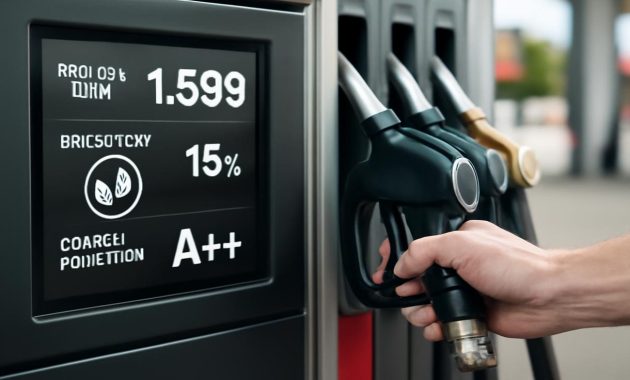
You notice it before you even step out of the car. The sky is that soft, washed-out blue of early spring, the air still holding a bite of cold, but there’s a promise of warmth tucked into the edges of the breeze. You pull into the gas station, the way you’ve done a thousand times before, mind already shifting ahead to errands, work, tonight’s dinner. But today, something under the bright canopy is different. The familiar pump, the same blinking screen, the same card slot. Yet there’s a new panel of information you’ve never seen before—larger, clearer, impossible to ignore. For the first time, the story of the fuel you’re buying is being told right here, in front of your eyes.
The Day the Pump Started Talking Back
For years, filling up has been a strangely silent act. You swipe, you pump, you stare vaguely at numbers racing upward, maybe glance at a faded sticker about taxes or octane ratings. The fuel goes into your car, and that’s where the conversation ends. Where it came from, what it contains, how much of it is fossil, how much is bio-based, what it means for the air you breathe or the climate you live in—that’s all kept somewhere out of sight, buried in reports and policies the average driver never sees.
But starting March 12, that changes. By law, gas stations will have to display clear, standardized information right at the pump. Not on a back wall, not in tiny print tucked near the cashier, but where your hand meets the handle and your eyes settle while the liters tick by. For the first time, the fuel you buy must come with something like a passport—showing its environmental footprint, its energy content, and how it compares to alternatives like electricity or hydrogen.
It might sound like a small adjustment: a new label, a few more lines of text, a neat little graphic checked off on some government compliance form. But stand there for a moment, with that nozzle in your hand, and let the idea sink in. For decades, the most consequential environmental decision most of us make in a week—the choice to burn fossil fuel—has been strangely abstracted, hidden behind brand names and color-coded handles. Now the pump is required to talk back.
It’s official, and it’s good news: as of March 12, every stop at the station becomes a tiny moment of education, a fleeting but powerful interaction with reality. And reality, as it turns out, can be a pretty effective teacher.
The New Labels: More Than Just Fine Print
Walk up to a pump after March 12, and your eyes will be drawn to a new section, usually near the price-per-liter display or on the front of the dispenser. The design may vary slightly from station to station, but the core information will be mandatory and familiar wherever you go. No more guessing, no more “industry secrets” hidden behind corporate branding. The basic story of your fuel will be right there.
These labels are designed to answer a few simple but powerful questions:
- What kind of energy am I actually buying?
- How does it impact the climate, compared to other options?
- How much of it comes from renewable or bio-based sources?
- How does this fuel compare to what an electric vehicle or other alternative would use?
You might see something like a bar chart comparing the average greenhouse gas emissions per kilometer for cars running on gasoline, diesel, biofuel blends, and electricity. Or a clear statement about how much of the fuel is derived from renewable sources. Perhaps a visual scale—green to red—showing the relative climate impact. The language is meant to be plain. The graphics intuitive. A quiet but undeniable nudge: what you’re doing here matters.
Instead of forcing you to hunt through dense PDFs or rely on vague marketing terms like “eco” or “premium,” the pump itself gives you a snapshot. You still get to choose—but the choice is now informed. And that, quietly, is revolutionary.
From Mystery to Measurable
Think back to the last time you stood in front of a food label, turning a box over to check calories, sugar, or ingredients. Nutrition labeling didn’t change what food was made of overnight—but it did change how we relate to it. We began to understand that not all snacks are created equal, that serving sizes matter, that hidden sugars add up. It didn’t fix everything, but it shifted awareness and eventually behavior.
Fuel labels are trying to do something similar for the energy we burn. For years, many people have vaguely known that gasoline and diesel are “bad for the climate” in the same general way that we know “too much sugar is unhealthy.” But vagueness is easy to ignore. Now the harm—and the alternatives—come into sharper focus. Emissions get a number. Renewable content gets a percentage. Electricity and hydrogen show up as real, comparable options instead of abstract technologies for “other people.”
Standing there in the faint smell of fuel and rubber, the digital numbers on the pump are no longer the only story. Right next to the cost to your wallet, you can see a hint of the cost to everything beyond it—the morning air, the warming seasons, the coastlines, the forests, the quiet places you love. Not as a guilt trip, but as a gentle anchor to reality.
Why This Change Matters More Than It Seems
It’s easy to underestimate the power of small, consistent encounters. A label on a single pump, read by a single driver, on a single Tuesday morning, doesn’t transform the world. But think about scale. Millions of people fuel up daily. Millions of glances, millions of fleeting moments of awareness. Over time, those moments add up to a subtle but steady shift in the background story we carry about energy.
For decades, fossil fuel use has felt like a sort of default condition—just “the way things are.” Policy debates have raged, scientific reports have piled up, but down at the day-to-day level, filling a tank has remained strangely untouched, as routine and unquestioned as tying your shoes. This new rule cracks that routine, just slightly. It inserts a sliver of transparency where there was previously a wall.
When you can see that a particular fuel blend emits less, or that a biofuel mix contributes fewer greenhouse gases, or that electricity has a dramatically different footprint, the abstractions shrink. You may not sell your car tomorrow, but maybe next time you rent one, you ask for a hybrid. Maybe the idea of going electric on your next purchase stops feeling like a leap into the unknown and starts feeling like the next logical step. Maybe, at the very least, you stop seeing fuel as a simple commodity and start seeing it as a choice.
Small Labels, Big Ripples
This is how social shifts often start—not in dramatic, cinematic moments, but in the quiet repetition of new information becoming normal. The first time you read the label, you might barely process it. The second or third time, you glance a little longer. Maybe you mention it in passing to a friend: “Did you see that the pump shows emissions now?” That friend notices it next time too. A small network of recognition forms.
And in the background, other players feel the tremor. Fuel suppliers who previously had little incentive to differentiate themselves on environmental performance suddenly see their product framed in public, side-by-side, with numbers and graphics. The competition subtly changes. If a certain station can show a lower-emission blend, or higher bio-based content, they’re no longer just selling “fuel.” They’re selling a story that looks better on that label. That’s pressure—the kind that can tug at an entire industry’s attention.
A Moment of Truth at the Pump
So what exactly might you see when you pull up after March 12? Imagine approaching the pump in the dim light of early evening. You select regular gasoline. The familiar clunk of the handle, the whir of the internal valves. And right there on the front panel, below the price-per-liter, you notice a neatly bordered box.
Inside, there’s a simple comparison chart showing average lifecycle greenhouse gas emissions per 100 kilometers for different energy types: conventional gasoline, diesel, a biofuel blend, and electricity used in an electric vehicle. Each option has a colored bar—electricity perhaps in pale green, diesel in darker red. The labels are plain, the numbers calmly precise. You can see at a glance that while your gasoline car might emit a certain amount of CO₂-equivalent per distance, an EV, running on the current electricity mix, emits substantially less over that same span.
Beneath the chart, another line: “This fuel contains up to X% bio-based content” or “This fuel is derived 100% from fossil sources.” The statement doesn’t scold. It just states. A final brief note might mention that emissions are averaged across the full lifecycle—from extraction and refining to combustion—and that technological improvements may change these values over time.
Something like this kind of information table could appear across different stations, adapted to each fuel type:
| Energy Type | Typical Use | Relative Climate Impact* | Renewable Content |
|---|---|---|---|
| Gasoline (E5/E10) | Conventional petrol cars | High | Low (small ethanol blend) |
| Diesel (B7) | Diesel cars, vans, trucks | High | Low (partial bio-component) |
| High Biofuel Blend | Compatible flex-fuel vehicles | Medium | Medium to High |
| Electricity | Battery electric vehicles | Low (varies by grid mix) | High potential with renewables |
| Hydrogen | Fuel cell vehicles | Low to Medium (depends on production) | Can be very high if produced from renewables |
*Relative climate impact shown on a general scale, not as exact values, and may vary depending on local production methods and energy mix.
On a mobile screen, a table like this fits neatly, each row easily scrollable with a thumb, each column aligned enough to make a quick comparison painless. It’s not meant to overwhelm you with detail; it’s there to plant a seed—a sense of proportion, a feeling that not all energy is the same, that there is a spectrum between “worse” and “better,” and that your choices slide along that line.
The Sensory Side of Knowing
Once you’ve seen the label a few times, something subtle shifts in the way the whole scene feels. The hiss of fuel rushing through the hose, the faint gurgle in the tank, the smell that clings to your fingertips when you accidentally brush a drop—these sensations, once purely mechanical, start to carry a bit more weight.
You might imagine the invisible plume of exhaust that will trail your car later, the way it will mix with others, drift across towns and fields, fold into the shared atmosphere that holds in just a little more heat each year. But you might also picture something else: the hum of an EV pulling quietly away from a charging spot; the future version of this same gas station, sprouting more electric chargers, maybe a hydrogen dispenser, maybe a canopy lined with solar panels.
The label at the pump is not there to shame you for needing to fill up. Most of us live in systems built around this act; walking away isn’t always simple or even possible right now. Instead, it’s an invitation to see each fill-up as part of a bigger story—a story that’s changing, and that you are, like it or not, a character in. Information doesn’t fix everything. But it breaks the spell of not knowing.
From Passive User to Active Participant
There’s something almost empowering about that. Instead of feeling like a passive user of whatever energy system has been handed down to you, you begin to feel like an active participant in a transformation that is already underway. The numbers and comparisons on the label don’t tell you what to do; they simply show you where things stand.
You may start asking new questions: Could my next car be more efficient? What would it take to switch to a different type of vehicle? Are there better fuels available in my region? Is there public transport or a bike path I’ve been ignoring? You might not change overnight, but the direction of your curiosity shifts. And with collective curiosity, policy and markets tend to follow.
Good News Hidden in Plain Sight
The fact that this labeling is becoming mandatory is, in itself, a quiet piece of good news. It means that transparency is winning ground. It means that public policy is no longer content to leave everyday climate decisions in the realm of the invisible. It means that the conversation about energy has slipped out of conference rooms and headlines and into the concrete, everyday choreography of life—right down to the moment you’re standing in the chill of early morning, waiting for the pump to click off.
It also signals something about where we’re headed. You don’t bother labeling something that’s never going to change; you label it because comparison will matter over time. Maybe today, the numbers on that chart still tilt heavily toward gasoline and diesel. But the very act of formalizing the comparison with electricity, hydrogen, and other lower-carbon options tells you that the landscape is expected to shift. The station of today is being gently recast as the energy hub of tomorrow.
And in that sense, this new rule is not just a mirror of where we are—it’s a signpost of where we’re going. A world in which you can see, with simple clarity, the impact of what you burn is also a world that’s quietly committing to burning less, or at least burning smarter.
Looking Ahead to Your Next Fill-Up
Picture your next visit after March 12. Maybe it’s raining, droplets collecting on the pump display, the label speckled with tiny beads of water. Maybe the sun is sharp and bright, reflecting off the car roofs in the lot, warming the side of your face as you stand there. Perhaps it’s late, the station almost empty, the forecourt lights humming softly in the dark.
You slide your card, select your fuel, lift the handle. Your eyes drift over the new information—not for the first time now, but more deliberately. You trace the colored bars. You do a quick mental comparison with that electric car your neighbor drives. You feel, in a small but real way, more connected to the consequences of this simple act. The tank fills, the pump clicks, the receipt prints. Life goes on. But the story has changed, if only by a few words.
It’s official, and truly, it is good news: from March 12 onward, gas stations are no longer just places where energy disappears into your tank. They are also places where information appears in your mind, where a quiet, necessary conversation between you and the future has finally been posted in clear, legible type. It’s not the end of the journey toward cleaner transport. It isn’t even the biggest step. But it’s a step that meets you exactly where you are—hand on the handle, eyes on the numbers, heart somewhere between where you’ve been and where you’re going.
FAQ
Why are gas stations required to show this new information at the pump?
The main goal is transparency. By making environmental and energy information visible where decisions are made, drivers can better understand the impact of their fuel choices and how they compare to alternatives like electricity or hydrogen.
What kind of information will I actually see on the pump?
You can expect to see standardized details such as relative greenhouse gas emissions, energy content, and renewable or bio-based content of the fuel, often presented in simple charts or labels that are easy to read at a glance.
Will this change the price of fuel?
The labeling requirement itself doesn’t directly change fuel prices. However, over time, clearer comparisons might influence demand for different fuels and encourage suppliers to offer cleaner options, which could affect the market.
Does this mean I need to switch to an electric or hybrid car immediately?
No. The labels are about information, not obligation. They help you make more informed decisions over time—whether that means driving more efficiently, choosing different fuels when available, or considering a different type of vehicle in the future.
Are all stations and all fuels covered by this rule?
The intention is that mainstream fuels offered at public gas stations display the new mandatory information. Implementation details may vary by region and station type, but the trend is toward broad, standardized coverage so that drivers see consistent information everywhere.
How reliable are the emissions and impact figures on the labels?
The numbers are based on standardized, lifecycle assessments that account for production, distribution, and use of the fuel. While they represent averages and may not reflect every specific circumstance, they are designed to give a fair, comparable picture across fuel types.
Can this small change really make a difference for the climate?
On its own, a label won’t solve the climate crisis, but it’s an important piece of a larger puzzle. Consistent exposure to clear information can shift behavior, consumer expectations, and industry competition over time—helping to accelerate the transition toward cleaner forms of transport.