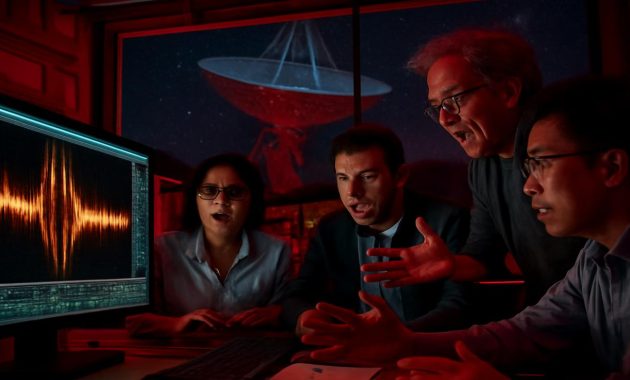
The night the signal arrived, the desert was breathing. Warm air rose from the baked rock and spilled out beneath the stars, and the great white dish of the ATLAS array turned its metal face toward a streak of darkness between constellations. The astronomers on shift were half-asleep, fingers wrapped around paper cups of stale coffee, watching, as they had watched for years, for the faintest whisper from the quiet between the stars. And then—a spike. A clean line on a screen. A soundless shout from nowhere. A number that did not belong where it appeared.
The Visitor Between the Stars
They call it 3I/ATLAS, which sounds less like a traveler and more like a filing code—or something written on the side of a forgotten satellite crate. But to the people who track the sky, that name carries weight. The “I” stands for “interstellar,” the tiny marker that says: this object was born under another sun.
When it was first noticed, 3I/ATLAS was just another faint smudge of motion against the slow drift of background stars. We had seen two such visitors before—ʻOumuamua and 2I/Borisov—both of them sparking intense debate and then fading away into the dark. Interstellar objects are cosmic messages in bottles, fragments of other systems thrown into the deep sea of space. They come in fast, stay briefly, and vanish forever. By the time you notice them, the clock is already ticking down.
So telescopes pivoted. Schedules were rewritten. Radiotelescopes that usually listened to pulsars, quasars, the glum heartbeat of dead stars and black holes, were retuned to a new frequency. They were pointing, instead, at a small, indifferent speck—3I/ATLAS—no bigger, perhaps, than a small mountain, tumbling through the Solar System on a hyperbolic path that would never loop back.
No one expected anything except silence. Interstellar space, after all, is supposed to be dead—cold, almost empty, a place where dust drifts, thin gas whispers, and radiation seeps out like a fading echo. Nothing more exotic than that. The textbooks, the simulations, the decades of dogma all agreed.
And then the signal came.
A Spike in the Static
In the control room, the first person to see it didn’t believe it. A technician, eyes red from too much screen time, watched as the usually jagged noise from the receiver flattened, then reared upward in a narrow, focused peak—a radio frequency line, strong, sharply defined, right where there shouldn’t have been anything at all.
For a few seconds, no one said anything. Data scrolled. Software flagged it. Loggers dutifully tagged the time and coordinates. Then the room snapped awake. Hands flew to keyboards. Someone muttered, “Check the ground radar. Check the satellites. Check everything.”
The signal was narrowband—concentrated in a small slice of the radio spectrum. Nature is usually messy. Cosmic radio emissions from gas clouds, stars, or galaxies tend to smear across frequencies like spilled paint. But this was neat, disciplined, almost surgical: a line so thin you could balance a theory on it.
Even more unsettling, it appeared to be coming from roughly the same direction as 3I/ATLAS. The signal rose as the telescope tracked the object and faded as it drifted off. It wasn’t perfectly synchronous, but close enough to send a ripple of unease across the room. The desert outside stayed quiet. Crickets, wind, the distant hum of a generator. Above, the sky glowed with silent stars, none of them revealing what they knew.
“We’ve got something,” someone finally said, breaking the spell. And with those words, a wave began that would crash through observatories, universities, and message boards around the world.
The First Question: Is It Us?
The foundational rule of modern radio astronomy is almost a superstition:
assume it’s us until you’ve exhausted every boring explanation. Earth is noisy. We live inside a cloud of our own radio junk—satellites, aircraft, radar, broadband, military tests, garage door openers, all chattering into space.
So they dug in. Was 3I/ATLAS coincidentally lined up with some geostationary satellite? Could a military radar sweep have bounced off the atmosphere just so, masquerading as a cosmic whisper? Was someone down the road testing a new transmitter right as the dish rotated?
The technicians checked frequency allocations: no match. They ran comparisons with known satellite passes: nothing. Other observatories looking at the same patch of sky, hours later, reported weak hints of the same narrowband tone, subtly Doppler-shifted—stretched and squeezed—by something moving fast. It wasn’t much, but it was enough to keep the excitement from collapsing under its own skepticism.
| Observation | Conventional Expectation | What 3I/ATLAS Showed |
|---|---|---|
| Interstellar object radio emission | No detectable artificial-like signal | Strong, narrowband spike in a clean band |
| Frequency profile | Broad, noisy, natural spectrum | Thin, well-defined frequency line |
| Source alignment | Random background or local interference | Roughly tracks 3I/ATLAS trajectory |
| Duration | Momentary blip or continuous noise | Transient, returns in short bursts |
Across the scientific community, a single phrase began to circulate in emails and hushed hallway conversations: “If this holds up…” The phrase did not need completion. Everyone knew what sat at the far end of that sentence, like a fragile, shimmering possibility: maybe interstellar space is not as lifeless as we thought.
Decades of Comfortable Emptiness
To understand why this one signal rattled so many cages, you have to go back to how comfortable we’ve become with the idea of sterility between the stars. For most of modern astronomy, interstellar space has been a kind of cosmic hallway—what you pass through on your way from one interesting room (a star, a planet, a nebula) to another.
We know it contains gas so thin that a single breathful would be spread across cubic kilometers. We know it’s filled with dust grains that float like the faintest smoke, building dim clouds that only reveal themselves in long exposures. We know it’s crisscrossed with magnetic fields and bathed in radiation from a thousand distant sources. But “life”? “Technology”? Those words do not belong in the same sentence as “interstellar medium”—at least, not in the traditional story.
Even among those who spend careers searching for extraterrestrial intelligence, the expectation has usually been that any beacon, any deliberate signal, would come from a star system: a planet, a civilization anchored to a sun, building transmitters on the ground. Interstellar space was the dark ocean between distant island nations, not a place where anything would live.
3I/ATLAS didn’t politely ask if that assumption was valid. It kicked down the door.
New Theories, Old Fears
Within days of the detection publicizing through conference whispers and preprint uploads, the theories began to multiply—elegant, wild, desperate, sometimes all three at once. Perhaps the signal was the radio signature of some previously unknown plasma phenomenon, the way charged particles dance along an interstellar magnetic filament near a fast-moving object. Maybe 3I/ATLAS plowed through a hidden pocket of gas, like a boat hitting a shoal, and the impact produced a sharp, radio-bright flare.
Others leaned into the stranger possibilities. Could the object be more than a rock? A shard of engineered material sloughed off by a much larger, unseen structure? A dead probe, its last automatic transmissions finally brushing our receivers? Some even resurrected ideas that had seemed too speculative to say out loud in polite seminars: that the void between stars might be threaded with devices—dormant, drifting, awake only when triggered by something interesting, like another technological species stumbling into range.
For every bold suggestion, a chorus of caution replied. Extraordinary claims, the old axiom goes, require extraordinary evidence. Right now, all we had was a strange spike, a few scattered observations, and a sky full of unknowns.
Still, under the academic restraint, an old fear stirred: What if we’re wrong about the universe at a deeper level than we realized? What if the safe emptiness we’ve assumed beyond our Solar System is not empty at all, but quietly occupied—by physics we don’t understand yet, or by intentions we can’t yet decode?
The Politics of a Single Spike
Science fiction rarely pauses to depict the part that comes right after a discovery: the meetings, the memos, the tense calls from funding agencies, the requests from governments who suddenly remember your field exists. But in the wake of the 3I/ATLAS signal, those scenes took center stage.
Was this a matter of public interest or national security? If repeated observations hinted at something artificial, who would get to say so, and when? The question of alien life has always carried a strange political charge. It cuts across ideology, belongs to no particular party or nation, and yet touches on religion, economics, defense, and our collective imagination in ways few other topics do.
Some argued for radical transparency: release the raw data, let independent teams tear it apart, let citizen scientists and curious amateurs download the signal and see what they could find. Openness, they said, is the only antidote to conspiracy theories and wild misinterpretations.
Others urged caution. What if it was a misidentified military signal, wrapped in classified technology? What if some country’s deep-space hardware had just accidentally announced itself to the whole world? Or what if, in the unlikely event that the signal was something engineered and non-human, premature announcements triggered panic, markets spiraling, institutions wobbling, all over a phenomenon we barely understood?
In the middle of this tug-of-war stood the astronomers and engineers—people used to being left quietly alone to hunt pulsars in the dead of night. Now they found themselves at the center of a cultural storm, their once-esoteric graphs and spectrograms suddenly matters of global curiosity.
Shifting the Story of the Cosmos
Beyond the immediate scramble, 3I/ATLAS pressed on a deeper fault line in how we tell the story of the universe. For centuries, we have thought in binaries: habitable or inhospitable, alive or dead, worlds or void. We pictured life, if it existed elsewhere, as something emerging from oceans and atmospheres, evolving on planets that look at least a little like ours.
But what if this is too narrow a view? What if interstellar space—those light-years of darkness between suns—is not a sterile separator but an active environment, with its own chemistry, its own structures, its own capacity to host unusual forms of order?
Even setting aside aliens, the mere existence of an unexplained, coherent radio feature tied to an interstellar object forces us to adjust. It hints that the space between stars may be more dynamic, more structured, than we thought. Perhaps interstellar gas and dust are threaded with fine-scale filaments that we have barely glimpsed. Perhaps tiny, dense clumps or shock zones light up under special circumstances—say, when a fast traveler like 3I/ATLAS rams through them.
And if, someday, a signal does turn out to be artificial—if we catch the deliberate murmur of someone else’s technology using the void between stars as a medium—then our mental map of the cosmos will have to be rewritten from the ground up. Space will no longer be an empty backdrop; it will be habitat.
Life in the Silence
Meanwhile, out in the desert, the ATLAS dish still turns. The nights following that first detection were filled with anticipation. Every time the object came into range, the instruments were ready, pointing, listening. Sometimes the narrowband spike flirted at the edge of detection. Sometimes it vanished entirely. Each non-detection deepened the mystery—was the signal intrinsically intermittent, or had that first night been a statistical fluke overlain with human hope?
The research teams grew quieter in public, noisier in their private discussions. Draft papers circulated, collected comments, softened their claims. “Anomalous radio feature” replaced “candidate signal”; “unconventional origin” sidled in behind “natural explanations cannot yet be excluded.” You could feel the language bending under the twin weights of caution and wonder.
Outside the professional bubble, the story took on its own life. In city apartments, in rural backyards, under streetlamps and in dark fields, people found themselves looking up a little longer. The idea that something had called to us—however faintly, however ambiguously—from a visitor born around another star, tapped into something primal.
It wasn’t just the old childhood question—“Are we alone?”—reborn. It was a different, subtler one: “Have we misunderstood the very place we’re floating in?” Maybe interstellar space wasn’t a blank between the dots on our star maps. Maybe it was a place with texture, with character, with secrets we hadn’t yet built the right ears to hear.
In the end, the controversy swirling around 3I/ATLAS says as much about us as it does about the object itself. We are a species standing on the shore of a cosmic ocean, hearing what might be the first faint splash from far offshore, and arguing with ourselves about whether it was real, and whether to tell the neighbors.
After the Echo Fades
3I/ATLAS will leave us, as all such visitors must. It will curve around the Sun, swing past the planets, and slip back into the interstellar dark, carrying with it memories of another system and the mystery of the signal that may—or may not—have come from its direction. The data we gathered while it passed will linger on our hard drives, in our datasets, in the algorithms trainees cut their teeth on years from now.
Maybe, with time and better instruments, we’ll find a perfectly mundane explanation. A type of interference no one had cataloged before. A glitch buried deep in the receiver chain. A once-in-a-career coincidence of ascending satellites and atmospheric conditions dancing in just the wrong way. That’s a likely outcome, and many quietly expect it.
Yet even then, something has changed. The certainty that interstellar space is uninteresting has already fractured. Telescopes will be pointed more often at passing interstellar objects, not just to photograph their shapes and measure their trajectories, but to listen. New proposals will argue for sensitive, wideband monitoring of the sky between known sources. What used to be observational dead time may become the next frontier.
And if the signal resists explanation, if follow-up detections and cross-checked observations keep narrowing our list of natural culprits, then we may be standing at the start of a much stranger story—one in which the dark between stars hums with phenomena we didn’t expect, or with technologies that quietly use the void as their canvas.
For now, the dish waits, and so do we. The desert wind skims across concrete and sand. The galaxies wheel above, silent as ever. Somewhere out there, 3I/ATLAS is turning in its long, lonely arc. Whether it meant to or not, it has thrown a stone into the still pond of our assumptions, and the ripples are only beginning to reach the shore.
FAQ
Was the 3I/ATLAS signal confirmed as alien in origin?
No. As of now, the signal is considered an unexplained anomaly. Researchers are actively investigating natural and human-made explanations, and no consensus has been reached that it is artificial or “alien.”
Could the signal just be interference from Earth?
Yes, that’s one of the leading possibilities. The first response to any unusual radio detection is to look for terrestrial interference from satellites, radar, or other transmitters. Part of the controversy comes from the fact that, so far, a clear, simple source of interference has not been identified.
Why is interstellar space usually thought to be lifeless?
Interstellar space is incredibly sparse—far emptier than any vacuum we can create on Earth. It contains thin gas, dust, and radiation, but no obvious environments like planets or moons where we expect life to form. So historically, it’s been treated more as a transit zone than a potential habitat.
How is 3I/ATLAS different from ʻOumuamua and Borisov?
All three are interstellar objects, but 3I/ATLAS became uniquely controversial because of the reported narrowband radio feature associated with its passage. ʻOumuamua and 2I/Borisov raised questions about their shapes and compositions, but they were not tied to a similar radio anomaly.
What happens next in the investigation?
Teams will continue to reanalyze the original data, compare it with other observatories’ records, and refine models of natural processes that could produce such a signal. Future interstellar visitors will likely be monitored more closely for similar radio features, providing either corroboration or a counterexample to the 3I/ATLAS event.