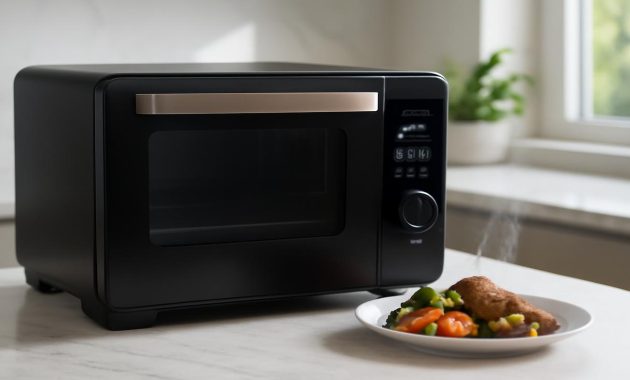
The first time I heard the soft hiss of the device, I almost didn’t look up. It was late, the kind of weeknight when the kitchen is more landing strip than sanctuary, and I was half-scrolling, half-searching for something to eat. No pots, no pans, no panicked stirring—just a low whir and a pulse of warm air that smelled faintly like wood and bread crust. Then I realized: dinner was already done. No microwave beep. No soggy edges, no icy center. Just a plate of roasted vegetables and salmon that looked like it had just stepped out of a restaurant kitchen, not a beige plastic box.
The device sat on the counter where my microwave used to live, but it didn’t hum with that familiar fatigue. Its sides were cool, its door clear like an oven’s, but the inside glowed with an almost gentle light. I remember thinking: this doesn’t feel like an appliance. It feels like the future trying very hard to be friendly.
The Unassuming Box That Wants to Retire Your Microwave
Call it what you like—smart oven, rapid cooker, countertop convection system—but the new generation of high-efficiency, multi-function ovens is being whispered about in test kitchens and lab reports as “the microwave killer.” That sounds dramatic until you stand in front of one and watch it do something we’ve all quietly accepted as impossible: reheat leftovers so they taste better than the first time.
Instead of zapping water molecules with high-frequency radiation the way a microwave does, these new devices use a combination of powerful convection heat, focused radiant elements, and sometimes even a touch of steam. A fan pushes hot air in precise patterns around the food, sensors track temperature changes, and smart software adjusts power on the fly. The result: food heats evenly, browns where it should, stays tender where it matters, and doesn’t emerge half-lava, half-iceberg.
One energy researcher described it this way: “Microwaves were built for fast. These are built for fast and correct.” In test labs, they’ve been put head-to-head with traditional microwaves, and the data is quietly rewriting the story of what “convenient cooking” can look like.
A New Kind of Heat
Stand close to one while it runs and you’ll notice the difference in your own body first. A microwave radiates a kind of abstract warmth—you know something is happening behind that opaque door, but you can’t quite sense it. This new device feels more like standing near an oven that actually listens. The fan sounds rise and fall, the light dims and brightens, and the air around it never gets oppressively hot. You see the food change color through the glass: cheese bubbling, bread rising, the faint crackle as chicken skin tightens and turns gold.
Underneath the countertop grace is a brutal kind of efficiency. In a controlled test, one lab compared three standard kitchen tasks: reheating a plate of pasta, baking chicken thighs, and toasting vegetables from cold. The new rapid oven finished each job in less time than the microwave-and-oven combo—and used significantly less total energy. The pasta? Just under three minutes, evenly hot and not welded to the plate. The chicken? Crisp skin, juicy inside, in less than 18 minutes. The vegetables? Charred at the edges, sweet and tender in ten.
But data points don’t tell you what it’s like to open the door and breathe in dinner. That’s where this thing really parts ways with the microwave. It doesn’t just heat; it cooks, finishes, restores. And that’s starting to change how people move in their kitchens.
Why Microwaves Were Never Really Good at Food
Microwaves, for all their cultural weight, have always had a quiet problem: they’re fast, but they’re not very kind. They work by exciting water molecules inside your food, which heats it from the inside out—at least in theory. In reality, uneven density, awkward shapes, and cold spots in your dish mean your meal turns into a patchwork of temperatures. That’s why your leftovers often come out steaming on the edges and chilly in the middle.
They also don’t brown. No Maillard reaction, no crisp edges, no caramelized sugars. You can fake it with special browning plates or pre-heated gadgets, but the microwave doesn’t naturally know how to give you crust, texture, or that deep roasted flavor that makes food feel cooked instead of just warmed.
And then there’s the quiet energy problem. While a microwave’s wattage seems low compared to an oven, its efficiency varies depending on what you’re cooking and how long you’re running it. For quick tasks like melting butter, it’s fine. For larger portions, especially anything that needs even heating, it starts to stumble, both in quality and energy use.
The Science Behind “Far More Efficient”
The new device, by contrast, leans hard into targeted heat. Imagine a tiny, hyper-focused oven that knows exactly how to move hot air around your food, when to blast, when to coast, and when to simply hold. Heat comes from multiple directions, often with sculpted metal walls that swirl air like a miniature wind tunnel. Some models use variable-speed fans and smart controllers that are constantly sampling temperature and humidity inside the chamber.
When energy experts say it’s “far more efficient,” they’re talking about more than watts on a label. In lab tests, these devices often:
- Use 20–50% less energy than a conventional oven for small meals.
- Beat microwaves on energy-per-gram of food heated for many tasks, especially reheating mixed dishes and cooking from raw.
- Reduce waste heat into the kitchen, so your home doesn’t need extra cooling in warm months.
The key is focusing energy only where it’s needed, for exactly as long as necessary. A microwave blasts a constant stream of electromagnetic energy and hopes the turntable does its job. The new system behaves like a conductor, raising and lowering intensity, routing airflow around awkward shapes, and shutting down the moment the food reaches its target state.
Here’s how the two stack up in simple terms:
| Feature | Traditional Microwave | New High-Efficiency Oven |
|---|---|---|
| Primary Heating Method | Microwave radiation excites water molecules | Convection air, radiant elements, and smart control |
| Food Texture | Soft, often rubbery; no browning | Crisp, browned, and evenly heated |
| Reheat Quality | Uneven; can dry out or overcook edges | Consistent; closely matches fresh-cooked |
| Energy Use (Per Similar Task) | Higher for complex or larger dishes | Lower overall; optimized for small meals |
| Versatility | Reheat, defrost, basic steaming | Bake, roast, air-fry, reheat, toast, dehydrate |
Life With a Device That Actually Likes Leftovers
The real test isn’t the lab. It’s Tuesday night.
Picture opening the fridge and pulling out yesterday’s roasted potatoes and a piece of grilled chicken, both of which would normally be microwave sacrifices. You toss them on a tray, slide it into the device, tap “reheat dinner,” and walk away. By the time you’ve poured a drink and checked a message, the kitchen smells like you just cooked from scratch. The potatoes come back with crisp edges, the chicken skin tight and glistening instead of slack and rubbery.
For families, it shifts the rhythm of the week. Batch cooking becomes less of a compromise and more of a strategy. Parents can roast a big tray of vegetables, cook a couple of proteins on Sunday, and trust that everything will revive beautifully in minutes, not limp into existence under a microwave dome. Teens can cook a frozen pizza that actually looks like the photo on the box—charred bubbles on the crust, cheese browned at the edges—without waiting for a big oven to lumber to 220 degrees and beyond.
Quiet Changes in Home Cooking
You start to notice subtle behavioral changes. People bake more often, because preheating takes just a couple of minutes. Vegetables show up on plates with more frequency, because they’re no longer a 40-minute oven commitment. Toast isn’t just toast; it’s a canvas for roasted tomatoes, blistered directly in the same device alongside the bread.
For anyone who cooks in a small apartment or a van, or who lives in a hot climate where turning on the main oven feels like inviting the sun inside, this new device can quietly redraw what’s possible. You get the performance of a full oven without the slow, heavy baggage. It’s the difference between thinking, “Is it worth it to bake a single fish fillet?” and simply doing it.
Restaurants and cafés have already begun slipping these into tight back-of-house spaces, using them to finish dishes at the last moment—crisping pork belly, reheating par-baked bread, flashing vegetables back to life without drying them out. Energy auditors like them because they don’t leak heat into the room the way big ovens do, trimming both electricity and cooling costs.
The Expert Verdict: Tested, Measured, and Verified
Behind the poetic promises, there are spreadsheets. Lots of them.
When engineers and food scientists started rigorously testing these devices, they didn’t just compare how fast they could thaw a bagel. They tracked energy draw over time, surface and internal temperatures, humidity loss, and sensory scores—color, aroma, texture, flavor. They invited panels of tasters to compare microwave-reheated food with food revived in the new ovens, without knowing which was which.
The results were remarkably consistent: tasters chose the food from the new device most of the time, often by a wide margin. They described it as “fresher,” “more like it was just cooked,” and “less tired.” The data backed up their palates. Moisture loss was lower, browning was more even, and energy use per portion was measurably reduced.
Efficiency Beyond the Plug
There’s another layer to the efficiency story that doesn’t show up on a single electricity bill: waste reduction. When leftovers taste good, they get eaten. When they emerge from a microwave in uneven, rubbery heaps, they quietly die in the back of the fridge.
In households that switched to these devices, some early adopters reported that they were throwing away less food. Old roasted cauliflower, day-three pasta, cold roast chicken—all of it became genuinely welcome again when the promise of a quick, high-quality reheat was real. That’s energy saved in the field and in the home: less food produced, shipped, stored, and eventually discarded.
Experts measuring “whole-system” impacts talk about this as a hidden benefit. If a single countertop device can help people consistently transform leftovers into desirable meals, the net energy savings could ripple outward—farm to factory to fridge.
Is This Really the End of the Microwave?
In most kitchens, revolutions don’t happen all at once. Your microwave won’t vanish overnight in a puff of steam. But something quieter may already be happening: people are using it less—and noticing.
The new device doesn’t just promise to replace the microwave; it sneaks into all the small cracks of daily cooking that used to belong to a jumble of appliances. The toaster, the air fryer, the tiny half-hearted oven under the range—they all suddenly have a rival that can do their jobs better, faster, and with more control.
The microwave hangs on for a while because old habits are sticky. It’s still good for a mug of water, a reheated coffee, a very quick defrost when you forgot to take something out of the freezer. But day by day, it’s being edged out by a box that can actually cook.
What It Feels Like to Let Go
You might not even set out to replace your microwave. Maybe you buy the new device because a friend won’t stop raving about it. It arrives in a cardboard cocoon, you slide it out, plug it in, and tell yourself you’ll just use it for “real cooking.” The first week, you bake a tray of salmon and some vegetables. The second week, you try reheating pizza and lasagna and find they no longer slump sadly on the plate. By the third week, you’re using the microwave only for defrosting—and then you discover the new device can do that gently, too.
At some point, you realize you haven’t heard that familiar microwave beep in days. The space it takes up starts to feel like a compromise. You look at the counter, at your increasingly beloved new oven, and ask yourself an unexpected question: Do I really need both?
For more and more households, the answer is becoming no.
FAQs
Is this new device completely safe compared to a microwave?
Yes. These ovens rely on controlled hot air and radiant heat, not microwave radiation. They’re similar in principle to a traditional convection oven, but more focused, efficient, and better insulated. As with any hot appliance, basic caution is required, but there’s no unique safety concern beyond normal oven use.
Will it actually save me money on my electric bill?
For people who frequently use large ovens for small meals, or who reheat food often, these devices can reduce energy use. They heat up quickly, cook faster, and waste less heat into the room. Over time, and especially in smaller households, that can translate into noticeable savings.
Can it really replace all the things my microwave does?
It covers almost all daily tasks: reheating leftovers, cooking from raw, roasting, baking, and crisping. Simple jobs like melting butter or warming a single mug of milk may still be slightly quicker in a microwave, but many users find the new device so versatile that they stop relying on the microwave entirely.
Does food take longer to cook than in a microwave?
Reheating times are often similar and sometimes faster, especially for mixed plates and larger portions. Cooking from raw is usually quicker than a traditional oven but slower than a microwave-only “steam” effect—however, the quality is far superior, with better texture and flavor.
Is it complicated to use for someone who doesn’t cook much?
Most models come with simple presets such as “reheat,” “pizza,” “vegetables,” or “chicken,” alongside manual controls. If you can use a microwave and a toaster, you can use one of these. The difference is that it quietly adjusts itself behind the scenes to give better results, even when you just press a single button.
What kinds of cookware can I use in it?
Because it relies on hot air and radiant heat, it works with metal trays, oven-safe glass, ceramic dishes, and many baking pans—basically anything you’d use in a regular oven. Unlike a microwave, metal is not only safe but often preferred for good browning.
Is this just a fancy air fryer with better marketing?
Air fryers are essentially small, high-powered convection ovens with simple controls. These new devices share some DNA but typically add more precise sensors, smarter software, better heating elements, and greater versatility. You can think of them as the evolved, all-purpose cousin of the air fryer—capable of replacing your microwave, toaster oven, and even many tasks you’d once reserve for a full-size oven.