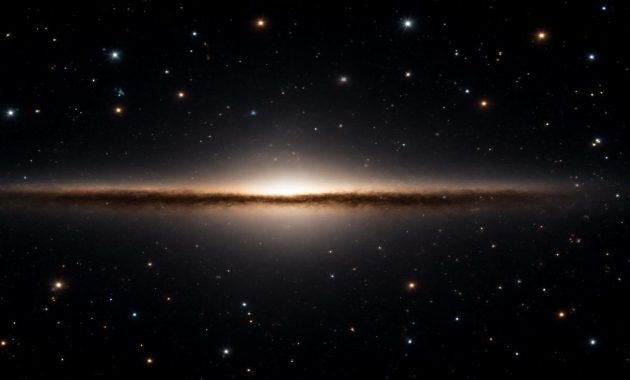
The first time you see it, it barely looks real. A pale, enormous ring hangs in space like a ghostly halo, half-illuminated, half-vanished into blackness. It isn’t a planet. It isn’t a galaxy. It is something stranger—an immense, whisper-thin disk of gas and dust, so wide that if you laid our entire solar system inside it, you’d need forty copies just to span its reach.
Hubble saw it first. Or more precisely, Hubble noticed that something out there was refusing to behave the way the universe usually does in our textbooks. The familiar rules—starlight travels, bends a bit through space-time, maybe brightens, maybe fades—were suddenly twisted around a gigantic, hidden structure. What began as a subtle distortion in a star’s glow turned into one of the most remarkable discoveries of recent years: a massive disk, vast and strange, looming in the dark like a cosmic monolith built from dust and gravity.
A Shadow Written in Starlight
Imagine you’re staring at a single star through the Hubble Space Telescope. That’s the daily bread-and-butter of orbiting observatories: distant pinpricks of light, each one a quiet sun in a distant neighborhood. But now picture that light flickering, dimming—not like a planet passing in front of it, neat and predictable, but with a complex, whispered irregularity. To an untrained eye, it’s noise. To astronomers, it’s a message.
This particular message came from a star system wrapped in a sprawling, thin disk of material so broad it’s almost comical compared to our own galactic backyard. Our solar system, from the Sun out to the orbit of Neptune, spans about 60 astronomical units—60 times the distance between Earth and the Sun. This disk stretches more than forty times that. Think four Neptunes laid side by side, not as planets, but as full solar systems, and you’re beginning to grasp its scale.
But here’s the twist: you can’t see the disk directly in any simple, “let’s snap a picture” kind of way. You sense it by what it does to light. Hubble excels at picking up these subtle clues: faint shadows, weird arcs, smeared halos around stars. When light from a young star filters through or past a colossal disk, it leaves fingerprints—a soft dimming here, a distortion there, a scattering pattern that says, unmistakably, something enormous and oddly shaped is in the way.
The result, when processed and carefully teased from the data, is evocative: a flattened, ghostly structure, like chalk dust swirled across the sky and frozen in place. This is not the solid, sharp-edged ring you might associate with Saturn. It is tenuous, wispy, but collectively massive. And it whispers of worlds not yet born.
What Exactly Is a Disk Like This?
You can think of this disk as both cradle and construction site. Some are called protoplanetary disks—disks of gas and dust around young stars where planets are actively forming. Others, a bit more mature, are called debris disks, built from leftover material: crunched-up rocks, icy shards, comet fragments. What Hubble has snagged in this case is a gargantuan structure that straddles these ideas. It is more than a clean ring of debris. It’s a complex environment, layered in density and temperature, thick with possibility.
Inside this disk, dust grains collide and stick, just slightly, like flour becoming dough. Over millions of years, some of those grains will grow to pebble-size, then boulders, then mountain-scale planetesimals, and, eventually, whole worlds. A disk forty times the size of our solar system isn’t just spectacular—it’s a canvas big enough to paint a truly intricate planetary system, one that could dwarf ours in both number and variety of planets.
Yet size alone doesn’t tell the whole story. Disks come in different flavors—some are dense and bright, some thin and barely there. Some are warped, twisted by invisible companions like hidden planets or even neighboring stars. Hubble’s detailed images and light measurements reveal the structure in layers: brighter inner regions where material is thicker, fainter outer edges that stretch into the dark like the ghost of a galactic ring.
To a scientist, this colossal disk is a rare opportunity to glimpse planet building on a grand scale. To the rest of us, it’s a reminder that our solar system is just one modest layout in a cosmos of wild, experimental architectures.
Seeing Something So Big from So Far Away
There’s a quiet irony to all this: we’re talking about something unimaginably large, yet we find it by hunting for the smallest hints in the faintest light. Hubble orbits Earth at an altitude of about 540 kilometers, barely past our atmospheric edge, and yet it is gazing across hundreds, sometimes thousands of light-years to find these features. How?
Part of the trick lies in Hubble’s sharp vision. Above the blur of Earth’s atmosphere, starlight is pin-sharp, letting astronomers notice tiny, delicate differences: a soft halo where none should be, a fainter arc of light, a shape that looks slightly stretched. Instruments on Hubble can block out the blinding glare of a star—like holding up a hand to block the Sun—so the faint material around it becomes visible. This technique, called coronagraphy, turns hidden disks into visible ghosts.
But in the case of such a huge disk, researchers also rely on time. Over multiple observations, watching how the light dips and brightens, how features shift or remain stubbornly fixed, they can reconstruct a three-dimensional shape from what is, essentially, a series of flat shadows. It’s like watching a flock of birds fly in front of a streetlamp at night and deducing their patterns, their height, their distance, just from fleeting silhouettes.
This is where the narrative of the universe becomes a detective story. Each observation is a clue: a certain wavelength of light scattered more than others, indicating dust grain size; a particular gap in the disk’s brightness suggesting something—perhaps a planet—carved a path through it. Piece by piece, the faint, flattened oval of light becomes a map of forces and histories.
The Cosmic Scale: A Quick Comparison
To put this behemoth into perspective, it helps to lay out the numbers side by side. The figures are approximate, but the contrast is what matters: the difference between our familiar home and this sprawling, newly glimpsed structure.
| Object / Region | Approximate Size | Notes |
|---|---|---|
| Inner Solar System (to Mars) | ~1.5 AU | Home to rocky planets; tiny compared to the disk. |
| Entire Solar System (to Neptune) | ~60 AU | Orbits of major planets contained here. |
| Kuiper Belt Region | ~30–50 AU | Icy debris and dwarf planets like Pluto. |
| Oort Cloud (inner estimate) | Up to ~100,000 AU | A vast, sparse comet reservoir. |
| Newly Observed Disk | > 2,400 AU | Over 40× the diameter of the planetary region of our solar system. |
“Forty times the size of our solar system” doesn’t just mean a little bigger. It means this disk would swallow the entire orbit of Neptune many times over and still have room to spare, like a city-sized lake surrounding a tiny fountain at its center.
Why a Disk This Big Feels So Unsettling—and So Beautiful
There’s something quietly unsettling about objects this large. Our brains are built for hills and oceans, for city skylines and mountain ranges, not for structures that could swallow every orbiting world we know and extend far beyond. You picture this disk as a ring you might fall off, like the edge of a cosmic vinyl record spinning in silence. But the truth is stranger and softer.
The disk is not a hard-edged object you could walk on. It is more like a fog—a cloud of dust and icy grains, thickest in a central band and thinning at the edges. If you tried to “stand” in it, you wouldn’t feel a surface, only an ever-sparser sprinkle of particles drifting in the star’s thin breath. And yet, collectively, all this material adds up. Enough gravity to shape orbits. Enough building blocks to assemble planets. Enough structure for Hubble to see from across the darkness.
What makes this so beautiful is the tension between its delicacy and its power. Dust grains, each smaller than a puff of smoke, are colliding and merging under the firm, invisible hand of gravity, quietly constructing the future. Some regions of the disk may be warmer, glowing faintly in infrared; others colder, where ices cling stubbornly to grains and comets are born. In the gaps—those strange, clear lanes Hubble can sometimes glimpse—there may already be newborn planets, sweeping their orbits clean, shepherding the dust like cosmic cattle dogs guiding a flock.
When you look at the Hubble images of disks like this, you’re not just looking at raw astronomy. You’re looking at possibility. At a system that might, millions or billions of years from now, host its own crowded sky of moons, oceans under alien suns, icy dwarf planets tracing their lonely loops.
What This Disk Tells Us About Our Own Origins
Long before Earth had an atmosphere, long before its oceans, our own solar system was once a disk not so different in principle from the one Hubble has spotted—just smaller in scale. The Sun formed from a collapsing cloud of gas and dust. As the cloud spun faster, material flattened into a disk. Inside that cosmic pancake, planets condensed, clumped, and collided. Earth was born from that churning, violent construction zone.
We can’t rewind time and image our own protoplanetary disk. It’s long gone, swept up into planets, moons, asteroids, and comets, or blown away into space by stellar winds and radiation. But by studying other disks—especially enormous, unusually structured ones—we get something like an archaeological dig into our own beginnings.
A disk forty times our solar system’s size forces us to ask questions: How big can a planet-forming disk be and still form stable planets? Do larger disks make more planets, or just more room between fewer worlds? Could such a system build planets on bizarre, far-flung orbits—worlds that take thousands of years to circle their star even once?
By comparing the chemistry of the disk’s gas and dust to what we find in our own comets and meteorites, astronomers can trace the ingredients that go into building planets like ours. Water, carbon-bearing molecules, silicates—the raw stuff of rocks, oceans, perhaps even life. Each disk we study adds a brushstroke to a cosmic mural of how solar systems form, evolve, and occasionally become homes.
The Subtle Role of Hubble in a New Era of Telescopes
In a world where the James Webb Space Telescope now dominates headlines with its deep, infrared vision, it’s easy to see Hubble as an aging elder of astronomy. But discoveries like this remind us that Hubble is not a relic—it’s a cornerstone. Webb can see the warm, inner glow of disks, the heat of dust and gas close to the star. Hubble, with its sharp optical and ultraviolet eyes, excels at seeing scattered starlight in the cooler, outer regions and tracing fine structures in exquisite detail.
Together, Hubble and newer telescopes build a layered portrait. Webb maps the inner warmth, revealing where gas is collapsing, where planets may be forming close to the star. Hubble sketches out the vast, ghostly expanse surrounding it, where comets and icy worlds may eventually roam. Radio observatories like ALMA add another layer, tracing cold gas and large grains that form the skeleton of the disk.
For this strange, colossal disk, Hubble is the artist drawing the outline, the sweeping curve that defines just how big, how wide, how faintly glowing this thing really is. Without that outline, the story is incomplete—a puzzle missing its frame.
Standing Under a Foreign Sky
It’s tempting to imagine what it would feel like to live inside a system with a disk this large. Picture standing on a distant planet under that sky. Perhaps you’re far from the star, on a cold, dim world where the sun is a pale ember. The disk might be a wide, silvery band arcing from horizon to horizon, brighter than our Milky Way, muting the brilliance of the night with its dusty shimmer.
Closer in, the sky might glow with scattered light, giving long twilights, turned copper and gold by the dust. Meteor showers could be more frequent, as debris left from planet formation occasionally plunges into atmospheres, streaking the sky with brief, electric scars.
Of course, this is partly imagination—an attempt to clothe the data in a sky our senses can grasp. Yet that’s one of the quiet powers of a discovery like this: it invites us to feel, not just calculate, the sheer diversity of cosmic architecture. Not every solar system is a neat set of eight or nine planets following nearly circular paths inside a modest bubble of space. Some live in sparse emptiness. Others are wrapped in rings and belts and massive disks that change the very mood of their skies.
Looking at Hubble’s view, we are both outside observers and time travelers. We see the early chapters of countless possible stories: planets that might become gas giants, scorched rocky worlds, icy wanderers skirting the edge of darkness. We see, in a sense, a mirror of our own lost past and a map of futures we will never walk—but can still imagine.
Questions Written in Dust
As with most big astronomical discoveries, this gigantic disk does not come with a neat, tied-off conclusion. It lands in our understanding like a stone in a lake, sending out ripples of new questions:
- How common are disks of this scale?
- Are they a brief phase in a star’s early life or the sign of something unusual in its birth environment?
- Do such enormous disks tend to form planetary systems like ours, or something far wilder?
In the coming years, Hubble will likely return to this system again, taking new looks, searching for subtle changes, new shadows, emerging gaps. Other telescopes will weigh in, each adding their part of the spectrum, their own translation of what the light is trying to tell us. Bit by bit, the portrait will sharpen. The disk will go from an oddity to a key example in the story of how solar systems grow up.
For now, it remains exactly what it first appeared to be in Hubble’s patient gaze: an enormous, translucent ring, forty times the size of the space that cradles our planets, drifting quietly through the dark. It is a place where gravity is sculpting dust into futures we can’t fully see yet. A place where, perhaps, some distant intelligence, billions of years from now, will look back and say, “We began there—in that faint, strange haze Hubble once spotted, far across the stars.”
FAQ
Is this disk a galaxy or part of a galaxy?
No. The disk is not a galaxy; it is a structure around a single star (or star system) within our galaxy. Galaxies are vast collections of billions of stars. This disk is built of gas and dust bound to one stellar system, more like an exaggerated version of the disk that once surrounded our own young Sun.
Does “40 times the size of our solar system” mean it’s more massive too?
Not necessarily. Size and mass are different things. The disk is wider—its diameter is more than forty times that of the region occupied by our major planets—but much of it is extremely sparse. It can still hold a great deal of material overall, but being big does not automatically mean it is more massive than our entire solar system.
Could there be planets already forming in this disk?
Very likely. Large disks are prime locations for planet formation. Gaps, rings, or asymmetries in the disk often hint that young planets are carving paths through the dust and gas. While we may not have directly imaged planets there yet, the conditions are exactly what theory predicts for planet birth.
Can we ever visit a place like this?
With current or near-future technology, no. The distances are simply too vast. Even reaching the edge of our own solar system is a journey of decades for a spacecraft. Traveling to another star’s disk would take many thousands of years with today’s technology. For now, our “visit” is through telescopes and light.
What role did the Hubble Telescope play that other telescopes couldn’t?
Hubble’s position above Earth’s atmosphere gives it exceptionally sharp vision in visible and ultraviolet light. That lets it detect fine details in scattered starlight and faint structures around stars that ground-based telescopes struggle to see. For wide, delicate disks like this, Hubble excels at tracing the overall shape and brightness, providing a crucial piece of the puzzle alongside newer instruments.