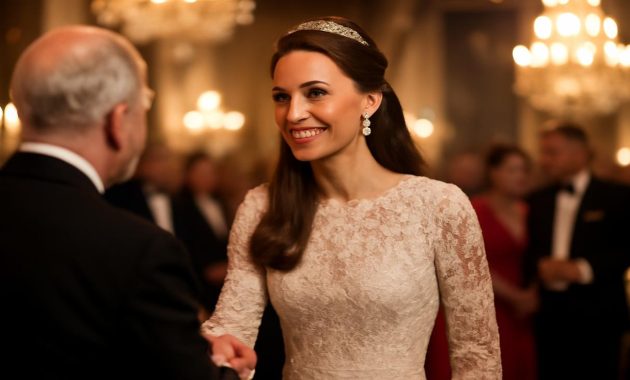
The room seemed to hush itself the moment she stepped in. Crystal chandeliers softened their glow, conversations thinned into a low murmur, and for a heartbeat the great state dining hall of Buckingham Palace felt like a still pond waiting for the first ripple. Kate Middleton—Catherine, Princess of Wales—moved through that pause in a long dress embroidered with Chantilly lace, light catching on every delicate thread as if someone had stitched moonlight straight into the fabric.
A Dress That Sounded Like a Whisper
From a distance, the gown read as a pure, almost uncomplicated column of ivory and light. Only when she drew closer did the details begin to emerge—the way Chantilly lace floated over the bodice like a breath of frost on glass, the soft floral motifs blooming so finely they seemed almost sketched in air. You didn’t see a dress first; you saw movement. The fabric didn’t simply hang; it listened to her body, responding with the slightest hush as she walked, like pages of a book gently turning.
The evening was a state banquet in honor of the American president, the kind of event that exists half in the world of politics and half in the world of symbols. Silverware gleamed in tight, formal rows; arrangements of white roses and greenery spilled low along the center of the table, perfuming the air with a sweetness tempered by the faint iron tang of polished cutlery. Footmen in livery moved along the edges of the room like well-rehearsed shadows. Everything, from the exact height of the candles to the folds of the napkins, carried a quiet message: this was Britain at its most choreographed, its most watched.
And at the center of it—by design, by habit, by the kind of magnetism that has nothing to do with effort—was Kate.
Her dress, cut close through the bodice and easing outward in a gentle, unhurried fall, seemed to elongate her already tall frame. The Chantilly lace was embroidered in a way that looked almost impossibly delicate: fine scalloped edges at the neckline, threads looping into tiny blossoms that trailed down the sleeves, and a soft, sheer overlay that suggested more than it revealed. There was nothing loud here. No crystal eruptions or domineering colors. It was a dress that understood its job: to be memorable without shouting.
But it wasn’t the lace that shifted the mood of the room. That came when she brought out the accessory that has, over the years, become her quiet signature—her favorite constant in a world where everything else seems to be endlessly photographed, endlessly scrutinized, and endlessly changing.
The Return of Her Favorite Accessory
On paper, it sounded like yet another detail in a sea of details: she wore her favorite tiara again. But that small line would never tell the truth of what it felt like in that room when the light first caught its familiar shape in her hair.
Perched just above her forehead, nestled into an impeccable updo, the tiara seemed to float, its diamonds throwing off tiny, cool sparks each time she turned to greet a guest or share a joke with a diplomat. For most people watching at home, it would be a moment of recognition—She’s wearing it again—and, for those who pay attention to the visual language of monarchy, an answer to a question they hadn’t realized they were asking.
Over the years, this tiara has become something more than a jeweled frame for her face. It’s become her favorite in a way that feels almost personal, even though it’s anything but. It’s old, older than she is by more than half a century, and it’s carried on the heads of other royal women through other state dinners, other tense political moments, other careful smiles.
But with Kate, the piece has found a kind of second life. When she wears it, there’s a sense that she understands the story she’s stepping into, and she’s choosing—not just being required—to continue it. On this evening, paired with the softness of Chantilly lace and the subdued palette of her gown, the tiara became the sharp point of light in an otherwise hushed look. It was the star above the snowfield.
The room seemed to orient itself around her. As she moved along the receiving line beside the king and queen, diplomats and members of the American delegation watched as much for her expression as for her words. Cameras tucked discreetly behind floral arrangements tried to capture the moment where the tiara, dress, and demeanor came together—the instant in which a royal becomes both a person and a symbol at once.
The Language of Repeating What You Love
In a world obsessed with the new—new dresses, new designers, new “never-before-seen” jewels—there is something quietly radical about choosing to repeat a favorite accessory. Especially when that accessory is a tiara, the kind of object that carries entire chapters of royal history in its metal frame.
Kate’s decision to bring out her favorite piece again for the American president’s banquet felt deliberate. Repetition, in fashion, can be a kind of storytelling. It says: this is who I am, this is what feels true, this is the line I’m drawing through different chapters of my life. Each time she wears it, the tiara gathers more associations: charity galas, state visits, portraits, headlines, and the private, unrecorded moments that unfold in the seconds before she steps in front of the cameras.
Up close, under the warm, candlelit halo of the dining room, the tiara looked almost alive. Not in some mystical sense, but in the way old jewelry does when it’s finally given its purpose again. Diamonds are at their best in moving light, not trapped behind glass in a display case. And this night, the stones were in constant, subtle motion: glancing off the American president’s cufflinks as he turned to say something to her, catching the gleam of a wineglass lifted in a toast, echoing the glints from the First Lady’s gown.
When she leaned forward to listen—she does this often, an instinctive curve of the shoulders that makes even the stiffest diplomatic exchange feel almost conspiratorial—the tiara moved with her, tiny shadows slipping between the stones. You could imagine the weight of it, the slight tension at the scalp where pins held it in place, the coolness of metal that had been on other heads on other nights, in other eras that believed themselves to be just as modern, just as watched, just as significant.
The Room, the Ritual, and the Roses
One of the easiest mistakes to make when seeing photographs from an evening like this is to believe that the magic comes from the clothes alone. The gown, the tiara, the carefully chosen jewelry, the immaculate hair—these are the visible anchors. But the real story is always larger, spilling out into the room itself.
The state dining hall had been prepared with the fussy devotion of a stage set. White linen fell in sharp, perfect planes over the long tables, the kind of crispness you only get from hours of pressing. Each place setting was a tiny ecosystem of ceremony: gold-rimmed plates, crystal glasses so clear they seemed not to exist until they caught the light, and cutlery aligned in precise formation, ready to guide guests through a multi-course performance of British hospitality.
The scent in the room was a layered thing. White roses, chosen for their elegance and their lack of overwhelming perfume, mingled with the faint beeswax aroma of candles that had been burning just long enough to gloss the air. There was the slightest trace of something sharper—polished wood, old stone warmed by the bodies and breath of everyone gathered.
When Kate took her seat near the American president, her lace sleeves brushed the table linen with a sound that only those closest to her could hear: a whisper of fabric against fabric. The tiara appeared in every reflective surface: multiplied in the curves of silver coffee pots, broken into shards in the facets of crystal goblets, ghosted in the dark glass of the windows, where night pressed softly against the palace.
The American president, in his dark suit and white tie, carried the weight of his own symbolism. Across from him, Kate’s ensemble seemed to tell a complementary story: continuity, grace under scrutiny, the soft power of elegance. As courses arrived—delicate fish, tender cuts of meat, jeweled desserts—there was a choreography to her movements. Forks and knives were handled with the easy assurance of someone who has done this often enough for it to be muscle memory, but not so often that she moves without thinking.
When Fashion Becomes a Form of Diplomacy
This is the invisible work of royal dressing: every decision is a sentence in a message most of us will never fully decode. The Chantilly lace, with its French heritage, nodded silently to Europe. The tiara, with its history threaded through decades of British monarchy, spoke to tradition and continuity. Together, they formed a bridge between past and present, between Britain’s own story and the story it wants to tell the world—especially a world watching through American eyes, used to a very different idea of power and performance.
For the cameras, the effect was seamless. For those in the room, it was more textured. They could see how the lace moved when she laughed at something the president said, how her hand—toying absently with the stem of her glass at one point—caught the light on a delicate ring. They could also sense, perhaps, the human pulse beneath the perfection: a brief adjustment of a hairpin at a quiet moment, a quick smoothing of the dress as she stood up between courses.
Below is a simple glimpse at how her key elements of style worked together that night:
| Element | Description | Effect in the Room |
|---|---|---|
| Chantilly Lace Dress | Long, ivory gown with finely embroidered lace overlay and soft, flowing lines. | Created a gentle, almost ethereal presence; moved softly among the formality. |
| Favorite Tiara | Historic diamond tiara, often chosen by Kate for major state occasions. | Added sparkle, authority, and a sense of continuity with royal history. |
| Jewelry & Accessories | Discreet earrings, a delicate bracelet, and minimal rings. | Kept the focus on the tiara and lace, balancing luxury with restraint. |
| Hairstyle | Structured updo designed to secure and frame the tiara. | Showcased her face, neck, and shoulders, emphasizing the neckline of the dress. |
| Color Palette | Soft neutrals, ivory, and diamond white. | Stood out against rich reds and golds of the hall, yet felt calm and diplomatic. |
Small Gestures, Large Audience
As speeches began, the hall settled into a different kind of stillness. The American president rose, notes in hand, his voice carrying over the room’s gilded edges. Cameras zoomed in to catch reactions, landing often on Kate’s face—composed, attentive, lit softly by the candles lined in front of her.
In moments like these, every tiny reaction becomes a point of interest. The tilt of her head, the quick flash of a smile at a well-crafted joke, the faint tightening around her eyes at a particularly earnest line—all of it framed by the tiara, all of it held in the gentle embrace of lace. She wasn’t speaking, but she was communicating all the same.
When the king spoke, and then the president answered with his own toast, the sound of crystal touching crystal traveled around the table like a ring on water. Kate lifted her glass with a grace that looked effortless but was, in reality, a practiced dance—careful not to let lace brush the flame of a candle, mindful of the cameras that would freeze this moment into an image replayed around the world.
In between official moments, there were quieter ones. A shared smile with the First Lady over an aside about jet lag. A brief, private word with a senior British diplomat who leaned in just enough to be heard over the soft hum of the string ensemble in the gallery. A sideways glance at her husband across the table, quick and knowing.
The Human Beneath the Ornament
It’s easy to forget, when confronted with diamonds and embroidery and state carriages, that there is a person under all of it. Someone who probably thought about this dress days or weeks in advance, who had fittings and adjustments, who may have felt the faint, familiar flutter of nerves before descending the palace staircase and stepping into the bright net of cameras.
There is something almost paradoxically down-to-earth about the way Kate wears her favorite tiara. It never feels like the centerpiece of a costume; it feels like a companion she has come to trust, a familiar weight that signals: tonight, the world is watching a little more closely. The Chantilly lace dress, for all its luxury, worked the same way. It framed her without overwhelming her, allowing her expressions, her movements, the warmth in her conversation to remain the heart of the story.
As dessert plates were quietly cleared and coffee arrived in silver pots that steamed gently into the air, the tension of the evening softened. Conversations grew a little looser, laughter more frequent. Even the tiara seemed less like a symbol and more like an ordinary part of her silhouette, as natural to her as the arc of her shoulders or the curve of her hands around a porcelain cup.
When the Night Becomes Memory
Hours later, as guests began to depart and the great dining hall slowly emptied of its political gravity and electric anticipation, the lingering image of the evening was not of policy or speeches. It was of a woman in a lace dress, walking with calm, deliberate lightness beneath the soft rain of chandelier light, diamonds winking in her hair like small, attentive stars.
Outside, London night pressed close to the palace, cool and damp, the city’s hum stretching out along the river. Inside, staff moved in to begin the quiet undoing of ceremony: collecting glasses, polishing away fingerprints, loosening the tight geometry of the table. The roses, slightly wilted from the heat of the room and the long hours, leaned a little more heavily against their vases.
In days that followed, the images would travel everywhere—shared, reposted, analyzed: the dress, the tiara, the smile, the posture. Style watchers would identify references, trace lace patterns, recall previous nights she’d worn the same favorite accessory and chart how her role, her confidence, her presence has grown with each appearance.
But for those who saw it in real time, the memory would live in smaller sensory details. The soft rustle of lace when she turned to greet someone by name. The polite, low murmur of her voice, warm but measured. The tiny halo the tiara created in the glass of a nearby window, a fragile reflection hovering over her shoulder as if the past itself were watching her step into its story.
And beneath all of it, a quiet understanding: on nights like this, clothing does more than decorate. It speaks. The Chantilly lace whispered of craftsmanship and care, of femininity that doesn’t apologize for its softness. The favorite tiara answered with a steadier, older voice: of duty, of weight, of a line of women who have stood in these gilded rooms before, smiling through evenings that will one day be reduced to a single photograph, a single headline.
Together, they turned a political dinner into something more tender and more human: a shared moment in which power dressed itself in light and lace and dared, for a few hours, to be beautiful.
FAQ
Why is Kate Middleton’s tiara considered her favorite accessory?
It’s often described as her favorite because she has chosen it repeatedly for major state events and formal portraits. In the rigidly symbolic world of royal jewelry, that kind of repetition signals a personal preference as much as a stylistic fit.
What makes Chantilly lace special for a royal gown?
Chantilly lace is known for its fine, detailed patterns and delicate, almost weightless feel. It photographs beautifully, moves softly under light, and carries a heritage of European craftsmanship that suits the formality and symbolism of a state banquet.
How do royal accessories function as diplomacy?
Every visible choice—colors, fabrics, jewelry—can carry meaning. Royals may reference host nations, historical ties, or shared values through what they wear, sending subtle messages of respect, continuity, and cultural awareness without saying a word.
Why do royals often repeat accessories instead of choosing new ones every time?
Repeating accessories creates a visual narrative over time and reflects a sense of responsibility and restraint. It shows that they value heritage, sustainability, and continuity, rather than constant novelty, which is important for institutions built on tradition.
What is the atmosphere like inside a state banquet compared to how it looks in photos?
Photos capture the surface: glittering jewels, formal clothes, perfectly laid tables. In person, there are more layers—soft music, the murmur of conversation, the scent of flowers and food, the slight tension of protocol, and the very human moments of laughter and brief, private exchanges between all that ceremony.