The wind changed in the night. You might have felt it at the edge of sleep—a softer breath against the window, a drip starting somewhere in the gutters, the distant shudder of ice loosening its grip. Just a week ago, the world outside seemed locked in steel. Temperatures plunged in that late January cold snap, sidewalks hardened into glass, and every breath came out as a small ghost in the air. Yet here we are, with winter already shifting underfoot, the season tilting in a direction that has meteorologists talking in unusually urgent tones about February and March 2026. What happens next, they say, could quietly redraw the way we think about the end of winter.
A Winter That Doesn’t Know What It Wants To Be
Picture a Tuesday morning in early February 2026. The calendar insists we are deep in winter, but out the front door the scene feels oddly undecided. The ground is a patchwork: a tired crust of snow clinging to the shady side of the street, dark asphalt steaming faintly where the sun pries open thin seams of warmth. A crow calls from a rooftop, voice raspy, impatient, as if it too is waiting for the weather to make up its mind.
Only days ago, the story was simple: cold, relentless, uncompromising. That late January snap locked entire regions into a hard freeze. Pipes burst, frost bloomed along basement walls, and rivers slowed to a crawl under plates of brittle ice. Schools closed not because snow was falling, but because stepping outside felt like walking into a wall of razor blades. In some places, overnight lows dropped lower than anything recorded in decades.
Now, the script is turning. High in the atmosphere, far above those gray February clouds, the jet stream—the rapid river of air that steers weather systems around the hemisphere—is starting to bend, kink, and wobble. Patterns that once moved with the steady confidence of a train timetable now look more like a tangled string. The late January cold snap was not a conclusion; it was a prelude. The months ahead, especially February and March 2026, are poised to become a kind of experimental theater for the climate system, a jittery performance of freeze, thaw, storm, and calm that has experts shifting uneasily in their chairs.
Walk down the street and you can feel this instability translated into small, bodily details. Your heavy coat feels too warm in the afternoon, but you still need gloves in the morning. The snowbank at the corner smells faintly of mud and exhaust now, thawed and refrozen into a gray, lumpy sculpture. A few dazed flies tap at the kitchen window on a surprisingly mild day, and then vanish again when another blast of cold surges in from the north. It is winter, yes—but a winter that seems unsure of the script it’s supposed to follow.
The Jet Stream’s New Meander: Why February Could Feel Strange
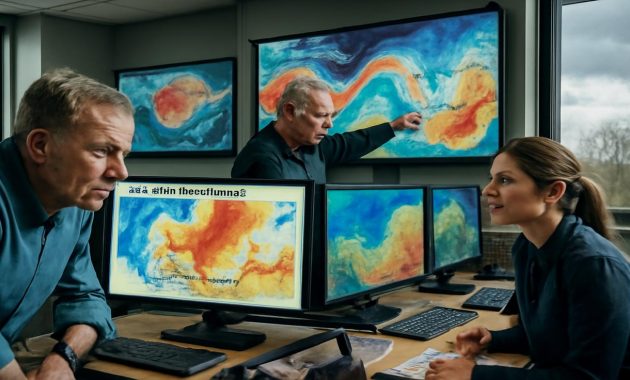
In the back rooms of weather centers and research institutes, February 2026 is not being discussed as just another cold month on the calendar. Meteorologists are tracing thin, colored lines across global maps, their fingers following the high-altitude winds that snake around the planet. Those lines, the path of the jet stream, are the main character in this unfolding story.
Under more stable conditions, the jet stream behaves like a fairly clean, fast ribbon of air, flowing from west to east and guiding storms along a familiar route. But when the Arctic warms faster than the rest of the planet—as it has been doing for years now—that ribbon begins to fray and sag. The temperature contrast between polar and mid-latitude air shrinks, and the jet stream starts to fold into big loops, allowing frigid air to spill south and milder air to surge north in dramatic, lurching exchanges.
The late January cold snap was one such lurch: a deep plunge of Arctic air that barreled down over parts of North America, Europe, and Asia, flattening daily routines into survival mode. Now, forecasts for February 2026 hint at a new kind of volatility. Instead of a long, stable thaw or a consistent freeze, we may see rapid swings—three or four days of unseasonable warmth, followed by a quick, intense return of cold. Rain turning to ice overnight. Snow changing to heavy, wet slush before draining away in gutters that gurgle like early spring.
On a human level, this means your coat rack might become a daily decision tree. You’ll stand there in the morning, phone in hand, thumbing through alerts and radar loops, trying to decode what kind of winter day this will be. Is it safe to leave the ice scraper in the trunk? Will that sidewalk that was wet at noon turn into a skating rink after sunset? The answer, increasingly, is: maybe, maybe not. The weather is starting to speak in half-sentences.
It’s not only people who feel this. Trees, too, can be fooled. A mid-February warm spell coaxes sap upward and buds to swell. Then a sudden snap back to sub-freezing temperatures can burn those tender buds, stealing a spring flowering season before it even begins. Roads, hammered by freeze–thaw cycles, open up in jagged potholes. Power lines, heavy with alternating loads of ice and water, strain against the shifting weight.
When “Average” Stops Feeling Reliable
We’re used to thinking of February as a known quantity—cold, maybe snowy, reliably wintry. But in this emerging pattern, the idea of “average” weather starts to lose its meaning. If you blend a week of record-breaking cold with a week of record-breaking warmth, on paper it might look like a perfectly ordinary month. For the ecosystems and infrastructures that actually live through it, there is nothing ordinary at all.
This mismatch—between what the data says and what the world feels—is one of the quieter alarms experts are raising. We are moving toward a future where extreme swings balance out statistically, even as they destabilize us practically. February 2026 may be one of those months we look back on and say: the numbers were normal, but the experience was not.
March 2026: The Month That Could Rewrite the End of Winter
If February is a month of wobbling, hesitant change, March 2026 is shaping up to be the real wild card. Traditionally, March is a transitional character in the seasonal story—the lion that roars in with one last snowstorm and leaves quietly as lamb-soft breezes shake water from the trees. But the new patterns being modeled now suggest a March that might arrive like a shapeshifter, switching faces faster than we can keep up.
Imagine this: on a Monday, heavy, wet snow blankets the neighborhood. Children build snowmen that lean like tired travelers; plows push slush into mounded walls along the street. By Thursday, those same snowmen are sinking into the grass under a warm, almost balmy sun. You unzip your jacket and notice the first, timid smell of thawed soil rising from flowerbeds. But just as you start to believe in spring, the jet stream pulls another hard U-turn, and by the weekend, sharp, crystalline air is back, biting the tips of your fingers and painting the sky a cold, hard blue.
For wildlife, this kind of back-and-forth is more than confusing—it can be dangerous. Migratory birds that use temperature and daylight as signals may arrive too early to find sufficient food. Amphibians might emerge from their winter hiding spots during a warm spell, only to be caught out when the mercury drops again. Insects wake, buzz, and then vanish, their life cycles snapped like twigs by sudden frost.
Now fold humans into that picture. Farmers preparing their early-season plans watch the sky with a growing sense of unease. The soil temperature may say “plant,” while experience whispers, “wait.” Urban planners, long used to thinking about winter storms ending in February, may find themselves revisiting emergency protocols for late-season snow and ice that hit just as cities are scaling back their winter operations.
Why Experts Are Saying This Isn’t Just Weather
When meteorologists and climate scientists look at February and March 2026, they are not only seeing a quirky year. They’re seeing another data point in a pattern that’s been emerging for decades: winters that arrive later, end earlier, and fracture more often in the middle. The coldest days are still very cold—in some places, occasionally colder than before—but they come in sharper, shorter bursts, framed by periods that feel suspiciously like early spring.
Climate change isn’t turning winter off like a light switch. Instead, it’s rewiring the circuit. The balance of snow and rain is shifting in many regions. Where once snowfall slowly seeped into groundwater as it melted, now more winter precipitation arrives as rain, rushing off in quick floods instead of soaking in. The timing of the thaw creeps forward, overlapping awkwardly with the tail end of the freezing season. Ice on lakes and rivers no longer forms as thickly or lasts as long, with consequences for everything from fish habitat to the safety of people who have, for generations, trusted that ice as a winter road.
March 2026, with its projected ping-pong of warm and cold, wet and dry, may be a kind of living demonstration of this new circuitry. If the forecasts hold, we could be looking at a month in which each week feels like a different season, each day a roll of the dice. For those paying attention, it will not be just another quirky winter; it will be a story about how our climate’s old rhythms are being remixed into something more volatile and less familiar.
On the Ground: How Communities and Ecosystems Feel the Shifts
It’s one thing to talk about jet streams and long-term models. It’s another to walk around your town in mid-March 2026 and see what those patterns actually look like. The changes are measured in puddles and potholes, in sore backs and late-night sirens, in the quiet panic of a beekeeper opening hives too early or a utility crew glancing nervously at sagging, ice-laden lines.
Consider a small river that winds past a neighborhood park. In the old pattern, the river froze reliably enough that local kids knew not to expect flowing water again until mid or late March. In the new pattern, that river might freeze hard in late January, crack open in early February during a warm surge, re-freeze in patches, and then swell dangerously when heavy March rain arrives on top of lingering snowpack. Floodplains designed for a single, predictable spring melt are suddenly asked to handle multiple thaw events and rain-on-snow storms.
For the people living nearby, this means sandbags in garages, emergency numbers pinned to refrigerators, and a wary eye on the weather forecast during what used to be a predictable shoulder season. Snowplow drivers, instead of gearing down in March, may be called in again for surprise storms. Road crews patch potholes that reappear days later. The strain is cumulative: overtime hours, budget overruns, worn-out equipment designed for a winter that no longer behaves the way it did on the planning spreadsheets.
Ecosystems feel that cumulative strain too. Forests adapted to slow, steady winters now must cope with ice storms that encase branches in glass, shattering limbs and opening new wounds in the canopy. Fields freeze and thaw so often that soil structure breaks down, increasing erosion. Streams run muddy more often, carrying sediment that clouds water and smothers the gravel beds where fish spawn.
All of this makes the end of winter feel less like a peaceful exhale and more like a series of small crises stacked on top of each other. By the time genuine spring arrives, people and landscapes alike may feel oddly exhausted, as if they’ve been holding their breath for weeks, waiting for the weather to settle into something recognizable.
A Closer Look at the Season’s Swings
To understand how these changes might play out in everyday life, it helps to imagine a simple comparison between a more “traditional” late winter pattern and the kind of volatile pattern experts are warning about for 2026:
| Aspect | Traditional Late Winter (February–March) | Emerging Pattern in 2026 |
|---|---|---|
| Temperature | Gradual warming, mostly cold with a few mild days | Rapid swings between unseasonable warmth and sharp cold snaps |
| Precipitation | Snow dominant, occasional rain near the end of March | Frequent rain-on-snow events, ice storms, heavy wet snow |
| Snowpack | Steady snow cover, slow melt into spring | Patchy cover, repeated melt–refreeze cycles, abrupt loss of snow |
| Ecosystem Signals | Buds swell and insects emerge closer to stable spring warmth | Premature budding and emergence followed by damaging late frosts |
| Human Impact | Predictable planning for plows, floods, and planting | Higher uncertainty, more short-notice responses and infrastructure stress |
Listening to the Alarms: What Experts Want Us to Hear
As headlines flare and fade, it’s easy to brush off warnings about a wobblier winter as just another piece of climate noise. But the alarms experts are raising about February and March 2026 carry a particular edge: they speak less about distant possibilities and more about near-term, lived realities.
Climatologists stress that no single season “proves” climate change. Yet they also point out that seasons like this one are exactly what models have been hinting at for years: more extremes packed into shorter windows of time. Rolling from brutal cold to disconcerting warmth and back again is exhausting not just emotionally but economically. Energy grids must be ready to handle both high heating demands and sudden drops. Emergency services must prepare for cold-weather crises and flood events in the same narrow slice of the calendar.
One of the quieter yet most troubling concerns lies in the erosion of trust—our trust in patterns, in experience, in the signals nature has always sent us. When “late winter” stops meaning what it used to, the knowledge stored in farmers’ almanacs, local lore, and even city engineering manuals starts to wobble too. How do you design a culvert for a snowpack that may or may not exist? How do you choose a planting date when the old rules of thumb no longer match reality?
Finding Our Feet in a Moving Season
Still, within the unease, there’s also a subtle invitation. A winter that no longer behaves the way we expect forces us to pay closer attention. It asks us to look up from screens, to listen for the drip of meltwater and the crack of ice, to notice which birds have arrived early and which have not yet returned. It reminds us that weather is not just background noise; it’s the stage and soundtrack of our lives.
Communities are beginning to adapt in small but telling ways. Some towns are revising snow-removal contracts to stretch later into March. Gardeners are experimenting with varieties that can handle a late frost. Schools and workplaces are building more flexibility into schedules when storm forecasts are no longer as neatly seasonal. None of this solves the larger problem, but it signals an important shift: the recognition that winter is changing, and that we must change with it.
As February and March 2026 unfold, the story of the end of winter may feel less like a gentle fade-out and more like a series of sharp edits. The cold snap of late January will sit at the front of that story—a stark reminder of how deep winter can still cut—while the strange, unsettled weeks that follow may show us how much the season is stretching and straining, pulled between an older climate’s habits and a new climate’s demands.
Step outside on one of those days when the air can’t decide between frost and thaw. Feel the ground, listen to the sky. The season is speaking in a different voice now. The question—one that experts are asking with increasing urgency—is whether we are ready to listen, and what we will do with what we hear.
Frequently Asked Questions
Why was the late January 2026 cold snap so intense?
The cold snap was linked to a disrupted jet stream that allowed Arctic air to plunge unusually far south. While cold outbreaks are a natural part of winter, a warming Arctic can make the jet stream more wavy, increasing the chance of such deep, sudden incursions of frigid air.
How is climate change connected to these shifting winter patterns?
Climate change warms the planet unevenly, with the Arctic heating faster than many mid-latitude regions. This reduces the temperature contrast that helps stabilize the jet stream, making it more prone to large swings. The result can be sharper, shorter cold snaps and more frequent warm spells in the heart of winter.
Will February and March 2026 be warmer or colder overall?
Long-range outlooks suggest that the overall averages may not look extreme, but the key story is volatility. We may see rapid flips between above-normal warmth and below-normal cold, rather than a steady trend in one direction.
What kinds of hazards should people be prepared for?
People should be ready for ice storms, rain-on-snow events, localized flooding, and hazardous travel due to sudden freeze–thaw cycles. Power outages from heavy, wet snow or ice-laden lines are also more likely in such unstable patterns.
How can communities adapt to these changing end-of-winter conditions?
Adaptation can include extending winter maintenance contracts, reinforcing infrastructure against flooding and ice, updating emergency plans to cover late-season storms, and revising agricultural practices and planting schedules to account for more frequent late frosts and erratic thaws.