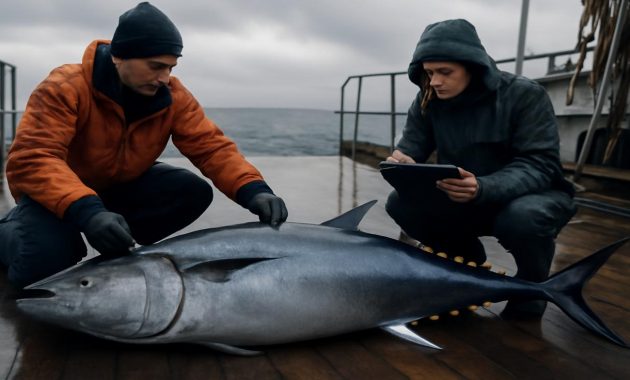
The boat rocked in a slow, deliberate rhythm, like a creature breathing in its sleep. Beyond the gunwale, the Atlantic was a textured sheet of pewter and slate, ruffled by the kind of wind that lifts salt into the air and paints it on your lips. At first, the fish was only a rumor—a strained line, a deep bend in a rod, a sudden, electric hush among people who know the difference between a big fish and something else entirely. Then the ocean rose in a dark, shimmering arc, and the rumor became real: a giant Atlantic bluefin tuna, thick as an oil drum and longer than the deck hatch, rolled at the surface.
The Moment the Ocean Tilted
There’s a specific silence that happens when people understand they are in the presence of something rare. When the bluefin came alongside the boat, gaffs and lines ready yet used with surprising tenderness, nobody shouted. The crew muttered in short, clipped phrases. One of the marine biologists, Rae, exhaled a single word that hung in the wind between all of them.
“Massive.”
Up close, the fish was less an animal than an event. Its skin was a deep, living chrome, shifting between indigo and gunmetal as it twisted. Sun glare slid over its back like liquid glass. The pectoral fins, long and scythe-like, flared against the side of the boat as if the fish were trying to reclaim water, to return to the gravity it understood. Its eye was large and black and calm, taking everything in, saving it somewhere beyond human reach.
Beneath the quiet excitement, there was a current of urgency. This wasn’t just a lucky catch. This fish might be a data point in a story stretching across oceans and decades, a story of collapse, recovery, and what happens when humans decide a species is too extraordinary to lose. And to tell that story properly, it had to be measured—not casually, not roughly, but in strict accordance with the slow, careful heartbeat of science.
The Dance of Science on a Wet Deck
They had rehearsed this. That’s what struck observer Jonas, a visiting graduate student, as he watched Rae and her team move around the tuna. On deck, routines mattered. Efficiency wasn’t just for precision, it was for respect—for the fish and for the data it would become.
“Everyone ready? Clock starts when the tape touches skin,” Rae said, one gloved hand braced on the rail. Her voice carried over the wind but never rose above it.
The team had exactly what you’d expect in a peer-reviewed study and nothing you’d see in a fishing magazine spread. Waterproof field notebook. Pre-printed data sheets. A handheld GPS. Digital calipers. Cameras with timestamp overlays. Flexible fiberglass measuring tapes calibrated to millimeters. And an almost ceremonial sense of procedure.
The tuna lay in a specialized cradle slung over the side, half-submerged to keep its gills bathed in water. A pump hummed quietly, pushing oxygen-rich seawater across its mouth. They were taking no chances—this was a catch-and-release operation designed from the beginning to minimize harm. The fish’s body flexed occasionally, powerful muscle memory reminding everyone what they were wrestling with.
“Standard ICCAT protocol?” Jonas asked, more to confirm his own notes than to challenge.
“Exactly,” Rae replied. “Straight-line fork length and total length. And we’ll photograph every step.”
He knew the acronym well—ICCAT, the International Commission for the Conservation of Atlantic Tunas—the body whose methodologies and definitions shaped almost every serious study of tuna in the Atlantic. Their measuring guidelines, argued over in conferences and refined through peer-reviewed literature, were the quiet backbone of what was about to happen.
How to Measure a Giant That Won’t Stand Still
To the untrained eye, it might have looked simple. Lay a tape down, call out a number. But peer-reviewed protocols don’t trust simple. They ask for clarity, repeatability, proof. So every movement was deliberate, and every measurement would be able to stand in front of skeptical reviewers—the merciless guardians of modern science—and hold its ground.
“Fork length first,” said Mia, the data recorder, pen already hovering above the sheet. “Snout tip to fork of tail.”
Two researchers crouched on either side of the fish, one anchoring the end of the tape at the very point of the snout, the other running it down the curve of the body, keeping the tape tight but not digging into the skin. The tuna’s tail flicked once, heavy and slow as a falling door, splattering everyone’s faces with saltwater and mucus. No one wiped it away.
“Stop. Right there. Line up with the deepest part of the fork,” Rae instructed, her eyes level with the tail. She checked once, then again.
“Two hundred ninety-one point eight centimeters,” the tape reader called.
“Repeat,” Mia said.
“Two nine one point eight.”
The number went onto the sheet, then into a backup notebook. The tape was lifted away, and the process started again for total length—from snout to the longest tip of the tail, the caudal fin. Photographs were taken from directly above, a small placard in each frame showing the date, time, GPS coordinates, and a unique ID code for the fish.
The rigid choreography served a purpose. When the data eventually appeared in a paper, perhaps buried in a table or a methods section, other scientists needed to trust that “291.8 cm” meant the same thing to everyone—measured in the same way, under the same definitions, following the trail laid down in peer-reviewed methodological studies.
Why Peer-Reviewed Protocols Matter More Than Fish Stories
On docks up and down the coast, stories of giant bluefin tuna have been traded for generations. Caught one the size of a car. Bigger than the last record. Broke three lines before we finally saw it. Those tales live warmly in the human voice, but they don’t live well on a graph.
Science, for all its poetry about wonder and discovery, is fierce about one thing: evidence that can be checked. That’s where peer-reviewed protocols come in. They’re not just bureaucracy; they’re a shared language.
Years before this fish surfaced, other scientists had obsessed over the dull details. What’s the best way to measure a fish that curves? What’s the error margin if you measure along the body instead of a straight line? How do different measurements correlate with weight and age? Those studies were written, reviewed by experts, challenged, revised, and finally published. Over time, they formed a toolkit—how to measure, what to record, how to report it.
Rae’s team wasn’t winging it. They were stepping into a conversation already underway. By following standardized protocols—like measuring fork length instead of just “length,” or taking photos that could be re-evaluated by others—they were ensuring that this tuna would join a long-term dataset that stretches across years and continents.
Later, when someone asks whether Atlantic bluefin are really recovering, whether the giants are returning, it won’t be dock talk that answers. It will be numbers like 291.8 cm, confirmed and comparable, whispering from spreadsheets and statistical models.
What They Recorded From the Giant
As Jonas watched, he realized he was standing inside a living paragraph of a methods section—the part of a paper most people skim but every scientist studies like a map. The team moved through a checklist familiar to anyone who’s read the literature on bluefin research:
- Fork length and total length, to the nearest millimeter.
- Girth at a standardized position behind the pectoral fins.
- Estimated weight using established length–weight conversion formulas.
- Sex, if determinable from external features or minimally invasive sampling.
- Tissue samples: a tiny fin clip, preserved for genetic and stable isotope analysis.
- External tag applied in a pre-approved position to minimize drag and injury.
- Time-on-hook and handling duration, to assess stress and survival chances.
Every action was anchored in prior studies. Methods for reducing handling stress? Peer-reviewed. Tag attachment techniques that don’t compromise swimming? Peer-reviewed. Even the decision to keep the fish in a sling rather than haul it fully onto the deck had roots in published survival analyses.
“Ninety-one minutes on the line, ten minutes handling,” Mia called. “Tag ID 5443-B. GPS logged.”
They were not just catching a fish; they were building a story that other scientists could audit, replicate, and fold into broader research.
The Weight of a Number
The fish seemed to grow heavier even as they worked quickly. The cradle sagged under its mass, water cascading off its flanks in sheets. Its skin was slick to the touch, tiny embedded scales giving it the texture of wet, polished stone. Under Rae’s glove, she could feel the micro-vibrations of its muscles—dormant power waiting for water and depth and darkness.
“Okay,” she said softly. “Let’s get a weight estimate.”
For a fish this large, a physical scale would be awkward and risky. Instead, they relied on length and girth to estimate mass using formulas validated in published studies. Back at the lab, they would double-check the measurements, maybe run them through multiple models, but for now, the number sketched the outline of the fish in a different language.
| Measurement | Value (Approx.) | Method/Protocol |
|---|---|---|
| Fork length | 291.8 cm | Straight-line, snout tip to tail fork (ICCAT) |
| Total length | ~310 cm | Straight-line, snout tip to longest tail tip |
| Girth | ~220 cm | Measured behind pectoral fins |
| Estimated weight | 400–450 kg | Length–girth formula from published studies |
| Handling time | ~10 minutes | Timed to assess post-release survival |
Rae looked at the approximate weight and didn’t say anything at first. Numbers like that didn’t need adjectives. They carried their own gravity.
“That’s… a serious fish,” Jonas finally managed.
“That’s an old fish,” Rae corrected gently. “Decades, probably. Older than you.”
The idea landed with quiet force. This animal had been migrating across ocean basins since before some of the people on the boat had finished high school. It might have slipped through fleets of longliners, swum under storms that never touched land, and chased schools of herring and mackerel across invisible temperature gradients only tuna know how to read.
The Long Memory of a Species
There’s a certain humility that comes from running your hands along a living being that remembers, in bone and blood, the worst of what humans have done to its kind. In the late 20th century, Atlantic bluefin tuna were hammered by overfishing. High demand, lax enforcement, and ignorance—or indifference—pushed their populations to the brink. For a while, it was entirely plausible that future generations would know them mostly as cautionary tales and photographs of giants from “the old days.”
And then something unusual happened: people changed course. Conservation groups, scientists, policymakers, and even some fishers pushed for stricter quotas, better monitoring, and smarter management. Not everywhere, not perfectly, but enough to matter. Over time, stock assessments began to show glimmers of recovery. Juvenile fish became more common. Adults, once scarce, started returning to historical feeding grounds in numbers that made old-timers squint and say, “Feels like it used to.”
But feelings don’t rebuild trust in a system. Data does. A fish like this giant bluefin doesn’t merely inspire awe—it tests a hypothesis. Are we really giving them room to come back? Are the old giants reclaiming the map of the Atlantic? Peer-reviewed protocols make those questions answerable.
Release: Letting the Data Swim Away
When the last measurement was taken, when the tag was secure and the cameras had captured everything they needed, the work shifted from extraction to return. The giant bluefin’s mouth opened and closed around the stream of pumped seawater, a slow, mechanical rhythm gradually gathering intent.
“Ready on the cradle,” Rae said.
Two crew members loosened the straps and angled the sling so that more of the fish’s body found water again. The tuna’s color deepened, flashing briefly into a richer blue, like a sky after rain. Its tail gave a stronger kick.
“We’re going to walk it forward,” she added. “Keep the head pointed into the current. Let it decide.”
They eased the fish from the cradle, guiding it alongside the boat, hands on its flank and tail. The hull slipped through the water at the slowest possible speed, just enough for flow over the gills. For a moment, the tuna hung there, an enormous, uncertain shadow. Then something ancient lit up behind its eye. With one powerful sweep of its tail, it wrenched free of their grip and vanished below, leaving only a boil of white water and a drifting feather of scales.
Rae watched the turbulence subside and finally spoke.
“There it goes. Data with opinions.”
They laughed, a little too loudly, feeling the release of both fish and tension. Somewhere beneath them, a tagged, measured, meticulously documented giant resumed its life, carrying with it a tiny package of human curiosity bolted just beneath its dorsal fin.
From Wet Deck to Dry Pages
Back on shore, the romance of the moment would compress into cells on a spreadsheet. Dates. Coordinates. Lengths. An ID number for the tag. A line of notes about condition and behavior on release.
Later still, in the quiet lamplight of offices and labs, those numbers would join hundreds or thousands of others. Statistical models would swallow them whole, then return curves and confidence intervals and p-values. A reviewer on another continent might look at “291.8 cm fork length” and never picture the wind, the sway of the deck, the salt-soaked gloves. They would simply ask: Was this measurement taken properly? Were the methods sound? Can I trust this?
The answer would lie in the protocols. In the photos. In the recorded times and standardized techniques. In the fact that Rae’s team had measured not as anglers crowing over a trophy, but as temporary witnesses carefully describing a brief encounter with something wild and old and, for now, still here.
What One Fish Can Tell Us About the Future
Later that evening, after the gear was rinsed and the data sheets were spread out on the galley table, Jonas ran a finger down the column that held the giant’s measurements.
“Do you think it’ll matter?” he asked. “This one?”
Rae considered the question carefully. Outside, the harbor lights cast trembling paths across the dark water. Somewhere out beyond the breakwater, the ocean resumed its work without witnesses.
“On its own?” she said. “It’s a story. A good one. But in the dataset? It’s evidence. A point at the far end of a curve. When you start seeing more points like it, you can argue for patterns. You can say, ‘Look, the big breeders are back. The age structure is recovering.’ That’s the difference between a fish tale and a management plan.”
He nodded, tracing the number again. 291.8. A single fish, a single line. Somewhere in its spine, bands of bone were recording its age, year by year, like a tree ring turned inward. Somewhere in its tissues, carbon and nitrogen isotopes held the ghostly signatures of every feeding ground it had visited. Somewhere behind its black eye, a mental map of currents and temperatures and seasons was etched in a language humans barely understand.
Measuring it didn’t capture all of that. But it captured enough to connect this moment with thousands of others—a chain of measurements, each taken in line with peer-reviewed protocols, each one a step toward understanding whether we’ve learned enough, soon enough, to let giants like this keep swimming.
Out on the open sea, the bluefin moved through the dark, body tapering perfectly to the crescent of its tail, built for speed and distance in a way that made human engineering look clumsy. The only evidence of its meeting with the surface world was a small, flashing tag, silently listening, quietly remembering, turning one rare encounter into a thread in a much larger tapestry.
FAQ
Why is fork length used instead of just total length?
Fork length—measured from the snout tip to the fork of the tail—is less affected by tail damage or variation in tail shape. It’s a standardized measurement used in peer-reviewed studies and management protocols so data from different teams and years can be compared reliably.
How can scientists estimate the weight without a scale?
Researchers use published length–weight relationships developed from many fish that were both measured and weighed directly. By plugging fork length and girth into these formulas, they can estimate weight with reasonable accuracy, especially for large species like bluefin tuna.
What makes this giant bluefin tuna “rare”?
Decades of heavy fishing drastically reduced the number of very large, older bluefin tuna. While management has improved and signs of recovery are emerging in some areas, individuals of this size and age are still relatively uncommon and scientifically valuable.
Why are peer-reviewed protocols so important in field measurements?
Peer-reviewed protocols provide standardized, tested methods that other scientists have scrutinized and accepted. Using them ensures that measurements are accurate, comparable across studies, and credible in stock assessments and conservation planning.
Does tagging and measuring harm the tuna?
When done correctly under established protocols, tagging and brief handling have low impacts. Fish are kept in water as much as possible, handling times are minimized, and tag designs are tested to reduce drag and injury. Survival rates for properly handled, tagged bluefin are generally high, allowing them to continue their migrations—and to keep contributing information to science.