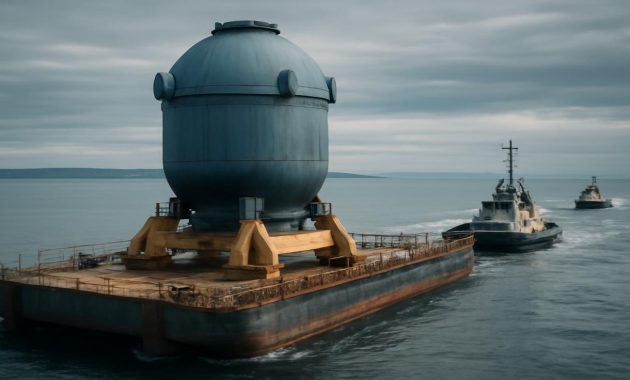
The colossus began its journey before dawn, wrapped in steel and secrecy. Along the quiet banks of the River Rhône, floodlights painted the water in hard, white streaks as a 500-tonne nuclear component — a gleaming cylinder of metal and promise — inched its way onto a waiting barge. It was an unlikely traveler: heavier than a fully loaded Boeing 747, more complex than most satellites, and destined not for a war zone or a megacity, but for a windswept corner of the English coast named Hinkley Point C. There, on the Somerset shoreline, this French-built giant will become the heart of Britain’s first new nuclear power station in a generation.
A Colossus on the Move
Imagine watching it from the riverbank: the slow choreography of cranes, cables humming under tension, the low murmur of engineers counting off measurements in French and English. The component — part of the nuclear steam supply system for a generation III reactor — doesn’t shout its importance. It doesn’t glow or hum or radiate science-fiction energy. It just sits there, massive and silent, a monument to millimeter-perfect engineering. Yet inside that metal shell lies an invisible future: thousands of megawatts of low-carbon electricity, enough to light millions of British homes for decades.
A winter mist clings to the water as the barge pushes off, its hull dipping almost imperceptibly under the cargo’s weight. Somewhere upriver, in Le Creusot and other French industrial towns, furnaces have already cooled, steel has been tempered, machined, inspected, and inspected again. France, a nuclear nation to its core, has built this colossus to British specifications, for a power station that won’t fully come alive until the early 2030s — a reminder that energy planning is less like shopping and more like planting forests. You don’t do it for this year. You do it for your grandchildren.
As the barge noses toward the sea, the journey becomes symbolic. On one level, it’s just logistics — a heavy-load shipment from one European country to another. On another, it’s a quiet handshake between two nations facing the same storm: a heating planet, volatile gas prices, and the stubborn reality that electricity doesn’t just need to be clean. It needs to be there. All the time.
The Beating Heart of a Generation III Reactor
Hinkley Point C’s reactors are no ordinary machines. Classified as EPRs — European Pressurised Reactors, or more broadly generation III+ reactors — they are the product of decades of incremental learning, design refinement, and long, difficult lessons from nuclear’s troubled past. Their promise is almost paradoxical: to harness a process as violent and fundamental as nuclear fission and make it as boring, predictable, and quotidian as a kitchen kettle boiling water.
That 500-tonne French-built unit is part of this domesticated violence. In essence, its job is simple to describe and hard to do: take the heat from uranium atoms splitting inside the reactor core and turn that heat into high-pressure steam, which spins turbines, which spin generators, which push electrons through cables into the British grid. What makes it extraordinary is not the concept but the precision.
Every weld on that metal behemoth has been scanned, every surface measured, every valve tested under pressures beyond anything it will encounter in its service life. Inside the reactor building at Hinkley Point C, it will sit encased in thick concrete and steel, surrounded by redundant safety systems: extra cooling loops, emergency backup power, containment structures designed to withstand extreme events.
Listening to an engineer describe it feels like listening to a luthier talk about a violin the size of a cathedral. The physics are elegant, the engineering dense with detail. Generation III reactors come with handfuls of safety upgrades — passive safety systems that work even when pumps fail, double containment barriers, improved control systems — all designed to make what happens inside the core as uninteresting, from a risk perspective, as possible.
And yet nothing about this project feels small. It stretches across cultures and time zones, across rivers and coastlines. The component that left France in the half-light of morning will one day sit at the center of an industrial landscape on the Bristol Channel, humming invisibly while, outside, seabirds ride the wind and the tide sucks at shingle and sand.
The Journey Across Water and Border
From France to the UK, this colossus travels not on motorways but on waterways and seas. There’s a kind of old-world romance to it: a technological artifact of the nuclear age moving along routes once used for timber, grain, and wine. Tugboats guide the barge like patient shepherds. On deck, the component is shrouded in its protective casing, white and anonymous, like a sleeping animal too large for any cage.
It will pass coastal villages where people look up briefly from their lives — from dog walks, cigarette breaks, bike rides — and see this improbable object glide along the horizon. Many won’t know what it is, or where it’s going. But they might sense, in its sheer size, that it carries a story about the future. The story of how a continent that built its wealth on coal and oil is trying, belatedly, to rewire its foundations.
| Key Aspect | Details |
|---|---|
| Component Weight | Approximately 500 tonnes |
| Origin | Manufactured in France for Hinkley Point C, UK |
| Reactor Type | Generation III+ EPR (European Pressurised Reactor) |
| Role in Plant | Core part of the nuclear steam supply system, converting fission heat to steam |
| Destination | Hinkley Point C nuclear power station, Somerset, UK |
| Planned Operational Life | Around 60 years, subject to approvals |
When it finally reaches the British coast, the spectacle begins again in reverse: cranes, cables, spotlights, the slow lift from ship to shore. From there, a carefully prepared route — reinforced roads, temporary traffic measures, the occasional removal of a signpost or guardrail — will ease it toward its new home. In the villages it passes, curtains will twitch; phone cameras will rise. The convoy will move with the pace and gravity of a procession.
Hinkley Point C: A New Chapter on an Old Coast
The Somerset coast is not the first place you’d think to look for the future. At low tide, the Bristol Channel pulls back in wide, muddy swathes, exposing rippled sandbanks and the faint, lichen-streaked bones of old harbor walls. Sheep graze in fields that slope down toward the sea. The wind smells of salt and wet earth. And yet this coast has a long, unflashy intimacy with big energy.
Hinkley Point A, a small Magnox reactor, began generating electricity in the 1960s and shut down in 2000. Hinkley Point B, an advanced gas-cooled reactor, followed and is now in decommissioning. Their concrete hulks stand as reminders that the nuclear age isn’t new to this landscape; it has been quietly intertwined with it for more than half a century. Hinkley Point C is the latest, biggest chapter in that story — two generation III reactors promising enough electricity to power millions of homes, without the carbon emissions of coal or gas.
Stand on a nearby hill and the construction site looks like a strange, animated coastline of its own: cranes swinging like mechanical herons, floodlit towers, concrete pours happening around the clock. The site is huge, but it exists within a human-scale world of farms, buses, quiet lanes, and the occasional pub where, over a pint, the conversations about it are tangled and nuanced.
Some locals speak of jobs and apprenticeships, of rental income and new roads. Others talk of disruption, of traffic and noise, of a wariness that comes with any project so large it seems to dwarf the community that hosts it. Many hold two or three of these feelings at once. Nuclear power, like the tides, has always been about trade-offs — what you gain, what you risk, what you are willing to live beside and for how long.
What Generation III Really Promises
“Generation III” sounds like marketing, the kind of branding you might find on a smartphone launch. In nuclear terms, it’s more like a generational treaty: an agreement that, if we’re going to keep using this technology, it has to become more robust, more transparent, and less tolerant of human error.
These reactors are designed with layers of safety like nested shells. Passive cooling systems rely on gravity and natural circulation, not just pumps and wires. Core catchers — reinforced basins under the reactor — are designed to contain molten fuel if the worst were ever to happen. Control systems are more redundant, emergency protocols more refined, oversight more intense.
None of this erases the unease many people feel about nuclear power. Radiation is not like smoke or soot; it is invisible, intangible, and the disasters that have seared themselves into public memory — Chernobyl, Fukushima — loom large. For some, the very word “nuclear” sits in the gut like a stone. For others, the danger lies in not building plants like Hinkley Point C fast enough, in clinging to fossil fuels long after we know what they’re doing to the climate.
That 500-tonne French component, then, is not just metal. It’s a wager: that with better design, stricter regulation, and hard-won experience, nuclear power can be what its advocates have always claimed — a dense, steady, low-carbon backbone for an energy system increasingly crowded with wind turbines and solar panels.
The Tension Between Fear and Need
Across Europe, the conversation about nuclear is a low, persistent hum beneath the louder headlines of politics and war. France, already deeply invested in atomic power, is refurbishing its aging fleet and planning new reactors. The UK is betting on a handful of large stations like Hinkley Point C and Sizewell C, alongside experimental small modular designs. Germany has stepped away entirely, shutting its reactors and leaning on renewables and imported power.
Within this patchwork of choices runs a shared thread: the race to decarbonize, to slow the warming of the atmosphere that lashes coastlines and withers crops. Wind and solar are now the bright darlings of the energy world, and for good reason: their costs have plunged, their output is clean, their visual language — white blades, blue panels — feels airy and modern. Nuclear, by contrast, is heavy, secretive, armored in concrete and steel, easy to imagine but hard to see into.
And yet the physics are stubborn. The wind does not always blow; the sun does not always shine. Batteries, hydrogen, interconnectors — all these tools can help smooth out the lulls, but large-scale, low-carbon, always-on power remains the missing keystone in many national energy plans. That is where nuclear sits, uncomfortably but undeniably, offering an answer that some find unpalatable and others see as indispensable.
On a grey afternoon, standing near Hinkley Point’s perimeter fence, the argument can feel oddly abstract. You hear the clang of steel, the rumble of trucks. You see distant waves breaking against the seawall. The future that this place is supposed to guard — one with fewer greenhouse gas emissions, fewer coal chimneys, fewer gas flares — exists only as lines in government strategies, as colored blocks on grid-operator charts.
Yet somewhere out at sea, that 500-tonne French-built heart is already on its way, crossing a border that — for energy, for climate, for atmosphere — doesn’t really exist. CO₂ doesn’t care where it’s emitted. Electricity doesn’t care who made the turbine that spun it into being. The politics are national; the physics are global.
A Franco-British Energy Story
There’s something quietly poetic about France shipping this colossus to Britain at this moment in history. In the age of Brexit rhetoric and nationalist slogans, here is a project that simply cannot exist without cooperation. French expertise in nuclear engineering and heavy manufacturing meets British financing, regulation, and a coastline willing to host the plant. Chinese partners have stakes in the project too, adding another layer to the global entanglement.
It raises a question that feels bigger than energy policy: in an era of climate constraints, what does sovereignty really mean? Is it the ability to walk away from deals and stand alone, or the humility to recognize that some problems — like keeping the lights on without overheating the planet — are structurally shared?
On the factory floor in France where that component was born, welders and inspectors might never see the Bristol Channel. The British electricians and riggers who will install it may never visit the workshops where its steel was poured. Yet their work is braided together in a single arc: from ore to furnace to foundry to barge, from ship to site to reactor hall, from reactor to grid to the quiet click of a thermostat in some terraced house three hundred kilometers away.
When the switch is finally thrown, years from now, nobody will be able to tell by the color of their lightbulb whether the electrons came from a French-built reactor, a Scottish wind farm, or a solar panel on a Devon rooftop. In that sense, the colossus is both profoundly specific — this piece of metal, this river, this coastline — and curiously anonymous. Its destination is the background of modern life, the electricity we hardly think about until it’s gone.
Living With the Colossus
In the end, the story of France’s 500-tonne nuclear shipment to Hinkley Point C is not just about engineering or geopolitics. It’s about how we choose to live with the forces that sustain us. Every form of large-scale energy reshapes landscapes: wind turbines crown hills, dams flood valleys, solar farms spread across fields, coal mines bite into mountains. Nuclear power concentrates that impact into a smaller physical footprint, but stretches it over longer timescales — decades of operation, centuries of waste management.
Walking the paths near Hinkley, you might notice new hedgerows planted to soften the visual edges of the site, newbat roosts and wetland areas created in an attempt to balance what is being built with what is being disturbed. You might see buses full of workers rolling through village streets at shift change, or hear the distant beep of reversing vehicles where, years from now, only the soft hum of turbines will remain.
For some, this is deeply reassuring: a sign that even the most imposing industrial projects can try to weave themselves into the local fabric. For others, it feels like decoration on top of something fundamentally unsettling. Both reactions are legitimate. To stand before that 500-tonne component and feel awe, anxiety, hope, or all three is to be paying attention.
Because beneath the arguments, beneath the paperwork and environmental assessments, beneath the escort vehicles and the security fences, lies a simple fact: modern life is power-hungry. Everything from hospital ventilators to data centers, from heat pumps to high-speed trains, leans on an electrical system we mostly prefer not to see. When France sends this colossus across the water, it is sending a piece of that hidden machinery — heavy enough to bend steel, quiet enough to vanish from daily thought once it is sealed away and running.
The river mist that greeted its departure will long since have lifted by the time Hinkley Point C comes fully online. Children starting school today will be adults with families of their own. Heatwaves and storms will have written themselves deeper into the climate record. By then, the French-built heart of Britain’s newest reactor will be just one more established presence on the coast, as familiar and overlooked as a line of pylons or the slow rotation of distant wind turbines.
Whether history will judge this moment as a necessary bridge to a livable future, or a misstep on the way to something better, is a question that can’t be answered from the deck of a barge or the cab of a crane. But it is there, in the groan of steel under load, in the careful hands guiding the colossus onto its cradle, in the silent, unfolding agreement that some risks are worth taking because others — the risks of inaction, of delay, of burning through what remains of the planet’s carbon budget — are greater still.
FAQ
What exactly is the 500-tonne component France is shipping?
It is a major part of the nuclear steam supply system for a generation III+ EPR reactor at Hinkley Point C. In practical terms, it is one of the core pieces of equipment that transfers heat from nuclear fission to water, creating high-pressure steam to drive turbines and generate electricity.
Why is it being built in France for a UK power station?
France has long-standing expertise and industrial capacity in nuclear engineering and heavy component manufacturing. The Hinkley Point C project is a collaboration that draws on French designs and factories, British regulation and financing, and an international supply chain.
What is a generation III reactor, and how is it different?
Generation III (and III+) reactors are advanced designs that incorporate lessons from earlier plants, with improved safety features such as passive cooling, stronger containment structures, and more redundancy in critical systems. They aim to reduce the likelihood and severity of accidents compared to previous generations.
Is Hinkley Point C safe for nearby communities and the environment?
Hinkley Point C is subject to stringent UK and international safety regulations. Its design includes multiple safety barriers and systems intended to prevent and mitigate accidents. While no large industrial project is without impact, extensive environmental assessments and ongoing monitoring are part of its operating conditions.
How long will Hinkley Point C operate, and what about nuclear waste?
The reactors are planned to operate for around 60 years, subject to continued safety approvals. Spent fuel and other radioactive waste will be managed under strict regulations, initially stored on site in secure facilities and ultimately intended for long-term disposal in deep geological repositories, according to national policy.