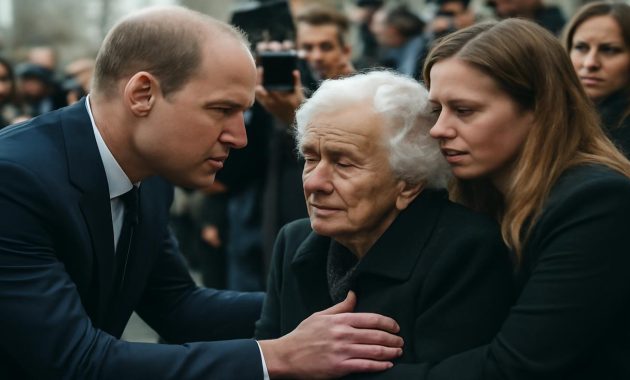
The rain had promised to stay away, at least that’s what the forecast had said. Yet the sky above the small English town had the heavy, pewter look that made people clutch their umbrellas just in case. Still, they gathered—hundreds of them—pressed against metal barriers, cheeks flushed with the cold, phones raised like tiny glass flags pointed toward the road. They weren’t only here to see a prince; they were here to glimpse a story they could tell later, to say, “I was there when he came.”
They had come for the ceremony, the speeches, the dutiful cutting of the ribbon. But what stayed with them, long after the last police motorcycle disappeared and the last camera crew packed away its cables, was something that wasn’t on the schedule at all. It happened quietly, almost awkwardly, in the wake of heartbreak that hung in the chilled afternoon air like mist.
It began with a child’s photograph on a creased piece of paper, held in trembling hands.
A Town Holding Its Breath
By mid-morning, the town center was dressed for royalty. Fresh bunting fluttered from lampposts, and shop windows were washed until the reflections looked almost unreal. Inside a small bakery on the corner, the smell of warm bread and sugar and butter melted into the air as staff peered nervously over cupcakes iced in careful shades of royal blue. Outside, a brass band arranged their sheet music, the thin white pages rattling softly in the breeze.
Children perched on their parents’ shoulders, plastic union flags rolled tightly in tiny fists. At the front of the crowd stood a group who had arrived before dawn, when the streets were still empty and silent: a mother, her teenage son, her elderly parents, and an empty space between them where someone else should have been.
The mother’s name was Claire—though most people would only learn that later, from hurried TV interviews and online articles. At first, she was just another face in the sea of expectation. But even from a distance there was something about her stillness, the way her fingers worried the frayed corner of the photograph she held, that set her slightly apart.
The photograph showed a young boy with an unruly smile and hair that refused to stay flat. His name was Oliver. He had been ten years old when he died suddenly the previous year. The ache of his absence seemed to exist not just in Claire’s eyes, but in the way her son beside her kept staring at the pavement, tracing circles with his shoe, as if drawing a boundary around the space they’d all been forced to live without.
The arrival was almost theatrical in its precision: the roar of motorbikes, the sweep of dark vehicles, the shimmer of high-visibility jackets. As Prince William stepped out of the car, his familiar profile set against the grey sky, a murmur rolled through the crowd, a soft, human wave. Phones rose higher. The public engagement had officially begun.
The Careful Choreography of Royal Life
There’s a choreography to royal engagements—the practiced arc of a smile, the steady rhythm of handshake and greeting, the gentle stoop to talk with a child. William moved along the barrier with that well-worn ease, asking people where they’d come from, thanking veterans for their service, admiring hand-drawn posters tilted anxiously towards him.
Protocol hovered over everything: security officers watching from the edges, press lenses trained and ready, staff timing each moment with unspoken precision. Royal encounters are meant to be brief—polite, warm, but contained. An encouraging word, a clasp of the hand, and then the quiet forward motion toward the next waiting face.
As William approached the spot where Claire and her family stood, the crowd shifted slightly—as crowds always do—leaning forward in a wave of anticipation. You could feel the town’s heartbeat quicken: here he comes, nearly here, this is it. Beside Claire, her father straightened his old army blazer, his medals catching the weak light.
Claire’s hands trembled around the photograph. She hadn’t known, exactly, what she would say if she had the chance. Grief has a way of tangling words, especially when they matter most. But as the prince drew level with her, something steadied in her. Whether it was the way he dipped his head to meet her eyes, or the faint lines of tiredness around his own, she would never quite be able to describe.
“Your Royal Highness,” she began, her voice quivering. “I… I just wanted you to meet my son.”
When the Script Quietly Falls Apart
Royal visits aren’t supposed to unravel into intimate scenes of shared sorrow. They are meant to be orderly, respectful—human, yes, but within edges carefully drawn. Yet grief is notoriously uninterested in edges or protocol.
Claire held out the photograph with both hands, as though it were something fragile that might crumble if not offered just right. William took it, glancing down. The boy’s grin seemed to leap from the paper. For several seconds, the background noise—camera shutters, distant traffic, a child crying somewhere in the crowd—seemed to disappear.
“This is Oliver?” William asked quietly.
Claire nodded, tears already spilling free now that his name had been spoken aloud. “He died last year,” she said. “I… I didn’t know if I should come today. But he loved you. He loved all of this,” she added, gesturing vaguely to the flags and the gathering behind her. “I thought… I thought I should bring him with me.”
According to royal protocol, this was the moment where someone steps gently in—the aide, the softly apologetic staff member—guiding things onward. A few kind words, a sympathetic tilt of the head, perhaps a brief hand on the arm, and then the event continues. The next person in line, the next planned interaction.
Instead, the prince’s hand tightened around the photograph. For a moment, William didn’t look like the future king. He looked like a father. A son who had walked quietly behind his own mother’s coffin. A husband who had seen his wife’s eyes when their children hurt. The air between him and Claire thickened with something unscripted.
Without speaking, William stepped away from the neat line of the barrier. Security tensed. Staff glanced at each other. The cameras, sensing something, clicked faster and closer.
The Moment He Stepped Beyond the Barrier
He walked around, through a narrow gap that no one had expected him to take, and stood beside Claire, not opposite her. It was a simple change in geometry, but suddenly they were no longer prince and subject across a divide; they were just two parents, side by side in shared human scale.
“I’m so sorry,” he said, his voice low, almost drowned out by the swell of silence that rolled across the crowd as people realized something different was unfolding. “I really am.”
He placed the photograph gently against his chest and looked at it again, longer this time. The cameras caught the angle of his face, the small swallow in his throat, the way his eyes seemed to shine before he blinked hard.
Grief recognizes itself. To many watching, it looked as if something had pulled at an invisible thread inside him and he’d simply followed where it led.
“No parent should have to go through this,” William said. “No family.”
Those are the sort of words that can sound hollow when repeated from a podium or a press release. But here, with Oliver’s photo between two pairs of hands, they were simply truth laid bare. Claire nodded, shoulders shaking, and without thinking—without asking, without waiting for permission—the prince did something that rippled against years of palace caution.
He wrapped his arms around her and held her tightly.
Breaking Protocol, Keeping Humanity
The embrace was not the polite, brief contact of a royal pat on the arm. It was long enough that people shifted their weight, unsure whether to look away. Long enough for Claire to cry into the shoulder of a man whose image had been printed on millions of glossy pages, and yet who, in that fragile moment, felt like one of them: simply human, unguarded.
It is technically against royal protocol to initiate such prolonged, close physical contact in public. Boundaries exist to protect both sides—to prevent overwhelming intrusion and preserve a sense of dignity and distance. But rules like that were written for days with perfect weather and predictable conversations.
“I know what it’s like to lose someone you love so suddenly,” he continued softly, once they stepped back slightly. “You don’t get over it. You learn to live with it. And some days are… harder than others.”
His words floated out over the crowd, caught by the press microphones but also by dozens of bare ears pressed into the moment. Many there knew his history, knew the outlines of the story he didn’t need to spell out: the black car in Paris, the endless flowers outside palaces, the two boys walking behind the coffin watched by the whole world.
The official itinerary for the day mentioned a wreath-laying, a speech about community resilience, a tour of a local charity project. It did not mention any of this. Yet it was here, in this unscheduled moment, that the engagement took on a different kind of meaning.
Beside Claire, her teenage son had stood frozen, his eyes sharp with the awkwardness of grief and the shock of proximity to royalty. William turned to him, reaching out a hand.
“You must miss your brother a lot,” he said.
The boy swallowed and nodded. “Every day.”
“Look after your mum,” William told him gently. “And let her look after you. Talking about him helps, even when it hurts.”
The boy’s shoulders softened, a tiny defensive shell cracking. Later, he would say to reporters that it was the first time since Oliver’s death that an adult had told him directly it was okay to hurt, that it was okay to talk.
A Small Moment, Echoing Far
As William slowly moved back toward the official line, the spell didn’t break so much as shift into something quieter. He didn’t rush. The staff around him, usually precise and composed, seemed to silently adjust. The day’s schedule flexed by a few minutes. No one complained.
People in the crowd dabbed at their eyes with gloves, jacket cuffs, the edges of scarves. A child on someone’s shoulders asked in a loud whisper, “Why is that lady crying?” and her mother, unable to speak, just squeezed her tiny leg in answer.
Someone further back, who couldn’t see properly, held up their phone to record what they could. That video would later loop across screens and feeds, but it could never quite capture the texture of the air in that square: the feeling that something unscripted, something gently defiant, had just unfolded.
It was not the first time William had quietly bent the rules. Over the years, there have been moments caught on camera—him hugging a grieving widow, crouching in the dust beside a traumatized child, wrapping an arm around the shoulders of someone who has just said the one thing that cracks open his practiced composure. Each time, a small tremor runs through the idea of what royalty is supposed to look like.
But that day in the town square, with Oliver’s photograph still folded carefully inside his jacket pocket as he continued the engagement, it felt as though a bridge had been strengthened: between monarchy and public, protocol and instinct, symbol and human heart.
What Witnesses Remember
Afterwards, inside the hall where the official ceremony took place, the scent of polished wood and fresh flowers did its best to restore the day’s intended tone. William delivered his speech with the calm assurance expected of him, speaking about community spirit, about the importance of coming together in difficult times. Yet for many in the audience, the words now carried an extra weight, because they had seen what togetherness looked like when the cameras were supposed to stay at a polite distance.
At the back of the room, a local teacher whispered to a colleague, “I’ll never forget that hug. That’s what the kids will talk about.” Outside, the band members packed away their instruments in near silence, each returning in their minds to the moment the town’s cheerful soundtrack had fallen still.
By late afternoon, news outlets were already sharing the photographs. Headlines tumbled over each other: “Prince William breaks protocol,” “Deeply emotional scenes,” “A royal embrace that moved a nation.” Yet for Claire, none of this was about headlines. When she finally returned home, exhausted, her coat still carrying traces of unfamiliar cologne and the faint static of a thousand camera flashes, she placed Oliver’s photo back on the mantle.
“He met you,” she whispered into the quiet of the house. “He knows your name.”
Somewhere else, in a room lined with files and briefing notes, staff would later note the moment in their internal reports: the security risk, the protocol breach, the need to be prepared for similar instances in the future. But it’s hard to quantify the protective power of a gesture that says, in essence, we see you, even in your darkest hours.
How One Gesture Travels
The story, like so many in our time, traveled quickly. People watched it on their phones while riding trains, sitting in silent kitchens, standing in supermarket queues under the harsh hum of fluorescent lights. In the scrolling glow, the details might blur: which county it happened in, what the event had officially been about.
What stuck was the sight of a man stepping out of the pre-ordained frame and into the unpredictable, often messy, always sacred space of another person’s grief.
Some said it made them remember their own lost children, partners, parents. Others said it made them think of the moments when they had wanted someone—anyone—to break the invisible rules of polite distance and say, “Tell me about them. Say their name. Let me stand here with you for a minute.”
It’s easy to be cynical about public figures, to assume that every gesture is calculated, every moment rehearsed. But there is something about the way a body leans in, the way eyes shine, that resists choreography. That afternoon, whether or not he intended to, William offered something that can’t be neatly written into speech notes or palace protocol.
He offered proof that even within an institution built on ritual and repetition, there is still room for impulse, for empathy, for a human heartbeat that sometimes drowns out the drum of duty.
A Quiet Legacy of a Rain-Gray Day
In the weeks that followed, the town slid back into its ordinary rhythms. The bunting came down; the barriers were stacked away. The bakery on the corner sold the last of its royal-themed cupcakes, blue icing leaving faint stains on children’s tongues. The band rehearsed new pieces for other occasions, other crowds.
But for those who had been there, something lingered. Parents who had lost children found their story reflected on screens and felt, perhaps, a touch less invisible. Teachers spoke to their students about grief with a little more openness, referencing not the prince himself but the simple act of acknowledging someone else’s pain in public.
And in one living room, Claire and her family continued to navigate the strange landscape of absence. There were still nights of raw, aching silence. There were still mornings when the house felt too large, the empty seat at the breakfast table too loud. But now, whenever she passed the mantle and saw Oliver’s photograph, she remembered another image layered behind it: the future king holding her son’s face to his heart, standing beside her in a space no palace manual had prepared him for.
On that rain-gray day, in a small town that will likely never again see such a flurry of cameras and expectation, something soft but enduring had happened. Protocol had bent just enough to let compassion breathe. A public engagement, designed with precision, had made room for something unplanned and essential.
And as the story continues to be told—on screens, in newsprint, whispered across café tables—it carries with it a simple reminder: titles and traditions may set people apart, but grief and love pull us irresistibly back together. Sometimes, all it takes is one person willing to step beyond the barrier and say, without words, I am here with you.
A Glimpse at the Day, In Moments
| Time | Key Moment |
| Morning | Crowds gather, town dressed with bunting and flags, families staking out places along the barriers. |
| Late Morning | Prince William arrives, moving along the crowd with the usual mix of smiles, handshakes, and brief conversations. |
| Midday | Claire offers Oliver’s photograph; conversation turns unexpectedly to loss and grief. |
| Moments Later | William steps beyond the barrier, embraces Claire, and speaks gently with her and her son, breaking usual protocol. |
| Afternoon | Official ceremony continues, but the town—and soon the country—holds on to the image of a prince choosing humanity over distance. |
Frequently Asked Questions
Did Prince William really break royal protocol in this situation?
Yes. While royal family members often show warmth and empathy, they are generally advised to limit prolonged, close physical contact during public engagements, especially unscheduled hugs or embraces. By stepping away from the barrier and holding a grieving mother for an extended moment, William moved beyond typical protocol in favor of a deeply human response.
Why is physical contact considered a breach of protocol for royals?
Royal protocols around touch exist partly for security and partly to maintain a respectful, manageable boundary between the royal and the public. With large crowds and tightly timed schedules, clear guidelines help prevent chaos and protect personal space on both sides. However, in practice, these rules are often softened when compassion and context call for it.
How did onlookers react to William’s gesture?
Witnesses described the scene as profoundly moving. Many people in the crowd were visibly emotional, some wiping away tears. Those who saw it felt they were watching a rare moment when formality fell away and genuine empathy stepped forward, leaving a powerful impression long after the visit ended.
What made this moment stand out among other royal engagements?
Most engagements follow a carefully planned structure: brief conversations, speeches, and appearances. This encounter stood out because it was unplanned, deeply personal, and emotionally raw. Instead of simply offering scripted condolences, William entered into the family’s grief in a tangible, physical way, which is uncommon in such public, tightly managed settings.
Why do moments like this matter to the public?
Many people see royalty as distant or symbolic figures. When a royal openly shares in someone’s pain, it can narrow that distance, reminding people that behind titles and traditions are human beings who also know loss and vulnerability. For those living with grief, being seen and acknowledged in such a visible way can offer comfort and a sense that their private pain is not invisible.