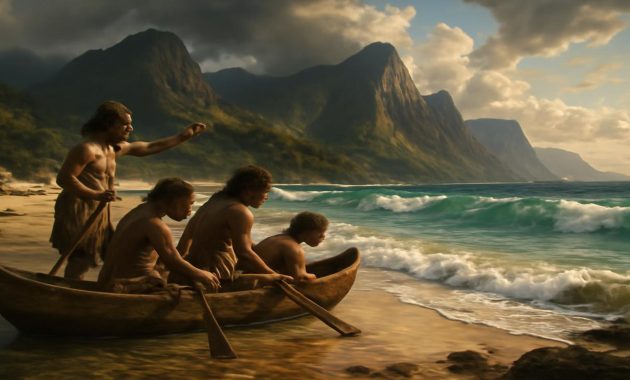
The first thing you notice is the silence. Stand at the edge of an outback evening, where the heat slips away and the sky turns the color of burned sugar, and you can almost hear it: the faint echo of footsteps that are not your own. For tens of thousands of years, people have walked this land, watched these same constellations rise, listened to the same wind comb through spinifex and paperbark. Now, a new DNA study is telling us just how long that story has been unfolding—and it reaches deeper into time than many of us were prepared to imagine.
The Night the Timeline Changed
The news did not arrive with a thunderclap, but with the quiet firmness of scientific consensus. A team of geneticists and archaeologists, combing through fragments of ancient DNA and the genomes of living Indigenous Australians, have converged on a remarkable conclusion: humans reached Australia at least 60,000 years ago.
On one level, it’s just a number, another line in the timeline of human migration. On another, it is an invitation to rethink nearly everything we thought we knew about the peopling of this continent—and about the creative, stubborn, adaptable species that we are.
Imagine the world then. Sea levels were lower, climates harsher in some places, more generous in others. The great ice sheets to the north locked up water and chilled entire hemispheres. In Africa, the species we now call Homo sapiens had already begun to wander. Some of those wanderers turned east, hugging coasts, following rivers, tracing shorelines that are today drowned beneath the sea.
At some point in that deep past, a group—small by today’s standards, perhaps a few hundred people—made the most consequential journey in Australian history. They crossed a landscape that no longer exists, a connected region of islands and shelves we now call Sahul: a supercontinent that once joined Australia, New Guinea, and Tasmania into one sprawling, living landmass. Their arrival would start one of the longest continuous cultural stories on Earth.
How DNA Became a Time Machine
The new study, like many breakthroughs in modern science, is part detective work, part time travel. DNA, after all, is a molecular diary. Every generation edits it slightly; every migration leaves a trace. When geneticists look at the genomes of living people, and, where possible, fragments from ancient remains, they can reconstruct old journeys, old splits, and old reunions.
For Australia, this genetic diary has long told a distinctive story. Indigenous Australians share ancestry with the early migrants who left Africa, but their genetic line diverged early from other non-African populations. That split—like a fork in an ancient road—marks the beginning of a separate journey, one that ends on the shores and deserts of Sahul.
By comparing mutation patterns and their rates—think of them as slow, random ticks of a biological clock—researchers can estimate when different populations parted ways. The latest analyses, using larger datasets and improved statistical models, now point with new confidence to an arrival at least 60,000 years ago, and possibly even earlier.
This doesn’t erase the debates of past decades. Archaeologists have long argued over the oldest sites: stone tools, charcoal, ochre stains, and shell middens that seem to whisper of very ancient camps. Some sites, like those at Madjedbebe in northern Australia, have teased dates pushing past 60,000 years, sparking both excitement and skepticism. But what’s changed here is that DNA—the internal record we all carry—has stepped in as an independent witness, backing up the deeper end of that timeline.
Walking Into an Unfamiliar Eden
Try to picture that first crossing. It wasn’t one leap from Asia to Australia but a stitched-together series of island hops, aided by lower seas. Even then, open water crossings were unavoidable. Somewhere along the way, canoes, rafts, or some other kind of watercraft carried families, food, fire, tools, and stories over channels where now only ocean swells move.
Landing in Sahul would have felt like stepping into an unfamiliar Eden—one that was also laced with danger. Giant megafauna moved across plains and forests: huge marsupial lions, towering birds, wombats the size of small cars. Rivers ran in courses that are now lost, swallowed by shifting climates and rising seas. The night wrapped itself around new sounds—unknown frogs, unseen hunters, the crack of unfamiliar branches in the dark.
But the migrants were not strangers to adaptation. They carried with them a memory of other landscapes, other challenges. Very quickly, human ingenuity and local knowledge began stitching themselves together into the first chapters of Aboriginal culture, rooted in particular places, waters, and skies.
Think of the first child born on Sahul who never saw the homeland across the water. For that child, “home” would be this new land alone. Their descendants would, over tens of thousands of years, become custodians of regions so specific—this stretch of river, this grove of trees, this rock shelter—that they would know the taste of local water and the sound of local weather the way they knew the rhythms of their own breath.
| Key Event | Estimated Date (Years Ago) | What It Means |
|---|---|---|
| Early humans leave Africa | 70,000–80,000 | Founding migrations of modern humans into the rest of the world. |
| Split of ancestors of Indigenous Australians from other Eurasians | 65,000–75,000 | A distinct genetic branch begins that will eventually reach Sahul. |
| Human arrival in Sahul (Australia–New Guinea–Tasmania) | ≥ 60,000 | The first people set foot on the continent, beginning continuous occupation. |
| Expansion across diverse Australian environments | 50,000–40,000 | Settlement of deserts, coasts, forests, and highlands; cultural and linguistic diversification. |
| Sea levels rise, isolating Australia, New Guinea, and Tasmania | After ~12,000 | Communities become separated by new seas, shaping distinct regional cultures. |
Stories Older Than Ice
For Indigenous Australians, none of this is new. What science calls “discovery” often sounds, in Aboriginal communities, like belated agreement. Oral traditions across the continent speak of deep time in ways that, for many years, non-Indigenous listeners misunderstood or dismissed.
There are stories of coastlines that no longer exist, of hunting grounds now far out to sea, of rivers changing course and islands rising from or sinking beneath the waves. As sea levels rose at the end of the last Ice Age, they flooded broad coastal plains. Yet some oral histories appear to remember those ancient landscapes and the transformations that followed.
In recent decades, researchers have begun to notice striking correlations between certain Dreaming stories and geological events—sea-level changes, volcanic eruptions, the formation of reefs. Some narratives may encode events more than 10,000 years old. The new DNA evidence stretches the potential time frame of cultural continuity even further, into a realm so deep we have barely any words for it.
Imagine a story told from one generation to the next, again and again, without writing, without books, without digital backups, for thousands of years. Imagine knowledge carried that way across 600, 700, 800 generations. Now imagine that this is not a solitary effort but the work of an entire culture, woven into song, ceremony, art, and law.
The 60,000-year DNA timeline does something humbling here. It reminds us that Aboriginal cultures are not simply “old” in some vague, poetic sense. They are among the longest continuous cultural traditions anywhere on Earth—anchored to a specific land, shaped in dialogue with it, over a span of time that makes pyramids and cathedrals look like recently built sheds.
Science in Conversation with Country
To tell this story honestly, we have to acknowledge something important: the narrative of “discovery” has often erased the voices of the people whose history is being described. When genetics labs announce a new date for human arrival, it can sound as though they have the first and last word. But on this continent, the first words belong to the communities whose ancestors walked ashore all those thousands of years ago.
Increasingly, genetic research in Australia is being guided by partnerships with Indigenous groups. That means consent, co-authorship, shared decision-making about how samples are used, and clear limits on what can be done and said. DNA is not just data; in many Aboriginal worldviews, it is part of the living person, connected to kin and Country. Treating it as a mere resource to be mined is both ethically and culturally unacceptable.
When collaboration works, something powerful happens. The data from genes, the evidence from stone tools and hearths, and the lived knowledge of Elders begin to talk to one another. You end up with a richer, more layered story. A rock shelter with 65,000-year-old artefacts is no longer just an archaeological site; it is part of someone’s ancestral homeland, linked to songs and totemic beings and customary law.
In that sense, the new 60,000-year date is not just a scientific update; it is also a kind of recognition. It says: the continuity that Aboriginal people have always asserted—“we have been here since time began”—has a deep-time echo in the genome itself. The language of Country and the language of molecules are, improbably, pointing in the same direction.
Rethinking What It Means to Be Human
There is another, quieter revolution nested inside this finding. Once upon a time, the human story was told as a kind of stairway: “primitive” at the bottom, “advanced” at the top, with Europe often placed smugly near the summit. Truth has been undoing that staircase for decades, and Australia’s 60,000-year timeline pulls out a few more steps.
To survive in Australia for that long—through vast climatic swings, extinctions, coastal drownings, and inland desertification—required a sophisticated understanding of ecosystems, water, fire, and seasons. Aboriginal fire practices, for instance, created mosaics of vegetation that enhanced biodiversity and reduced catastrophic wildfires. Knowledge of plant foods and medicines, of animal behavior, of sacred and sustainable places to harvest—these were not casual observations. They were science, tested by practice and time.
The genetic evidence of early arrival underscores just how long that experiment in sustainable living has been running. While many societies elsewhere in the world have risen and fallen, expanded and collapsed, this one persisted. It changed, of course—no culture is frozen—but it remained rooted to Country in a way that is almost without parallel.
As we face a century of escalating climate disruption, that perspective matters. Many people are now turning to Indigenous knowledge systems for clues about how to live well with a changing Earth. The idea that a culture has sustained itself in partnership with a difficult continent for 60,000 years is not just impressive; it is instructive. It suggests that being “advanced” may have less to do with shiny tools and more to do with long-term survival, reciprocity, and balance.
Standing in Deep Time
If you visit certain parts of northern Australia today, you might stand in front of sandstone walls painted and repainted over thousands of years. Layers of ochre images—fish, turtles, ancestral beings, even sailing ships from recent centuries—crowd the rock. The living descendants of the artists can sometimes tell you who created particular motifs, which clan has responsibility for that site, what rituals connect those figures to land and law.
Now, put the DNA timeline next to that rock art. Somewhere in those deep layers, ghosting behind the visible figures, are the marks of people whose genes diverged from other humans more than 60,000 years ago. Their bodies have returned to dust, but their descendants are here, speaking, painting, arguing, laughing, deciding how to pass on what they know.
What the new study offers is not a complete story—science never is—but a clearer sense of the scale we’re dealing with. It invites us to expand our imagination. To think of 60,000 years not as an abstract number but as a long thread running through every blade of spinifex and every tide line, through the language names of hills and waterholes and deserts.
And it asks something of us, too. If a people can sustain a relationship with land for that long, what does that mean for those of us who arrived much later, or who live in other parts of the world? Perhaps it means understanding that we are, all of us, latecomers to somebody’s ancient home. That our own stories, no matter how new or old, are now entangled with timelines far older than our institutions, our laws, or our maps.
The night deepens. Overhead, the Milky Way spills across the Australian sky. Some of the constellations are different from what northern eyes expect. That, too, is a reminder: the universe looks different, depending on where you stand, and on whose stories you listen to. The DNA study has given us one more view of that sky—one more way to see ourselves as a young species on an old Earth, still learning how to belong.
Frequently Asked Questions
How do scientists know humans reached Australia 60,000 years ago?
Researchers use genetic data from Indigenous Australians and compare it with DNA from other global populations. By studying the accumulation of mutations over time and modeling when lineages split, they can estimate when ancestors of today’s Aboriginal peoples first arrived in Sahul. These estimates align with some of the oldest archaeological sites, strengthening the 60,000-year timeline.
Does this mean there were people in Australia even earlier than 60,000 years ago?
Possibly. The 60,000-year figure is a conservative minimum based on current genetic and archaeological evidence. Some sites suggest human presence might be older, and as methods improve, the estimated date of first arrival may shift slightly earlier. But right now, 60,000 years is the widely supported benchmark.
What is Sahul, and why is it important to this story?
Sahul is the name for the ancient supercontinent that once connected present-day Australia, New Guinea, and Tasmania when sea levels were much lower. Humans did not simply arrive in “Australia” as we know it now; they settled across this broader landmass. Rising seas later separated these regions, isolating communities and shaping distinct cultures.
How does this research relate to Aboriginal oral traditions?
Many Aboriginal stories describe ancient environmental changes, such as shifting coastlines and flooding of low plains. Some of these accounts correlate with geological events from thousands of years ago. The new genetic evidence of very deep ancestral roots supports the idea that these oral traditions may preserve memories across extraordinary spans of time.
Why is collaboration with Indigenous communities important in DNA research?
DNA is not just scientific material; it is part of a person’s identity and is deeply connected to family, ancestors, and Country. Ethical research in Australia requires informed consent, respect for cultural protocols, and shared control over how genetic information is used and interpreted. Collaboration ensures that scientific stories about deep time are told with, not just about, the people whose history is being studied.