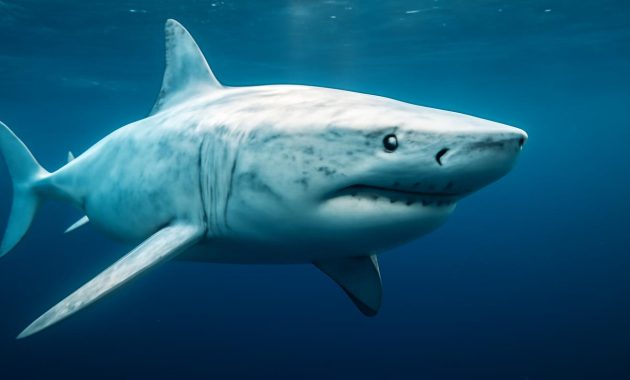
The first thing everyone noticed was the silence. Not the usual hush of an early morning ocean, but a held-breath kind of quiet, as if the sea itself were waiting. The sky was still gray, the sun just a pale bruise above the horizon, when someone on the bow pointed and whispered the word that would ripple across the boat, across the town, and soon enough, across the world: “Shark.” Not just any shark. A dorsal fin, high and confident, cutting through the surface like a black stone. A flash of pale mass beneath. The unmistakable heft of something many had quietly decided no longer truly existed here. A great white.
A ghost in familiar waters
By the time the animal came fully into view, nobody on the boat was talking. You could hear only the gentle slap of swell against fiberglass and the electric fizz of camera shutters and phone mics snapping on. The shark moved just beneath the surface, a slow, deliberate glide, as if measuring the hull with its eyes, weighing history against hunger, curiosity against caution.
It is hard to convey how large a great white really is until you see one under your feet. The numbers—four meters, maybe more; a ton or two of power and purpose—fail to describe the way the water seems to tilt around it, how the light breaks over its shoulders, how everything else suddenly feels small, almost toy-like. On that morning, a few miles off a temperate coastline where beach towns have, for years, comforted themselves with the narrative that “big sharks don’t really come here anymore,” a living contradiction traced a slow circle.
For local fishers, divers, and scientists, great whites had become a kind of maritime rumor—stories passed around dockside coffee and late-night bar talk. Old-timers said they’d seen them decades ago, back when seals still filled certain rock outcrops and sea temperatures were cooler. Younger folks knew them mostly as pixelated shapes on nature documentaries, or as teeth and legends: the shark that was, not the shark that is.
So when the dorsal fin appeared that morning, slicing through the early light, people did the one thing we always do when a myth suddenly resolves into muscle and motion. They reached for cameras, for witnesses, for proof—some way to make sense of a ghost that had decided to show itself.
The “ghost” species that never left
To call great whites a ghost species is not to say they were gone, only that they’d slipped into a kind of cultural invisibility. They had become, in the words of one marine biologist, “functionally absent from the public imagination” in this region. No daily sightings. No regular encounters. Just the occasional rumor, the rough shape of a fin in a blurry photo, a bite mark on a dead whale that might have been them or something else.
Conservation stories have conditioned us to simple binaries: present or extinct, safe or doomed. But the truth for many large ocean predators exists in the uneasy space between. Great whites were never truly gone from most of their historical range; they just became rarer, quieter, harder to see. Overfishing trimmed their food base. Targeted killing and older bounties thinned their numbers. Pollution, climate shifts, and coastal development scrambled their routines. Population graphs fell, leveled, and then turned into mysteries with wide error bars and cautious maybes.
For locals, though, numbers on a graph matter less than what eyes can confirm. In many communities, people had gone decades without a clear, verifiable sighting. The shark that once loomed over their imagination had faded into the background buzz of old news, nudged out by more immediate concerns: shrinking fish stocks, warmer summers, intense storms. The ocean, always in motion, had shifted its cast of daily characters. Dolphins, smaller sharks, the occasional turtle—these were the familiar faces now.
That’s what made this sighting feel like a visitation. Not the sudden arrival of something new, but the return of something remembered, like a relative you weren’t sure was still alive. And yet the shark that surfaced near the boat that day was not just a nostalgic callback—it was an ecological message, finned and unmistakable: I am still here. This place, in some way, can still support me.
The science behind the surprise
The crew did what you do in the twenty-first century when something astonishing happens: they recorded, measured, and shared. Video footage and still images ended up on the screens of local marine researchers within hours. Frame by frame, the evidence was inspected: the width of the head, the bullet shape of the snout, the coloration—slate gray fading to a soft, almost luminous white belly, flanks speckled with the scars and scratches of a long life at sea.
Identification wasn’t hard. Even among sharks, great whites are unmistakable when seen in detail—the thick, conical snout; the robust tail; the slow, unhurried confidence of an apex predator that has very few things to fear. What was harder was accepting what that identification implied. This wasn’t a young, lost wanderer. Based on the length estimated from boat measurements, this was a fully mature great white. Not a stray, but a survivor.
Shark researchers, many of whom had spent years tracking subtle changes in local food webs, saw the sighting as part of a bigger pattern. In recent seasons, seals had begun to return to certain haul-out sites, and occasional carcasses of dolphins or whales had shown up with crescent-shaped bites. Offshore fish stocks—though far from fully recovered—had stabilized in some areas after tighter regulations. The pieces of the puzzle had been stacking quietly in the background. The great white was, in a way, the final piece clicking into place.
“We sometimes talk about charismatic megafauna as if they’re separate from the system,” one scientist noted later. “As if they appear and disappear like celebrities. But they’re not separate. They’re the last visible sign that everything beneath them, all the invisible relationships, are just intact enough to support them again.”
When legend meets lens
Word spread the way it always does in small coastal communities: through half-whispered phone calls, grainy screenshots, and that peculiar blend of skepticism and hope that comes when someone says they saw something extraordinary. People crowded into the local harbor café to watch the videos on replay, pointing at the jerky line of fin and the massive body turning beneath the surface.
Outside, the ocean looked the same as it had the week before—same rolling swell, same salt-heavy wind that curled through the dunes and over the rooftops. And yet everything felt slightly altered, as if the water now held a different story about itself. Parents griped quietly about beach safety. Surfers traded nervous jokes about “sharing the lineup.” Older fishers shook their heads and said it was about time the big ones came back—proof, perhaps, that the sea had not been entirely emptied by decades of taking.
It’s easy, in an age of endless footage, to assume that cameras have already revealed everything. That if something exists, we’d see it all the time, in constant clips and trending hashtags. But the ocean is wide and deep, and great whites are not circus animals. They are wide-ranging, stealthy, and deeply uninterested in being seen by us. Many spend large portions of their lives in offshore waters, cruising along temperature fronts and underwater ridges invisible from the surface.
This is one of the quiet truths that the sighting dragged back into public view: absence of evidence is not evidence of absence, especially in the sea. Vast territories go unobserved, days and weeks pass with no human eyes on them, and in those unmonitored spaces, life goes on—unseen, uncounted, still holding on.
What the numbers quietly suggest
Scientists have long struggled to pin down exactly how many great whites remain globally. Tagging efforts, photo-identification projects, and long-term observation programs have suggested cautious hints of stabilization, even modest recovery, in some regions where protections have been enforced and key prey species rebound.
In the area where this shark was spotted, a patchwork of fishing restrictions, protected areas, and accidental refuges created by rough weather and difficult access has, over time, offered some relief from constant pressure. The predator-prey balance is far from fully restored, and the system still bears scars: depleted species, altered migration routes, pockets of pollution that silently shape who survives.
And yet, the presence of a mature great white—healthy, broad-bodied, moving slowly and confidently through coastal waters—hints at a system that, while bruised, is not broken beyond repair. It suggests that some of the threads connecting top predators to their prey, and prey to the smaller life beneath them, remain strong enough to carry the weight of a shark that can live for 70 years or more.
To put the sighting in a simple perspective, consider how the perceived “rarity” of such encounters compares with what researchers suspect is quietly happening out at sea:
| Aspect | What People Commonly Think | What Evidence Suggests |
|---|---|---|
| Great white presence | “Basically not here anymore.” | Occasional, low-density visitors still pass through. |
| Population trend (locally) | “They must be almost extinct.” | Numbers are small, but not zero; possibly stable or slowly improving. |
| Human–shark encounters | “If they’re here, we’d see them all the time.” | Most of their lives unfold offshore and beneath the surface, unseen. |
| Meaning of a single sighting | A one-off anomaly. | A rare window into an ongoing, mostly hidden reality. |
Fear, awe, and the ethics of sharing a shoreline
When a species with teeth like polished ivory and a jaw wide enough to reshape a wooden boat’s side appears on your doorstep, fear is natural. The great white is not a harmless creature. It hunts seals, sometimes whales. On very rare occasions, it mistakes a human silhouette for prey with tragic results. But the narrative that rises so quickly around these animals—of mindless killers, of marauding monsters at the beach line—is wildly out of step with what science knows.
Most great whites want nothing to do with us. They are cautious, curious, and surprisingly sensitive to disturbance. Tagging studies have shown individuals altering their routes around dense boat traffic or noisy harbors. Many encounters end with the shark slipping silently beneath the surface the moment it senses something unusual.
Standing on a headland days after the sighting, watching the tide pull threads of foam backward from the sand, it’s easy to feel the pull of two competing emotions. One is that primal unease—a sense that somewhere out there, just beyond clear water, something powerful enough to end you in an instant is passing by. The other is wonder at the sheer fact that it is passing by at all, that after everything humans have thrown at the sea, a creature that evolved millions of years before us is still tracing its hunting grounds along our crowded shores.
To live with great whites is to accept that we share space with something we cannot fully control, only respect and attempt to understand. Coastal communities are slowly relearning that relationship—through better safety protocols, realistic public education, and the cultivation of an attitude that sees sharks not as invaders, but as native citizens, returning to old neighborhoods.
The stories we choose after the sighting
How a community talks about a great white sighting may shape what happens next more than the shark’s behavior itself. Do headlines scream of terror and attack, or do they focus on rarity, context, and coexistence? Do policy responses reach reflexively for culls and nets, or for research funding, monitoring, and better beach management?
In the days after the rare great white appeared, something quieter than panic began to take root: conversation. Beach organizations hosted information nights. Scientists shared what they knew about shark movement, feeding, and risk. Lifeguards updated training. Surf schools posted not just warnings, but explanations. Children, who a week earlier might have drawn sharks with exaggerated fangs and angry eyes, now added details: the blush of gray across the shark’s back, the wide, dark pupil inside its black eye, the scars like old maps on its flanks.
The ocean did not suddenly become more dangerous because one shark chose to rise near a boat. It simply became more honestly described. The truth is that the sea has always held large predators, even when we forgot to look for them. The difference now is that our tools—camera traps, drones, tags, citizen science apps—are making their presence harder to ignore.
There is power in telling the story of the great white not as an intruder, but as a returning neighbor. A rare sight? Yes. But also a rightful one.
Why a single fin matters
In a world where entire species vanish without anyone ever knowing their names, it might seem strange to devote so much attention to one shark gliding past one boat on one quiet morning. And yet, that dorsal fin slicing through grainy video is more than just a wildlife moment—it’s a symbol, a focal point for a tangle of questions we can no longer avoid asking.
What does it mean that a top predator can still complete its life cycle in coastal waters altered by a century of extraction? How many unseen individuals move through our blind spots, surviving in the margins of our awareness? And, perhaps most importantly, if a “ghost” species like the great white still lingers where we thought it gone, what responsibility do we have now that we can no longer claim ignorance?
On that morning, as the great white finally tilted away from the boat and slipped into deeper blue, its departure felt strangely gentle. No dramatic last breach, no cinematic thrash—just a steady, unhurried descent. A few bubbles rose to the surface and burst. The sea reabsorbed the moment, smoothing its skin as if nothing unusual had happened.
But for the people onboard, and for everyone who later watched that fin appear on their screens, something had changed. They had seen living proof that the ocean’s story is not a simple arc of decline, but a far messier, more hopeful narrative: one where absence can be mistaken, where survival can be quiet, and where rare does not always mean gone.
Somewhere out beyond the line where the water turns dark and featureless to human eyes, the shark continued its journey. It will never know that for a brief stretch of time, its passing stirred a coastline into conversation. It will not care that people called it a ghost, a relic, a miracle. For the great white, there is only the cold logic of the hunt, the faint silhouettes of seals, the shifting temperatures that guide its path along the continental shelf.
But for us, that fleeting encounter is an invitation. To look more carefully at what we’ve written off as lost. To grant that the sea’s silences are not always empty. And to remember that, sometimes, the most important proof of life is a sudden fin on a quiet morning—reminding us that the wild we thought we had erased is still, stubbornly, astonishingly, alive.
Frequently Asked Questions
Are great white sharks making a full comeback?
There is some evidence of stabilization or modest recovery in certain regions where protections and better fisheries management are in place, but great whites are still vulnerable. A single sighting does not mean a full comeback; it suggests that the ecosystem retains enough integrity to occasionally support them.
Does a great white sighting mean beaches are unsafe?
Not necessarily. Great whites have always been part of many coastal ecosystems, and attacks on humans remain very rare. Sightings are an opportunity to review safety practices—such as avoiding dawn and dusk swimming near seal colonies—rather than a reason for panic.
Why are great white sharks called a “ghost” species here?
They’re called a “ghost” species because they had largely disappeared from public view and local memory. They were not confirmed extinct or fully absent, but so rarely seen that many people assumed they were effectively gone from the area.
How do scientists confirm that a shark is a great white from video?
Researchers look for a combination of features: body shape, size relative to known objects (like a boat), coloration pattern (gray top, white underside), fin shape, and behavior. Good-quality video or photos often allow confident identification.
Is killing or culling sharks an effective way to protect swimmers?
Most experts say no. Culls and lethal nets often kill non-target species and can disrupt ecosystems without reliably reducing risk. Evidence-based approaches—public education, real-time monitoring, temporary beach closures, and non-lethal detection systems—are considered more effective and ethical.
Why don’t we see great whites more often if they’re still around?
Great whites are wide-ranging and spend much of their time offshore or deep beneath the surface. Our time in the water is limited and localized. The ocean is vast, and even relatively healthy populations can remain largely invisible to casual observers.
What can ordinary people do to help protect great white sharks?
Support science-based marine protections, reduce single-use plastics, choose seafood from more sustainable sources, and share accurate information about sharks instead of fear-driven myths. Participating in citizen science projects—such as reporting verified sightings to local researchers—can also be surprisingly valuable.