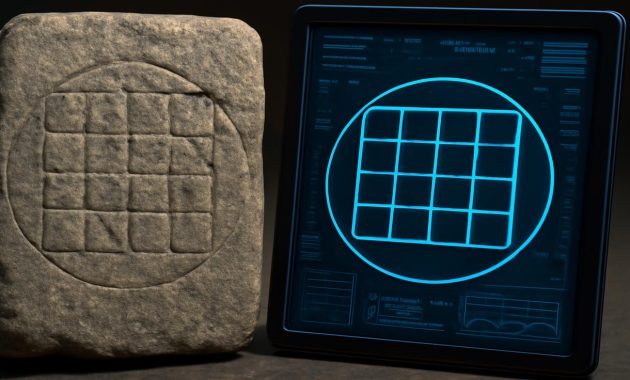
The stone is colder than you expect. It sits under a cone of museum light in the Netherlands, its surface worn by nearly two thousand winters and the touch of hands that no one remembers. At first glance, it looks unremarkable: a rectangular block, some faint lines, a ghostly grid etched into old Roman limestone. People pass it, murmur, move on. But quietly, invisibly, another kind of gaze has been fixed on this stone—one made not of eyes, but of algorithms. And that gaze has just cracked open a forgotten chapter of human play.
When a Game Board Isn’t Just a Game Board
For years, archaeologists cataloged the stone as yet another Roman “game board.” The Empire left these things everywhere: scratched into paving stones, carved onto steps, inked on scrap pottery. Little windows into the way soldiers, merchants, and bored teenagers passed the time. Most of the time, no one knows the rules. The boards are mute—just grids, circles, lines.
This particular slab was unearthed at a former Roman frontier site in what is now the Netherlands, near the northern limits of an empire that preferred its borders straight and its stories clean. The stone, about the size of a laptop, bore a strange arrangement of intersecting lines and symbols. Too complex, some thought, to be just a game. Too neat, others argued, to be anything else.
The catalogs gave it a label and moved on. “Possible game board,” they wrote. No one could prove otherwise.
But then a team of Dutch researchers decided to ask a different kind of intelligence. What if, they wondered, a machine could learn to “read” playful patterns the way it reads letters and numbers? Could artificial intelligence, trained on cracked mosaics and half-erased inscriptions, tell them what humans had never quite managed to see?
The Day the Stone Started Talking
The stone was scanned in excruciating detail. High-resolution photography captured every nick and scratch. 3D models recreated the shallow grooves that time had nearly erased. Even the microscopic shadows cast by worn edges became data points.
Then they fed it all to an AI system built to do a quietly radical thing: recognize not just characters, but intent. This was not your average text-reading model. It had been trained on thousands of Roman inscriptions, game boards, counting tables, and architectural marks—everything from temple dedications to the idle scratches of soldiers on long-duty watch.
The first breakthrough came not in the lines, but in their rhythm. The AI flagged the layout as “non-random,” a phrase that made the researchers lean in. Based on pattern analysis and comparison with known artifacts, the system suggested this wasn’t simply a playing surface or a static inscription. It was both: a hybrid board, part rulebook and part battleground.
As the algorithms iterated, one interpretation rose steadily above the rest. According to the AI’s models, this stone did not depict a variant of any known Roman board game like ludus latrunculorum or tabula. It belonged to an entirely different family—one the model tentatively grouped with a sparse, half-understood tradition of “race-strategy” games. The kind of game where luck and tactics mingle, and each carved line meant something more than decoration.
How AI Pieced Together the Rules
To understand the game, the AI compared the grid and symbols on the stone with thousands of digitized artifacts, including damaged boards from across Europe and the Middle East. It wasn’t looking for a perfect match—those hardly ever exist in archaeology. Instead, it hunted for echoes.
It found them in surprising places: a fragment from a Roman fort in Britain, a carved slab from a villa in Gaul, a scratched pattern on a roof tile from the Danube. None of these were identical, but the ratios of distance between certain lines, the positioning of circles relative to the edges, the way certain intersections were emphasized—all gave off a statistical “scent.”
The AI started inferring function from form. Clusters of etched circles near the edge? These likely marked starting positions. A thicker, more deeply scored path curving inward across the board? Highly probable that this traced a main route of movement. Tiny cross-marks at regular intervals? Potential scoring points or “safe zones.”
From this, the model proposed a core mechanic: players advanced pieces around a looping track, racing not only to complete a circuit, but to strategically block and trap opponents at key choke points. Some markers seemed to indicate special squares—perhaps where a captured piece had to pause, or where a chance element like dice might intervene. The stone didn’t whisper the full rulebook, but for the first time, it spoke more than silence.
A Quiet Revolution in the History of Play
The discovery rattled more than just game historians. Until this stone “spoke,” most scholars believed Roman board game culture fell into a few broad categories: pure race games like tabula (an ancestor of backgammon), grid-based battle games like ludus latrunculorum (distant kin of checkers and chess), and simple counting or betting setups. The AI’s reconstruction of the Dutch stone suggested something else: a sophisticated hybrid, blending traffic-race mechanics with strategic blocking and positional play.
This matters because it nudges back the timeline on how early humans combined luck, movement, and territorial control into a single system. In other words, the Romans—at least the ones stationed at this cold frontier—might have been playing games that felt, structurally, closer to some modern board games than we ever imagined.
Imagine a group of Roman soldiers clustered around this slab during a long winter watch. Dice clatter—perhaps carved from bone or antler. Tokens made of glass, pottery, or smoothed stone hop across the carved pathways. A risky move provokes a groan. A clever block draws laughter. Wagers might be exchanged in coin, rations, or future favors. The border is quiet tonight, the river frozen. The game is the loudest thing in the room.
Until now, that scene was speculative. With the AI’s help, it’s still imaginative—but now, it’s also anchored in pattern, probability, and reconstructed logic.
From Stone and Code to a Table You Can Understand
To make sense of how bold this find really is, it helps to lay the old understanding next to the new. Here’s a compact view of what the AI-driven deciphering suggests compared to what historians used to think about early Roman board games:
| Aspect | Traditional View of Roman Games | Insights from the Dutch Stone & AI |
|---|---|---|
| Game Type | Mostly simple race or battle grids | Hybrid race–strategy system with positional blocking |
| Board Design | Seen as decorative or generic grids | Highly intentional layout with functional zones |
| Rule Complexity | Assumed fairly simple, few choices per turn | Multiple decision points, strategic trade-offs each move |
| Cultural Role | Mainly time-killers, gambling tools | Social arenas for planning, rivalry, and teaching tactics |
| Historical Impact | Considered a side-note in leisure history | Potential missing link in evolution of complex board games |
Rewriting Game History from the Edge of an Empire
One of the most startling parts of this story is where it happens. The stone wasn’t found in Rome, or some sun-washed villa filled with philosophers and scholars. It was unearthed on the frontier, in a place where the Empire frayed into marsh and mist. Historically, we treat these border posts as dull backwaters: forts, warehouses, staging grounds.
But this game board, and the AI that elucidated it, suggest something richer. Complex play was not just an elite pastime of the urban center. It thrived in cold barracks and muddy camps, among men and women who spent their lives watching rivers and treelines. Their minds, it seems, were no less hungry for layered strategy or abstract worlds.
In a curious twist, the frontier is once again where new knowledge is being made. Except this time, the frontier runs not along a river or wall, but between the known and the half-forgotten, between the human eye and the digital gaze.
By decoding the stone, AI has effectively added a new page to the manual of human creativity. It nudges historians to reconsider when and where advanced game mechanics took root, and whether our neat timelines of “simple” to “complex” do justice to the ingenuity of people who never had a chance to explain their ideas in writing.
How a Machine Learns to Read Things We Never Could
The obvious question hangs in the air: how can a machine be so confident about something we only partly understand? The answer lies in scale, subtlety, and repetition.
A human expert might see a few dozen, maybe a few hundred comparable artifacts in their career. The AI, trained on digitized datasets from museums and archives, “saw” thousands in weeks. It didn’t just register obvious features. It learned statistical tendencies: how far lines usually run in race games versus counting tables; how capture-based boards differ in symmetry from luck-driven ones; how the wear patterns cluster on genuine playing surfaces compared to decorative engravings.
When the Dutch stone entered this vast cognitive field, the system treated it like a fragment of a half-remembered language. Specific line lengths, their intersections, and even micro-abrasions from fingers moving across the board all became tokens in a grammar of play. It ran simulated rule sets across hypothetical boards, asking: with this layout, what patterns of movement would produce the kind of wear we actually see? Where would players most often place their pieces? How would they likely roll, move, pause?
The model didn’t deliver a single set of rules chiseled in certainty. Instead, it generated families of likely game structures—probability towers of how Romans may have played. From there, human historians stepped back in, cross-checking the digital suggestions with textual hints, similar finds, and what we know about Roman culture and mathematics.
Touching the Past Through Play
It’s tempting to see this as a triumph of technology over mystery, but in a way, it’s something gentler. AI, in this context, isn’t replacing human curiosity; it’s extending our fingertips into deeper time.
Board games are one of the most intimate forms of cultural expression we have. They live in the part of us that loves patterns, risk, and company. Rules are just stories with dice and counters: they say what we value, what we fear, how we think victory should feel. To realize that Roman frontier soldiers were engaging in nuanced positional contests, feinting and blocking much like modern board gamers, is to feel a line of kinship across twenty centuries.
If you’ve ever hovered over a board, heart pounding over a single decisive move, you know something those soldiers knew. If you’ve ever stalled, calculated, or shouted in triumph when a plan finally came together, you’ve stepped onto their side of the stone for a heartbeat.
The Dutch stone, reinterpreted through AI, doesn’t just rewrite an academic footnote. It reminds us that sophisticated, shared imagination was alive in places we assumed were barren of it. That in drafty barracks, the mind wandered not only to home or battle, but to little carved worlds of risk and reward.
What Comes After a Colossal Breakthrough
The implications of this work stretch far beyond the Netherlands, and far beyond Roman games. The same techniques that decoded the stone can be applied to Mesopotamian boards, Egyptian carvings, Viking tally sticks, even abstract patterns in prehistoric rock art. Anywhere there is repeated structure without surviving explanation, AI can serve as a speculative translator.
That doesn’t mean every mystery will tumble. Some patterns may remain stubbornly opaque, their meanings lost with the people who etched them. But now, instead of staring and guessing in the dark, researchers have a way to narrow the field, to test thousands of “what ifs” at a speed no human could manage.
Will we reconstruct an exact, rule-by-rule guide to the game played on the Dutch stone? Probably not. But we are already closer than any curator who labeled it “possible game board” ever imagined. We now suspect how many players might have crowded around it, what kinds of decisions they faced, even which parts of the board made their pulses quicken.
The more stones like this that AI helps interpret, the clearer the arc of game history becomes. We may eventually trace continuous lines of influence: from frontier race-strategy boards to medieval tables, from those to early modern parlor games, from those to the complex cardboard worlds stacked in living rooms today.
Frequently Asked Questions
Did AI really “read” the stone like text?
Not in the way we read letters or sentences. Instead, the AI analyzed shapes, layouts, and wear patterns, then compared them to thousands of known artifacts. From those comparisons, it inferred which types of game structures best fit the evidence.
Are the reconstructed game rules certain?
No. What we have is a set of highly probable rule structures, not a precise, fully confirmed rulebook. The AI narrows down likely possibilities, which historians then refine, but some details will always remain uncertain.
Why is this considered a “colossal” breakthrough?
Because it shifts Roman games from being seen mostly as simple pastimes to potentially complex, strategically rich systems. It also demonstrates how AI can unlock new knowledge from artifacts that seemed permanently silent.
Could this change our understanding of other ancient cultures?
Yes. The same methods can be used to analyze other ancient boards, carvings, and tools. As more datasets are added, AI may reveal patterns in play, counting, or ritual that humans have missed.
Will AI replace archaeologists and historians?
No. AI is a tool that processes huge amounts of data and proposes patterns. Human experts are still essential for interpreting cultural meaning, challenging the models, and weaving the findings into broader historical narratives.