The sirens in the small Polish town didn’t sound like war. They sounded like a school drill: shrill, brief, almost apologetic as they bounced across the red-tiled roofs and misty fields. Yet people still paused—hands hovering over car doors, dogs stiff on their leashes, factory workers eyeing the sky as if some invisible border above their heads had shifted overnight. In many ways, it had. Europe had decided it wanted more missiles, and suddenly the air felt a little heavier.
Missiles in the Morning Light
At dawn on a chilly morning near the Baltic coast, a line of trucks moved slowly past the edge of a sleepy village. Diesel engines muttered in the fog, and the silhouettes of long containers—too large to be innocent, too purposeful to be misread—rolled toward a new industrial park that had, until recently, been little more than an empty stretch of former farmland.
An old man standing by the roadside, cap pulled low, watched them go. “Used to be wheat here,” he muttered. “Now it’s rockets.” He didn’t say it with anger. It sounded more like resignation, tinged with a strange, reluctant pride.
This small new factory, partly financed with European Union funds, is one piece of a much larger puzzle. After decades of taking relative peace for granted, Europe is trying to relearn the language of defence—only this time in the accelerated, anxious dialect of the 21st century. The plan is simple to describe and deeply complicated to live with: Europe wants to encourage its member states to manufacture more missiles, together, faster, and at home.
Missiles have become the new shorthand for seriousness. They are not just weapons; they are political statements cast in steel and circuitry. And all across the continent, the mood is shifting from “someone else will protect us” to “we had better be ready ourselves.”
The Long Shadow of War on the Horizon
The spark, of course, came from the east. The war in Ukraine stretched into another season, then another year. Television footage showed missiles arcing through cold night skies, apartment blocks sliced open like dollhouses, families sheltering underground as the world debated red lines and supply chains.
In Brussels, the fluorescent-lit conference rooms began to feel less abstract. Defence ministers who once spoke in careful diplomatic phrases started using more urgent words: stockpiles, shortages, bottlenecks. The uncomfortable truth became impossible to ignore—Europe simply didn’t have enough ammunition or missiles of its own. Warehouses were thinner than anyone liked to admit. Industry couldn’t ramp up production quickly enough. And the old habit of relying on distant allies suddenly felt less like strategy and more like a gamble.
So the European Union began to sketch a new map, not of borders, but of factories, contracts, and shared risks. Out of that came a push: pool your orders, coordinate your investments, and build more missiles here, inside Europe. Not in a decade. Now.
From Peace Dividend to Defence Reality
For years after the Cold War ended, many European nations harvested what they called the “peace dividend.” Defence budgets shrank. Troops were cut. Fewer tanks, fewer jets, fewer missiles. Money flowed into schools, hospitals, green energy, social programs. It was hard to argue with the logic while old walls were coming down and old enemies seemed to be fading into memory.
But memory can be short, and geography never changes. The Russian invasion of Ukraine in 2014 was a warning shot that Europe half-heard. The 2022 full-scale invasion was a thunderclap. Suddenly the easy assumptions of the previous decades cracked. There were calls for “strategic autonomy”—a careful phrase meaning, in practice, “we need to be able to protect ourselves if we must.” That autonomy, in very concrete terms, meant rockets on launch rails and missiles stocked in secure depots.
The New Missile Map of Europe
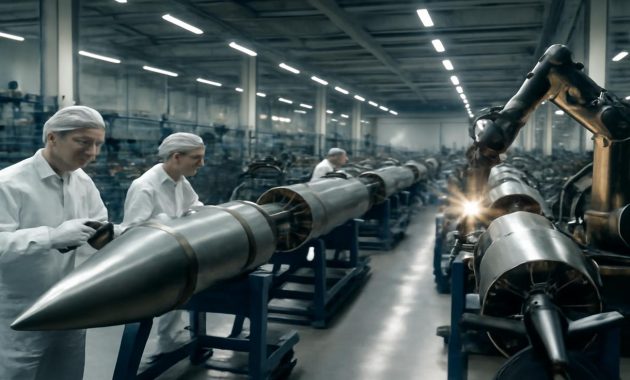
Inside a German factory hall, sparks flash like meteor showers as robotic arms weld the skeleton of what will become a sleek, precision-guided missile. The smell is metallic, sharp, cut with the oily warmth of industrial machines that have been working since before sunrise. On a raised platform, an engineer in a dark-blue fleece jacket points at a row of screens showing supply timelines, delivery schedules, and the neat columns of new contracts signed with other EU countries.
“Two years ago,” she says, “this line was mostly idle. Now we’re being asked if we can double capacity again.”
Across the continent, similar conversations are happening in French, Italian, Polish, Spanish, Finnish, and Czech boardrooms and shop floors. Europe, unused to thinking of itself as a war-making continent, is quietly becoming a weapons-manufacturing one again. Not for conquest, leaders insist, but for deterrence—for the ability to say: we are not an easy target.
Pooling Demand, Sharing Risk
In the past, each European country tended to order its missiles separately, like neighbors who all go shopping alone and then complain that everything is too expensive. The EU’s new push tries to flip that script. If several countries agree to buy the same missile together, producers get long-term certainty. With large, predictable orders, factories can justify hiring more workers, buying new machines, and expanding lines.
In Brussels, this is known in the dry language of policy as “aggregated demand” and “industrial scaling.” On the ground, it means that a Portuguese tax inspector and a Lithuanian farmer might rely, one day, on the same family of air-defense missiles made in a Czech or Italian plant. It means the life of a Swedish coastal town might be bound to the steady hum of a Slovak factory two thousand kilometers away.
It also means money—large, uncomfortable, morally complicated sums of it. Public funds, often. European-level incentives are designed to nudge industry into investing in production lines not just for artillery shells but for the more complex, costly world of missiles: anti-air, anti-ship, land-attack, and the careful systems that link them all together.
Missiles by the Numbers: Europe’s Emerging Arsenal
Behind the political declarations and factory-floor sparks lies a web of quantities and timelines that rarely make it into public speeches.-Europe’s shift toward homegrown missile production can be felt in several key trends that officials quietly circulate in meeting rooms:
| Aspect | Recent Trend |
|---|---|
| Joint EU defence initiatives | Increase in collaborative missile and air-defence projects among member states |
| Production capacity | Factories expanding shifts and lines to meet higher, long-term missile orders |
| Supply chain focus | Push to source more components within Europe to reduce external dependence |
| Budget priorities | Defence spending rising, with a noticeable share earmarked for missiles and air defence |
| Integration with NATO | European-made missiles designed to plug into shared NATO systems and strategies |
These trends don’t appear as dramatic headlines when you scroll the news on your phone. They live in budgets and planning documents, in the slow transformation of industrial parks, and in university labs where guidance software is tested on screens glowing faintly through the evening.
Factories, Forests, and the Feel of a Changed Continent
Drive north from a French city, and the suburbs give way to patchwork fields bordered by thin stands of oak and birch. Near a quiet riverbend, long, low buildings shimmer behind chain-link fences topped with cameras. This is one of the sites where Europe’s defence industry is weaving itself more tightly into the landscape.
Inside, the atmosphere doesn’t feel like the image of war many people carry from old films. There are no soldiers marching. There is the hiss of compressed air, the precise chatter of technicians discussing software updates, the sensation of stepping into a space where each object has been carefully labelled and tracked. It smells of plastic, machine oil, and the faint, lemony scent of industrial cleaning fluid.
Outside the plant, a hedgerow rustles with sparrows and field mice. Wind bends the tops of young poplars. Someone has planted wildflowers along the drainage ditch, perhaps as an afterthought, perhaps deliberately—as if hoping that splashes of yellow and violet might soften the presence of the warning signs on the fence.
The Ethical Weight in the Air
Not everyone is comfortable with this direction. In cafés and university auditoriums, at kitchen tables and public hearings, people ask the same question with different accents: are we making ourselves safer, or are we simply adding more weapons to an already overloaded world?
Teachers who once marched for nuclear disarmament look at their students and wonder how to explain that their country is now investing more in missiles than in music rooms. Young activists ask why “security” seems to mean rockets rather than climate resilience or healthcare or affordable housing. Religious leaders talk about just war and unjust peace. Economists talk about opportunity costs.
The answers from policymakers are often earnest and uneasy. They invoke deterrence—the idea that if Europe is clearly able to strike back, it is less likely to be attacked. They point out that missiles can protect cities from incoming threats, intercepting the violence before it hits apartment blocks and schools. They argue that in a world where others are arming, disarming alone is not a path to safety but an invitation to vulnerability.
Still, the ethical weight remains, dense and impossible to file away like a spreadsheet. The continent that once dreamed of being a purely “civilian power” now finds itself deliberately investing in the ability to destroy. The contrast is sharp enough to sting.
Local Lives in a Strategic Puzzle
In a small town in Central Europe, the opening of a missile-component factory has done something that government grants and business incubators failed to do: it brought the young back home. The new plant offers good wages, training, and stable contracts in a place that has been hollowed out by decades of outmigration.
A mother in a supermarket aisle studies the job notice pinned to the community board while her child tugs at her sleeve, asking about cereal. A teenager, fresh out of school, signs up for a technical apprenticeship and posts a proud photo of his security badge on social media, careful not to show any sensitive logos. A local café extends its hours to serve new workers finishing late shifts.
Yet, at the edge of the same town, a group gathers in a meeting hall to discuss what it means to anchor their economy to weapons. A retired nurse stands up and speaks quietly: “I’m glad my grandson has a job. I am. But I also know what missiles do on the other end.” Her words hang in the air, heavier than any chart or policy brief.
Nature Beside the Fenceline
Step just beyond the perimeter of many of these new or expanded industrial sites, and the non-human world continues its own rhythm. A deer crosses a dirt road at dusk, pausing to stare at the distant glow of security lights. Cranes lift sections of future assembly lines into place while clouds drift in layered ribbons above them. A river curves slowly past, carrying last year’s leaves and this year’s secrets.
Europe’s missile push is not happening in sterile emptiness; it is unfolding in valleys, on plateaus, near estuaries and plains where generations have farmed, foraged, and built quieter things. There is a question tucked into this coexistence that rarely makes it into official communiqués: what does it mean for a landscape to hold both skylarks and surface-to-air systems, both nesting herons and hardened bunkers?
Some argue that defending this land, its people and ecosystems alike, demands credible force in a dangerous era. Others fear that once the structures of war are rooted in the soil, they will be harder to uproot than any old fencepost or concrete slab.
A Future Written in Contradictions
At a European summit, under the soft hum of translation headsets, leaders speak of “incentivising production,” of “industrial coordination,” of “closing capability gaps.” The language is precise, professional, and, to many ears, numbing. Yet every phrase is the tip of a very human iceberg: fear of aggression, memories of occupation, the desire for control in a world that seems to be speeding toward unpredictability.
Encouraging member states to manufacture more missiles is not a simple industrial policy. It is an act of choosing a path at a fork in history. One path says: we will arm ourselves because the world is dangerous, and we cannot afford naivety. The other whispers: we will seek safety through other means, even if we stand more exposed in the short term. Europe, for now, is trying to walk a narrow line between them—arming, but talking about arms control; producing missiles, but framing them as reluctant necessities rather than triumphs.
On a quiet evening, the EU’s decisions resolve into something more tangible. A radar dome on a distant hill catches the last orange smear of sunset. In a field nearby, a girl throws a ball for her dog, the animal’s joyful barks snapping through the cool air. Above them, invisible but very present in policy documents and industrial planning, is a growing lattice of systems designed to track and, if needed, shoot down incoming threats.
The dog doesn’t know this. The girl likely only half-knows. Yet their future—whether their skies remain calm or crack open one day—is now tied to decisions taken in committee rooms, to contracts signed in glass-walled offices, to factories humming late into the night as missiles slowly take shape under fluorescent light.
Europe’s new missile moment feels like standing at the base of an old cathedral and hearing unfamiliar machinery start up in the bell tower. You know the building was shaped by centuries of conflict and compromise, treaties and tragedies. You also know that once something powerful is set in motion at the top, it’s hard to pretend it was never there.
So the sirens in the Polish town sound again—just a test, just a drill. People pause, then move on. The trucks keep rolling. The hedgerows keep rustling. Somewhere deep inside Europe’s industrial heart, another guidance chip is soldered into place. And the continent, with all its lakes and languages, forests and freeways, steps a little further into a future in which safety and danger are built from the same metal, travelling on opposite trajectories through the same sky.
Frequently Asked Questions
Why does Europe want to encourage more missile manufacturing now?
The primary driver is the changing security environment, especially the war in Ukraine and rising global tensions. European leaders have realized that existing stockpiles of missiles and ammunition are too low, and that relying heavily on external suppliers leaves them vulnerable. Increasing local manufacturing is meant to ensure they can defend themselves and support allies without facing long delays or shortages.
Does this mean Europe is preparing for war?
European governments present this shift as preparation for deterrence, not for starting conflicts. The idea is that if Europe has enough credible defensive and retaliatory capability, potential aggressors will think twice before attacking. Critics, however, worry that more weapons in general can raise the risk of escalation, even if the official intention is purely defensive.
How is the European Union involved in missile production?
The EU itself does not build missiles, but it coordinates and encourages member states and companies to do so. It can help by pooling orders from several countries, offering financial incentives for expanding production, and coordinating research and development. This approach aims to make manufacturing more efficient and reduce duplication among member states.
What about the impact on local communities and jobs?
In many areas, new or expanded defence factories bring jobs, training, and investment to regions that have struggled economically. Young people may find skilled work without leaving their hometowns. At the same time, some residents feel uneasy about tying their local prosperity to the arms industry and worry about long-term ethical and environmental implications.
Is there a conflict between investing in missiles and investing in social or environmental priorities?
Resources are always limited, so more money for defence can mean less for other areas if budgets are not expanded overall. Governments argue that security is a prerequisite for everything else, including social services and climate action. Many citizens and activists counter that overemphasizing military tools risks sidelining diplomacy, development, and environmental protection, which also contribute to long-term security.
Will this change Europe’s identity as a “peace project”?
That is one of the deepest questions raised by this shift. The EU was built in part to make war between its members unthinkable, and it has long emphasized civilian power and diplomacy. Increasing missile manufacturing doesn’t erase that legacy, but it does complicate it. Europe is now trying to hold two identities at once: a champion of peace and cooperation, and a continent determined to be militarily prepared in a more dangerous world.