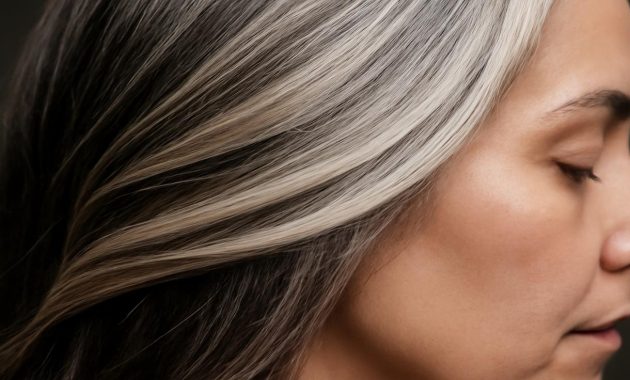
The woman in the mirror hesitated before tucking a silver strand behind her ear. It glinted against the soft amber light in the salon, a lightning streak through dark hair. She laughed under her breath. “When,” she asked no one in particular, “did I start looking like my mother?” The stylist behind her—calm, precise, a little amused—didn’t flinch. “You didn’t,” he said. “You just started looking more like yourself.” And with that, he sectioned her hair, clipped it up, and reached for the bowl of color that would turn those scattered grays into something intentional, luminous, and oddly liberating: a salt and pepper balayage.
The Moment Gray Stops Being a Problem and Starts Being a Palette
Ask almost any woman over 50 about the first gray hair she remembers. It’s rarely just a memory of a strand; it’s a feeling. A jolt in the bathroom mirror. A sigh in the car’s rearview. A private little funeral for the girl she used to be—or thought she had to be.
But something is shifting. The last decade has quietly loosened the rules on what aging is supposed to look like. Social feeds now hold more women with gleaming silver crowns beside their wrinkles, smiling like they know a secret. Actresses, anchors, and neighbors are letting natural grays surface, but with intention, not surrender.
This is where the salt and pepper balayage comes in. It’s not about covering gray. It’s about curating it—turning the random, patchy sprinkle of silver into a soft, dimensional pattern of light and shadow. It’s the difference between feeling like gray “happened” to you and feeling like you chose this look, this moment, this version of yourself.
One colorist described it this way: “When a client over 50 sits in my chair and says, ‘I’m tired of fighting my roots every four weeks,’ what she’s really saying is, ‘I want to stop arguing with my age.’ Balayage is the truce. Salt and pepper is the language of that truce.”
What Exactly Is Salt and Pepper Balayage?
Picture a painter standing in front of a canvas that already has a sketch on it. Your natural base—brown, dark blonde, black—is the sketch. Your gray hair is the light already on the page. Salt and pepper balayage is the painter choosing where to deepen the shadows, where to brighten the highlights, and how to leave some parts untouched so the original work still shows through.
Balayage itself is a technique, not a single “color.” The word comes from the French “balayer,” meaning “to sweep.” Instead of wrapping hair in foils with strict, uniform sections, the colorist hand-paints the lightener or tone in sweeping strokes. The result is softer, more organic, and grows out without that harsh, straight root line that gives away a dye job from across the room.
Salt and pepper balayage uses this technique to work with the gray instead of against it:
- “Salt” is your lighter tones: silvers, soft whites, cool blondes.
- “Pepper” is your deeper tones: charcoal, smoky browns, deep ash, or gently darkened natural roots.
In the hands of a skilled stylist, the two tones mingle like shadows on water. A bright streak around the face. Slightly deeper pieces near the nape. A halo of shimmering silver catching the light at your crown. It doesn’t scream “dyed.” It whispers “effortless.”
Why Hairdressers Swear by It After 50
Ask a hairdresser what they’d do with their own hair after 50, and many will say some version of: “A lived-in color, something that embraces the gray.” Salt and pepper balayage tops that list for several reasons:
- It respects your time. Root touch-ups every three to four weeks can feel like a treadmill you can’t step off without a dramatic line of demarcation. Balayage stretches that to eight, ten, sometimes even twelve weeks between appointments.
- It’s kinder to aging hair. Hair often gets drier, thinner, and more fragile with age. All-over single-process color, especially darker shades, can make it look flat and can emphasize breakage. Balayage can be placed strategically, leaving much of the hair untouched.
- It works with your skin tone’s evolution. Skin tones can soften, cool, or become more translucent over time. Harsh, opaque color (especially very dark) can make the face look more tired. The multi-tonal blend of salt and pepper balayage adds softness and brightness where you need it.
- It avoids the “stuck in time” look. There’s a subtle but powerful difference between looking like you’re clinging to your 30s and looking like you’ve grown into your 50s with curiosity. This kind of color says: Yes, I have gray—and I made it look amazing.
How It Actually Looks: Different Faces, Different Grays
No two heads of gray are alike. Some women get a white streak at the front, like nature’s own money piece. Others notice scattered silver mostly at the temples. Some go almost entirely white at the top while keeping their natural depth underneath. A good salt and pepper balayage honors all that uniqueness.
Imagine three clients walking into a salon:
Client 1: Dark Brunette with Early Temples of Gray
She’s in her early 50s, naturally a deep brown, with most of her gray concentrated near her hairline and a sprinkling elsewhere. For her, the colorist might apply cool, smoky highlights near the face and crown, just one or two levels lighter than her natural brown, and then tone the existing gray to a soft, pearly hue. The “pepper” stays rich, but not inky. The “salt” looks intentional, almost like the shimmer of aged wood in the sun.
Client 2: Medium Blonde with Diffused Silver
She’s been blonde for decades, and now finds that her gray comes in more as a cool haze than streaks. Her balayage will lean into airy, bright pieces. The colorist deepens a few strands with a muted taupe or sandy blonde to create contrast, while enhancing the gray with a violet or blue-based toner to keep it crystal rather than yellow. The result: a Nordic, breezy look that feels more like an evolution than a reinvention.
Client 3: Almost Fully Gray, Wants Dimension
Her hair is 80% gray, mostly a soft steel shade, but she feels washed out. Here, salt and pepper balayage can actually mean bringing the “pepper” back. The stylist might add lowlights in a soft graphite or cool mushroom brown through the mid-lengths and underneath layers, leaving the top and face-framing areas lighter. Suddenly her gray has depth, shadow, and movement—less “flat cloud,” more “stormy sky at dusk.”
A Quick Comparison: Traditional Color vs. Salt and Pepper Balayage
| Aspect | Traditional Single-Process Color | Salt & Pepper Balayage |
|---|---|---|
| Gray Coverage | Covers or masks all gray uniformly | Blends and enhances natural gray |
| Maintenance | Frequent root touch-ups (3–5 weeks) | Softer grow-out (8–12 weeks) |
| Hair Health | Can be more drying with repeated full coverage | Targets specific strands; less overall stress |
| Visual Effect | Flat, uniform color | Dimensional, natural, sun-kissed effect |
| Aging Effect | Can look harsh or artificial over time | Softens features, feels modern and intentional |
The Experience in the Chair: What the Process Really Feels Like
Walk into a good salon on a weekday afternoon and you’ll notice a certain calm. Scissors whisper. Blow-dryers hum. Foils crinkle. When you settle into the chair for a salt and pepper balayage, it’s not the frantic in-and-out of a quick root job. It feels more like a small ritual—a pause you give yourself.
Your stylist will start by talking, not painting. They’ll look at how your gray grows in: where it’s densest, where it sparkles only under certain light. They’ll watch how you move your hair when you talk—do you tuck it behind your ear, sweep it to one side, wear it up most days? They’ll ask about your mornings: Is styling your hair a daily pleasure or a necessary evil to be finished in five minutes?
Then, the plan forms. Maybe they’ll place lighter paint around the face to create a soft frame, like a subtle halo that draws attention to your eyes. Maybe they’ll paint deeper tones beneath to keep the overall look grounded. Balayage strokes tend to start in the mid-length and sweep down, leaving the root area softer and more diffused.
The sensation is gentle: the tug of a comb, the brush gliding on, the occasional cool drag of a tail comb dividing sections. There’s no clacking of endless foils around your head; sometimes the color is left open to the air, sometimes wrapped just enough to encourage lift.
Time passes slowly but pleasantly—maybe with a book in your lap, or a quiet conversation about the last time you did something just for yourself. When the color is rinsed and toned, the stylist will likely give you a good, solid cut that suits the new texture and pattern of light. Aging hair often loves a bit of shape: soft layers, a slightly blunt perimeter, a wispy fringe that catches the silver just so.
And then, the reveal. It’s in the way your eyes widen, not because your gray has disappeared, but because now it makes sense. It has a pattern, a story. It looks less like a sign of time and more like a signature: this is how the light lives in your hair now.
Keeping It Gorgeous: Low-Maintenance, Not No-Maintenance
Salt and pepper balayage is forgiving, but it’s still color. The difference is that you’re not racing the clock on a visible root line; you’re simply maintaining tone, health, and shine.
A few gentle rules most hairdressers share with their over-50 balayage clients:
- Use a sulfate-free shampoo. This helps preserve tone and moisture, especially when gray can be more porous.
- Introduce a purple or blue-toning product occasionally. Grays and cool blondes can pick up warmth from water and sun; a once-a-week violet-toned wash can keep brassiness at bay.
- Condition like it’s your part-time job. Masks, leave-ins, and lightweight oils keep aging, wirier strands smooth and reflective.
- Schedule “refresh” appointments rather than full overhauls. Many clients simply come in for a toner and a trim between bigger color sessions.
The magic is in the flexibility. Life happens: a long vacation, a busy season with grandchildren, a demanding stretch at work. If you skip an appointment by a few weeks, your hair won’t betray you with a hard line. It will just look like a slightly more grown-out version of the same woman—still you, still interesting.
More Than Aesthetic: How It Feels to Wear Your Age Beautifully
What’s striking about the salt and pepper movement isn’t just the look—it’s the emotion behind it. Sitting in the hairdresser’s chair at 52 is different than at 22, not because the tools have changed, but because you have. The stakes feel different. You’re no longer just asking, “Do I look pretty?” You’re asking, “Do I look like myself?”
Many women describe going gray as an unexpected mirror for everything they’ve survived. Careers built and dismantled. Relationships that ended, slowly or all at once. Children raised. Parents buried. Bodies that have weathered illnesses, surgeries, hot flashes, the sudden shock of a new ache in the morning. That silver isn’t just pigment—it’s history.
Turning that history into art, rather than trying to erase it, can be profoundly freeing. When a hairdresser tells you, “Your gray pattern is actually beautiful—we’re just going to highlight it,” they’re not just talking about your roots. They’re talking about letting yourself be seen clearly, without apology.
There’s a quiet confidence that comes from walking into a room and not wondering if anyone can see your “roots showing.” Your roots are the point now. They’re styled, intentional, and part of a larger composition. The work has shifted from hiding to refining.
And here’s another subtle gift: salt and pepper balayage adapts to you over time. As you gain more gray, your stylist adjusts the ratio of light to dark. The look never has to be dramatically “switched” one day. You’re allowed to arrive gradually at full gray, like a long, scenic drive instead of an abrupt exit ramp.
Talking to Your Hairdresser: Getting the Salt and Pepper You Actually Want
Walking into a salon and simply saying, “I want salt and pepper balayage” might not be enough. Like ordering coffee in a foreign language, you need a bit more detail to get it just right. Hairdressers love visual references, but they also love clear words about how you live in your hair.
Helpful things to share:
- How often you’re realistically willing to come in. If every 3 months is your max, say so. They’ll place color differently than if you love monthly tune-ups.
- How you usually style your hair. Air-drying vs. blow-drying, curling vs. straightening—all of it affects where the brightest and darkest bits should live.
- How much gray you’re ready to show. Some are ready for a bold embrace. Others want a softer intro, keeping a bit more of their original depth.
- What tones you prefer near your face. Cooler ash and silver can feel elegant and modern; soft beiges and warm taupes can feel gentle and glowing.
Bring a couple of photos—ideally of women whose skin tone and natural hair resemble your own. Point to what you like: “I love how bright it is around her face,” or “I like how her gray still shows but with depth.” A good stylist will translate that into a custom map for your head, not a one-size-fits-all template.
Choosing Yourself, Strand by Strand
Somewhere between that first hesitant gray at your temple and the day you decide you’re tired of chasing an unchanging color, there’s a turning point. It doesn’t always come as a bold declaration. Sometimes it arrives slowly—first as a missed appointment, then as curiosity: “What if I let a little of it show?”
Salt and pepper balayage lives in that in-between space—between fight and surrender, between covering and exposing. It’s what happens when you meet your reflection with less resistance and more collaboration. When you say, “Okay, this is where we are. How can we make it beautiful?”
In the end, the woman at the salon—eyeing the mirror, fingers pressed lightly to the new silver feathering her cheekbones—didn’t look like her mother after all. She looked a bit like her teenage self, strangely enough: the same spark, the same curiosity, the same readiness for what comes next. Only this time, she had streaks of wisdom painted right into her hair, and they shimmered when she laughed.
That’s the secret hairdressers keep repeating: after 50, your gray isn’t the end of your hair story. It’s simply a new chapter. Salt and pepper balayage doesn’t rewrite it. It underlines the best lines, adds contrast to the plot, and makes sure the light hits the page just right.
FAQ: Salt and Pepper Balayage After 50
Is salt and pepper balayage suitable for all hair colors?
Yes, it can be adapted for most natural bases, from dark brown to dark blonde. The stylist will adjust how much “pepper” (deeper tones) and “salt” (lighter or enhanced gray) they use so it looks harmonious with your natural shade and gray pattern.
Will it damage my already fragile, aging hair?
Any lightening process has some impact on the hair, but balayage is typically less aggressive than full-head bleaching or frequent all-over color. A good colorist will leave portions of your hair untouched, use bond-protecting products, and customize the placement to minimize stress on fragile areas.
How often will I need to maintain salt and pepper balayage?
Most people return every 8–12 weeks. In between, you might come in for a toner and a trim, which is quicker and gentler than a full color service. The beauty is that grow-out is soft; you won’t have a harsh root line.
Can I transition from years of dark dye to salt and pepper balayage in one visit?
Sometimes, but often it’s a journey rather than a single session. Dark, long-term dye needs to be lightened carefully, usually in stages, to avoid breakage and uneven color. Your stylist might plan two or three appointments to gradually lift the old color and invite your natural gray into the spotlight.
What if I decide later that I want to go fully natural gray?
Balayage is a helpful stepping stone. Because it softens the contrast between dyed and natural hair, growing out to full gray later will look more blended and intentional. Over time, your stylist can simply reduce the amount of added color until what you’re mostly seeing is your own, beautifully natural silver.