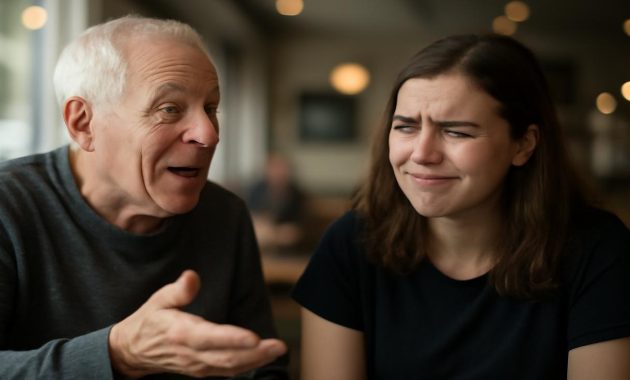
The young barista stared at the older man in front of her, latte art half-finished in her hand. He’d just smiled, slid a ten-dollar bill across the counter, and said, “Keep the change, kiddo. Don’t spend it all in one place!” She laughed politely, but the joke hung in the air like elevator music—recognizable, but oddly out of place. As he shuffled away, humming something that sounded suspiciously like Frank Sinatra, she pulled out her phone and texted a friend: “He really just said that. People actually talk like that?”
When Generations Speak Different Languages
Language isn’t just words. It’s atmosphere, history, and the smell of the time you grew up in—cigarette smoke in diners, the clack of typewriter keys, the whir of dial-up internet, or the soft glow of a smartphone under the blanket at midnight. If you listen closely in any coffee shop, grocery line, or public park, you’ll hear this: two (or three) generations sharing the same space but not quite the same language.
Those over 65 often carry phrases that were sharpened in a different world—a world where phones were attached to walls, coffee cost less than a dollar, and “cancel” was something you did to a magazine subscription. To young people, these phrases can sound like they were pulled out of an attic trunk along with old photo albums and yellowed newspaper clippings.
But they aren’t just “cringe” or outdated. They’re roots. They’re clues to how people once moved through the world, how they understood money, work, respect, risk, and time itself. Still, for young ears, they can also sound like static on an AM radio station.
Let’s step into that crackling space between generations—where “whippersnapper” meets “rizz” and “back in my day” squares off against “okay, boomer”—and look at seven phrases people over 65 often use that can sound totally out of touch to younger folks.
| Phrase | How It Lands With Young People |
|---|---|
| “Back in my day…” | Sounds like a lecture, not a story |
| “You’ll understand when you’re older.” | Feels dismissive and condescending |
| “Kids today don’t know how good they have it.” | Erases modern struggles and stress |
| “If you can’t say it to someone’s face, don’t say it at all.” | Ignores online realities and power dynamics |
| “That’s not a real job.” | Misunderstands the modern economy |
| “We didn’t need all this mental health stuff.” | Feels unsafe and invalidating |
| “You’re too sensitive.” | Shuts down honest emotion and nuance |
1. “Back in My Day…”
The phrase usually arrives with a sigh, like someone pulling up a mental rocking chair. “Back in my day, we walked to school in the snow.” “Back in my day, you could buy a house on one income.” “Back in my day, people respected their elders.”
To the person saying it, this is a bridge—an invitation into memory. They’re offering a snapshot of their youth: worn leather shoes, lunch boxes with metal clasps, a world before constant notifications. It’s their way of saying, “I’ve seen things. Let me show you the map I used.”
To a lot of young people, though, it doesn’t land as a bridge. It lands as a verdict. The implication seems to be: the present is worse, you’re weaker, and your struggles don’t measure up. If you’re juggling student loans, unstable work, climate anxiety, and rent that eats half your paycheck, “back in my day” can sound like someone bragging about finding cheap gas during a different century.
There’s also the math problem no one says out loud: the cost of living has changed, housing costs have changed, expectations about productivity have changed. When someone over 65 says, “I bought my first house at 24,” a younger person may mentally reply, “I can’t even afford a studio apartment.”
Ironically, buried inside “back in my day” is often a real story—a good one. It might be about resilience, scarcity, or a time when neighbors actually knew each other’s names. Told as a story instead of a moral, it could spark connection instead of defensiveness. But the phrase itself comes with so much baggage that younger ears hear more scolding than storytelling.
2. “You’ll Understand When You’re Older”
There’s a certain tone that often accompanies this line—a mix of world-weariness and quiet superiority. It appears during arguments about politics, choices, careers, or relationships. “You’ll understand when you’re older” is shorthand for: I know something you don’t, and I’m done explaining.
Older people using this phrase might honestly believe they’re saving time or sparing someone from hard truths. Many of them have been through divorce, layoffs, illness, burnout, wars, recessions. They’ve watched ideals soften under the weight of survival. To them, some realities can’t be described; they have to be lived.
But to younger people, this sentence often lands like a door slamming in their face. It dismisses their present awareness, their capacity to learn, and the legitimacy of their questions. It turns age into a trump card in a conversation that might have needed curiosity instead of hierarchy.
There’s also a quiet irony: young people are already understanding things older generations never had to at the same age—growing up online, facing a warming planet, living with school lockdown drills, navigating identity in a hyperconnected, hypercritical world. The idea that understanding only ever flows one way—from old to young—just doesn’t hold up anymore, if it ever did.
Imagine if that phrase were swapped for a different one: “I see it differently because of what I went through—want to hear?” Same wisdom, less shutdown. The experience is still there; it’s just offered instead of imposed.
3. “Kids Today Don’t Know How Good They Have It”
This phrase usually arrives in grocery aisles, in family kitchens, or echoing across holiday tables. It’s often triggered by a phone in a teenager’s hand or a complaint about school, work, or money. The older speaker looks around at wireless everything—wifi, earbuds, streaming—and shakes their head. “You’ve got all this, and you’re still not happy? When I was your age…”
For someone over 65, the contrast is real and tangible. They may remember outhouses, ration stamps, three TV channels you had to physically get up to change, and a time when long-distance phone calls were a luxury, not background noise. Hot water on demand, GPS in your pocket, and the ability to see a loved one’s face from an ocean away can feel like miracles.
To them, young people’s world looks convenient, cushioned, and always-on. But young people aren’t just living in a bubble of comfort; they’re living under a storm of pressure. Constant comparison on social media, the expectation to “hustle” all the time, an economy that doesn’t reward loyalty, and the hum of climate and political uncertainty in the background of everything. It’s not that things are worse or better—it’s that the stress has changed shape.
When an older person says, “You don’t know how good you have it,” a younger person often hears, “Your pain is invalid.” And that’s where the conversation breaks. Gratitude and struggle aren’t opposites. You can be grateful for fast internet and still be crushed by medical bills. You can love having a smartphone and still feel lonely in a crowd.
The generational disconnect here isn’t about comfort; it’s about visibility. Each side is looking at a different set of hardships and calling their own version “real life.”
4. “If You Can’t Say It to Someone’s Face, Don’t Say It at All”
On the surface, this sounds like pure integrity. It carries the scent of small towns and smaller classrooms, when gossip moved slowly and reputations were built (and ruined) face to face. For many over 65, respect meant looking someone in the eye, shaking their hand firmly, and dealing with conflict directly.
Young people don’t necessarily disagree with the value behind this phrase—but the world they live in makes it incomplete. A massive portion of their social, academic, and professional life takes place in digital spaces: group chats, forums, work platforms, comment sections. They’ve seen bullying, harassment, dogpiling, and doxing all unfold without anyone meeting in person. They know that what’s said online can be both brutally real and terrifyingly permanent.
For some, speaking up “to someone’s face” is actually more dangerous—especially when power is unequal. Calling out a boss on harassment in person can cost you your job. Challenging a teacher on discrimination could alter your grades. Going directly to someone who has hurt you might not be safe if they have more social, physical, or economic power.
Younger generations have learned another skill: speaking up through systems—HR channels, public posts, legal routes, anonymous surveys. Are these methods perfect? Absolutely not. But they’re part of a survival toolkit for a world where face-to-face doesn’t always mean fair or safe.
So when older people use this phrase like a moral mic drop, younger people may quietly think, “You don’t see the risks we live with.” The value of honesty is still there. It just needs to be updated to include psychological safety and power dynamics, not just courage and eye contact.
5. “That’s Not a Real Job”
This phrase tends to show up around dinner tables when someone mentions streaming, content creation, remote work, or anything that doesn’t involve a timecard and a physical building. “Influencer.” “YouTuber.” “Social media manager.” “E-sports.” To many over 65, these words sound like hobbies, not careers.
The older worldview of work is rooted in tangibility. Real jobs produced real things: cars, furniture, paperwork, physical services. You dressed up, you commuted, you had a boss you could point to with one finger. Work meant visible effort and visible output, often tied to a specific place—a factory, an office, a shop, a classroom.
Young people, though, have grown up in an economy where value is increasingly abstract. Memes move markets. Digital items sell for more than used cars. People build entire livelihoods around writing newsletters, editing videos, designing in-game items, and managing online communities. Someone streaming from their bedroom might be making more money than their uncle who’s been in the same office job for thirty years.
When older people say, “That’s not a real job,” they might think they’re being protective: warning younger relatives about unstable income, burnout, or platforms that could vanish overnight. But what younger people often hear is, “Your world isn’t real. Your skills don’t count.”
There’s a quiet grief here, too. Many over 65 dedicated decades to a single company or trade, only to see pensions crumble and loyalty go unrewarded. Watching a teenager make money from lip-sync videos can feel not just confusing, but deeply unfair. It’s not just misunderstanding—it’s a collision of economic stories.
Work has become less about where you go and more about what you can produce from anywhere. That shift can feel like liberation to some, chaos to others. But it’s real, whether or not everyone’s caught up with the language for it.
6. “We Didn’t Need All This Mental Health Stuff”
This one often emerges when someone mentions therapy, medication, burnout, anxiety, or taking a “mental health day.” For many over 65, the idea of openly talking about mental health still carries the echo of stigma. In their youth, mental illness was something whispered about—or not at all.
They grew up in a culture that prized stoicism: you pulled yourself up by your bootstraps, you soldiered on, you didn’t “complain.” Feelings were private, and if you were struggling, the acceptable answers were often work harder, drink quietly, or endure. In that world, therapy might have been seen as a last resort for those in absolute crisis, not a normal tool for understanding your mind.
When they say, “We didn’t need all this mental health stuff,” what they sometimes mean is, “We weren’t allowed to need it.” They survived by suppression. They built lives while quietly carrying trauma, stress, grief, and unspoken fear. In some cases, they are proud of their toughness. In others, they can’t bear to look directly at what that toughness cost them.
For younger generations, mental health isn’t an optional extra; it’s a central conversation. They’ve seen classmates disappear into depression, idols die by suicide, friends vanish under the weight of untreated anxiety. They’ve watched social media warp their sense of self-worth in real time. Naming these things and seeking help isn’t weakness—it’s basic hygiene.
So when an older relative shrugs and says, “We didn’t need all this,” it can feel like erasure. As if mind and body are separate planets. As if being overwhelmed by constant information, economic uncertainty, and performance pressure is just “complaining.”
Yet in quieter moments, many older adults will admit: if therapy had been normal back then, if someone had told them it’s okay to talk, they might have lived differently. The phrase isn’t always defiance; sometimes it’s regret wearing armor.
7. “You’re Too Sensitive”
This phrase is sharp, compact, and deeply familiar across generations. People over 65 might use it when a joke offends, when someone calls out a harmful comment, or when a younger person reacts strongly to news, politics, or media. It’s often followed by a scoff: “People are so sensitive these days.”
The older model of communication was more about enduring than adjusting. Racist, sexist, and homophobic jokes were mainstream. Corporal punishment was common. Crying in public could be a source of shame. The unspoken rule was simple: toughen up or get left behind.
To younger people, though, calling out harmful language or systemic injustice isn’t oversensitivity; it’s responsibility. They’ve been raised in—or have created—a social climate where words matter, inclusion matters, and silence can be complicity. What older generations might file under “harmless banter” is heard as a reminder of lived inequality.
“You’re too sensitive” doesn’t just critique the reaction; it delegitimizes the underlying value. It says, “My comfort matters more than your pain,” even if that’s not the intention. Over time, this phrase can make people doubt their own perception: Was that actually hurtful, or am I just overreacting?
There’s a subtle shift happening, though, one that sits right between these worldviews. Empathy is being reframed not as fragility, but as a skill. Being aware of how words land, adjusting your language, recognizing when someone is carrying a heavier invisible load—these are fast becoming signs of maturity, not weakness.
Older generations were taught to survive by hardening. Younger generations are trying to survive by softening toward each other. Each strategy makes sense in the landscape it grew from. But when “you’re too sensitive” meets “I’m trying not to repeat old harm,” sparks fly.
Bridging the Awkward Silence Between Eras
In the end, these seven phrases are more than just verbal relics or punchlines for social media posts. They’re tiny fossils of entire worldviews, pressed into daily speech. When someone over 65 says “back in my day” or “kids today,” they’re not just commenting on the present; they’re mourning or defending the world they once understood.
And when younger people roll their eyes, fire off a meme, or shut down at “you’re too sensitive” or “that’s not a real job,” they’re not just being dramatic. They’re protecting a more fragile, more fluid reality—one where the ground beneath them feels less stable than it did for many of their grandparents or even parents.
Somewhere between those phrases and the reactions they cause is a narrow path where genuine curiosity can grow. An older person can say, “Here’s what it was like for me,” without turning it into a judgment. A younger person can answer, “Here’s what it’s like now,” without treating the past as a joke.
Maybe the next time a grandparent starts with “Back in my day…,” the grandchild tries something different: “Tell me about it—but can I tell you about my day after?” Maybe when a teenager talks about burnout or an online job, an older relative resists the urge to say, “That’s not real” and asks instead, “What does your workday actually look like?”
Language will keep evolving. One day, today’s slang will sound as dated as “groovy” and “the bee’s knees.” The phrases that feel perfectly normal now will make someone in the future smother a laugh behind their hand. That’s the nature of time: it keeps walking, whether we’re ready or not.
But the decision to listen—to treat unfamiliar words and weird-sounding phrases as invitations instead of annoyances—that’s still up to us. The next time someone over 65 says something that makes you cringe, imagine the world it came from before you clap back. And if you’re the one saying “back in my day,” pause and notice the room. Maybe what you really mean is: “My world was different. Will you let me show it to you, and then show me yours?”
FAQ
Why do older people keep using these phrases even when they upset younger people?
Most of the time, they aren’t trying to upset anyone. These phrases are habits formed over decades, tied to their own experiences of hardship and survival. Many don’t realize how different the world feels to younger generations or how their words land now.
Are younger people just being too sensitive about language?
Younger generations are more aware of mental health, power dynamics, and systemic inequality. What looks like “sensitivity” from the outside is often a deliberate effort to reduce harm and create more inclusive spaces. It’s less about being fragile and more about being conscientious.
How can I respond respectfully when an older person uses one of these phrases?
You can acknowledge their experience and still share your own. For example: “I get that it was different back then. Today it’s hard in different ways—want to hear what it’s like?” This keeps the door open instead of turning the moment into a fight.
Is it okay to use some of these phrases if I explain what I mean?
Context and tone matter. If you say “Back in my day” as a way to tell a story, not to shut someone down, it can work. The key is being willing to listen just as much as you talk and to notice if the phrase consistently shuts down conversation.
Will my own everyday phrases sound outdated to future generations?
Almost certainly. Slang, assumptions, and “normal” expressions change with every generation. The goal isn’t to stay perfectly current forever, but to stay curious and flexible—to let language evolve and to be willing to evolve a little with it.