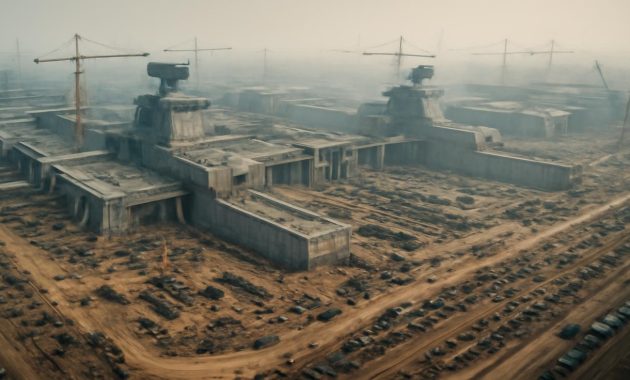
The first clue was not satellite images or leaked documents, but whispers from fishermen. They talked about a shape on the horizon that should not have been there—too straight, too long, too perfectly unnatural against the soft curve of the sea. At first it was just a hazy line, a low shadow where there used to be only clouds and waves. Then it grew. And grew. Until the rumors hardened into something stranger and far more unsettling: China was building something out there—something so vast that it was being quietly compared, in size at least, to entire cities. Ten times bigger than the Pentagon, some said. A military project unlike anything the world had seen before.
A Shape the Size of a Story
Imagine flying in at 30,000 feet as the clouds thin and the coastline unfurls in shades of rust and jade. Below, the usual shapes appear: shipyards, container ports, boxy warehouses, regimented rows of housing blocks. Then your eye catches something else. At first, it looks like a mirage—an endless geometric plate, stretching further than your window frame can hold, a gray titan pressed flat against the sea or desert. Your brain reaches for comparisons. Stadiums. Airports. Mega-malls. Nothing quite fits.
Somewhere in China, beyond the fence lines of ordinary curiosity, engineers, soldiers, and planners have been pouring steel, concrete, and intention into a footprint so enormous it defies quick comprehension. Ten times bigger than the Pentagon: those are the words that keep getting repeated, as if the only way to grasp its vastness is to measure it against the most iconic symbol of military scale the world knows.
But size is only the beginning of the story. Because every colossal structure is also a kind of declaration—of ambition, of fear, of the future a nation is quietly preparing for.
Walking the Edge of a Giant
If you could somehow slip through the layers of security and stand at the edge of this place, the first thing you’d notice is the sound. Not the roar of jets or the thud of artillery, but the constant, layered murmur of becoming: cranes swinging, welders hissing, trucks backing up with that repetitive electronic beep. The air would smell of rebar dust, furnace-hot tar, wet concrete drying under an unkind sun. There would be a fine grit that settles on your teeth when you breathe with your mouth open.
You begin to walk. At first it feels like any large construction site. Men in helmets, fluorescent vests, the metallic chatter of Mandarin shouted across distances. But five minutes later, you are still walking. Ten minutes. Twenty. The ground beneath you does not change much—painted lines, stacks of materials, skeletal frameworks of future buildings. Its sameness is what makes it eerie. You are not crossing a discrete facility; you are pacing along the hem of a man-made continent.
This is the kind of place where maps on clipboard paper feel ridiculous, where a single drone shot cannot capture the whole thing unless it climbs so high the details blur into abstraction. It swallows metaphors. It forces new language just to describe the sensation of standing in its shadow.
The Pentagon and the Colossus
The Pentagon, for all its cultural weight, is almost modest when rendered in numbers. It covers around 6.5 million square feet of floor space, spread over five concentric rings. It is a building you can photograph from a helicopter and still see all its edges in one frame.
Now imagine multiplying that footprint by ten. Not just stacking floors, but expanding its reach outward until it could host multiple Pentagons inside its boundaries with room to spare. Training fields. Runways. Test ranges. Docking basins. Communications hubs. Data centers, humming softly in climate-controlled anonymity. Barracks that could host the population of a small town.
It is not just bigger. It is an ecosystem.
| Feature | The Pentagon (Approx.) | China’s New Complex (Claimed) |
|---|---|---|
| Total floor space | 6.5 million sq ft | 65+ million sq ft |
| Primary function | Defense administration HQ | Integrated military mega-hub |
| Built era | World War II period | 21st-century, high-tech age |
| Symbolism | US global military leadership | China’s rising strategic reach |
| Public visibility | Highly iconic and well-known | Shrouded in secrecy, satellite-sourced |
The numbers are staggering, but numbers alone are dry. The reality is more tactile. A space like this demands rivers of resources. The concrete alone—if you poured it into one continuous slab—would harden into a platform big enough to land fleets of aircraft simultaneously. The steel skeletons of hangars and warehouses could, in another universe, have become bridges and hospitals instead.
Blueprint of a Future Battlefield
So what exactly is this behemoth for? The official line, as always, is misty. Dual-use facilities. Research parks. Logistics hubs. But if you squint at the hints, a more detailed picture slowly emerges, like a photograph appearing in a darkroom tray.
More Than Just a Base
Think of it less as a base and more as an operating system for power projection. Inside its boundaries, every aspect of twenty-first-century warfare could be rehearsed, refined, and recombined. Here, anti-ship missiles might be mated to their launchers under fluorescent lights. Swarms of unmanned aerial vehicles, the size of birds or small planes, could be tested against simulated defense networks. Hypersonic weapons could be assembled, checked, and pushed out toward launch sites beyond the horizon.
The complex might house cyber units behind tinted-glass windows, where the battles are silent and the weapons are strings of code. It could include electromagnetic testing grounds, places where radar pulses bounce off strange prototypes, and where new shapes are taught to hide from the watchful eyes of satellites and sensors.
Out on vast paved expanses, regiments could practice mobilizing at scale—trucks queuing with mechanical precision, armored vehicles slotting into convoys that feel unending from the ground. It is one thing to own the machines of war; it is another to choreograph them with the speed and order that modern conflict demands. A place this enormous makes that choreography possible at a terrifyingly high tempo.
A Living, Breathing War Laboratory
Then there are the laboratories you might never see, even from a drone’s-eye view. Tucked into low, windowless buildings would be rooms of white light and polished floors, where technicians in lab coats move between humming racks of equipment. Here, the boundaries between civilian and military blur almost completely. Artificial intelligence models, trained on oceans of data, could be tasked with war-gaming future conflicts in silico. Logistics algorithms might learn to shave minutes, then seconds, off deployment times. Simulations of naval battles, air defense grids, and orbital satellite wars could be run and rerun, each outcome fed back into design tweaks and doctrine revisions.
Step into another wing, and you might find the medical side: trauma research, advanced prosthetics, experiments in keeping soldiers functioning under greater stress and strain. Sooner or later, the human body is always dragged into the calculus of war. A complex like this makes room for that grim science too.
Steel, Stories, and the Sea
Of course, no giant appears in a vacuum. Around the perimeter of this project, life goes on in the stubborn, resilient ways it always has. Villages look up from their morning markets and see new silhouettes on the skyline. Roads that once carried only scooters and grain trucks now thrum with military transports, their tarpaulins flapping as they surge past. Small harbors, once cluttered with fishing boats, begin to share water with sleek gray hulls that do not go out to catch anything except advantage.
Ask the oldest residents and they will tell you what this land or coast used to be: fields, marshland, low dunes, maybe even a stretch of scrub forest where children hunted crabs or birds. Memory moves slowly, but construction moves fast. Within a decade, a landscape that took centuries to settle into its shape can be re-scripted in concrete and asphalt. A new story is written—loudly, irrevocably—over older ones.
Yet if you stand at the furthest edge of this facility, where its fence meets the raw world, you will still hear the older rhythms. Wind folding itself through dry grass. Waves folding themselves endlessly against breakwaters that didn’t exist ten years ago. Somewhere, a farmer curses about the loss of good soil, while a young engineer pulls another late night in a drafting office, proud to be part of something so monumental. Progress and loss are always braided together; here, that braid has the thickness of a nation’s grand strategy.
Neighbors in a Nervous World
Beyond China’s borders, the whispers have turned into analysis, and analysis into unease. In war colleges from Washington to New Delhi to Tokyo, this mega-project is being plotted on maps and inserted into simulations. Admirals stare at satellite photos, tracing its runways with calloused fingers. Generals ask quiet, sharp questions: How many aircraft can it support? How quickly can it surge forces? What would it take to shut it down—if such a thing is even possible without lighting up half the globe in response?
For neighboring countries along the Pacific Rim, the psychological impact may be as heavy as the physical one. It is not just that China is building a big base. It is that China is publicly demonstrating the capacity and will to reshape entire landscapes for martial purposes. That kind of signal ripples outward. Defense budgets elsewhere swell. Alliances are reaffirmed in slightly tighter tones. Exercises that once were routine become rehearsals for scenarios whispered in hallways.
Yet, paradoxically, such monumental projects can also act as anchors. When so much is poured into one place—so many resources, so much prestige—it becomes something that all sides must factor into their thinking not just as a weapon, but as a vulnerability. A single point of failure is also a single point of hesitation. In this way, the colossal can be both a sword and a shield, a boast and a burden.
Ghosts Under the Concrete
It is tempting to view all this only through the cold lens of geopolitics, to tally up capabilities and deterrents, to speak in acronyms and tonnage. But the deepest currents here are human ones, and they run both ways—into the heart of China and out toward the wider world.
Inside the Machine
Picture, for a moment, the young conscript stepping off a bus onto the fresh tarmac of this mega-complex. He is nineteen, maybe twenty. The air smells of paint and exhaust and the faint chemical tang of new construction. He has never been more than a few hundred kilometers from home before; now he stands inside a facility so large he cannot see its far edge. Overhead, a formation of jets carves white scars into the blue. He feels very small, and also—dangerously—very chosen.
This place is designed to create that feeling. Scale is a kind of language, and what it says to the people inside is as important as the message it sends to outsiders. You are part of something huge. You are a cell within a colossal body. Your individuality dissolves here, but in return you are granted belonging in an organism that stretches as far as the eye can see.
Back in distant cities and quiet villages, families will speak of this complex in half-formed phrases. “That base,” they will say. “That big place out there.” They will not know its full layout or purpose, only that it looms like a new mountain on the map of national destiny. Pride and anxiety will mingle in their voices. Where there is a giant, there are always stories, and not all of them are triumphant.
And under all that concrete—if you could peel it away like the lid of a container—would be the land as it was. The soil remembers the weight of rice stalks and reed roots. The coastline remembers storms that cracked open its old contours. Nature absorbs the shock of human ambition slowly, grudgingly, but it does absorb it. Seabirds will learn new flight paths around the no-go zones. Weeds will find the cracks between slabs. Even inside a fortress, moss will eventually find a way to green the edges.
What a Giant Really Means
In the end, the phrase “ten times bigger than the Pentagon” is both specific and poetic. It is a measurement, yes, but also a metaphor for something vaster: a shift in who gets to shape the world’s strategic landscape and how far they are willing to go to do it. Buildings are just the visible part. Beneath them lie assumptions about the future—that conflict is likely, that power must be projected, that security is something best expressed in megastructures.
One day, years from now, a satellite will drift overhead and capture a crisp, cloudless image of this facility in its mature form. Analysts will zoom in on parked aircraft, tracked vehicles, the scrawl of fuel lines and service roads. Articles will be written. Speeches given. Doctrines adjusted. The giant will have fully stepped into the world’s field of vision.
But there is another possible image, harder to imagine and yet worth holding: this same sprawling complex seen through the softened lens of time, not as a launchpad but as a relic. Hangars repurposed, barracks turned into dormitories, radar domes rusting gently under a more patient sky. Monuments of fear have a way of outliving the fears that birthed them; history is full of fortresses turned museums, of walls turned walking paths.
For now, though, this project is still in its ascendant phase—a colossal, humming declaration that China intends not just to participate in the global military order, but to redraw its lines. Whether it ultimately becomes a cornerstone of stability or a fault line of crisis will depend less on the concrete poured into its foundations than on the choices made far beyond its gates.
Somewhere out there, the fisherman still looks up from his nets and sees a low, unnatural line against the horizon, a gray geometry that was not there when he was young. The waves roll in as they always have, indifferent and patient. Between the quiet persistence of the sea and the restless ambition of nations, this is where we now stand—watching a giant take shape, and wondering what kind of world it is building itself into.
Frequently Asked Questions
Is it confirmed that China’s new complex is really ten times bigger than the Pentagon?
The “ten times bigger” figure is an estimate based on satellite imagery and expert analysis, rather than a precise official number. However, most open-source assessments agree that the facility’s overall footprint is vastly larger than the Pentagon’s and ranks among the largest military-related complexes ever built.
What is the main purpose of this massive project?
While full details are classified, evidence suggests it functions as an integrated military mega-hub—combining logistics, training, research, testing, and command functions. It likely supports air, naval, missile, and cyber operations, making it a central node in China’s broader power-projection strategy.
Where is this colossal complex located?
Open-source reports point to coastal and near-coastal regions in eastern China, where access to sea lanes, existing infrastructure, and supportive industrial zones make such a project feasible. Exact coordinates are typically omitted or blurred in public discussions for security reasons.
How does this project change the regional balance of power?
By concentrating enormous capacity in a single, highly developed hub, China strengthens its ability to mobilize, sustain, and coordinate large-scale operations. This amplifies its influence in surrounding seas and airspace, prompting neighboring countries and rivals to update their defense planning and deepen their own cooperation.
Could a facility this large ever become obsolete?
Yes. Military technology and doctrine evolve quickly. While the complex gives China a powerful advantage today, future changes in warfare—such as greater reliance on distributed, mobile, or space-based systems—could reduce the strategic value of even the largest fixed installations. Over long timeframes, such mega-bases can be repurposed, partially abandoned, or transformed for civilian use.