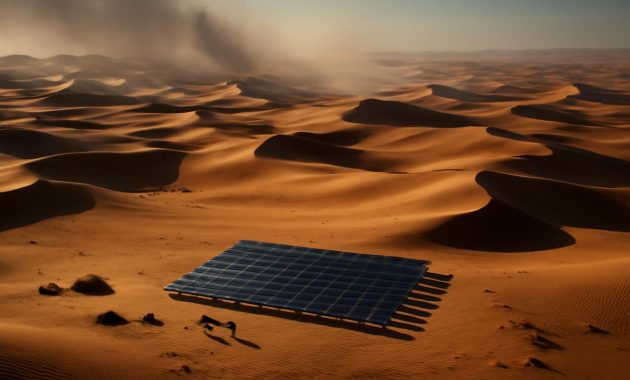
The first time someone suggests it, the idea feels almost too elegant to question. You picture the satellite image you’ve seen a hundred times: the Sahara, a vast golden quilt wrapping the top of Africa, 9 million square kilometers of almost nothing. Then you imagine it covered—not in dunes and mirages—but in orderly, glinting rows of solar panels. All that harsh, merciless sun, finally tamed. A single desert powering the world. How hard could it be?
The Mirage of a Simple Answer
It’s late afternoon in southern Morocco, and the desert light has gone from white to honey. The air still carries the day’s heat like a memory. If you stand still long enough, you can hear the sand shifting, whispering in threads and rivulets. This place does not feel empty. It feels alive, stern, and busy with things that have nothing to do with your electricity bill.
Yet, in conference halls and online comment threads, the Sahara is often treated like a blank canvas. People toss the idea around with an easy confidence:
“We only need a small percentage of the Sahara to power the whole world.”
There are even colorful maps floating around the internet: neat red squares stamped on North Africa, labeled with the world’s annual electricity demand. It all looks clean. Linear. Painless.
But deserts are tricksters. They look simple from far away; up close, nothing is simple at all.
The Numbers That Make It Sound Obvious
Let’s be fair: the basic math really is seductive. The Sahara gets an enormous amount of solar radiation—on the order of 2,000 to 3,000 kilowatt-hours per square meter each year in many regions. Cover “just” 1% of it with high-efficiency solar panels, people say, and you could generate more electricity than humanity currently uses.
The numbers are roughly in the right ballpark, in a purely theoretical sense. But theoretical ballparks are like mirages: impressive from a distance, useless when you walk toward them with real cables, real money, and real politics.
Because “just” 1% of the Sahara is not a postcard-sized patch of sand. It is an area roughly the size of Hungary. And solar panels are not abstract blue rectangles; they are physical objects that must be manufactured, cleaned, cooled, wired, guarded, maintained, and then replaced every couple of decades.
The solar dream in the Sahara is not just an engineering project. It’s a planetary reshaping with a footprint you can feel in your lungs, in your economy, and in the lives of the people who actually live here.
The Desert Is Not Empty
From a high altitude photo, it looks like no one lives in the Sahara. But if you come down to ground level at dawn, you’ll see goat herders moving across the scrub, women gathering water, children walking to schools that are more dust than walls. There are oases trembling with palm trees, carefully tended gardens, wells that are watched like treasure.
We like to call such a place “unused” or “empty land” because the scale of it dwarfs our imagination. Yet more than 2.5 million people live in the Sahara region, and far more rely on its water, grazing, and cultural routes. Tuareg caravans, ancient trade paths, fragile groundwater aquifers—these don’t show up on the solar potential maps.
Whose Desert Is It, Anyway?
Imagine standing at the edge of a proposed mega-solar “zone” and looking out: hundreds of square kilometers of mirrored glass and dark panels, fenced and guarded. Now ask some simple questions:
- Who owns this land—on paper, and in practice?
- Who decides where a solar farm goes, and who gets pushed out of the way?
- Where does the electricity go: to the closest village, or to a distant city or even another continent?
- Who benefits financially—and who just absorbs the dust and heat?
In theory, giant Sahara solar farms could bring investment and jobs to North African countries. In practice, history offers a colder story. Large extraction projects, whether oil, gas, or minerals, often end up exporting raw “resource” outward while leaving local communities with environmental damage and little power—literal or political.
The Sahara-as-power-plant fantasy, if unexamined, can slip easily into a new shape of colonial thinking: a vision of the Global North wiring itself to the South’s sun, still treating the desert as a warehouse rather than a home.
Heat, Dust, and Breakable Things
Even if you set the politics aside for a moment, the Sahara is a deeply inconvenient place to build a fragile, high-tech machine the size of a small nation.
Sand: The Slow Enemy
Stand in a desert windstorm just once and you will understand how much the sand wants to move. It gets into everything. It stains your teeth, scours your skin, infiltrates your camera. For solar panels, this is not romantic; it’s expensive.
Dust and sand settling on solar panels can significantly reduce their output—often by 20% or more if not cleaned regularly. Multiply that loss across millions of panels, and you’re bleeding gigawatts into the wind.
Cleaning them is not a trivial business. You need water, and the Sahara is not exactly a spare-bathtub kind of place. You can use dry robotic cleaning, but that demands more technology, maintenance, and cost. Or you truck in or desalinate water, weaving in another energy-hungry system just to keep your energy-harvesting surfaces functional.
Heat: Too Much of a Good Thing
Solar panels are like people—they work better when they’re not overheating. Their efficiency drops as temperatures rise. The Sahara routinely hits surface temperatures far above 40°C. That means your shining desert project is working under constant thermal stress.
Not only does this reduce the amount of electricity each panel produces; it also shortens their lifespan. Electronics and extreme heat are not friends. You can design systems to cope with this, but again: the more hardcore your environment, the more money you pour into beating it.
Machines Need Roads, Not Mirages
To build and maintain an enormous solar complex, you need access. That means roads, vehicles, supply chains, storage depots, fuel, repair shops, and people who can survive weeks out there. Every stray screw, every broken inverter, every shattered panel has to be brought in and out across long distances.
The Sahara is not a smooth parking lot; it’s an ever-shifting quilt of dunes, rocky plains, and erodible soil. Building infrastructure here is a constant negotiation with terrain that does not want to cooperate.
The Invisible Web: Transmission and Storage
Let’s say you’ve somehow solved the dust, the heat, the access, and the land rights. You now have a sparkling ocean of solar panels several hundred kilometers across, humming under the Saharan sky. Now comes the part of the puzzle we don’t put on posters: getting that power to where people actually live, when they actually need it.
Electricity Doesn’t Like Long-Distance Travel
Electricity is terrible at long-distance relationships. The farther you try to send it, the more it fades away as heat and loss. High-voltage direct current (HVDC) lines are much better than traditional AC lines over long distances, but they still aren’t magic. You lose energy just moving it around.
Now picture the map. If the plan is to send Saharan solar power to Europe, you’re laying thousands of kilometers of HVDC lines across desert, mountains, and sea. Each segment is vulnerable: to weather, to sabotage, to political upheaval, even to very mundane wear and tear.
Then multiply the risk by the number of countries you must cross. Every border is another handshake, another contract, another occasion for disputes. A massive transcontinental power line is not just an engineering project; it’s a long, fragile, political compromise.
Night Falls, and the Panels Go Dark
Solar power has an obvious flaw: when the sun goes down, the panels produce nothing. The Sahara doesn’t get a special exemption from this rule just because it looks dramatic in photographs.
To rely heavily on a single gigantic solar source, you need somewhere to put the surplus daytime energy, so it can be used at night or in cloudy weather. That means storage.
We have options: batteries, thermal storage, hydrogen production, pumped hydro in some locations. But building storage at a scale to match a Sahara-wide solar hub is a different beast. It means:
- Gigantic industrial battery facilities full of materials we already struggle to mine sustainably
- Massive thermal systems with their own efficiency losses and infrastructure
- Converting electricity into hydrogen or other fuels, then back again, losing chunks of power every step of the way
The more centralized your generation is, the more immense and complex your storage and transmission network must be. That complexity is a kind of vulnerability—one earthquake, one conflict, one system failure, and lights could go out thousands of kilometers away.
A Subtle Climate Trap
There is another problem that lurks further below the surface—literally. Turning huge swaths of reflective, pale desert into dark, light-absorbing solar fields might change more than just the local electricity supply.
Changing the Color of the Desert
Natural sand reflects a good chunk of the sunlight that hits it; scientists call this reflectivity “albedo.” Solar panels are dark and purpose-built to absorb light. Cover enough desert with them, and you’re altering the energy balance in a very real way.
More absorbed sunlight means more heat at the surface. That rising heat affects air circulation, potentially changing patterns of wind, cloud formation, and even rainfall. Some modeling studies suggest that blanketing very large areas of the Sahara with solar and wind farms could drive shifts in regional climate—possibly increasing rainfall in some zones while warming others.
That sounds like a neat side effect until you remember that millions of people live within and around these climate systems. Their agriculture, migration, health, and cultural rhythms are all tuned to the current patterns of heat and rain. You don’t nudge a system this big without consequences.
Deserts Are Ecosystems, Not Wastelands
Spend a quiet evening in the Sahara and you begin to notice how much is hidden. There are beetles that harvest dew from morning fog. Plants that bury their roots deep into secret water. Foxes that pad silently across the sand, feather-light. Migratory birds that use the desert like a sky-road.
These ecosystems might look sparse to us, but they are finely calibrated. Large solar farms mean more roads, more human activity, more habitat fragmentation, and more disturbance. The desert’s illusion of emptiness has long been its shield; industrial-scale development would strip that away.
Why Local Sun Beats a Single Giant Sun-Factory
When you zoom out and see the tangle of issues around turning the Sahara into the world’s battery, a quieter, less glamorous answer emerges: instead of one giant fix, we need millions of smaller ones.
Distributed, Not Dominant
Solar panels on city rooftops. Local community solar farms close to where power is used. Regional grids that share energy across modest distances instead of one continent-sized umbilical cord. Wind farms offshore. Geothermal where the ground runs hot. A weave, not a spear.
Distributed generation offers some key advantages:
| Aspect | Sahara Mega‑Project | Distributed Renewables |
|---|---|---|
| Reliability | Highly vulnerable to single‑point failures and political shocks | Failures are localized; rest of the system keeps working |
| Transmission Losses | Huge distances, higher losses, and expensive lines | Power used closer to where it’s generated |
| Local Benefits | Risk of export‑focused projects bypassing nearby communities | Easier to tie projects directly to local needs |
| Ecological Impact | Large concentrated disturbance of fragile desert ecosystems | Smaller, more adaptable footprints; easier to avoid sensitive habitats |
| Political Risk | Requires stable, long‑term agreements across many borders | Can be built under diverse local governance systems |
None of this means the Sahara has no role in our energy future. Carefully planned solar installations in desert regions can absolutely be part of the solution—especially when tied directly to local grids, local jobs, and local needs.
But relying on it as the single, mythical “switch” that powers the planet is like expecting one river to water every field on Earth. It’s neither realistic nor fair.
Listening to the Desert Instead of Talking Over It
In the end, the fantasy of the Sahara as a giant solar power plant tells us something about ourselves as much as it does about the desert. It reveals our hunger for simple, elegant answers to complex problems. It exposes how easily we see distant landscapes as blank—waiting for our blueprints—rather than as intricate worlds already in motion.
One evening, the sun slides down behind the dunes and the light goes purple. The heat bleeds out of the sand. Stars begin stitching themselves across the sky in impossible numbers. In that vastness, it’s tempting to think: here lies the solution to everything. All this wasted sunlight.
But the Sahara isn’t wasting anything. Its energies move through wind and heat, through roots and hooves, through old caravan trails and radio towers and ancient aquifers. The question isn’t “Why don’t we turn this into a machine for our convenience?” but “How do we change our systems so that we don’t need to turn entire regions into machines at all?”
We do need solar power, and a lot of it. We need wind and water and better grids and more storage and less waste. We need to cover our own roofs before we lay claim to someone else’s horizon.
Maybe the most honest way to look at the Sahara is this: not as a giant, unused battery, but as a reminder that our solutions must fit the planet as it is—messy, inhabited, interwoven—rather than the simplified maps we draw from far away.
FAQ
Could the Sahara theoretically produce enough solar energy to power the world?
In very rough theoretical terms, yes. Covering a relatively small percentage of the Sahara with efficient solar panels could generate more electricity than current global consumption. But “theoretical” ignores crucial practical issues like transmission, storage, costs, politics, ecology, and long‑term maintenance, which make such a single-source solution unrealistic.
Are there already solar projects in or near the Sahara?
Yes. Several North African countries, including Morocco, Algeria, and Egypt, are building significant solar (and wind) projects in desert regions. These are generally meant to supply national or regional grids, not to power the entire world. They face many of the challenges discussed—dust, heat, water scarcity, and the need for robust infrastructure.
Would large solar farms in the Sahara harm the environment?
At small to moderate scales, carefully sited projects can be designed to reduce ecological damage. At very large scales, however, impacts become harder to avoid: habitat loss, disruption of wildlife, increased local temperatures, and altered land surfaces. There’s also the potential for broader climate effects if enormous areas are covered with dark, heat‑absorbing surfaces.
Why not just build better transmission lines and fix the distance problem?
High‑voltage direct current (HVDC) lines can make long‑distance transmission more efficient, but they’re still expensive, politically delicate, and not loss‑free. They must cross multiple borders, withstand environmental extremes, and be protected against sabotage and conflict. The more centralized your generation is, the more catastrophic a single failure can become.
So what’s the better alternative to a giant Sahara solar plant?
A more resilient path is a diversified, distributed energy system: many smaller solar and wind projects close to where power is used, complemented by local storage, smarter grids, and a mix of renewables. The Sahara can still host solar and wind projects, but sized and governed in ways that respect local ecosystems and communities, instead of being treated as the world’s endless, anonymous power socket.