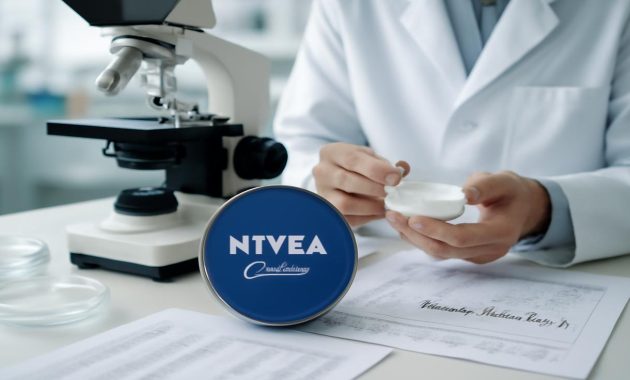
On a winter morning in Hamburg, a small blue tin sits on a laboratory counter, its lid pried open like a storybook. The scent that drifts out is instantly familiar—soft, powdery, almost like clean linen dried in cold air. A group of chemists, dermatologists, and self-confessed skincare nerds lean closer. Nivea Creme. The same cream that sat on our grandmothers’ dressing tables, that glistened on chapped winter hands and sun-reddened noses, that squeaked faintly as it was rubbed into skin. For more than a century, this little tin has followed us through generations. But now, under the bright, unforgiving lights of modern science and new-age skincare trends, it’s being looked at again—with fresh eyes and sharper instruments.
How a Little Blue Tin Followed Us Through Time
Before the spreadsheets and spectrometers, there are memories. A woman in Lisbon remembers her mother dabbing Nivea on her cheeks before school, the cream leaving a faint white veil that disappeared as she warmed her hands and smoothed it in. A retired mountaineer in the Alps recalls stuffing a tin into his backpack, using it on wind-burned faces and cracked knuckles after days in the snow. In Nairobi, a barber briskly massages it into a customer’s neck after a shave. In Mumbai, it sits next to a mirror, paint-flecked from years of use in a one-room flat.
Few skincare products have become as woven into ordinary life as Nivea cream has. Launched in 1911, it predates the invention of the television, the ballpoint pen, and even many of the synthetic materials that fill our homes today. Yet this cream, born from an early emulsifier called Eucerit, has hardly changed in more than a hundred years. That alone makes scientists curious.
In a world where new serums arrive every week boasting rare mushrooms, lab-grown peptides, and space-age delivery systems, why is an inexpensive, thick white cream in a blue tin still selling by the truckload? What keeps it on store shelves from Berlin to Buenos Aires, from tiny corner pharmacies to glossy supermarkets?
To find out, experts began where all good investigations start: with the ingredients list printed in tiny letters on the back of the tin.
The Ingredient Line That Launched a Thousand Debates
Laid out on a whiteboard in the lab, the formula looks simple, almost old-fashioned: water, mineral oil, microcrystalline wax, glycerin, lanolin alcohol, paraffin, panthenol, citric acid, a handful of stabilizers, and fragrance. No rosehip elixir. No sea buckthorn ferment. No hyaluronic acid with four molecular weights. To devotees of “clean beauty,” it might even look a little alarming. Mineral oil? Paraffin? Lanolin? Aren’t those the things blogs warn us about?
But when cosmetic chemist and formulation analyst Dr. Lena Hartmann looks at the formula, she sees something else: stability, efficiency, and a particular kind of quiet cleverness that is easy to underestimate.
“Nivea Creme is not trying to be everything,” she says, tilting the tin so the cream glows under the light. “It is not pretending to erase wrinkles or resurface your face overnight. It is a classic occlusive moisturizer. It’s a raincoat for the skin.”
In the language of skin science, “occlusive” is not an insult; it is a description. Occlusive ingredients like mineral oil and waxes create a thin, semi-occlusive film on the skin’s surface, helping to lock in water and reduce transepidermal water loss—the process where moisture silently evaporates from our skin into the air.
To see what this looks like, researchers run controlled tests in climate rooms: dry air, constant temperature, instruments measuring every flicker of moisture. Skin treated with Nivea Creme loses significantly less water than untreated skin. The numbers are not glamorous, but they are solid, repeatable, and surprisingly impressive for such a simple-looking formula.
“People want miracles,” Hartmann says. “Sometimes they forget that basic skin health—keeping the barrier intact, preventing water loss—is already a quiet miracle.”
What Experts See When They Look at Nivea’s Formula
Dermatologist Dr. Aaron Mensah likes to describe Nivea Creme as “a warm coat for cold, cranky skin.” To him, the formula is less about individual ingredients and more about what they do together.
The base is a water-in-oil emulsion. That sounds technical, but you can feel it the moment you dip your finger in: it’s dense, almost waxy, and as you rub it between your hands, it turns silky. Most modern lotions are oil-in-water—lighter, more fluid, quicker to sink in. Nivea goes the opposite way. The oil phase surrounds droplets of water, giving it that iconic thickness and creating a robust barrier when applied.
“For very dry or compromised skin, that’s a blessing,” Mensah explains. “It doesn’t just disappear into thin air. It stays, it coats, it protects.”
Then there’s glycerin, the humectant workhorse. Humectants draw water into the upper layers of the skin, plumping it from within. Panthenol, a pro-vitamin B5 derivative, joins in with soothing and moisturizing effects, often used in products for sensitive or damaged skin. Lanolin alcohol, sometimes misunderstood because of its origin (from sheep’s wool), provides emolliency and a lipid profile that, in many ways, mimics our own skin’s natural barrier.
This combination—humectant, emollient, and occlusive—is simple skincare architecture, but it’s the same structure behind most dermatologically recommended moisturizers. The difference is that Nivea wraps that structure in a sensory experience that borders on nostalgic ritual.
The Scent, the Squeak, and the Strange Comfort of Routine
When cosmetic historian Marta Silva invites volunteers into a sensory lab, she doesn’t start with questionnaires. She starts with blindfolds. Volunteers close their eyes, and she dabs anonymous creams onto their hands. Some are luxury products in frosted glass jars. Some are drugstore lotions. One is Nivea Creme.
What happens, she explains, is almost always the same. People recognize Nivea even when they don’t know they know it. The scent—powdery, soapy, almost baby-like—triggers buried memories. “They say, ‘This smells like my grandmother,’ or ‘This is the cream my father kept in the car.’”
The texture, too, is unmistakable. That initial drag and “squeak” against the skin, the way it seems too thick at first and then softens with warmth, the way it leaves a faint sheen—these are not accidents. The formulation is designed to feel substantial, to reassure you that something protective is happening.
In an age of invisible serums that vanish as soon as they are applied, Nivea is defiantly tangible. When experts analyze the cream in a lab, they also talk about the psychology of touch. A product that feels like it is working can influence how people use it, how often they apply it, and even how they perceive its results.
“It’s not just the barrier on the skin,” Silva says. “It’s the barrier between chaos and care. For many people, opening that tin and massaging the cream in is a small act of grounding. You are here, you have a body, you are looking after it.”
The Science Table: What’s Actually Inside That Tin?
Spread across a digital tablet in the lab is a simple chart. It doesn’t look like marketing. It looks like homework done well.
| Key Component | Role in the Cream | What Experts Say |
|---|---|---|
| Water (Aqua) | Hydrates the upper layers of skin | Acts as the fundamental base of the emulsion |
| Mineral Oil & Paraffin | Form a protective, occlusive film | Highly stable, non-reactive, effective at reducing moisture loss |
| Glycerin | Draws moisture into the skin | Well-studied, gentle humectant used across dermatology |
| Lanolin Alcohol | Softens and conditions the skin | Rich, skin-like lipids; can be sensitizing for a small number of people |
| Panthenol | Soothes and supports barrier function | Common in after-sun and healing creams; known for calming effect |
| Fragrance | Gives the signature Nivea scent | Pleasant for most users, but potential irritant for very sensitive skin |
The mineral oil and paraffin, often vilified by online myths, turn out to be far tamer under a microscope. Highly purified and tightly regulated, they sit on top of the skin rather than slipping deep inside. Dermatologists have used them for decades in products for eczema and extremely dry skin because of how efficiently they trap moisture.
“If you strip away the marketing noise,” Mensah notes, “these ingredients are like well-tested winter boots. Not fashionable, but when the storm hits, you’re grateful.”
Where Nivea Shines, and Where It Stumbles
For all its virtues, experts are quick to point out that Nivea Creme is not a perfect match for everyone, or for every climate.
In humid tropical cities, some users describe it as too heavy, almost suffocating—a blanket in a heatwave. The very occlusiveness that saves dry skin in winter can feel like overkill in monsoon summers. Those with oily, acne-prone skin sometimes find that such a rich, waxy texture can sit uncomfortably, especially if layered over several other products or used in thick quantities on the face.
“Think of it as a tool,” Hartmann suggests. “Beautifully made, but invented for a specific purpose: to protect and nourish dryness. If your skin is already greasy, you don’t necessarily need a winter parka.”
There is also the question of fragrance and lanolin sensitivity. A small but real percentage of people experience irritation or allergies from fragrance components or lanolin derivatives. Patch tests in dermatology clinics occasionally identify Nivea Creme as a trigger in such cases. For them, fragrance-free, hypoallergenic formulas may be a safer option.
Then there’s the unavoidable reality of time. Modern skincare has expanded beyond basic moisturization into targeted concerns: hyperpigmentation, collagen loss, photoaging, pollution defense. On those fronts, Nivea Creme is candidly quiet. It does not brighten, resurface, or deliver cutting-edge actives in concentrated doses. It doesn’t claim to.
“If you want a minimalist routine,” Mensah says, “this can be your moisturizer. But if you’re chasing specific goals—like fading sun spots or smoothing fine lines—you’ll likely need other products as well.”
The Surprising Places Experts Still Recommend It
For all these caveats, when you ask skin professionals where Nivea Creme still quietly excels, their answers paint a map of small, ordinary rescues.
In high-altitude clinics, doctors suggest it as a wind shield: a barrier cream for cheeks and hands facing harsh, dry air. Parents use it on children’s knees and elbows scuffed from playground gravel. Nurses apply it to the backs of hands cracked from constant sanitizing. Outdoor workers use it as a nightly repair ritual after days in sea spray or dust.
Some makeup artists even keep the blue tin in kits as an emergency glow-maker, dabbing the tiniest amount onto cheekbones for a dewy highlight, or smoothing it over flaky patches so foundation doesn’t cling and crumble.
“In a sense,” Silva muses, “it has become a people’s balm—never boutique, always reachable.”
Old Cream, New Eyes: What Really Surprised the Experts
When the lab tests and patch trials were done, when the histology slides of skin cross-sections had been examined and the moisture-loss curves drawn, the surprising thing was not that Nivea Creme worked. It was how quietly and consistently it had been working, in the background of so many lives, while the beauty world roared on about novelty.
Its formula, when seen through modern regulatory lenses, is simple but sound. No banned preservatives. No secret steroid. No magical herb from a mountain that cannot be pronounced. Just a careful arrangement of well-known molecules performing a nearly old-fashioned job: keep the skin from drying out.
Even the controversies—mineral oil paranoia, lanolin fears, fragrance worries—look different when held up to actual data rather than internet anecdotes. Yes, some people will react. That is true for almost any product. But for the majority, the cream is unremarkably safe.
“The surprise,” says Hartmann, closing the tin and rolling it between her hands, “is that in an industry obsessed with disruption, one of the most reliable products is something your great-grandmother already knew.”
In a way, the story of Nivea Creme is not really about a brand at all. It is about how our relationship with our own skin has changed. We used to ask for protection from wind and cold, from soap and sun. Now we ask for youth, luminosity, perfection. The little blue tin can’t grant those wishes—at least not in the way glossy campaigns promise. What it can offer is sturdier, quieter: comfort, moisture, and the small, grounding ritual of taking a moment to touch your own skin with care.
Perhaps the most unexpected thing experts found, after all the analysis, was that this humble cream did something science can measure—but also something it can’t quite chart: it stitched itself into memory. Hands that once opened the tin in dimly lit bedrooms now pass it to younger hands in brighter bathrooms. The cream remains the same; the faces change.
So Nivea Creme endures. Not because it’s flawless or futuristic, but because, in a world racing forward, there is still room for a solid, reassuring constant in a small blue circle of metal and scent.
Frequently Asked Questions
Is Nivea Creme safe for sensitive skin?
For many people with dry or mildly sensitive skin, Nivea Creme is well tolerated and can be very soothing. However, it does contain fragrance and lanolin alcohol, which can irritate or sensitize a small number of users. If you have very reactive skin, eczema, or a history of fragrance allergies, it is wise to patch test on a small area first or consult a dermatologist.
Can Nivea Creme be used on the face?
Yes, it can be used on the face, especially for very dry, tight, or wind-chapped skin. Some people love it as a night cream or occasional “moisture mask.” But because it is rich and occlusive, those with oily or acne-prone skin may find it too heavy and may prefer lighter, non-comedogenic formulas for daily facial use.
Does Nivea Creme clog pores?
Nivea Creme is not specifically labeled as non-comedogenic. The rich, waxy texture and occlusive ingredients could potentially aggravate breakouts in individuals prone to acne, particularly if applied thickly or layered over heavy products. Many people use it without issues, but if you are breakout-prone, start with small amounts or limit its use to drier areas such as cheeks or around the eyes.
Is mineral oil in Nivea Creme harmful?
The mineral oil used in cosmetics like Nivea Creme is highly refined and regulated. Studies and dermatological practice have generally found cosmetic-grade mineral oil to be safe and non-sensitizing. It sits on the skin’s surface to reduce moisture loss and does not accumulate in organs or “toxify” the body as some myths suggest. The main concern is texture preference and, for some, potential pore congestion, rather than toxicity.
Can Nivea Creme replace all other skincare products?
Nivea Creme can be a solid, basic moisturizer, particularly for dry skin on the face or body. However, it does not provide sun protection, nor does it contain targeted actives like retinoids, vitamin C, or exfoliating acids. For long-term skin health, especially in sunny climates, it should be paired with a sunscreen, and if you have specific concerns such as pigmentation or wrinkles, additional targeted products may be helpful.