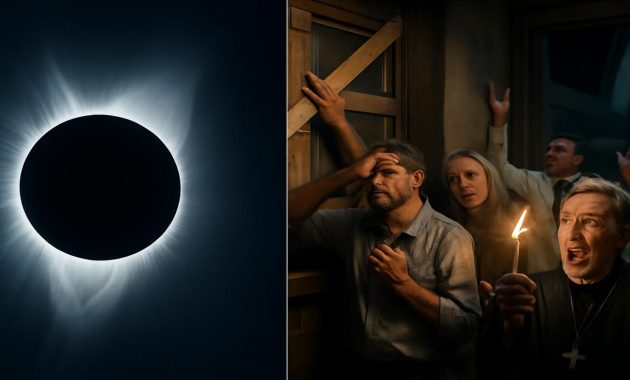
The first rumor arrived long before the shadow did. It slipped through late-night radio shows and grainy social media videos, rode along on whispered conversations in market stalls and office break rooms. People said that day would turn to night—completely, unnervingly—and that this eclipse would last longer than any seen in a hundred years. They said the birds would fall silent. They said the oceans would misbehave. Someone’s aunt swore that babies born during the darkness would carry a mark. By the time scientists stepped up to the microphones to explain what was coming, the story had already outrun them.
When the Sun Became a Story
It began, as these things often do, with an ordinary calendar note in an astronomy lab: “Total solar eclipse, path of totality crossing five continents, maximum duration over seven minutes.” On the whiteboard, it was a clean arc of numbers and geometry—orbital mechanics at work. But outside that room, beyond the language of umbras and penumbras, the same line on a chart quickly turned into something else: a prophecy, a warning, a test.
Scientists tried their best to translate the sky into human terms. They described how the Moon, tracing its eternal path, would neatly slide between Earth and Sun. How, for a fleeting slice of time, the Moon’s apparent size would perfectly cover the solar disk, casting a narrow river of darkness across the planet’s daylight face. They talked about the corona—the pale, ghostly crown of plasma usually drowned in light—coming into view. It would look, they said, like a shimmering halo, a white fire blooming from a black hole where the Sun ought to be.
In labs and observatories, the long eclipse meant opportunity. Instruments were pulled from storage, lenses polished, sensors calibrated. High-altitude balloons were prepared to ride the edge of space, to taste the sudden chill in the stratosphere. Teams rehearsed their movements in the dark: fifteen seconds to switch filters, thirty seconds to re-point the telescope. There was a certain race-day tension—meticulous, almost surgical.
But out in the streets and fields, the language was different. Farmers asked if their crops would suffer. Parents wondered if children should be kept inside. In some places, local leaders talked about omens, cycles of misfortune, curses older than the telescopes themselves. It wasn’t the science that frightened people; it was the scale of the moment. Day would surrender to night in the middle of everything, right in the open, for longer than anyone alive had ever seen.
The Longest Shadow of the Century
When astronomers call it “the longest eclipse of the century,” they are speaking with the precision of clocks and ephemerides. The geometry is delicate: the Moon near its closest point to Earth, the Earth at just the right place in its orbit, the alignment nearly perfect. Add it all together, and you get a few extra, breathtaking minutes of totality—a handful of moments where time exaggerates itself into myth.
Along the predicted path, cities prepared. Some planned festivals: food trucks, viewing parties, public lectures. Others quietly drafted emergency memos. Police chiefs anticipated traffic jams as people attempted to chase the shadow by car. Hospitals reviewed contingency plans, not for any cosmic danger, but for the very human stress, anxiety, and, inevitably, the injuries that follow any mass gathering of the uncertain and the unprepared.
The tension between wonder and worry could be felt in how people spoke about it. Astronomers used diagrams and models, standing before projection screens with tidy arcs and labeled axes. Yet for many, the eclipse refused to stay inside those graphs; it spilled out into the imagination.
On one side were the eager skywatchers, booking flights, mapping routes to remote villages, rehearsing with their eclipse glasses like kids trying on costumes before a parade. On the other side stood those for whom the word “eclipse” carried a heavy history: stories told by grandparents about livestock collapsing, harvests failing, wars starting under a darkened sun. The shadow was coming, and people were choosing the story they would stand inside.
Science Versus the Whisper Network
As the countdown ticked closer, scientists watched something else eclipse their careful explanations: the surge of superstition. Clips claiming that the eclipse would trigger earthquakes or volcanic eruptions spread faster than any press release. A heavily edited video of an old volcano documentary resurfaced with a new caption insisting, “This is what happened last time.” It had nothing to do with any eclipse, but facts were no match for fear dressed as memory.
Astrophysicists gave interviews warning about the psychology of mass superstition itself—the very idea that belief in disaster can cause real damage. Panic doesn’t bend tectonic plates, but it can fracture societies. If enough people believe that something terrible is coming, they may behave in ways that make tragedy more likely: crowd crushes, reckless driving, stampedes toward imagined “safe” places.
In some communities, religious leaders added their voices to the storm. A few framed the eclipse as punishment, or as a cosmic test of faith, encouraging followers to stay inside, refuse to look at the sky, to pray through the darkness with curtains drawn. Others, more quietly, reached out to local observatories, asking for guidance so they could reassure their congregations.
Science agencies released calm, carefully worded statements: the eclipse is natural; it is predictable; it will not cause disasters. But their tone—measured, almost clinical—struggled to compete against the visceral thrill of a doomsday rumor whispered in the dark. Data had to share a stage with dread, and dread had rehearsed this script for centuries.
| Aspect | Scientific Reality | Common Superstition |
|---|---|---|
| Impact on Animals | Temporary confusion; birds roost, insects change activity. | Animals will go mad or die from fear. |
| Effect on Health | No harm if proper eye protection is used. | Eclipse rays cause illness, birth defects, or curses. |
| Weather & Earthquakes | Minor, brief temperature drops; no link to quakes. | Major storms, earthquakes, or floods will be triggered. |
| Spiritual Meaning | A predictable celestial alignment. | A sign of divine anger or impending catastrophe. |
Standing in the Path of Totality
The morning of the eclipse arrived like any other, stubbornly ordinary. Traffic lights cycled, coffee machines hissed, birds argued in the trees. Somewhere far out over the ocean, the shadow touched Earth for the first time, a soft bite taken from the Sun’s face. In coastal towns, early risers on the beach saw the first sliver disappear, and a low murmur went up—uncertain, awe-struck, almost reverent.
In places where superstition had sunk its deepest roots, shutters were already closed. Streets that usually rang with bicycle bells and market chatter were strangely hollow. A woman swept dust from her doorstep, glancing furtively at the sky, then hurrying back inside before the light changed too much. On a nearby rooftop, a teenager defied her parents’ orders, hiding a pair of approved eclipse glasses under her hoodie, curiosity wrestling with inherited fear.
Further along the path, in cities that had embraced the spectacle, people gathered in stadiums and parks. The air smelled of sunscreen, food trucks, and the faint metallic tang of anticipation. Children clutched cardboard viewers crafted in classrooms. Strangers traded spare glasses, comparing the world through smoky plastic lenses. Above them, the Sun slowly morphed into a crescent, the light turning sharper, thinner, as if the day was being edited with careful strokes.
Camper vans lined remote highways where the forecast promised clear skies. Astrophotographers triple-checked their settings—ISO, aperture, exposure, filter on, filter off—hands trembling not from fear, but from the weight of the moment. Seven minutes of totality is an eternity and no time at all. Every second would count.
When Day Surrenders
The approach of totality is not a simple dimming; it is a mood shift in the bones of the world. As the Sun’s crescent narrows into a silver thread, colors drain from the landscape. Shadows sharpen into uncanny clarity, edges etched like ink on paper. The air cools more quickly than seems polite for midday. A wind stirs that wasn’t there before, carrying with it the startled hush of creatures misreading the clock.
In a field on the outskirts of a small town, a flock of swallows that had been spiraling overhead suddenly drops, skimming low, then disappearing into hedges as though someone flipped an invisible switch to “night.” Crickets begin to chirp—their chorus hesitant at first, then gathering confidence. Streetlights in the distance sputter on, confused circuit boards obeying sensors that know only light and dark, not awe.
Then comes the final breath: that last, impossibly thin fragment of Sun. The world seems to hold itself still as it vanishes. A collective gasp rises from millions of throats along the shadow’s track as the sky falls into a soft, deep twilight. Stars punch through the sudden darkness. Planets appear where only blue had been a heartbeat ago.
Where fear had warned people not to look up, instinct betrays them. Curtains twitch, doors crack open, eyes dart skyward. What they see there is quieter than any prophecy: a black circle, framed in white fire, hanging in a sky turned indigo and strange. The corona ripples, delicate tendrils stretching outward like ink drifting through water. It is not an angry eye, not a gateway, not a divine scowl. It is a geometry come to life—beautiful, indifferent, exact.
In that silence, even the loudest rumors falter. Panic has trouble breathing in the presence of such stark, wordless wonder. For a few long minutes, spanning continents, humanity shares something primordial: the feeling of being very small beneath a very large sky, and yet somehow deeply connected to it.
The Fury Behind the Warnings
For scientists, those seven minutes are gold. Telescopes capture high-resolution images of the corona, seeking clues about why it burns millions of degrees hotter than the surface below it. Temperature sensors scribble lines on graphs that will later become journal figures. Advance teams in aircraft chase the shadow across the globe, extending totality for just a little longer, trying to stretch this fragile window into a broader understanding.
But behind the calm of their recorded data lies a flicker of anger—the “fury” that headlines keep mentioning. The frustration is not at the eclipse itself, but at the way superstition and panic threatened to swallow it whole. Many scientists had watched in real time as their careful explanations were twisted or ignored, replaced by apocalyptic narratives that traveled smoother through the channels of fear.
Some had received threatening messages for “challenging divine will” or “hiding the truth.” Others watched local governments consider unnecessary curfews, or cancel school programs that could have turned the eclipse into a lesson instead of a specter. In a few regions, there were reports of animals being locked in cramped shelters for no reason, of pregnant women being forbidden from stepping outside, of young students told that even a glimpse of the darkened sky would curse their futures.
The fury was not about being disbelieved; scientists are used to skepticism. It was about lost chances—for learning, for shared wonder, for a moment where humanity could feel its place in the cosmos without flinching. It was about watching fear strip the sky of its meaning and sell it back as menace.
Ironically, the eclipse itself did nothing to support the rumors. When the light returned, buildings still stood. Seas did not rise. The earth did not split. But the chaos seeded by superstition had left smaller, more human scars: a traffic pileup from panicked drivers fleeing the path, a marketplace stampede sparked by someone shouting that the dark was a sign to run, a child burned by staring at the crescent Sun through a fragment of tinted glass sold as “eclipse safe” by an opportunist.
After the Shadow Moves On
And then, as gently as it arrived, the edge of the Moon slips away from the Sun’s face. A bead of dazzling light flares—a “diamond ring” against the fading corona. Crickets fall quiet again. Birds tentatively resume their daytime script. The world eases back into color, as if a hand turning the dimmer switch has decided, mercifully, that the show is over.
The shadow continues its race across the planet, leaving behind a patchwork of reactions. In some villages, people emerge from their houses blinking, hearing neighbors describe the sight they chose not to witness. In cities, social feeds flood with images of a black Sun wreathed in light, interspersed with shaky videos of crowds gasping, laughing, crying. Headlines pivot almost instantly: awe, relief, a dozen think pieces published before the last edge of darkness clears the far horizon.
In classrooms, teachers gather students and ask what they saw, what they felt. Some children describe stars at midday. Others talk about how the temperature dropped, how their dog whined just before it went dark. There will be new scientists born from this, drawn not by equations alone, but by the visceral memory of the sky changing shape around them.
In homes where superstition had won the day, stories begin to diverge. A few insist that unseen harms have been unleashed, that any misfortune in the coming months will trace back to this noon-time night. Others feel a different stirring: a realization that the worst did not come, that perhaps the next cosmic event could be watched instead of feared. Culture shifts not in declarations but in these quiet, internal negotiations with experience.
A Shadow’s Lesson
The longest solar eclipse of the century will live on in different ways, depending on who tells it. To astronomers, it will be a trove of data on solar magnetism, coronal heating, atmospheric response. To storytellers, it will be a day when the world slipped into dreamlight and the rules briefly rearranged themselves. To those who warned of curses and cataclysms, it may be an awkward memory, or worse, another excuse to retrofit meaning onto coincidences to come.
But for many ordinary people, it will be something simpler: a moment when they felt the machinery of the universe move, not as an abstraction, but as a shadow crossing their own faces. The texture of the air turning cool. The way their own heartbeat sounded louder in the hush. The sight of a Sun transformed into a burnished ring, hanging low in a sky suddenly deep and close.
Scientists will keep speaking out, not only about celestial mechanics, but about the cost of letting superstition claim these moments. Their fury is, at its heart, a kind of care. They know how rare it is for a planet, a moon, and a star to line up just so, at just the right distances, to allow a total eclipse at all. Most worlds never see one. To waste that on panic feels, to them, like squandering a miracle that needs no magic to be miraculous.
As the century goes on, there will be other eclipses, each with its own path and its own stories. Some may occur over open ocean, witnessed only by sensors and a handful of ship crews. Others will sweep over crowded cities, turning skylines into silhouette theaters. With each one, humanity will be offered the same choice: to meet the shadow with fear, or with understanding seasoned by wonder.
The sky will go dark at midday no matter which we choose. The Moon does not care for our narratives; the Sun does not flinch at our superstitions. But down here, standing in the path, the way we respond becomes part of our own ongoing story—a tale of how a thinking species learned, slowly, imperfectly, to look up at the universe not as an enemy, but as a vast, unfolding conversation.
Frequently Asked Questions
Is a long solar eclipse more dangerous than a short one?
No. The duration of totality does not make an eclipse more dangerous. The primary risk is eye damage from looking at the partially covered Sun without proper protection, whether the eclipse lasts two minutes or seven. As long as you use certified eclipse glasses or indirect viewing methods, the length of totality does not increase physical danger.
Can a solar eclipse cause natural disasters like earthquakes or storms?
There is no scientific evidence that solar eclipses trigger earthquakes, volcanic eruptions, or major storms. Eclipses can cause brief temperature drops and subtle atmospheric changes, but these do not translate into large-scale natural disasters. Claims linking eclipses to catastrophe are rooted in superstition, not data.
Why do animals behave strangely during an eclipse?
Many animals rely on light cues to structure their daily routines. When the sky suddenly darkens in the middle of the day, birds may roost, insects may begin chirping, and nocturnal animals may stir as if night has arrived. Their behavior reflects confusion about the rapid light change, not fear of the eclipse itself.
Is it safe to be outdoors during a total solar eclipse?
Yes. Being outdoors during a solar eclipse is safe, provided you protect your eyes when any part of the bright solar disk is visible. During the brief period of totality—when the Sun is completely covered—it is safe to look with the naked eye, but you must put eye protection back on as soon as the first sliver of sunlight returns.
Why do some cultures view eclipses as bad omens?
Before the motions of the Sun and Moon were understood, eclipses appeared sudden and inexplicable, turning day into night with no warning. Many societies interpreted this as divine anger, a sign of war, or a disruption of cosmic order. These stories became part of cultural memory and are still repeated today, even though we now understand eclipses as predictable, natural events.