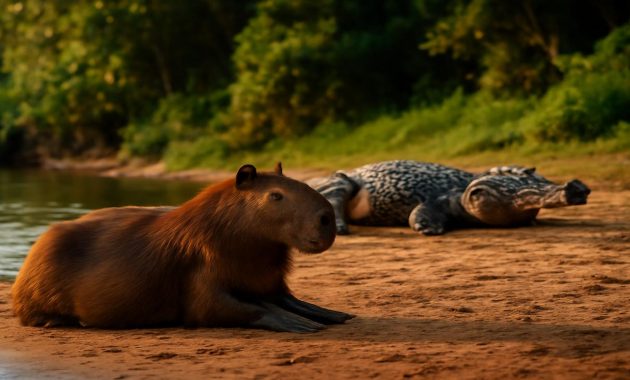
The capybara stands at the river’s edge like a boulder disguised as fur, its coarse brown coat slick with afternoon rain. It chews slowly, unbothered, while a pair of eyes—the only visible part of a lurking reptile—break the surface of the dark water. This is the kind of scene that makes nature-watchers hold their breath. Predator. Prey. The script seems obvious. But the seconds stretch into minutes, and the huge reptile does something strange: nothing at all. The crocodile (or caiman, or alligator, depending on where you are in the world) simply drifts past, water curling around its armored snout, and the capybara keeps on munching riverbank grass as if sharing space with a lethally toothed neighbor is the most ordinary thing in the world.
The Riverbank Truce You Weren’t Expecting
Spend some time on a South American river and the first thing you notice is not the drama, but the coexistence. Capybaras sunbathe in loose, loaf-shaped clusters. Caiman float nearby like driftwood that grew teeth. Egrets, herons, and kingfishers stitch white and blue into the sky above them. Everything breathes the same damp, heavy air—and, incredibly, most of it ignores everything else.
To many observers, especially those used to the sharp predator-prey lines of nature documentaries, this feels wrong. Crocodilians are supposed to be ruthless. Capybaras, the world’s largest rodents, are supposed to be walking snacks. The mental image writes itself: a capybara, woolly and unwary, is ambushed by a prehistoric reptile in a swirl of mud and teeth. And yes, that does happen on occasion.
But then you start to notice a pattern. In wetlands like Brazil’s Pantanal or the Orinoco floodplains, you can watch dozens of capybaras loafing ten or twenty meters from caimans, with nothing but muddy water between them. No panicked dashes. No constant attacks. Sometimes they’re close enough that, with a single explosive lunge, the reptile could easily close the gap.
So why doesn’t it?
The Myth of the Always-Hungry Monster
Part of the answer starts with us. Humans are very good at remembering drama. One filmed attack sticks in the mind far more than a hundred quiet afternoons where nothing happens. Add in a steady diet of movies and documentaries casting crocodilians as mindless eating machines, and we end up with a caricature: a creature that will attack anything, anytime, anywhere.
Real crocodilians are nothing like that. They are cautious accountants of energy—metabolic minimalists living inside armor. Each lunge, each sudden burst of power, is a withdrawal from a slow-to-refill energy bank. If they miscalculate and the prey escapes, they’ve burned precious fuel for nothing. Over millions of years, that has bred not a reckless killer, but an extreme strategist.
Capybaras, as it turns out, are not always worth the math.
Capybaras Are Big, Wet, and Surprisingly Difficult
On paper, a capybara looks like a feast. Adults can weigh as much as a human teenager, packed into a barrel of dense muscle and fat. To a casual observer, they appear slow and amiably clumsy, like a sack of potatoes that learned to waddle. But follow a group for an afternoon and you start to notice the details.
They are born into water. Capybaras slip into rivers and marshes the way other animals slip into shade. Their eyes, ears, and nostrils sit high on their skulls, echoing the crocodilian design—as if both creatures read the same engineering manual for “semi-aquatic life.” Under the surface, their heavy bodies become buoyant and quick. They can hold their breath for several minutes, paddling quietly away from danger, vanishing under mats of reeds with only nostrils exposed.
When alarmed, a capybara doesn’t hesitate. It detonates. That placid loaf of fur becomes a streak of brown, slamming straight into the water. They know every muddy path, every underwater hole, every shortcut between bank and refuge. A lunging crocodilian gets only a heartbeat to be perfect. If it misjudges by a fraction, the capybara is gone, leaving only widening ripples on the river’s skin.
The Energy Budget of an Ambush
Crocodilians—crocodiles, alligators, and caimans—are masters of stillness for a reason. Their cold-blooded bodies operate on a different economic model than warm-blooded mammals. They can go days, weeks, sometimes months between large meals. But this thriftiness works only if they spend almost nothing in between.
Picture the world as a marketplace of calories. Each hunt is a business decision. How many calories will this chase cost me? How likely am I to succeed? What happens if I fail? For a crocodilian, a failed attack isn’t just disappointing—it’s expensive.
Capybaras, especially adults, are not soft targets. They are cooperative sentinels, living in groups where someone is almost always on watch. The moment one animal gives a sharp bark of alarm, the whole band surges toward water. A crocodilian hoping to grab an adult from a vigilant group is gambling on speed and surprise against multiple sets of eyes and ears.
So the reptile does the quieter calculus: Is there something easier nearby?
| Food Option | Effort Required | Risk Level | Calorie Reward |
|---|---|---|---|
| Fish / Small Aquatic Animals | Low–Moderate | Low | Moderate |
| Birds & Small Mammals | Moderate | Low–Moderate | Moderate |
| Juvenile Capybara | Moderate | Moderate | High |
| Adult Capybara | High | Moderate–High | Very High |
In this ledger, the adult capybara looks tempting only if the reptile is desperate, the conditions are perfect, and there aren’t easier options. Most of the time, nature rewards laziness disguised as wisdom: eat the smaller, simpler things first.
Neighbors, Not Friends: The Illusion of Friendship
This is where the internet muddies the water. Scroll through social feeds and you’ll find video clips of capybaras lounging beside caimans, a bird comfortably perched on a capybara’s back, turtles sharing a log, everyone apparently one step away from forming a band. Captions declare them “best friends” or “the most chill animal ever.” The crocodile, in this storyline, becomes the reformed villain: misunderstood, gentle, a symbol of nature’s hidden kindness.
The reality is both colder and more beautiful than that. Crocodilians and capybaras are not friends. They are neighbors who operate under a set of unspoken ecological agreements. Their apparent tolerance is built on physical rules, evolutionary history, and the algebra of risk, not empathy or affection.
For the crocodilian, a capybara on the riverbank is part of the scenery, like reeds or driftwood—except that sometimes the scenery is edible, and sometimes it isn’t worth the trouble. For the capybara, the caiman in the shallows is a constant background threat, as ordinary as a rain cloud. They live as if danger is always present, and that persistent awareness is precisely why they’re still here.
Safety in Numbers, Vigilance in Silence
Capybaras rarely travel alone. A typical group is a loose, shifting cluster of females, their young, and a dominant male, with others drifting in and out at the edges. In that cluster, every ear swivels, every eye watches; the family is wired like a living alarm system.
This matters when crocodilians are around. A lone capybara at dusk, far from water, is vastly more vulnerable than a small herd pressed close to the river’s edge. One animal may be distracted, but ten animals create a composite alertness. The crocodilian doesn’t just face a single set of senses; it faces a ring of vigilance.
Because attacks from the water are directional and sudden, capybaras also stage their behavior. The more relaxed animals typically graze a little higher up the bank, while others stay closer to the water’s edge or stand half-submerged, scanning. When one startles, the reaction spreads through the group in a wave faster than words could travel.
This social nervous system means that many potential ambushes never even begin. The crocodilian stays hidden, feeling the ripples, watching the angles, and decides—without moving a single muscle—that today’s risk/return ratio is all wrong. Another slow afternoon passes, uneventful to human eyes but full of quiet calculations.
Water Worlds and Shared Blueprints
There is something uncanny about seeing capybaras and crocodilians occupying the same patch of water. Their silhouettes rhyme: nostrils upturned, eyes high-set, bodies built to transition between land and liquid. They are evolutionary strangers that seem to agree on what it means to inhabit a wetland.
Crocodilians are ancient—older than the Amazon River itself. Capybaras, by contrast, are comparatively modern mammals. Yet both have converged on a shared blueprint: spend the heat of the day near or in water; use that water as refuge, highway, and cooling bath; emerge to graze or bask as light softens.
Because both species rely on water for escape and comfort, conflict becomes a cost. If every approach to the river turned into a battle, both would suffer. Capybaras would lose vital refuge; crocodilians would waste precious energy in failed pursuits or unnecessary skirmishes. Over time, natural selection tends to favor individuals—on both sides—who navigate this interface with a kind of cautious choreography.
Different Niches, Overlapping Lives
The idea that two species must be enemies simply because they can hurt each other is a very human simplification. In reality, most ecosystems are built on overlapping lifestyles rather than constant warfare. Crocodilians consume a wide variety of prey: fish, snails, birds, dead animals, the occasional unlucky mammal. Capybaras are strict herbivores, busy converting tough grasses into solid, walking calories.
In this web, their roles scarcely touch. Crocodilians don’t compete with capybaras for food. Capybaras don’t threaten the reptiles’ nests in any systematic way. Instead, capybaras act as large, wary, plant-processing machines that also feed jaguars, pumas, large snakes, and—yes, sometimes—crocodilians. Predators, in turn, keep capybara numbers from overshooting what the land can support.
Seen this way, the riverbank “truce” isn’t a miracle; it’s the expected outcome of millions of years of adjusting edges. Enough aggression to keep everybody sharp. Enough restraint to keep the system from tearing itself apart.
Do Crocodiles Ever Eat Capybaras?
They do. The quiet answer beneath all this subtlety is that crocodilians, especially larger individuals, will take a capybara if the circumstances favor them. Young capybaras are the most vulnerable: small, less experienced, and sometimes straying a little too far from the safety of adults or deep water.
In the wet season, when rivers swell and food is more dispersed, hunting opportunities can be patchier. A hungry caiman or crocodile will exploit any advantage: murky water, steep banks that complicate escape, nighttime when mammals hesitate just a fraction longer to find footing. In those moments, the river’s surface erupts, and the story looks exactly like the one you thought you knew—sharp teeth, churning foam, silence.
But those moments are exceptions, not the default. If you filmed the same stretch of river for a month, you’d get a few brief bursts of violence and hundreds of hours of low, quiet coexistence: capybaras grooming each other, small ones wandering nose-first through flowers, a caiman cruising lazily past, not even turning its head.
That asymmetry—the gap between what’s common and what’s memorable—is why “crocodiles don’t eat capybaras” feels evocatively true, even though it’s technically false. It isn’t that they can’t or never do; it’s that, given all the options and all the risks, they mostly choose not to.
From Fear to Understanding
There is a powerful shift that happens when we trade in horror stories for honest complexity. The crocodilian becomes less of a movie monster and more of a patient strategist. The capybara, instead of a helpless victim, emerges as a capable, water-wise grazer whose greatest survival tool is not ferocity but social awareness and calm vigilance.
In that clearer light, the rivers and marshes where they meet gain a certain dignity. The drama is still there—death is part of the script—but it is framed inside long stretches of ordinary life. Animals resting, digesting, waiting. The world does not run on continuous crisis. It runs on balance punctuated by sudden, necessary violence.
And so the big rodent chews at the edge of the water. The crocodilian eye slides past like a drifting marble. Air hums with insects and the smell of wet earth. Two very different survivors share a liquid border, each aware of the other, each shaped by the other, yet not always locked in the simple story we might have written for them.
FAQs
Do crocodiles really not eat capybaras?
They do sometimes eat capybaras, especially young or isolated individuals. However, attacks are far less frequent than people assume. Most of the time, crocodilians and capybaras share the same habitat without direct conflict.
Why don’t crocodiles attack capybaras more often?
Because hunting adult capybaras is risky and energy-consuming. Capybaras are fast, highly alert, and excellent swimmers. Crocodilians often find it more efficient to feed on easier prey like fish, smaller mammals, or carrion.
Are capybaras afraid of crocodiles?
Capybaras treat crocodilians as a serious but familiar danger. They are cautious rather than panicked—staying in groups, keeping close to water, and reacting quickly to any sign of threat. Their behavior shows respect for the risk, not total fear.
Do capybaras have any defense against crocodiles?
Their primary defenses are speed, water skills, and social vigilance. Capybaras can dash into water in an instant, dive, and stay submerged for several minutes. Living in groups gives them many eyes and ears to detect danger early.
Can capybaras and crocodiles really be seen resting near each other?
Yes. In places like the Pantanal, it’s common to see capybaras and caimans sharing riverbanks or shallow water with minimal visible tension. This is not friendship; it’s a practical coexistence shaped by cost–benefit decisions on both sides.
Do crocodiles prefer other prey over capybaras?
Often, yes. Fish, birds, smaller mammals, and carrion can be easier and safer for crocodilians to catch than a large, wary capybara. When food is plentiful, there is little incentive to gamble on difficult prey.
Are capybaras important to the ecosystem even if predators sometimes eat them?
Very much so. Capybaras help shape vegetation through grazing and serve as a key food source for big predators like jaguars, pumas, large snakes, and occasionally crocodilians. Their presence supports the overall health and balance of wetland ecosystems.