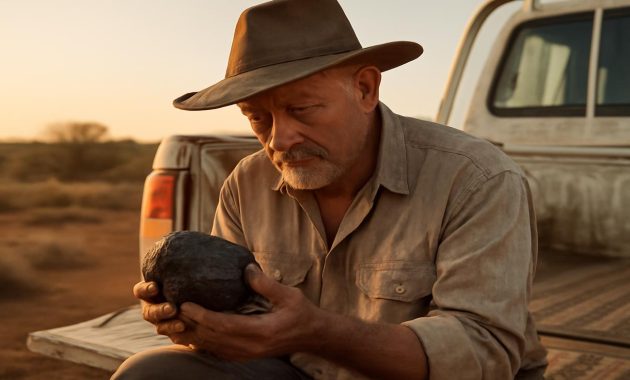
The first thing Doug thought was that it shimmered wrong. Gold, real gold, doesn’t glint like that, not in the hard, slanting light of an outback afternoon. But there it was, half-sunk in the ochre dust of the Australian bush, a dark, oddly heavy lump that lit up his metal detector with a jubilant scream. His pulse hammered. Months of fruitless wandering, of false alarms and bottle caps and bent nails—and suddenly, at his boots, a signal so strong it buzzed right through his arm.
He crouched, breath shallow, and dug with the practiced urgency of someone who’d learned not to get his hopes up too fast. The soil gave way easily. In his hands emerged something that looked almost disappointing: not a bright yellow nugget, not the classic prospector’s dream, but a dense, smooth, charcoal-colored stone with an iron sheen beneath its dusty crust. Still, it was heavy. Very heavy. That was enough to make his imagination roar to life.
“Must be gold in there somewhere,” he muttered, turning it over in his fingers. The outback breeze brushed his sunburnt neck, carrying with it the smell of hot eucalyptus and dust. Above him, crows circled lazily, their cries thin against the endless blue. Somewhere in that vast sky, a story older than the Earth itself had just landed in his hands—and he had no idea.
The Day the Sky Fell into His Hands
Doug had been walking that same stretch of ground for weeks, an hour outside Maryborough in the state of Victoria—quiet country marked by scrubby trees, rusted fence posts, and the faint ghosts of long-forgotten gold rush dreams. He was the sort of weekend prospector who knew the history of every creek and hillside: where miners had once pitched tents; where the ground had given up fortunes, and where it had stubbornly kept its secrets.
The land was steeped in stories of luck. Old-timers in the nearby pub liked to speak of the Eureka days and those miraculous moments when a spade bit into earth and came up shining. For Doug, that romance was part of the draw. He wasn’t planning to get rich. But still, each beep from his metal detector held a flicker of possibility—some buried relic, an old coin, a forgotten ring, or just maybe, that mythical lump of gold that would change everything.
On that afternoon, when the device screamed into his headphones, it didn’t feel like a maybe. It felt like a certainty. The reading was off the charts. The tone had a fullness to it, a kind of solidity that told him something substantial was down there.
But as he wiped away the loose dirt and held the object in his palm, he felt his certainty wobble. This did not look like the stories. No bright sparkle, no jagged veins of yellow. Instead, it was almost black, with a subtle bronze plate on one side, as if it had been scorched in some colossal furnace.
“Strange sort of rock,” he said to no one, his voice swallowed by the spacious quiet. He weighed it again. Too heavy for what it looked like. Too smooth to be just another chunk of ironstone. Somewhere deep in his memory—maybe from a childhood book, maybe a TV documentary—another word surfaced: meteorite.
A Different Kind of Treasure
He didn’t say the word out loud. It felt silly, dramatic, like accusing an ordinary cloud of being a UFO. Instead, he tucked the stone into his backpack, the fabric sagging under its surprising weight, and continued walking for another half hour, swinging the detector in lazy arcs. But his mind kept circling back to that dense, dark lump. Gold. Meteorite. Gold. Meteorite.
Back home, under the yellow kitchen light, the rock looked even stranger. The smoothness of its surface was unusual, like it had been polished by violence rather than time. Tiny, metallic flecks caught the light when he tilted it. Doug found himself whispering, “Who are you?” as though it might answer.
His first instinct was still gold. Maybe it was some kind of iron-rich host rock with pockets of gold inside, the kind that needed a good hammering to reveal its prize. He thought of videos he’d watched of prospectors cracking open stones like this, gold gleaming from the fractured heart. His fingers itched for tools. Yet something held him back.
That lingering word again: meteorite. A piece of space. A fallen star. An actual fragment of something older than every tree and brick and bone he had ever known. You don’t just take a hammer to that… if that’s what it truly was.
From Backyard Curiosity to Planetary Story
The next step felt oddly nerve-wracking. Doug wrapped the rock in a towel and carried it out to his truck like it was an injured animal. Instead of driving to a gold dealer, he headed into town, to a small regional museum where a pale, enthusiastic volunteer spent her days cataloging local fossils and old mining tools.
Her name was Claire, and as soon as Doug placed the stone on the counter, her eyebrows climbed. She didn’t proclaim it a meteorite on the spot—real scientists, Doug would later learn, rarely make grand declarations that quickly. Instead, she reached for magnets, magnifying lenses, a notebook covered in neat, meticulous handwriting.
The magnet clung to the stone’s surface with a solid, unambiguous pull. She nodded, half to herself. Under the magnifier, the surface revealed tiny specks of metal and a pattern that didn’t quite look like anything she’d seen in ordinary rocks. The weight, she said, was a clue. The outer fusion crust—a thin, darkened shell formed when something tears through the atmosphere at impossible speed—was another.
“I can’t say for sure,” she told him, brushing dust from her hands. “But if you don’t mind, I’d like to send this to some colleagues. Proper testing. It could be… well, it could be something special.”
Doug left without his rock, walking back into the bright Australian sun feeling oddly hollow, as if he’d just handed over a secret. For days, his phone remained stubbornly silent, the world spinning along with no concern for the small, very heavy question mark sitting in a lab somewhere.
What a Meteorite Really Is
When the call finally came, he was sitting on his porch, watching the late afternoon turn the paddocks into bands of burnished copper. Claire’s voice crackled through the line, triumphant and breathless.
“It’s a meteorite,” she said. “And not just any meteorite. It’s an H5 ordinary chondrite. A real fragment of the early solar system.”
The words washed over him in a rush of scientific syllables and muted astonishment. H5. Ordinary chondrite. The terms sounded dry, almost bureaucratic, but what they meant hit him like a second impact. He hadn’t just found a rock with some space dust. He’d found a tangible chunk of the universe’s childhood.
Chondrites, the scientists explained, are some of the most primitive materials we know—unchanged leftovers from the swirling disk of gas and dust that once circled the newborn Sun. Inside them are tiny beads called chondrules, formed as molten droplets in that ancient cosmic chaos, frozen nearly untouched for over four and a half billion years. Before Earth fully came together, before oceans, before air, before even the idea of blue sky—this stone already existed.
At about 4.6 billion years old, it predated the ground Doug stood on, the continent that carried his house, the very minerals in his own bones. Gold, he realized with a small, stunned laugh, was suddenly the less impressive option.
Older than Every River, Younger than Every Dream
In the labs, technicians sliced into the meteorite with diamond-tipped tools, revealing a mottled interior of gray matrix dotted with shimmering metal. Each slice was precious; they cut as sparingly as they could, preserving the structure so future scientists—with better tools, sharper questions—could continue to study it.
Chemical analysis traced its journey. The meteorite must once have been part of a larger asteroid, orbiting quietly between Mars and Jupiter. For unimaginable ages, it circled there, locked in an endless loop around the Sun, a cold witness to the birth and death of worlds. At some point, a collision shattered it free, sending fragments slowly spiraling inward, nudged by tiny gravitational tugs, guided by chance and physics toward a rendezvous with Earth.
Then, one night—no one knows exactly when—it slammed into the atmosphere over what would eventually be called Australia. Superheated plasma flared around it as it screamed through the sky at tens of thousands of kilometers per hour. To anyone watching, it might have looked like a shooting star, the kind people close their eyes and wish on, never suspecting that sometimes, those wishes keep on falling and survive.
By the time it struck the ground, it had slowed, partially melted on the outside and cracked within from the brutal temperature shift. There it lay, silent and small, as empires rose and fell on continents an ocean away, as marsupials hopped past and gum trees spread their roots, as humans eventually arrived with spears, then horses, then trucks and metal detectors.
When Doug found it, the meteorite had probably been in that patch of soil for tens of thousands of years, maybe longer. Long enough for ice ages to ebb, for seas to rise and recede, for languages to be born and vanish. He’d simply been the first person to recognize that it didn’t quite belong.
Gold Fever vs. Star Fever
Doug’s find wasn’t the largest meteorite ever discovered, not even close. It weighed in at a solid but modest mass compared to legends like the Hoba meteorite in Namibia. In strict monetary terms, if sold as a specimen, it might fetch less than a lucky gold strike of similar heft. And yet, value is a slippery thing, especially when wonder gets involved.
Word of the meteorite spread in quiet ripples—local newspapers, a spot on the radio, a mention in a regional science journal. At the museum, school groups started visiting more often. Kids pressed their faces against the display glass, eyes wide, as teachers explained that the rock in front of them was older than the dinosaurs, older than the very ground under their shoes.
Some of them asked the same question Doug had once circled around: “What’s it worth?”
Claire had her answer ready by then. “We could put a price on it,” she’d say. “There are collectors who would buy something like this. But its real worth is in what it tells us—how planets form, what our early solar system was made of. It’s like owning a page torn from the universe’s diary.”
Doug thought of the afternoons he’d spent sweeping his detector over anonymous dirt, dreaming of bright metal, of the soft chime that might mean freedom from bills and overtime. He still occasionally went looking for gold; old habits and small hopes die hard. But every time he heard a promising signal now, he found himself wondering—not just “What if it’s gold?” but “What if it’s another piece of the sky?”
When Ordinary People Meet Extraordinary Time
There’s something disarming about how meteorites show up. No fanfare, no warning, no cosmic drumroll. They simply lie there, waiting for someone to notice. Some are discovered by scientists on icy Antarctic plains; others by farmers in fields, children in backyards, or prospectors like Doug, wandering with headphones on under a hot, unblinking sun.
Our world is constantly negotiating with space, trading dust and stones back and forth in a slow, ongoing conversation. Most of the debris burns up before it ever reaches us, streaking briefly across the night in a silent, luminous farewell. But every so often, something bigger punches through, a messenger bearing messages we haven’t yet fully learned to read.
In recent decades, scientists have become increasingly interested in meteorites like Doug’s. Inside them are not just metals and minerals, but stories of temperature and impact, of cosmic chemistry and planetary assembly lines. Some even hold organic molecules—simple ones, but tantalizing reminders that the ingredients for life might be as common as starlight.
To hold one is to compress billions of years into the space of your palm. It’s to connect, in a very physical way, with an era before Earth was anything more than a swirling thought in gravity’s mind. Unlike telescopes, which show us space as it is—or as it was, through the delayed mirror of light—meteorites are space, dropped at our feet.
A Fragment of the Solar System, A Mirror for Ourselves
Doug visited the museum one quiet weekday, months after the tests were done. The meteorite, now carefully labeled and lit, sat in a glass case on a simple metal pedestal. A nearby plaque described its classification, its estimated age, and its likely origin in the asteroid belt. There was a small note crediting “local prospector” for its discovery.
He approached it the way one might approach an old friend dressed in unfamiliar clothes. Through the glass, he could see the subtle metallic glints that first caught his eye in his kitchen. The fusion crust looked darker under the museum lights, like a bruise on the surface of time.
It struck him then that he was probably the last person who would ever hold it bare-handed. From now on, it belonged to history and education and the quiet march of research. That made him unexpectedly proud. Not possessive, but connected.
He remembered the weight of it in his palm—the dense, obstinate heaviness that had first made him think of gold. Gold has its own story, born in the catastrophic deaths of massive stars, scattered into space and later collected into veins beneath mountains and rivers. But this was different. This was raw, unruly, unrefined time. Not wealth carved by human hands, but heritage delivered by cosmic chance.
Standing there, he realized something subtle had shifted in him. The outback around his town no longer felt like just old goldfields and scrub. It felt porous, threaded through with the possibility that somewhere, still half-buried under gum trees and dry grass, other fragments of creation might be waiting for someone’s bootstep or shovel.
A Sky That Never Stops Falling
That’s one of the easiest truths to forget about our world: the sky is not a ceiling. It’s an ocean, and things are always drifting down.
Every day, tiny grains of cosmic dust fall through our atmosphere, settling unnoticed on rooftops, car hoods, and quiet ponds. Now and then, a larger piece carves its brief, incandescent scar across the heavens and survives the descent. Sometimes it splashes into ocean, sometimes it buries itself in tundra, sometimes it lands in a paddock in rural Australia and waits patiently for a man with a metal detector and an old dream of gold.
When scientists hold meteorites in their hands, they see data, formation histories, mineralogical puzzles. When Doug thinks about his meteorite now, he sees something slightly different: an invisible thread connecting his small corner of Earth to all the places the rock has been. To the cold arc of the asteroid belt. To the violent furnace of the early solar system. To the anonymous expanse of space from which it came and to which, in a sense, it still belongs.
Gold would have changed his bank account. The meteorite changed his sense of time.
He still returns to that same stretch of bushland some weekends, the metal detector’s gentle hum in his ears, the smell of dry earth rising as the sun climbs. He listens for the beeps, for the signals, for the language of buried things. When a strong tone rings out, his heart still kicks. Maybe it’s a rusted horseshoe. Maybe it’s a hidden nugget, the kind that makes headlines and draws crowds.
Or maybe—just maybe—it’s another gift from the sky. Another fragment of the vast, spinning story we’re all part of, whether we notice it or not.
| Aspect | Gold Nugget | Meteorite Fragment |
|---|---|---|
| Age | Formed within Earth, millions to billions of years old | Often ~4.5–4.6 billion years old, older than Earth’s surface |
| Origin | Deep within Earth’s crust and veins | Asteroids and parent bodies in space |
| Primary Value | Market price, jewelry, investment | Scientific insight, rarity, cosmic history |
| Appearance | Bright yellow, metallic, often irregularly shaped | Dark fusion crust, heavy, may show metal flecks inside |
| Emotional Impact | Fortune, luck, personal gain | Wonder, perspective, connection to the universe |
Frequently Asked Questions
How can you tell if a strange rock might be a meteorite?
Most meteorites are unusually heavy for their size, often feel denser than typical rocks, and many will attract a magnet because they contain iron and nickel. They may have a thin, dark “fusion crust” from burning through the atmosphere and a smooth, rounded shape rather than sharp edges. However, many Earth rocks can mimic some of these traits, so laboratory testing is the only way to be sure.
Are meteorites more valuable than gold?
The answer depends on what kind of value you mean. Some rare meteorites can sell for high prices to collectors, but many are worth less than their weight in gold on the open market. Their deeper value lies in their scientific importance: they preserve information about the early solar system that we can’t get any other way.
What do scientists learn from meteorites like the one found in Australia?
Meteorites reveal the composition of the early solar system, the conditions under which planets formed, and the processes that shaped asteroids and planetary bodies. By studying their minerals, isotopes, and microscopic structures, researchers can reconstruct events that occurred billions of years ago, long before Earth’s surface solidified.
Is it legal to keep a meteorite if you find one?
Laws vary by country and region. In some places, meteorites found on private land belong to the landowner; in others, they may be considered part of the nation’s scientific heritage. Before selling or exporting a suspected meteorite, it’s wise to check local regulations and consult a museum or geological survey.
Can ordinary people realistically find meteorites?
Yes, though it’s not easy. Many meteorites are discovered by farmers, hikers, metal detector enthusiasts, and kids simply paying close attention. Dry, open environments like deserts and some parts of the Australian outback make meteorites easier to spot because dark rocks stand out against pale ground and weathering is slower. Patience, curiosity, and a willingness to have lots of “false alarms” are essential.