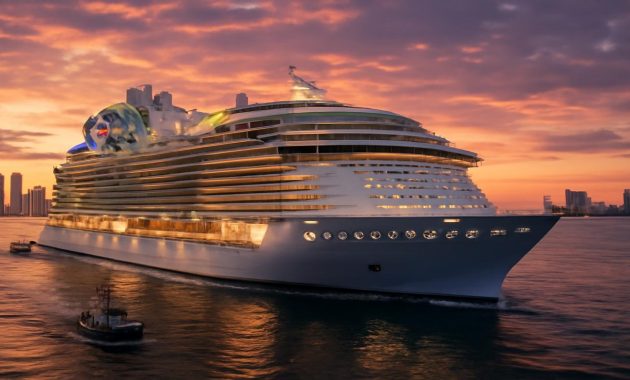
The harbor wakes before the sun. Steel murmurs, gulls argue, and somewhere in the half-light a low horn rolls across the water like distant thunder. People pause on piers, on balconies, at open hotel windows, clutching coffee cups in both hands. They are waiting for something too large to hide, too loud to ignore—a floating city about to take its first breath. When the world’s largest cruise ship eases away from the dock for the very first time, it is not just a ship that moves; it is the horizon itself, shifting.
When a City Lets Go of the Shore
At first, it doesn’t feel real. The ship has been docked here for days, towering above the port like a glass-and-steel cliff, a vertical neighborhood painted in blues and whites. Standing on the pier, you can’t see it all without tilting your head back as if you’re looking up at a skyscraper. Balcony upon balcony, deck upon deck, stacked like shelves of light.
There is the faint, briny smell of the harbor. Diesel and seaweed mingle with roasting coffee wafting from a café that opened early just for this morning. A boy in an oversized sweatshirt leans against the rail, eyes wide as he traces the ship’s name with his lips in a whisper, as if saying it out loud might summon it into motion.
Somewhere on the high decks, invisible from the pier, thousands of passengers are finding their way. Suitcases rattle. Elevators sing their gentle chimes. Crew members slip down hallways in purposeful silence, fixing a sign here, smoothing a wrinkle there, tightening the last details of a project that took years of engineering and negotiation and dreaming. This is the moment those late nights were written for.
You can sense it before it happens—the way the air thickens with a shared intake of breath. And then the horn sounds, long and low, cutting through the chatter and phone cameras and gull cries. Conversations stop mid-sentence. Everyone looks up, as if the ship might answer back with a second, deeper voice.
Slowly, almost tentatively, the lines fall away. The massive hull shivers with the energy of unseen thrusters pushing gently against the dark water. It’s like watching a glacier decide, after centuries, to dance.
The New Scale of “Big” at Sea
We thought we knew what “large” meant in the cruise world. We’ve seen ships with malls inside them, ships with ice rinks and rock-climbing walls, ships that look less like vessels and more like condensed resorts. And yet, as the world’s largest cruise ship now proves, our idea of “big” was only the prologue.
This ship, on her debut departure, carries the kind of numbers that sound like exaggeration until you walk her corridors. She stretches longer than some of the world’s tallest towers laid neatly on their sides, longer than several city blocks sewn together. Standing at the bow and looking back, you hardly see the stern; it fades into a perspective trick, the way train tracks vanish into a point.
The scale becomes more intimate when you count people instead of meters. On board are thousands of guests, enough to populate a small town; add in crew from every corner of the globe and the ship becomes a living tapestry of languages, traditions, and backstories. Kitchens will serve more meals in one day than some restaurants do in a year. Pools will circulate more water than a neighborhood’s worth of backyards. The ship can produce its own freshwater, manage its own power grid, handle its own waste—an autonomous floating infrastructure designed to roam the planet’s edges.
To capture the sheer sense of magnitude, it helps to line this new giant up against familiar references:
| Feature | World’s Largest Cruise Ship | Everyday Comparison |
|---|---|---|
| Approximate Length | Over 360 meters (1,180+ ft) | Longer than 3 football fields |
| Passenger Capacity | 5,000–7,000+ guests | Population of a small town |
| Total Persons on Board | Upwards of 8,000 including crew | Equivalent to a packed arena |
| Number of Decks | 20+ total, 15+ for guests | A high-rise building on its side |
| Onboard Dining Venues | Dozens of restaurants & bars | Comparable to a city food district |
But numbers, as impressive as they are, don’t quite capture how it feels to be part of her first sailing. For that, you need the texture of lived experience, the small details you can’t measure in feet or tons.
The First Walk Through a Floating World
Boarding for the inaugural voyage feels like entering an airport, a shopping mall, and a theatre backstage all at once. There’s the familiar choreography of scanners and boarding passes, but it leads not to a gate, rather to an air-conditioned doorway that opens into a soaring interior space. Light pours down from a glass dome overhead. A grand atrium hums with the low roar of luggage wheels, overlapping introductions, and the faint clink of glasses as the first celebratory drinks are poured.
The scent inside is its own blend: polished wood, new upholstery, roasted coffee, a hint of citrus from freshly cut fruit arranged at a juice bar already open and bustling. Somewhere, music spills from hidden speakers—a soft, upbeat soundtrack timed perfectly to the pace of discovery.
You step onto a promenade that doesn’t feel like the inside of a ship at all. It feels like a narrow, lively street in a modern city. There are storefronts with curated window displays; a pastry shop where trays of still-warm croissants glisten under glass; a bar with a polished brass rail catching reflections of passersby. Above, balconies lean in like city apartments, guests peering over the edge like new residents surveying their neighborhood.
Every few steps, an unexpected detail appears: a living wall of greenery climbing several decks high. A sculpture that bends light into strange and beautiful shapes. A quiet nook with oversized chairs facing the sea, where early birds have already claimed their first view of open water.
You ride a glass elevator, watching decks slide past like chapters in a book. One level reveals an entire water park, slides coiling in neon curves, pools shimmering aquamarine. Another is home to a theater with a stage large enough to host full-scale productions—musicals, acrobatics, live bands that will play late into warm nights. Higher still, you glimpse an observation deck with floor-to-ceiling windows, a sanctuary for sunrise watchers and stargazers.
On the very top, the smell changes. Up there, the wind wins. You taste salt. You hear flag lines snap in the gusts. The city you boarded fades behind you; the ship now feels fully, undeniably, at sea.
A Milestone for the Cruise Industry
More Than Just Another Big Ship
This launch is not simply about winning a contest of size. It marks a culmination—and a turning point—in how the global cruise industry sees itself and its future. For decades, the race has been to build bigger, brighter, more spectacular vessels. Each new flagship became a testament to what engineering could do: taller atriums, larger theaters, more pools, more everything.
But as this new giant sets sail, there’s a sense that what she represents goes beyond capacity counts and deck plans. She embodies a changing expectation: that a cruise ship must be not only a destination in itself but also a statement of responsibility, of efficiency, of adaptation to a planet in flux.
Industry leaders have spent the years leading up to this moment navigating a rapidly shifting seascape. Environmental regulations have tightened; traveler values have evolved. There is more conversation now about carbon footprints, about fuel choices, about how tourism touches coastal communities and fragile ecosystems. Relief and pride mix in the voices of the executives watching from VIP terraces as the ship moves away. Their glittering dream has to live up to more than just guest reviews—it must meet a test of conscience.
Engineering at the Edge of Imagination
Inside the ship’s restricted areas—the ones most passengers never see—a parallel world hums with precision. Control rooms glow with wall-sized screens tracking power loads, navigation data, and real-time weather patterns. Below those, labyrinths of corridors house machinery carefully calibrated to keep an entire mid-sized city running around the clock on a moving platform.
Redesigned hull lines and advanced propulsion systems aim to push through the water with less resistance, sipping rather than gulping fuel compared to their predecessors. There may be alternative fuels blended into the tanks, systems that reclaim heat to power onboard operations, and waste management facilities that resemble small, efficient factories more than the old image of a ship’s “engine room.”
For naval architects and marine engineers, this ship is a manifesto carved in steel: proof that complex, luxury-driven human experiences can be balanced, at least in part, with a more careful footprint. It is not perfection—but it is a direction, and that matters.
Life On Board: A Day in the Floating City
Morning Light on the Wake
On the second morning at sea, the ship awakens slowly. The early risers find themselves on open decks bathed in a pale, peach-colored light. The horizon is a clean line, no land in sight, only the long white scar of the wake trailing behind like the tail of a comet.
Joggers circle the upper track, the soft thud of their shoes swallowed by wind. In a corner, a yoga class moves through a sequence facing the sunrise, mats lined up in careful rows, the instructor’s voice barely audible over the rush of air. Camera shutters click as the sun breaks free from the ocean’s lip.
Down in the dining halls, breakfast smells like every morning from every corner of the world colliding: strong coffee, miso broth, freshly baked bread, sizzling bacon, ripe mango, and pineapple. Families cluster at tables, mapping out their day with the help of printed schedules and apps, pointing at water slides, craft sessions, dance classes, lectures on marine life, cooking demonstrations. There’s an almost childlike joy in realizing you don’t need a car or a map to reach any of it—just time and curiosity.
Afternoons of Endless Choices
By midday, the ship is a hive. At one end, the pool decks explode with laughter and splashes, live music pouring over rows of sun loungers. At another, tucked behind thick glass, a quiet library offers a sanctuary for readers, the gentle rocking of the ship turning pages into lullabies.
In a sheltered courtyard, you might find an open-air café shaded by trees whose roots never touch soil, their branches coaxed to grow in carefully maintained planters. It smells of espresso and sunscreen. Nearby, children squeal as they chase each other across a splash pad; couples linger over late lunches of grilled seafood and cold white wine.
Elsewhere, there are workshops happening: a bartender teaching the fine art of a perfect citrus twist; a naturalist explaining the migratory routes of whales and sea turtles that share these waters with the ship; an art instructor guiding hesitant hands over blank canvases as the ocean outside provides the only model they need.
Nightfall in the Mid-Ocean City
As evening falls, the ship transforms again. The decks glow, a floating constellation moving across dark water. Soft golden lights spill from restaurant windows, silhouettes of diners flickering by like shadow plays. The air carries a new mix: grilled meats, perfume, the faint tang of salty hair on sunburned skin.
The theaters fill. Curtains rise on acrobats who twist through the air with a backdrop not of plywood but of real, moving sea glimpsed through distant portholes. Live bands tumble through covers and classics. A pianist in a quiet lounge coaxes old standards from the keys while waves whisper beyond the glass.
Later, when crowds thin and most families drift toward their cabins, a different quiet takes hold. On the highest open decks, you can stand at the rail, feel the wind tear at your clothes, and look up to a sky almost clean of competing light. The ship’s own glare fades at the edges; stars pierce through. If you’re lucky, you might see the flash of bioluminescence in the bow wave, tiny organisms ignited by the ship’s passage, galaxies above and below.
In moments like these, the scale flips again. The world’s largest cruise ship, with all its decks and restaurants and theaters, becomes something small—almost fragile—against the endless black plain of the ocean. Its greatness is suddenly not its size but its audacity: the idea that humans dared to build a radiant, self-contained world and send it sliding across this vast, indifferent water.
Questions in the Wake
The Balance Between Wonder and Responsibility
For every gasp at the ship’s grandeur, there is an echoing question: can an industry built on leisure and abundance truly coexist with the limits of a warming, crowded planet? The launch of such a colossal vessel throws that tension into sharp relief.
Cruise lines have begun to talk more openly about their environmental strategies—about cleaner fuels, advanced wastewater treatment, reduced single-use plastics, and partnerships with ports to manage visitor flow. This new flagship, with its efficient design and high-tech systems, will be held up as evidence of progress.
Yet, the questions remain important. Travelers, increasingly, are asking not just where a ship is going but how it gets there, what it leaves behind. The ship’s first voyage becomes a kind of global test—can this symbol of excess also be a symbol of evolving ethics?
As she moves from port to port, she will carry not only passengers and luggage but also expectations. The world will be watching: for the data, for the compromises, for signs that the industry can keep its promises to the seas that made it possible.
Why This Moment Matters
In a decade, there will be other big ships, other launches, other milestones. Records, by their nature, invite challengers. But this first sailing of the world’s largest cruise ship lands at a particular crossroads of time: after years of turbulence for global travel, amid accelerating environmental urgency, during an era in which people are rethinking what it means to move across the world for pleasure.
For some, the sight of this gleaming giant sliding away from the pier will trigger nostalgia—a reminder of simpler days when ocean liners were symbols of hope and adventure. For others, it will spark critique, a visible embodiment of a lifestyle that must evolve quickly if it is to remain defensible.
Yet, walking her decks, watching families reunite, strangers strike up conversations, and first-time travelers taste their first open-ocean sunrise, it’s hard to deny the raw human hunger this ship answers: the desire to be carried somewhere, to be cocooned in comfort while the unknown stretches in every direction.
In that sense, this ship is less a final destination than a question mark carved in steel: How big can we dream? How gently can we tread? How can we design our pleasures so they honor the world that makes them possible?
Back at the pier where it all began, the harbor quiets after her departure. The gulls reclaim their sky. The coffee cools. Somewhere, a child stares at the empty berth and imagines the ship just beyond the horizon, a glittering line inching across a blue map. For that child—and for all of us—this historic voyage is a reminder that the sea is still a place where we write the next chapters of our shared story, in wakes and currents and the slow, steady arc of a ship that dares to be the biggest of its time.
Frequently Asked Questions
Why is the first sailing of the world’s largest cruise ship considered historic?
It marks a new high point in shipbuilding and hospitality, combining record-breaking size with advanced engineering, complex logistics, and evolving environmental standards. It reflects how far the cruise industry has come—and how it is trying to adapt to modern expectations.
How many people can the world’s largest cruise ship carry?
Depending on final configuration, the ship can host several thousand guests—often between 5,000 and 7,000—plus a multinational crew that brings the total number of people on board to well over 8,000, comparable to a small town or packed stadium.
What kind of experiences are available on such a large ship?
Guests can explore a wide range of venues: multiple pools and water parks, theaters, live music lounges, fine dining and casual eateries, sports facilities, spas, kids’ clubs, quiet libraries, observation decks, and dedicated spaces for learning, art, and wellness.
How does a ship this big affect the environment?
Large cruise ships consume significant resources, but the newest vessels also tend to feature the most advanced efficiency measures: optimized hulls, modern propulsion, improved wastewater treatment, and efforts to lower emissions. The overall impact depends on how effectively these systems are designed, maintained, and continuously improved.
Is bigger always better when it comes to cruise ships?
Not necessarily. Larger ships offer more variety and amenities but can feel overwhelming to some travelers. Smaller ships provide a more intimate atmosphere, access to different ports, and often a different style of travel. The “best” size depends on personal preference and the type of journey you want to have.