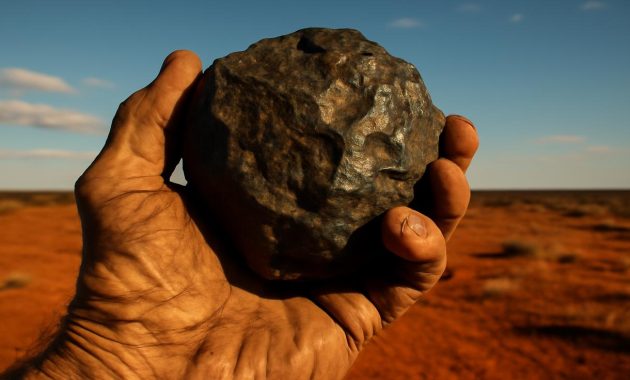
The rock in David Hole’s hand was impossibly heavy. It sat in his palm like a secret, dense and silent, its skin the color of dried blood and rust. The winter air in the Australian bush bit at his cheeks, but he barely noticed. His metal detector lay forgotten by his boots, still humming softly. Out here, under a sky that had just shrugged off dawn, he was sure he’d found it at last—gold.
The Man Who Went Looking for Gold and Found the Cosmos
For years, David had walked the scrubby fields of Maryborough, not far from Melbourne, listening to the soft chatter of his detector. Every beep meant possibility. Every dig brought up more dirt, more stones, more disappointment. But this—this was different.
The rock had turned the detector wild, shrieking with that urgent, insistent tone that makes a prospector’s heart jump. He’d kicked aside dry grass, scraped at the soil, and there it was: a smooth, oddly molded lump of rock, darker than the earth that had cradled it.
He shifted its weight from hand to hand, testing it. Smaller than a football, but astonishingly dense. Heavy, as if it carried something more than mass—something like gravity itself.
“This has to be it,” he muttered to the empty paddock. “Has to be.”
In this part of Victoria, the ground holds stories of fortune. The 19th-century gold rush once set these fields ablaze with feverish hope. Men had crossed oceans for a chance at glittering veins buried in red soil. David liked to imagine them sometimes, sweating under the same sky, pulse racing at the sight of gold dust in a pan.
Now it was his turn, he thought. His moment. Because what else could ring so loud beneath the detector and sit so heavy in his hand, if not gold?
The Rock That Refused to Break
Back home, David laid the rock on a workbench. Even indoors, it looked like it belonged somewhere else—too dense, too dark, its surface dimpled and smoothed as if it had been sculpted by fire. Under the harsh garage light, it gleamed faintly, a muted metallic sheen beneath the rust-colored crust.
He tried the obvious first. A hammer. He braced the rock and swung down hard.
The blow echoed. His wrist stung. The rock didn’t even flinch.
He tried again, then again, the sound dull and stubborn. No cracks. No flakes. No glittering flash of gold.
“You’ve got to be kidding me,” he said under his breath.
Over the following days, he threw everything he could at it: a heavier hammer, a saw, even an angle grinder. Sparks flew, metal rang, but the rock just sat there, indifferent to his effort. Like a secret that would not open.
Finally, he tried chipping away a small piece with a chisel. The steel bit skidded. Tiny dents marked his tools; the rock remained smooth.
It was maddening. Precious things were supposed to be delicate, fragile—gold bends, gold scratches, gold surrenders. This thing? It was like beating on bone from some impossible animal.
After months of failed attempts, the thrill faded. Maybe it was just an unusually hard ironstone. Maybe the detector had oversold its promise. The rock ended up shoved into a corner of the yard, then the house, occasionally moved, never forgotten. A mystery wrapped in frustration.
When a Rock Starts to Feel Like a Question
Years passed. Life went on. The rock traveled with him, not because it was useful, but because it refused, in a way, to be thrown out. There was something in its weight that nagged at him—an unfinished sentence, a book left open.
At some point, curiosity pulled harder than disappointment. Maybe, he thought, it was time to ask someone else.
He carried the rock into the Melbourne Museum one day, walking past glass cases of fossils, gemstones, taxidermy, and bones. It felt strange to hold something so ordinary-looking in a place filled with curated wonders.
A geologist took it from him, cradling it with care. They’d seen plenty of “maybe gold, maybe meteorite” rocks before—hundreds, if not thousands. Almost all of them turned out to be just rocks. Earth-bound, unremarkable, misread by hope.
Still, something about the density, the smooth, melted exterior, the magnetic pull of the rock made the geologist pause.
“We’ll take a closer look,” they said. “No promises. But it is interesting.”
Inside the Stone: A Story Older Than Earth
In the lab, the rock finally met its match—not a hammer, but a saw designed to carve through the hardest stone with precision. A small slice was carefully extracted, polished, and slipped under the lens of a microscope.
What lay inside was not gold. It was something far rarer.
Under magnification, the rock revealed a shimmering network of tiny metallic flecks reaching through a dark, dense matrix. There were no neat crystals, no familiar mineral patterns. Instead, it looked like a frozen storm—metal and stone fused by impossible heat and speed.
Tests followed: density measurements, chemical analysis, structural examination. Bit by bit, the story emerged.
The rock that had once been thought to be gold was a meteorite—a real one. Not just any meteorite, but a rare type known as an H5 ordinary chondrite. Ordinary, because it’s one of the more common classes found here on Earth. Extraordinary, because of what that actually means.
Chondrites are fragments of the early solar system. They formed before Earth was a planet, before there was even a stable orbit of worlds around the Sun. These rocks are the cosmic leftovers from a time when dust and ice and gas collided in a young, violent system, clumping slowly into planets.
Inside chondrites are chondrules: tiny spherical droplets that once floated molten in space before cooling into little glassy beads. Holding a chondrite is like cradling ancient fire—a memory of the solar system’s first, chaotic breath.
This particular meteorite, later studied and cataloged, weighed over 17 kilograms. A cosmic boulder that had traveled through vacuum, survived a plunge through the atmosphere, and buried itself in Australian soil until a curious man with a metal detector came wandering by.
The rock wasn’t just old; it was unimaginably old. Around 4.6 billion years. Older than any mountain on Earth. Older than the continents. Older than oceans, forests, or bones. It had watched, in its silent way, as planets formed, collided, and settled into their orbits.
And for years, it had sat quietly in a garage, resisting hammers.
From Outback Dirt to a Map of the Solar System
In a world obsessed with gold, you might think David would be disappointed. What he had found wasn’t precious metal, and it wasn’t going to fund retirement. But in another currency—the currency of wonder, of science, of story—it was arguably worth far more.
Researchers got to work. By analyzing the meteorite’s minerals and isotopes, scientists could reconstruct parts of its journey. The balance of metals inside—iron, nickel, and trace elements—matched other known H chondrites, suggesting it came from a particular type of asteroid belt object, a long-broken parent body circling the Sun between Mars and Jupiter.
They looked at how its crystals had been altered by heat and shock. Somewhere, billions of years ago, this rock had been part of something larger—hammered by collisions, maybe even partially melted in the aftermath of impacts. Eventually, a piece of that body was knocked free, drifting alone through deep time.
At some point, gravitational nudges—from Jupiter, from Mars, from other asteroids—pulled it onto a new course. Its orbit slowly decayed until one day, after perhaps millions of years looping silently around the Sun, its path intersected with Earth’s.
Then came its final plunge.
Imagine the sky over what is now Victoria, long before cities and roads, maybe even long before humans saw it. A sudden streak of light, silent at first, then a scream of atmosphere tearing at stone. The rock’s outer skin would have blistered and melted, forming that rust-colored, glassy fusion crust David first saw. It would have decelerated, slowed, and finally fallen, still hot, into the dirt.
There it waited. For centuries. For millennia. For someone with a coil of wire and a hopeful heart to walk near enough to hear its faint metallic echo from beneath the soil.
What Makes a Space Rock Different from an Earth Rock?
The difference isn’t always obvious at a glance. To an untrained eye, a meteorite can look like an oddly dark, lumpy stone, not much to fuss over. But hold one, and the weight speaks first. Many meteorites, especially iron-rich ones like David’s, are far denser than common Earth rocks.
Their outer surface is often smooth, with shallow dimples called regmaglypts—thumbprint-like marks carved by rushes of hot air as they blaze through the atmosphere. They may be slightly magnetic, the metal inside tugging at a compass or magnet.
Inside, the patterns deepen. Cut and polished, iron meteorites sometimes reveal crystalline lattices—Widmanstätten patterns—formed only when metal cools painfully slowly in the vacuum of space, over millions of years. Stony meteorites, the chondrites, show those tiny chondrules: beads of solidified cosmic magma, frozen mid-story.
Earth rocks, by contrast, are shaped by weather, water, pressure, biology. They have vein patterns from fluids, obvious layering from sediment, or minerals that form under very specific terrestrial conditions. Our rocks remember rivers, volcanoes, life. Meteorites remember something more primitive—dust, collisions, the wild infancy of a solar system coming into being.
A Pocket-Sized Time Capsule
What struck the scientists most about David’s meteorite wasn’t just its age, but its integrity. It was a relatively pristine piece of the early solar system that hadn’t been completely transformed by melting or reshaping. It carried, atom by atom, a kind of chemical time capsule.
Inside it, researchers could read ratios of certain isotopes—versions of elements with different weights—that act like cosmic clocks. Some record how long the rock’s surface was exposed to cosmic rays in space. Others preserve the original chemistry of the dust cloud that formed our Sun and planets.
By decoding these clocks, scientists refine their models of how fast planets formed, how long the early solar system stayed chaotic, when heavy elements were stirred into the mix. Rocks like this one from Maryborough become data points on a cosmic timeline.
In a way, the meteorite doesn’t just tell its own story; it tells ours. Because in the grand scheme, it’s not separate from us. The iron in your blood, the calcium in your bones, the silicon in your phone screen—all of it was once drifting through space, just like that rock, before gravity pulled it into something bigger.
A Story That Begins Before Stories
When word finally reached David that his stubborn rock was not gold but a fragment of the solar system itself, older than any human dream of treasure, he didn’t react the way a prospector disappointed by fool’s gold might. Instead, there was wonder.
He hadn’t just found a valuable object; he’d stumbled into a narrative that began long before the first human ever stared at the stars and wondered what they were. He’d reached down into Australian soil and picked up a page from a book written in the language of atoms and time.
The irony is easy to love: a man goes searching for wealth beneath his feet and ends up holding the sky instead.
In the museum, where the meteorite now lives as both specimen and story, visitors press their faces closer to the glass, trying to feel the distance between themselves and that rock. It isn’t really distance at all. It’s connection. That rock is not an intruder from “out there,” but a relative, older and more traveled, returning home.
Outside, in paddocks and deserts, in dry creek beds and rocky hillsides across Australia and the world, other pieces of the story still lie hidden. Many will never be found. Some will be picked up by children and pocketed as curiosities. A few will make their way into labs, where they’ll be sliced, studied, named, and entered into catalogs of objects that once shared space with the Earth before there was an Earth.
And somewhere, as you read this, a meteoroid is beginning its final journey, shifting in an ancient orbit, on its slow, inevitable way toward a blue planet it has circled silently for eons.
A Small Rock, a Larger Perspective
What lingers from David’s story isn’t just the science, but the shift in scale it invites. One day you’re walking through scrub, listening to a machine chirp in the hope of finding something shiny and human-sized: a nugget, a coin, a relic. The next, you’re told that what you dragged home and tried to crack open with a hammer is a survivor from before your planet had cooled.
Gold is formed in the hearts of stars and in the violence of neutron stars colliding, scattered and later gathered into planets like ours. Meteorites, too, are stellar children, but they arrive more directly, unrefined, less processed. Where gold feels like a finished sentence, meteorites feel like raw words, straight from the first draft of creation.
Holding one blurs the line between “up there” and “down here.” The sky is not just something above us; it is something we are made from, something that still falls to meet us.
Perhaps that’s why David couldn’t quite bring himself to throw the rock away, even when it steadfastly refused to turn into gold. On some level, without the language for it, he might have sensed that there was more to it than disappointment.
In the end, his greatest strike wasn’t a vein of gold buried in Australian soil, but a reminder of an older truth: that the universe is not distant. It is literally in our hands, under our feet, coursing through our blood, whispering in the dense, stubborn weight of a rock that traveled billions of years to land, quietly, in a paddock.
Quick Comparison: Gold Nugget vs. Meteorite
For anyone who’s ever wondered whether that strange heavy stone in the backyard is just a rock or something from beyond Earth, here’s how David’s cosmic find compares to the treasure he thought he’d found.
| Feature | Gold Nugget | Meteorite (Like David’s) |
|---|---|---|
| Origin | Formed within Earth’s crust | Formed in the early solar system, in space |
| Appearance | Bright yellow, metallic, often smooth and malleable | Dark, often rusty surface, may show dimples or fusion crust |
| Hardness | Soft; can be scratched or flattened easily | Very hard; resists hammers and common tools |
| Magnetism | Not magnetic | Often strongly magnetic due to iron and nickel |
| Value | Financial; traded as precious metal | Scientific and historical; a physical fragment of the early solar system |
FAQ
How did the Australian man first find the meteorite?
He was using a metal detector in the goldfields near Maryborough, Victoria, searching for gold. The detector gave a strong signal, and when he dug into the soil, he uncovered a very dense, dark rock that he initially believed might contain gold.
Why did he think it was gold at first?
The rock was extremely heavy for its size and triggered a powerful response on his metal detector—both signs that usually point toward metal, such as gold. In gold-rich country, that combination can be very convincing.
What made the rock so difficult to break?
The meteorite was rich in iron and nickel and had been forged under immense pressure and heat in space. These conditions make many meteorites far tougher than common Earth rocks, so ordinary tools like hammers and saws barely scratch them.
How did scientists know it was a meteorite?
Geologists at the museum analyzed its structure, density, and chemical composition. They examined a cut and polished slice under a microscope and ran tests that showed it matched the characteristics of an H5 ordinary chondrite—a well-known type of stony meteorite.
How old was the meteorite he found?
The meteorite is estimated to be around 4.6 billion years old, roughly as old as the solar system itself. It formed before Earth had fully taken shape as a planet.
Is a meteorite like this worth more than gold?
In terms of raw market price per gram, gold is usually more straightforwardly valuable. But a rare, scientifically significant meteorite can be priceless to research and museums. Its true worth lies in the information it carries about the early solar system, not just in what someone might pay for it.
Can ordinary people find meteorites too?
Yes. Many meteorites have been found by farmers, hikers, children, and amateur prospectors. They’re easier to spot in dry, open areas—like deserts, ice fields, or sparsely vegetated plains—where dark, dense rocks stand out more clearly from their surroundings.
How can I tell if a strange rock might be a meteorite?
Common signs include unusual heaviness, a dark or burned-looking exterior, possible magnetism, and a generally smooth, sculpted surface. However, many Earth rocks can mimic these features, so the only way to know for sure is to have it examined by a geologist or a museum with expertise in meteorites.
What did scientists learn from this particular meteorite?
By studying its minerals and isotopes, scientists gained more insight into the composition and history of its parent asteroid, as well as conditions in the early solar system. Each meteorite adds another piece to the puzzle of how planets—including Earth—formed and evolved.
What happened to the meteorite after it was identified?
It became part of the museum’s collection, where it is preserved, studied, and sometimes displayed to the public. There, it continues its journey—not through space this time, but through human imagination and understanding, as a tangible fragment of the cosmos we can see and, if we’re lucky, stand close enough to almost touch.