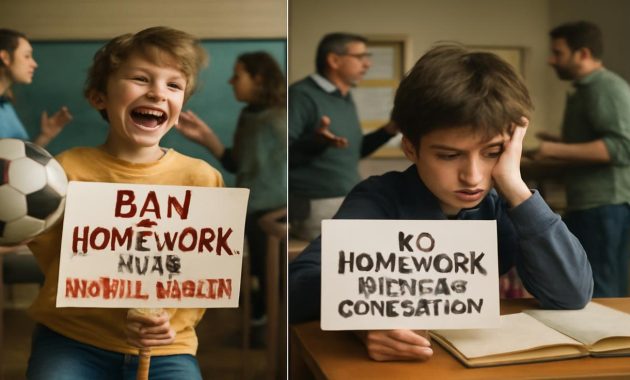
On a wet Tuesday afternoon, the rain hit the school windows like a slow, tired drum. Inside, thirty children hunched over glowing screens, fingers tapping, minds already far from the gray sky outside. On one desk lay a crumpled note from a parent: “Please excuse Lily from homework this week. It’s affecting her mental health.” The teacher folded the note, feeling a familiar twist in her chest. She thought of Lily’s quiet anxiety, her bitten nails, her too-heavy backpack. She also thought of the slow, steady muscle that practice builds—the kind you can’t see in the mirror, the kind that forms in the space between “I’m tired” and “I’ll try again.”
War over homework used to be a low hum—parents grumbling at the kitchen table, kids rolling their eyes, teachers negotiating minutes and pages. Now it sounds more like a siren. “Ban homework to save childhood!” shout some. “Keep it to build resilience!” shout others. Stuck in the middle are actual children, modern childhood itself, and an uncomfortable question that nobody really wants to answer: if we remove the friction that shapes them, who pays the price later?
The new battlefield: living rooms, not locker rooms
Once upon a time, childhood battles were fought in backyards, tree houses, and makeshift forts. Today, they’re fought in living rooms, with homework sheets, therapy referrals, and school policy emails as the weapons of choice. A generation of parents, themselves raised on “no pain, no gain,” now watch their children bend beneath academic pressure and wonder if they’ve led them into the wrong war.
We know more than ever about children’s mental health. We can name anxiety disorders once dismissed as “shyness,” we can measure cortisol and attention spans, we can count hours of sleep stolen by blue light and busy schedules. The numbers are worrying: more children reporting stress, more teens reporting burnout before they even touch adulthood. So the rallying cry to ban homework arrives with the clean logic of a well-sharpened pencil: take away one obvious stressor; you’ll ease the strain.
Parents imagine the reclaimed hours: their child biking with friends at dusk, reading for pleasure, building Lego cities, learning to cook, simply breathing. Teachers imagine evenings without marking, a school day that contains the whole learning experience, not just the prologue. It feels merciful. Humane. Modern. In the warm glow of possibility, homework looks like a relic of a harsher age, like making kids chop wood to “build character.”
But there’s another current running beneath the surface, one that doesn’t photograph well in advocacy campaigns. It’s the ancient, unpopular truth that growth is rarely comfortable. Muscles—mental, emotional, physical—are forged in the places where comfort ends. Homework, for all its clumsy worksheets and tedious chapters, has long been one of those uncomfortable edges.
The quiet work that nobody sees
Watch a child doing homework and you don’t just see schoolwork. You see small, unseen negotiations with themselves. They weigh the temptation of the tablet against the demand of the math sheet. They wrestle with boredom, confusion, frustration. They pause, ask for help (or don’t), correct a mistake, and try again. The finished assignment is only the visible tip of the work; the rest is hidden, like roots threading silently through dark soil.
When advocates call for banning homework to save mental health, they’re responding to real pain—but often to the loudest, most obvious layer of it. What we rarely talk about is this quieter layer: the way structured struggle can inoculate children against a world that will not stop demanding things of them once the bell rings for the last time.
Here’s the tension we rarely name out loud: mental health and mental strength are not the same thing, but they lean on each other. Protecting a child’s nervous system from chronic overwhelm is an act of love. But shielding them from manageable challenge can become something else entirely—a soft, well-meaning trap.
| Homework Role | Supports Mental Health | Risks to Mental Health |
|---|---|---|
| Building routine and predictability | Gives structure, creates sense of safety and control | Can feel suffocating if time is overloaded |
| Practicing focus and perseverance | Strengthens attention, frustration tolerance | May trigger anxiety if expectations are unrealistic |
| Connecting home and school | Invites parent involvement, shows progress | Can intensify family conflict and comparison |
| Preparing for adult responsibilities | Teaches deadlines, accountability, time management | If overdone, blurs line between childhood and work |
Erase homework entirely, and you don’t just erase stress; you erase practice. You smooth out one of the early, low-stakes ways children learn to carry discomfort without collapsing under it.
The fear behind the ban: are we breaking our kids?
Behind petitions to ban homework, there’s often a parent’s quiet panic: What if this is the thing that breaks my child? The meltdown at 9 p.m. over a reading log. The stomachaches before school. The flat, dull look in a teenager’s eyes after four hours of assignments. These are not imagined harms. They’re real, and they leave marks.
We’re living through a moment where childhood feels under siege from all sides: social media, climate dread, academic pressure, economic uncertainty. In that crowded field of threats, homework stands out because it’s something adults can actually change. We can’t switch off the economy or slow the internet, but we can tell schools: this, at least, you must stop.
Yet mental health is not improved by just subtracting burdens; it’s improved by changing the nature of them. Banning homework altogether is a clean, dramatic solution in a world addicted to clean, dramatic solutions. It’s much harder work to ask: How much is too much? What kind builds capability instead of corrosion? How do we teach children to rest without teaching them to retreat from every difficult thing?
There’s another fear in the room too, less comfortable to admit. It whispers: If we keep making everything easier, will they ever be strong enough to stand without us?
Will a homework-free childhood grow softer adults?
Imagine two twelve-year-olds on a late autumn afternoon. The first trudges home from school, dumps a backpack heavier than he is, and sits for two hours doing repetitive worksheets. His head aches; his hand cramps. He learns mostly that learning is a chore to be survived. The second drifts home, drops a light backpack on the floor, and collapses onto the couch with a tablet. There are no assignments, no obligations, no reasons to push against the warm gravity of convenience. She learns mostly that rest is the default state, and effort something optional and negotiable.
Between these extremes lies the uncomfortable sweet spot that modern life keeps missing: enough demand to provoke growth, not enough to crush it. But in the loud argument over homework, nuance keeps getting shoved aside. “More” and “none” shout at each other across the playground while “better” waits, mostly ignored, by the swings.
The danger of a homework-free generation is not that they’ll be stupid; curiosity finds other ways to feed itself. It’s that they may grow up with underused muscles of discipline, delayed gratification, and sustained attention. These are not fashionable virtues. They do not trend. But they are the quiet machinery behind every essay written at midnight in college, every job application finished after a long shift, every relationship repaired after a painful argument instead of being abandoned for something easier.
We worry, with reason, that homework is burning kids out. We talk less about the subtle ways that removing all structured challenge can hollow them out. Emotional fragility doesn’t only come from too much weight on the shoulders; sometimes it comes from never having to carry anything heavier than what you feel like doing in the moment.
Kindness with a cost: who carries the bill?
It’s tempting to treat homework as a simple transaction: remove it now, children feel better now. But childhood is a long game, and someone always pays the tab eventually. If a generation grows up less practiced at tolerating frustration, less familiar with finishing unpleasant tasks, less capable of sitting with boredom or confusion, that cost doesn’t vanish; it shifts.
Some of the invoice will be mailed to teachers, asked to remediate skills that used to grow in the quiet hours after school. Some will be mailed to employers, who inherit young adults fluent in feeling overwhelmed but less fluent in organizing themselves through that overwhelm. Some will land in therapists’ offices, whose waiting rooms already hum with the weight of young people who were promised that wellness meant never feeling strain, and now feel betrayed by their own lives.
And some of the bill will come back to the children themselves, later, when choices get harder and stakes get higher—when there is no parent to write a note, no teacher to adjust the policy, no principal to ban the discomfort. Work still needs doing. Rent still needs paying. Relationships still need tending when both people are tired and frustrated.
Kindness isn’t free. When we remove all friction from a child’s path, we’re not erasing it from existence; we’re simply delaying it, pushing it out into a future where they’ll face it with fewer skills, fewer scars, and less faith in their own resilience.
What if we’re asking the wrong question?
“Homework: yes or no?” is a satisfying question because it has the shape of a switch. On. Off. Good. Bad. End of debate. But childhood doesn’t work on binary, and neither does mental health. The more unsettling, useful questions sound more like these:
- What kinds of homework genuinely deepen learning rather than just filling time?
- How many minutes of meaningful challenge can a child handle before it flips into corrosion?
- Which children are actually being harmed by current practices, and what targeted changes would protect them without blunt-force policies for everyone?
- How do we build in homework that strengthens autonomy—choice of topic, pace, approach—instead of only obedience?
Picture a different sort of assignment: a weekly “wonder log” where students must notice something outside—a crooked branch, an ant hill, the way the light shifts in late afternoon—and write about it for ten minutes. Or a slow-building project where they interview an older relative, map family recipes, track neighborhood birds, build a budget for a dream trip. This is homework, too. It still asks them to return to a task across days, to plan, to shape effort into something finished. But it also respects their humanity, their bodies, the world beyond the worksheet.
Banning homework risks throwing all of this out along with the busywork. It treats the tool as the enemy, instead of interrogating the way we wield it.
Setting limits without erasing effort
There’s a way to protect children’s minds without softening their spirits to the point of collapse. It looks less like a crusade and more like a series of careful, sometimes boring adjustments: caps on total minutes per night, protections for weekends and holidays, explicit instruction in how to plan and break tasks into pieces, open communication about what’s actually happening around kitchen tables once the assignments leave the classroom.
It also looks like teaching children what effort feels like in their bodies: the weight in the limbs, the flutter of impatience, the stretch of focus—and naming that these sensations are not emergencies. They are the physical language of growth. We can teach them: this discomfort has a boundary. It will end. You can move through it. And when it gets too loud, we can teach them to rest without quitting, to pause without deciding that anything hard is automatically harmful.
The work of the adults—parents, teachers, policymakers—is to shape the conditions around that growth. Not by removing every challenge, and not by glorifying grind at all costs, but by guarding that narrow, living edge where effort strengthens instead of shatters.
In the end, what do we owe our children?
On that rainy Tuesday, the teacher who folded Lily’s note didn’t ban homework for the class. But she didn’t ignore it either. She called Lily’s mother after school. They talked about panic and perfectionism, about late nights and tear-stained worksheets. Together, they agreed on something messy, unsatisfying to slogans: for a while, Lily would do less homework, but not none. Five math problems instead of twenty. One page of reading instead of four. A gentle slope instead of a cliff.
Lily still came home to a backpack that asked something of her. But now, the questions it asked were sized for her actual nervous system, not for some abstract policy. She learned—slowly, with setbacks—that she could start something she didn’t feel like doing, tolerate the flutter of anxiety, and finish anyway. Her mother learned that protection doesn’t always mean evacuation; sometimes it means walking beside your child into the hard place, staying long enough to show them they can survive it.
As a culture, we stand in a similar doorway. We can slam it on homework entirely, call it an act of liberation, and feel the brief relief of having done something clear and bold. Or we can do the slower, less glamorous work of remaking it into a tool worthy of the children who carry it home.
We do owe our children kindness. But not the kind that wraps them in bubble wrap and then watches, years later, as real life pops every fragile seam. We owe them a fiercer kindness, one that allows them to meet difficulty early, in small, supported doses, while we are still close enough to catch them if they falter.
If we refuse to let them practice that now, if we declare all friction intolerable in the name of mental health, the world will still demand work of them. The only difference will be how prepared they are to answer. When that bill arrives—and it will—let it show that we spent their childhood not just protecting them from pain, but apprenticing them to their own strength.
FAQ
Does homework really improve academic performance?
Research suggests that moderate, well-designed homework can improve understanding and long-term retention, especially for older students. For younger children, the benefits are smaller and often depend more on the quality and type of homework than on the sheer amount of time spent.
Is homework always bad for children’s mental health?
No. Excessive or poorly designed homework can contribute to stress and anxiety, but reasonable amounts of thoughtful homework can support confidence, routine, and a sense of competence. The impact is strongly shaped by workload, family dynamics, and the individual child’s temperament.
How much homework is considered “too much”?
A common guideline is about 10 minutes per grade level per night (for example, 30 minutes in 3rd grade, 60 minutes in 6th). More than this, especially on a regular basis, can start to interfere with sleep, play, and family time—key pillars of mental health.
What can parents do if homework is overwhelming their child?
Parents can observe and document how long homework actually takes, then share this with teachers. They can request adjustments, help their child break tasks into smaller pieces, establish a calm, predictable homework routine, and watch for signs of genuine distress that may warrant deeper support.
Is banning homework the only way to protect children’s mental health?
No. Alternatives include limiting total homework time, prioritizing meaningful projects over busywork, protecting weekends and holidays, and explicitly teaching students time-management and coping skills. These approaches aim to preserve the benefits of challenge while reducing unnecessary harm.