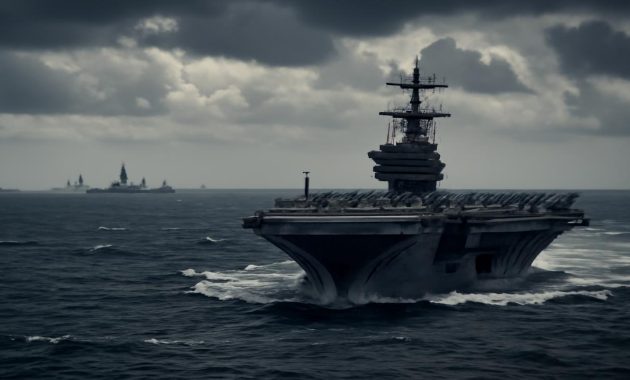
The sea looks deceptively calm the morning it begins—an expanse of silver-blue stretched to the horizon, slow-breathing under a high, white sky. Flying fish stitch quick, bright arcs across the surface, and a thin wind runs its fingers along the swells. If you were drifting out here in a small wooden boat, you might think this place was made only for tides and clouds and the steady, ageless pulse of waves. But today, far from any sandy beach or city skyline, steel and radio signals are rewriting the mood of the water. On one side, a column of Chinese warships pushes steadily through contested seas; on the other, an American aircraft carrier, vast as a floating city, draws closer—its wake a pale, unsettled scar across the ocean’s skin. Between them hangs a silence so tight it hums, a silence threaded with radar pings, coded messages, and thousands of human heartbeats waiting to see who yields first.
Steel on the Water, Ghosts in the Map
If you pulled back high above the Pacific, the scene would look almost abstract: small gray forms inching across an endless blue canvas. But the coordinates tell a different story. This patch of sea—unmarked to the naked eye, unscarred except by wind and wave—is one of the most disputed stretches of water on Earth. Somewhere below, coral reefs bloom in hidden gradients of green and gold, fish move like quicksilver, and seamounts rise like drowned mountains. Yet on maps in Beijing, Washington, Manila, Hanoi, and beyond, this is a place inked in arguments.
The Chinese fleet doesn’t move like a visitor; it moves like a landlord returning to a property it insists has always been its own. Ships in tight formation, hull numbers clean and white against gunmetal gray, signal masts bristling with antennas. Close by churn a cluster of auxiliary vessels—coast guard cutters, supply ships, and those blurry-category craft that look civilian from a distance but suddenly military through the sharp glass of a periscope or a spy satellite.
A few hundred nautical miles away, the American carrier group pushes westward. The carrier herself is enormous, almost mythic—decks buzzing with crew, elevators hissing, the smell of jet fuel drifting through labyrinthine passageways. Around her, escort ships slice the waves: destroyers, cruisers, a submarine somewhere underwater, unseen but never forgotten. The message is as clear as the day is hazy: freedom of navigation, support for allies, we will not be pushed away.
On a printed map it might look simple—two groups of symbols converging. But at sea, it feels messier, heavier, older than the flags fluttering above the decks. It feels like the ghosts of old empires and lost wars and half-remembered treaties have shown up too, crowding the horizon with invisible witnesses.
Voices in the Radio Hiss
“You Are in Our Waters”
Long before any headline flashes on a phone screen, the drama unfolds in the scratch and crackle of radio channels. A Chinese patrol vessel, white hull streaked with rust at the bow, hails the incoming American group. Somewhere on that ship, a young officer in a snug headset leans toward a microphone and, in carefully measured English, reads from a statement that’s been vetted and re-vetted.
“Foreign military vessel, you are entering waters under the jurisdiction of the People’s Republic of China. You are required to leave immediately…”
On the other side of the static, an American voice answers, bland and steady, like someone reading the terms and conditions.
“This is a United States warship operating in accordance with international law in international waters. We are conducting routine operations.”
The words are almost ritual now, spoken so many times they might as well be scripted theater. But behind every syllable is hardware that can’t be shrugged away—long-range anti-ship missiles cradled in vertical launch cells, fighters fueled and armed beneath carrier-deck canopies, torpedoes sleeping but ready in the shadowed tubes of submarines.
Out on those ships, sailors in faded uniforms and scuffed boots sip coffee that tastes of burnt metal and long hours, checking radar screens for subtle shifts: a course two degrees more aggressive, a speed increase that could mean nothing—or everything. Pilots pace under decks, helmets at their feet, wondering if today will be just another set of close passes and stern warnings, or the day someone misjudges distance and turns a near miss into a collision that lights up the global news cycle.
World Split by a Thin Blue Line
How the Same Sea Looks Different from Different Shores
Far from the contesting hulls, on land, the sea is turned into commentary. In Beijing, the official narrative is one of historical rights and national rejuvenation—a long storyline in which this maritime push is not escalation but correction. Old maps are displayed on glossy TV segments; viewers are told of fishing grounds “ours since ancient times,” of reefs and rocks that form a kind of watery homeland. To many Chinese citizens, the advancing fleet looks not like an aggressor, but a homecoming party finally refusing to be turned away at the door.
In Washington, the language is different. There the drama is framed as a test of resolve, a measuring of spines. Think-tank analysts sit beneath studio lights and talk of “freedom of navigation operations” and “deterrence signaling.” The carrier moving closer is presented as a stabilizing presence—proof that the United States will not allow any one country to turn shared sea lanes into a private moat. For some Americans, the idea of the carrier backing down feels like the first crack in a dam that’s held since the end of World War II.
Between those two capitals, smaller nations watch with a mixture of relief, unease, and something like quiet resentment. In the Philippines, Vietnam, Malaysia, and other coastal states, fishers tell stories of being chased, shadowed, or briefly detained. Yet they also depend on the very trade that sails through these same waters, on the power plays that keep shipping lanes open and insurance rates bearable. To them, both China and the United States can look like distant giants kicking up waves that swamp their modest boats.
Online, the world argues in every language. Some posts praise Beijing for refusing to bow to American pressure; others celebrate Washington for standing by allies and international rules. A single grainy satellite photo of ships in tight formation can be recast as defensive, provocative, or perfectly legitimate, depending on who’s editing the caption. It’s the same water, the same sky—yet in the theater of global opinion, everyone is watching a different play.
Comparing Key Perspectives on the Standoff
| Actor | How They Describe the Waters | Main Concern |
|---|---|---|
| China | “Historic maritime territory under our jurisdiction.” | Consolidating claims, projecting regional power, domestic pride. |
| United States | “International waters crucial to global trade.” | Freedom of navigation, credibility with allies, deterrence. |
| Coastal Southeast Asian States | “Lifeline for fishing, security, and national claims.” | Sovereign rights, economic survival, avoiding great‑power crossfire. |
| Global Traders & Shippers | “Artery for goods, fuel, and supply chains.” | Safe, predictable routes and stable insurance and fuel costs. |
| Ordinary Global Citizens | “A distant dispute that somehow affects prices and peace.” | Avoiding war, economic shocks, and long‑term instability. |
Close Passes and Held Breaths
When Meters Matter More Than Miles
The crisis is not a single thunderclap; it is a series of tiny, sharp cracks. A Chinese frigate alters course, a few degrees tighter than expected, crossing the projected path of an American destroyer. The distance between them shrinks rapidly—hundreds of meters, then less. Cameras on both sides are already running; clips destined for future press briefings and social media feeds are being born live, framed with jittery hands and pounding hearts.
On the American bridge, a junior officer swallows hard, eyes flicking between the digital display and the real, looming hull across the water. The captain’s voice cuts through the air—calm but edged: “Maintain speed, slight turn to port, keep separation.” On the Chinese ship, someone barks an order that snaps the vessel a few degrees off vector at the last moment. In the gap between calculation and panic, the sea responds with only a modest churn, but in human minds the moment detonates into a jolt of pure adrenaline.
Later, each side will release its own version of the event. One will talk of dangerous maneuvers, the other of rightful warnings. Diagrams will appear: colored arrows, measured distances, annotated timelines. But none of them will quite capture the raw, animal feeling of watching another enormous vessel bearing toward you across such a small scrap of ocean, knowing that tons of steel and fuel and explosive potential are moving on the strength of human decisions that could be nudged off course by ego, miscommunication, or simple fatigue.
Overhead, reconnaissance planes trace long, invisible loops. Their crews squint at screens full of blips and heat signatures, translating patterns into narratives: this many ships, that kind of formation, such-and-such distance from disputed features. Every movement is a word in a conversation that doesn’t admit silence. Back in operations rooms thousands of kilometers away, these words are strung together into briefings. Somewhere a leader reads them and decides whether to dial back or double down.
Nature Doesn’t Care Who Owns the Reef
Life Below the Tension Line
Meanwhile, under the waves that everyone is arguing about, life continues with quiet insistence. Shoals of sardines twist and turn in unison, their silver bodies flashing like coins under shifting light. Sea turtles graze on seagrass meadows, utterly indifferent to national boundaries. On the slopes of coral reefs, tiny cleaner wrasses pick at the scales of massive groupers with the assurance of longstanding contracts.
Yet even these deep places feel the tremors of tension. Naval exercises stir up sediment that drifts like smoke, settling on coral like a slow suffocation. Sonar pulses, sharp and metallic, travel farther than shiplights can reach, disorienting whales and dolphins whose world is built from sound. Oil and trash sometimes follow in the wake of big fleets, caught in eddies, drifting toward coasts that were never asked to host these technological parades.
For coastal communities, the stakes are not measured in diplomatic “wins” but in the size of the catch brought home at night, the price of fuel to reach rich grounds, the fear of being in the wrong place when a patrol boat decides to enforce a line on a map that doesn’t match the one in a village elder’s memory. A fisherman who has worked the same waters for forty years might suddenly find himself ordered away by loudspeakers from a hulking steel vessel painted with unfamiliar characters or foreign flags.
If you stand on one of these shores at dusk, you can watch the colors drain slowly from the sky into the sea, feel the breeze lift the smell of salt and dried nets, hear the slap of waves against wood. Somewhere beyond the visible horizon, billion-dollar ships eye each other. Here, a small family counts the day’s haul and wonders if the spreading nervousness in the region will mean less access, lower catches, higher danger. The ocean, once a wide-open promise, tightens into a chessboard.
The Thin Edge Between Posturing and Plunge
Why Everyone Is Afraid of an Accident
What keeps this from tipping into something much worse, most of the time, is a strange, fragile web of habits and half-agreements. Naval officers on both sides have studied not just tactics, but etiquette—how close is too close, what angle looks menacing, when to flash lights or fire a flare instead of anything more lethal. There are hotlines, protocols, and even occasional joint statements about avoiding collisions. Warships shadow each other, but often with a kind of grudging professional respect: you’re doing your job, I’m doing mine, let’s both try not to be the one who makes the mistake history will remember.
At the same time, pride and politics gnaw at restraint. No captain wants to be the one accused of blinking first in a staredown. No government wants domestic audiences to see retreat in careful de-escalation. The distance between “showing resolve” and “pushing too far” can be frighteningly small when careers and national prestige are on the line.
This is why so many observers talk not of deliberate war, but of accidental war—a conflict nobody truly wants, sparked by something that, in any other context, would have been a close call and nothing more. A misread radar contact, a malfunctioning steering system, a pilot who misjudges altitude in a buzzing flyby. A gunner who mistakes a flare for an incoming threat. The pathways from such moments to full-blown crisis are alarmingly short when the players involved carry enough firepower to reorder entire regions.
And yet, because backing down is costly, the pattern continues: one side pushes, the other answers, analysts tally who “won” the latest round, and the sea learns new routes for gray hulls and white wakes. Each episode is framed as proof of resolve; each also adds another layer of risk to the next encounter. The tension becomes not an emergency but a climate—a kind of geopolitical weather system the world learns to live under, even as storm warnings keep flashing.
What the Sea Remembers
Our Reflections in a Moving Mirror
By the time this particular standoff eases—because it will ease, as all such episodes do, at least for a while—the world’s focus may have already shifted to the next drama. News banners will thin out, hashtags will fade. The Chinese fleet will adjust its patrols; the American carrier will turn to new exercises or glide back toward another ocean. But something will remain, like salt crusting on skin after a swim.
For the people who were there—on bridges, on flight decks, in cramped radar rooms—the memory will be tangible. A certain hiss in the radio that brings back the way their throat tightened; the angle of sunlight on a foreign hull at uncomfortably close range; the smell of the ship’s paint in midday heat on the exact day they wondered, privately, if this was how it would start.
For everyone else, the episode becomes one more entry in a long ledger of tests and countertests between major powers. Some will see it as evidence that China is overreaching, others that the United States is refusing to accept a shifting balance of power. Some will feel that both are playing with matches in a dry forest that belongs to everyone.
But the sea itself will remember in other ways. In new shipping patterns that curve a little wider around tension points. In the latest upgrades to surveillance buoys anchored in deep water. In the wary choices of fishers who decide, quietly, not to sail as far as their fathers once did. The ocean is often described as a mirror for the sky, but it also mirrors us—our fears, our ambitions, our capacity for both restraint and recklessness.
Standing on any coast touched by these contested waters, you can listen to the waves and hear more than just wind and tide. You can hear the low, constant growl of engines many horizons away, the encrypted arguments carried by satellites, the careful language of communiqués attempting to tame the wildness of what steel and pride might do if left alone. The next time a headline mentions a Chinese fleet pushing forward or a US carrier steaming close, remember that somewhere underneath that drama, the sea is just doing what it has always done—rising and falling, erasing wakes as quickly as they’re made, waiting to see whether we learn to match its patience, or insist on testing how thin the line between posture and plunge can become.
FAQ
Why are these waters so contested?
They sit astride major shipping routes, rich fishing grounds, and potential oil and gas reserves. Several countries claim overlapping zones based on history, geography, and international law, turning the area into a strategic and economic prize.
Is a direct war between China and the United States likely because of this?
Most experts believe neither side wants a full-scale war, given the enormous costs. However, close encounters increase the risk of accidents or miscalculations that could spiral into a serious crisis if not carefully managed.
What does “freedom of navigation” actually mean?
It refers to the principle that ships of all nations can sail through international waters without interference, following agreed rules. The United States conducts patrols to demonstrate that it does not accept excessive maritime claims by any state.
How are local communities affected by these tensions?
Coastal communities and small-scale fishers may face restricted access to traditional fishing grounds, increased encounters with patrol vessels, and economic uncertainty when tensions disrupt trade or fuel prices.
Can diplomacy really reduce the risks at sea?
It can. Agreements on communication protocols, safe distances, and behavior during encounters at sea help officers make better decisions in tense moments. While diplomacy can’t erase rival claims, it can thicken the safety net that prevents an incident from becoming a catastrophe.