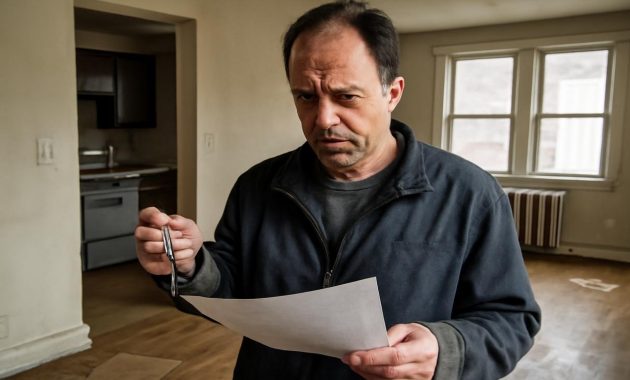
The locksmith’s drill whined through the quiet hallway, a high, metallic whir that echoed off the stairwell like a mosquito in a cathedral. Outside, morning light poured through the dusty glass of the entryway, catching on moving boxes and the landlord’s nervous hands. At the far end of the corridor, Apartment 3B stood like a question mark: lease over, tenant gone, and yet, not quite surrendered. The keys—those brittle little tokens of possession and power—were nowhere to be found.
When a Door Is Empty but Not Yet “Given Back”
It’s strange how a place can feel both abandoned and claimed at the same time. The air inside a recently vacated apartment has its own particular smell: dust, a faint ghost of cleaning spray, a lingering trace of laundry detergent and dinners cooked months ago. The fridge hums quietly, the blinds rattle a little with street traffic, and you can almost hear the echo of a life that was lived there—late-night phone calls, dropped cutlery, arguments, laughter, silence.
Legally, though, the question is more precise: when is that apartment truly “returned” to the landlord? Is it when the lease ends at midnight on a given date? When the last box is carried out? When the key lands in the landlord’s palm with a small metallic clink?
For generations, landlords have relied on a simple script: if the tenant doesn’t hand back the keys, the lease isn’t really over, and rent keeps ticking. Sometimes for days, sometimes for weeks. Even when the tenant has moved out completely, even when the rooms sit hollow and echoing, the argument has been that those tiny pieces of brass still hold time—and money—hostage.
But in a courtroom not so long ago, that quiet habit met a louder truth. A tenant failed to return the keys at the end of their lease. The landlord, used to the old logic, charged additional rent for the “extra time.” The case made its way through the slow, meticulous machinery of the law. And the court, peering through the keyhole, said: no. You can’t do that—not just because the keys weren’t handed back.
The Courtroom Where the Key Lost Its Crown
Imagine the courtroom: fluorescent lights, the faint rustle of legal pads, the air-conditioned hush. At one table, the landlord’s attorney, sharp suit and a stack of invoices. At the other, the tenant’s representative, a folder thick with emails and move-out photos. The judge sits elevated at the front, but in a way, the real authority that day is much smaller, resting between arguments: a key that never made it home.
The landlord’s story was simple, almost mechanical. The tenant’s lease ended on a specific date. The tenant moved out but didn’t return the keys on time. Therefore, the landlord argued, the tenant still held control over the property and should keep paying rent until the keys were dropped off or the locks were changed. No keys, no end to the obligation. Just like overtime on a parking meter.
The tenant’s narrative was messier, as human stories usually are. They’d moved their belongings out. They’d scrubbed the bathroom, vacuumed the living room, patched a few nail holes. They had photos with timestamps of empty rooms and bare shelves. The place, by all visible measure, was done with them and they with it. But the keys—forgotten in a jacket pocket, slipped under the wrong door, or perhaps simply lost during the chaos of moving—never made their official farewell.
When the judge looked at this conflict, they did something quiet but important: they separated symbols from reality. Yes, keys matter. Yes, they’re part of the ritual of ending a lease. But the court asked a deeper question: who actually had control of the property once the tenant moved out? Was the apartment truly inaccessible? Was the landlord locked out of their own place in a meaningful, practical way?
The answer, the court decided, was no. The rooms were empty. There was no furniture claiming space, no person living inside, no attempt to keep possession. The locks could be changed. The landlord could re-enter. The physical control—the real-world kind, not the imagined one wrapped around a bit of metal—had shifted back to the landlord when the tenant left.
So, the court ruled that the landlord could not simply extend the lease in their mind and bill more rent because a key had not changed hands. The lease ended when it ended. The tenant’s obligation to pay rent stopped with it.
What the Ruling Actually Changes (and What It Doesn’t)
News of decisions like this drifts through cities slowly, like rumors shared over coffee or in stairwell conversations. “Did you hear? A court just said you can’t charge extra rent just because someone forgot to return the keys.” Landlords frown. Tenants exhale a cautious, hopeful breath.
It doesn’t mean keys have suddenly lost all their meaning. Far from it. A tenant can still be charged for the cost of replacing locks or key fobs. If the landlord genuinely can’t secure the building or has to call a locksmith to protect the property, that’s a real, concrete expense. Courts tend to care about real things: invoices, work orders, receipts, tangible harm.
But what the ruling does undercut is the easy equation that used to float unchallenged: missing keys = automatic extra rent. That formula had the feel of something naturally true, like gravity. Now, it’s exposed as more of a habit than a law of physics.
In many places, courts look for evidence that a landlord has regained control or could reasonably regain control of the unit at the end of the lease. Did the tenant stay past the move-out date and keep living there? That’s holdover, and rent might indeed be owed. Did they leave their couch, boxes, and suitcases in the living room for days after the lease, effectively blocking the landlord from re-renting or renovating? Another story entirely.
But if the apartment was clean, vacant, free of furniture and people, and the only missing piece was the ceremonial handoff of tiny metal teeth, the ruling says: that’s not enough to keep extracting rent. The landlord had the power to move forward, change locks, inspect, plan. The law, in that moment, chose reality over ritual.
When Does a Lease Really Let Go of You?
The ruling sits at the intersection of two timelines: the legal one and the human one. On paper, a lease ends at a precise moment—midnight on the last day, or noon on a Sunday. But in life, it ends in stages. The last cup is boxed. The walls lose their pictures. A final sweep sends crumbs and hair and dust bunnies to the trash. You close the door behind you, and there’s a strange pang: this was home, and now it isn’t.
Legally, many courts look at factors like:
- Has the tenant removed their belongings?
- Is the unit still being used for living, sleeping, or storage?
- Has the landlord taken steps to re-enter, inspect, or repair?
- Is there an agreement, in writing, extending the lease or creating a “holdover” situation?
Keys play into that story, but they are not the whole story. They’re an indicator of intent, a signpost that says: I’m done here, this space is yours again. Yet in the case that inspired this shift, the court decided that all the other signs were already flashing that message loud and clear, with or without keys.
For tenants, there’s a quiet comfort in knowing that failing to drop keys in the right slot, on the right day, might not expose them to weeks of surprise rent. For landlords, it’s a wake-up call to be more precise, to base claims on actual possession and provable loss, not just on rituals that have outgrown their legal force.
The Small Metal Things That Say So Much
Walk through any city, and you’ll see them everywhere: keys flashing from belts, jangling in pockets, dangling from carabiners like little city-issue jewelry. They open front doors and mailboxes, laundry rooms and bike sheds. They are, in many ways, the quiet language of trust.
Landlords hand keys over on move-in day with a small ceremony: signatures flutter, deposits are tallied, the first month’s rent clears, and then, at last, a hand opens and lets the keys fall into new fingers. That sound—a soft clatter, maybe two or three pieces of metal colliding—is a kind of promise: you belong here now. You can lock the world out. You can come home at 2 a.m. and let yourself in without asking anyone’s permission.
When a lease ends, there’s a reprise of that ritual in reverse. The tenant’s fingers, once so certain on the keys, release them back: into a palm, an envelope, a worn wooden drop box. The apartment sighs, empty and watchful, waiting for the next person to turn a new key in its lock.
It’s understandable that landlords have long treated this return as the official moment of surrender. And to be fair, in many day-to-day situations, that’s exactly how it plays out. But the court’s decision nudges us to see keys differently: as a symbol, not a spell. They don’t magically extend rent into weeks of extra income just because they’re late.
Instead, keys become one part of a broader picture: proof that control has shifted, that someone has stopped living in a place. Their legal weight is now more proportional to their physical role. Lose the keys? You may pay for new locks. Delay their return? You may cause some annoyance. But absent other facts—like staying in the unit or blocking access—you can’t be retroactively roped into more rent just because of that small failure.
A Quick Look at What’s Fair: Landlord vs. Tenant
This is where law and fairness bump shoulders. Consider how a balanced outcome might look:
| Situation | What’s Reasonable for Tenant to Owe | What Landlord Can Expect |
|---|---|---|
| Tenant moved out fully, did not return keys, landlord changes locks | Cost of lock replacement or new keys | Reimbursement for locksmith, but no extra rent |
| Tenant stays past lease end and keeps living there | Holdover rent as allowed by lease or law | Payment for continued occupation |
| Tenant moves out but leaves furniture and boxes | Possible storage/disposal fees, maybe limited extra rent if unit can’t be re-rented | Compensation for loss of use and clean-out efforts |
| Tenant moves out, returns keys late, landlord suffers no delay or loss | Possibly nothing, maybe a small administrative fee if agreed in lease | Timely access, but no windfall from extra rent |
Seen this way, the court’s ruling doesn’t feel radical. It feels like a realignment: charges should reflect real costs and real occupation, not just the smooth convenience of tradition.
Walking Out the Door: What Tenants Can Learn
On the last day in any apartment, there’s a blur of details. A forgotten frying pan, a missed dust ball under the bed, the friend who promised to help move but texts, last-minute, “Running late. So sorry.” In the rush, handing over keys can feel like one more minor task in a day already overflowing.
Even with the court’s protecting logic, it’s still smart to treat your keys like a final signature. Practical steps can spare you arguments later:
- Document the empty unit. Take photos or a short video walk-through with timestamps on your phone.
- Confirm move-out in writing. Email or message your landlord on the last day: “I’ve moved out of the unit as of today.”
- Return keys in a traceable way. Hand them over in person and ask for a quick written acknowledgment, or drop them in the designated box and snap a photo of the drop, the envelope, even the building clock if there is one.
- Ask about charges upfront. If you’ve lost a key, acknowledge it early and ask what the replacement or locksmith fee will be.
The court may have clipped the wings of one unfair practice, but prevention is still kinder than fighting after the fact. You don’t want your final memory of a home to be an argument about something small and metallic that vanished in the chaos of moving boxes.
And What Landlords Can Rethink
For landlords, the ruling invites a different kind of attentiveness. Instead of relying on a blanket rule—“no keys, more rent”—it calls for a more observational approach: What is actually happening in the space?
Some shifts that align with this spirit:
- Clarify policies in the lease. Spell out specific charges for lost keys, fobs, or lock replacements.
- Distinguish between keys and occupancy. Base any claim for extra rent on actual continued use or blocked access to the unit.
- Act promptly at lease end. Schedule inspections, change locks if needed, and document the condition and vacancy of the unit.
- Avoid windfalls. Courts are often skeptical when a small inconvenience is used to justify a large financial gain.
The ruling doesn’t strip landlords of protection; it asks them to root their claims in reality instead of routine. It presses everyone toward a more honest accounting of who is actually living where, and when.
The Quiet Power of Letting Go
There is, in the end, something quietly poetic about the court telling a landlord: you can’t keep charging rent on an empty room just because a key never made its way back to you. It’s a recognition that space and possession are more than paperwork; they’re lived experiences. A home is a story you write in footsteps, in grocery lists on the fridge, in the wear pattern on the bedroom carpet where you once stood dressing for work.
Once that story has ended—once the shelves are bare, once the echoes are louder than any living sound—the law is learning to respect that ending, even if the symbols lag a little behind. The key in a long-forgotten pocket doesn’t outvote the echo of an empty room.
Moving out, like moving on, is rarely perfectly executed. We leave traces, forget things, misplace items sacred and trivial. But the courts’ emerging stance on keys and extra rent suggests a kind of legal mercy: yes, you should be responsible and careful. Yes, you should return what’s been entrusted to you. But your small, human errors shouldn’t be inflated into weeks of rent you never expected to pay, for a space you no longer occupy.
In that hallway where the locksmith’s drill once complained into the air, the landlord eventually stepped into the vacant unit, its rooms lit by pale afternoon. The tenant was gone. The lease was over. The apartment, in its own quiet way, waited for a new story.
FAQ
Can a landlord charge extra rent if I forget to return the keys?
In many jurisdictions, simply failing to return the keys is not enough by itself to justify extra rent after the lease ends, especially if you have completely vacated the unit. The landlord may be entitled to the cost of replacing locks or keys, but not ongoing rent without proof of continued occupancy or loss of use.
What can I be charged for if I lose my apartment keys?
You can usually be charged for the reasonable cost of replacing locks, re-keying, or issuing new fobs or access cards. These charges should be grounded in actual costs, not arbitrary penalties, and ideally should be outlined in your lease agreement.
Does the lease automatically extend if I still have the keys?
No, a lease generally ends on the date specified in the agreement. Holding the keys past that date doesn’t automatically extend the lease. Extra rent typically depends on whether you are still occupying the unit or preventing the landlord from using or re-renting it.
How can I prove I moved out on time?
Take dated photos or videos of the empty unit, send your landlord a written notice (such as an email) confirming that you have fully moved out, and, if possible, get written acknowledgment of key return or your move-out inspection. These small steps can be powerful evidence later.
What should landlords do when tenants don’t return keys?
Landlords should document the vacancy of the unit, change the locks if needed, keep receipts for locksmith or key replacement costs, and distinguish between recovering actual expenses and claiming extra rent. Any rent claim should be tied to real continued occupation or proven loss of use, not just the missing keys.