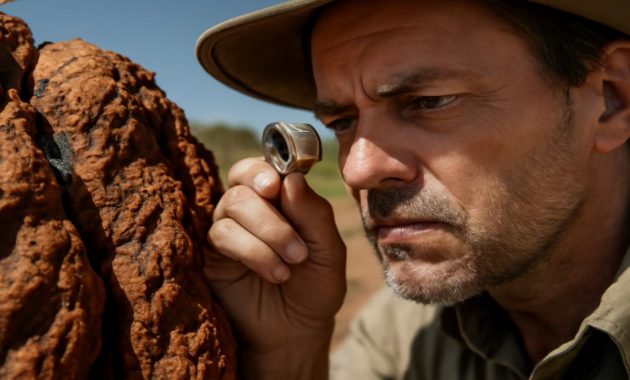
The first time you see them, they don’t look like a scientific revolution. They just look…odd. Shallow pits and tiny hollows, freckles of red on red, running across the surface of ancient sandstone in the Australian outback. They’re small enough to pass by without a second glance, tucked between spinifex, lizard tracks, and the slow grind of desert wind. But stare long enough, and those strange red rocks begin to whisper a bigger story—one that is quietly unsettling how we think about fossils, life, and the deep, deep past of our planet.
A Landscape That Feels Older Than Time
Morning in the Australian interior comes with a particular kind of light—thick, honeyed, almost heavy. It pours over iron-rich cliffs and low mesas, turning them into slices of rust and embers. The rocks here are not just old; they are almost unimaginably ancient, laid down long before forests, before dinosaurs, before even the notion of an animal with bones.
Out here, the ground is not just scenery. It is a slow, physical memory. Every layer of sediment is a page, every ripple and fissure a half-erased sentence. For decades, geologists and paleontologists have pored over these pages, trying to read what was alive when the world was still learning what “complex life” even meant.
And lately, in some remote corners of Australia, they’ve been finding something odd written into those pages—etched into crimson sandstone like tiny punctuation marks in a very old story.
What Exactly Are These Strange Red Rocks?
The rocks themselves aren’t unusual. Much of inland Australia sits on vast beds of red and orange sandstone packed with iron minerals. But it’s what’s on (and inside) some of these rocks that has everyone paying attention: peculiar circular pits, tube-like traces, and branching patterns, stained a deeper red than the rock around them. Some are smooth depressions; others look like miniature craters or the imprints of something that once pressed into soft sediment and vanished.
At first glance, they look like they might be tiny fossil burrows, jellyfish-like impressions, or trace fossils left by soft-bodied organisms—evidence of life that never grew bones or shells but still moved, fed, anchored, or slithered across the seafloor hundreds of millions of years ago. And for years, that’s exactly how many scientists interpreted them.
But then the questions started. The shapes were inconsistent. The chemistry was strange. Some of the features seemed too random, not quite organic. The more researchers looked, the more a nagging doubt crept in. Were these truly traces of life—or something else entirely?
When “Life” Turns Out to Be Just Rock
Paleontology has always had a ghost problem. Soft-bodied organisms rarely fossilize. Much of Earth’s early life left nothing behind but whispers in the chemical record or faint, questionable impressions in stone. This creates fertile ground for misinterpretation. A curious mark in a rock becomes a possible worm burrow. A ripple becomes a crawling trail. A blob becomes the outline of an early jelly-like creature.
In Australia, some of those strange red imprints once joined that growing list of “maybe” fossils. But a new wave of research—using high-resolution imaging, 3D scans, geochemical mapping, and careful comparisons with modern environments—is revealing a more unsettling possibility: many of these supposed traces of life might just be products of the rock itself.
Iron-rich fluids percolating through sediment long after it was buried. Micro-cracks forming and widening as the stone heated and cooled. Weathering carving out softer patches. Mineral growth blooming in patterns that, by chance, mimic the shapes of burrows or body outlines.
In other words, what we thought were fingerprints of ancient creatures might instead be fingerprints of geology: beautiful, intricate, and completely lifeless.
The Line Between Fossil and “Fake Fossil”
This isn’t just an academic quibble. It cuts to the heart of how we reconstruct the early history of life on Earth. For years, some researchers have used these kinds of features to argue that complex organisms were already moving through sediments, building communities, and altering environments earlier than standard fossil records suggested.
But if a portion of those features turn out to be non-biological—what scientists sometimes call “pseudofossils”—then some of our timelines for life’s evolution may need to be redrawn. Not dramatically, perhaps, but subtly. Enough to shift when we think certain behaviors evolved, or how quickly ecosystems grew in complexity after major events like global glaciations.
To sort real fossils from impostors, scientists are increasingly leaning on pattern recognition and context, not just looks. A single disc-shaped depression might be suspicious. A field of them, arranged in consistent sizes and depths, all within a certain sedimentary layer? That begins to sound more like a living community. Meanwhile, isolated shapes that follow cracks or chemical fronts in the rock start to look more like geology at work.
Reading the Desert Like a Book
Imagine standing with a small group of researchers on a low ridge of sandstone in central or western Australia. The air has that dry, metallic taste it gets in the desert after days without rain. Flies orbit your head in lazy, infuriating spirals. Someone kneels by a slab of rock, wipes dust away with the back of a gloved hand, and there it is: a small, perfect ring, a few centimeters across, stained maroon against the lighter red around it.
“What do you see?” one researcher asks.
“A burrow?” someone ventures. “Or a holdfast for something anchored to the seafloor?”
The scientist shakes their head. “Maybe. But look closer. See how the color fades into the rock here? That’s iron moving through the pores. And the rim? Sharper on one side, almost smeared on the other. That’s not how a living creature usually leaves its mark.”
They lift a portable scanner, capturing the micro-topography of the surface. Later, in a lab hours or continents away, 3D models will reveal the minute structure of the ring, the internal layering, the tiny channels leading into and away from it. Chemical analysis may show subtle gradients of minerals, more consistent with groundwater movement than biological growth.
In this way, the desert is being re-read—not as a static field of “fossils or not fossils,” but as a layered, evolving system where fluids, minerals, cracks, and time conspire to draw shapes that can fool even experienced eyes.
A Quick Glimpse at What Researchers Compare
To keep themselves honest, scientists often line up clues side by side. A simplified view might look like this:
| Feature | Suggests Real Fossil | Suggests Pseudofossil |
|---|---|---|
| Shape & symmetry | Consistent forms, repeated sizes, bilateral or radial symmetry | Irregular outlines, highly variable shapes, no clear symmetry |
| Internal structure | Layering or textures matching known tissues or burrow walls | Crystalline patterns, random fractures, or mineral veins |
| Distribution in rock | Clustered in specific horizons or communities | Aligned with cracks, joints, or fluid pathways |
| Geochemical signals | Element patterns suggestive of decay or biological activity | Uniform mineral changes unrelated to known biology |
In the case of many of Australia’s strange red features, that last column is getting a lot of ticks.
The Emotional Weight of Being Wrong About Life
Science loves the myth of the clean correction: the eureka moment, the elegant experiment, the neat revision. Reality, especially in deep-time research, is messier. Some of the scientists who first described these red-rock features as possible fossils didn’t do so carelessly. They worked with the best data they had, in a field where the evidence is thin, fragile, and incredibly hard to interpret.
It’s easy, in retrospect, to say “We misread the rocks.” Harder is acknowledging the quiet, personal disappointment that comes with realizing that the beautiful story you told about ancient life might not hold up. That what you hoped was the trace of a soft-bodied creature exploring a primordial seabed was, in the end, just iron-rich water seeping along a weak plane in stone.
And yet, there’s a quiet, stubborn beauty in that realization, too. Because it means the rocks are still speaking—just in a different language. Instead of telling us directly about early animals, they’re telling us how Earth’s crust breathes and bleeds, how minerals migrate, how landscapes evolve long after sediments are laid down. Those processes, in turn, shape the habitats where life can exist. The story changes, but it doesn’t diminish.
Why This Matters Far Beyond Australia
The implications of these red rocks extend well beyond the desert where they sit. Think about Mars. The red planet, like Australia’s interior, is rich in iron minerals. It’s a world of rocks that have been sculpted by fluids, freeze-thaw cycles, and slow weathering. Already, some Mars images have shown curious patterns—filaments, nodules, tiny pits—that inevitably raise the question: is this life, or just geology being creative?
What scientists are learning in Australia is essentially a training course in humility for planetary exploration. If rocks on Earth can produce such convincing “fossil-like” forms without any biology, then our standards for declaring life on another world must be incredibly strict. Every potential sign must pass layer after layer of scrutiny: structure, chemistry, context, and consistency.
The red rocks, in their quiet way, are reminding us not to rush into romance with the past. To ask harder questions. To be more cautious with our longing to find life in old stones or alien landscapes.
A New, More Careful Kind of Wonder
So where does this leave the story of life in Australia’s ancient seas? Not empty-handed, as it turns out. While some candidate fossils have fallen under suspicion, others have held up under close inspection—showing internal structures, consistent morphologies, and patterns that are very hard to explain without life. The fossil record of early complex organisms may be thinner than we hoped in some places, but it has not vanished.
Instead, what’s emerging is a more nuanced picture. Life was there, but the rocks are a noisy archive, full of false positives. To read it properly, scientists must separate signal from noise with ever finer tools and more skeptical eyes. The result is a kind of double vision: on one level, we see the choreography of geology; on another, the fragile, intermittent traces of living things that managed, against all odds, to leave a mark.
If you visit one of these red-rock sites yourself—not as a scientist, but as a traveler, a wanderer—you might feel that duality. You crouch beside a sandstone slab, trace a ring or hollow with your fingertip, and feel that pull: was this once touched by something alive? Or is it just you and the stone, sharing a moment across oceans of time and chance?
Maybe you never find out. Maybe no one does. But the question itself, held up against the bright sky and hot wind, is its own kind of connection.
Listening More Closely to Ancient Stone
In the end, the strange red rocks of Australia are not simply challenging whether specific features are fossils. They’re pushing us to reconsider how we listen to the ancient Earth. For a long time, we’ve wanted the rocks to speak clearly: here is a fossil, here is a trace, here is the moment complex life took a certain step. What these rocks suggest is that the conversation is more subtle, more layered.
Rocks, especially ancient ones, record overlapping stories. Sediment was laid down in shallow seas. Minerals migrated through it as tectonic plates shifted. Cracks opened and closed. Water rose, fell, evaporated, condensed. Each process left markings that can resemble, confuse, or obscure the traces of life.
Instead of a single, sharp snapshot of the past, we get something closer to a long-exposed photograph with multiple movements blurred together. The art—because it is an art as much as a science—is learning which blur belongs to which motion.
From the outside, this might sound like the story is dissolving. But talk to the people who actually do this work, and they often describe the opposite: a deepening of the narrative. The rocks are not less interesting because we have to work harder to find life in them. They are more interesting because they reveal how tightly intertwined geology and biology have always been.
Out under that heavy, golden light, in a land that feels older than time, those strange red marks in the stone are no longer just possible creatures or mere mineral stains. They become questions carved into the Earth’s skin—questions about how we recognize life, how we define it, and how we tell its story when most of its pages have been torn out or overwritten by time.
As the day cools and shadows stretch across the desert, the rocks themselves don’t care whether we call their markings fossils or pseudofossils. They will sit, as they have sat for hundreds of millions of years, softening at the edges, breaking grain by grain back into dust. The revolution they carry is not in them, but in us: in how we choose to read them, and how willing we are to let a small, stubborn patch of red sandstone change the way we think about life itself.
Frequently Asked Questions
Are these strange red features in Australia actually fossils?
Many of them probably are not. While some features were initially interpreted as possible fossils or trace fossils, newer research suggests that a significant number are likely pseudofossils—shapes created by geological and chemical processes rather than by living organisms.
What is a pseudofossil?
A pseudofossil is a pattern or structure in rock that looks like it might be a fossil but was formed entirely by non-biological processes, such as mineral growth, fluid movement, or fracturing. They can closely mimic the appearance of burrows, shells, or soft-bodied organisms.
Does this mean scientists were wrong about early life in Australia?
Some earlier interpretations are being revised, but that’s a normal part of science. The presence of early life in Australia is still well supported; what’s changing is our understanding of which specific rock features are truly biological and which are misleading lookalikes.
How do scientists tell real fossils from pseudofossils?
They look at multiple lines of evidence: shape and symmetry, internal structure, how the features are distributed in the rock layers, and detailed geochemistry. Advanced imaging and 3D modeling help reveal whether a structure is consistent with known biological patterns or better explained by geology.
Why is this important for the search for life on other planets?
Because planets like Mars have rocks and minerals that can form complex, “life-like” patterns, the lessons from Australia’s red rocks warn us to be extremely cautious. We need very strong, multi-layered evidence before declaring that a shape in alien rock is proof of past or present life.