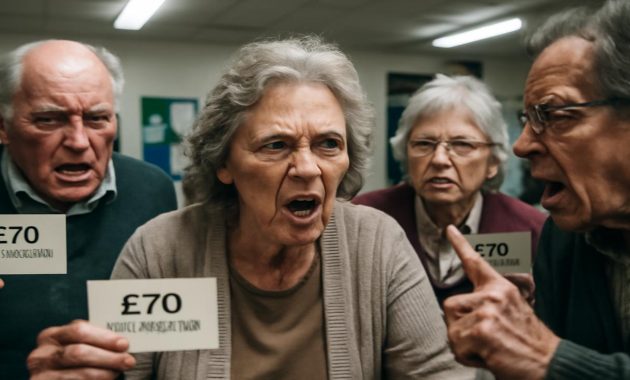
The news didn’t arrive with fanfare. No brass band at the village green, no minister on a podium, no proud logo projected on a town hall. It arrived instead in the quiet way so many big changes do these days: as a line in a letter, a notification on a council website, a mention between weather and sport on the local radio. “State pensioners will receive £70 supermarket vouchers from Tuesday in March.” A sentence, a number, a day of the week. But out in the streets, in tower blocks and terraced rows and bungalows at the end of country lanes, that line landed like a stone in still water—sending ripples of hope, suspicion, gratitude, embarrassment, and, for many, pure fury.
A Tuesday in March, and the Air Feels Different
The Tuesday in March began with grey light pouring over housing estates, high streets, and coastal towns where the wind tastes of salt and diesel. Overnight, the air had that late-winter chill—the kind that isn’t quite bitter anymore, but still lingers in the bones of those whose joints measure the season better than any calendar app.
At 7:30 a.m., outside a small convenience store in a Midlands town, the automatic doors breathed open and shut as pensioners shuffled in for milk, bread, a paper. The shop smelled of baked pasties and cheap floor cleaner; the radio behind the counter hummed softly.
“Did you hear?” one woman asked another, hovering beside the reduced section. “They’re giving us vouchers. Seventy quid.”
The other woman, grey hair pinned back with a plastic clip, gave a half-laugh, half-snort. “Oh, I heard. We’re meant to be grateful, apparently.”
On that Tuesday, envelopes lay on doormats like fallen leaves: brown, anonymous, thin. For some, the letter inside brought a brief, practical sense of relief—£70 in supermarket vouchers, enough to push back the fear of an empty fridge for a week or two. For others, it felt patronising, like a handout tossed from a moving car. A one-off, gesture-sized solution to a storm-sized problem.
“Is this what it’s come to?” one retired bus driver asked the local paper. “Forty-five years paying in, to be handed a voucher like a raffle prize.”
The Smell of the Aisles and the Taste of Humiliation
By mid-morning, a slow, steady current of older shoppers moved through the broad, bright aisles of supermarkets across the country. Under the hum of fluorescent lights and the quiet chug of refrigeration units, pensioners pushed trolleys and clutched crisp, unfamiliar vouchers, their names printed neatly next to barcodes.
The air was a mix of scents: oranges and onions, bakery bread and floral cleaning spray. Over it all, the tinny PA system announced offers on washing powder and biscuits, as if this were any other Tuesday.
For some, there was a strange, bitter taste to the whole performance. They had stood at factory lines, worked farms, delivered mail, cleaned schools before dawn. They had changed nappies under gas fires, queued for coal, lived through strikes and recessions. Now, they lined up to have a voucher scanned by a teenager on minimum wage.
One man in a navy cardigan held his voucher like a parking ticket. “Feels like they’re letting us into our own lives on a discount,” he muttered to himself. “As if the pension they promised was some luxury, not the basic right we were told it would be.”
Yet just down the aisle, a woman in a purple coat tucked her voucher into her purse with careful hands. Her eyes moved slowly over the shelves, calculating, weighing. She slipped a pack of salmon into her basket, then—after a second’s hesitation—a small tub of fresh soup instead of the tinned one. For her, the voucher wasn’t an insult. It was a rare breath. “I can get fresh fruit this week,” she’d said on the phone to her daughter the night before. “I might even buy strawberries. In March!”
So the day held two truths at once. Gratitude and resentment. Relief and anger. A full fridge and a gnawing sense that something had gone deeply wrong if people who had worked all their lives needed a supermarket voucher to feel secure.
Why £70 Feels Like Too Much and Not Nearly Enough
The conversation that roared to life that week wasn’t really about supermarket vouchers. It was about value—of money, of work, of age itself.
£70 sounds like something substantial when it’s framed as a lump sum. Newspapers ran breathless headlines: “Pensioners Handed £70 Boost” and “Cost of Living Help for Our Elders.” On television, presenters spoke cheerfully of help “to ease the pressure at the tills.”
But in kitchens where the fridge light falls on half-used margarine and a small block of cheese, people did their own maths. Across the country, pencilled notes appeared in the margins of old notepads, beside shopping lists and utility reference numbers:
- Milk – £1.55
- Bread – £1.20
- Eggs – £2.00
- Tea – £2.50
- Basic fruit & veg – £10.00–£15.00
- Meat or fish for the week – £15.00–£20.00
It didn’t take long to see where £70 vanished.
For pensioners whose heating bills had doubled over the winter, or who’d watched their rent creep up while their state pension nudged along behind inflation, the voucher felt like a sticking plaster pressed onto a fracture.
At a community centre in a northern town, a volunteer poured tea for a group of retirees whose conversations overlapped with the rhythm of teaspoons clinking against ceramic cups.
“It’s hush money,” one man said, his voice tight with frustration. “Prices jump every month, but we’re supposed to stay quiet because they’ve given us a voucher and a pat on the head?”
Across from him, a woman in a knitted hat sighed softly. “I’m glad for it,” she said, fingers curled around her mug. “But I’m frightened of what happens next month, and the month after that. Are we meant to live from token to token?”
The Landscape of a Life Measured in Bills
Outside the community centre, the town was a collage of the small, telling details of older life. Windows with lace curtains, bird feeders hanging from balconies, mobility scooters charging in hallways that smell faintly of frying and fabric softener. On buses, pensioners tapped their passes and checked their purses twice, out of habit more than need.
There’s a peculiar kind of tension in being old and poor in a rich country. You know the system intimately—you’ve funded it, obeyed it, believed in it through governments red, blue, and muddled. The local post office once knew your pay packet before you did. The pension you receive now was not a surprise; it was a promise, repeated over decades.
But the numbers don’t stretch like they did. Food has become stealthily expensive: biscuits you used to chuck in the trolley now return to the shelf. Cheese, once a staple, shrinks in size and grows in price. The “treat” aisle becomes something to pass by quickly, not linger over.
Seen from the outside, £70 might sound like a meaningful correction. Seen from the inside, from the vantage point of someone sitting alone at their kitchen table with two envelopes in front of them—one a voucher, one a utility demand—it can feel almost mocking.
The voucher is bright and clean, with its barcode and brand logos. The bill is blunt: final reminder, increased tariff, estimated usage. When the choice is between topping up the meter or buying decent food, a supermarket voucher lands like someone throwing you a life jacket while continuing to drill holes in the boat.
The Fury That Doesn’t Fit Neatly on a Headline
“Furious backlash,” the newspapers wrote, rolling the phrase around like a drumbeat. It sounded dramatic, almost theatrical—angry crowds waving placards, shaking fists, blocking roads.
But the backlash from state pensioners was, mostly, quieter than that. It simmered in private conversations, in letters to local MPs, in muttered remarks at checkout lines, in long phone calls between grown children and ageing parents trying to sound okay.
At one coastal town café, three old friends sat by the window as the March wind scudded along the promenade outside. Inside, the air smelled of coffee grounds and toasted bread.
“You know what bothers me most?” one of them said, stirring sugar into his tea. “It’s the idea that we should be grateful for scraps. Like we’re beggars being tossed a coin, not citizens who’ve done our bit.”
Another leaned back in his chair, eyes following a gull swooping low over the waves. “My granddaughter asked me why they were ‘helping old people’,” he said quietly. “I told her we were promised a pension you could live on. She looked at me like I was talking about dragons and castles. Something from a fairy story.”
Across town, in a quiet cul-de-sac, a retired nurse sat with her voucher on the table beside a half-eaten slice of toast. Anger, for her, wasn’t a flame; it was a stone in the gut.
“I’m not ungrateful,” she said, half to herself, half to the silent kitchen. “But I hate that they’ve made me feel like this. Like I’m supposed to say thank you, and never mention the fact that I used to be able to buy what I needed without waiting for a voucher.”
Between Dignity and Dependence
Inside that tangle of emotions sits one sharp, difficult word: dignity.
Dignity curls itself around small everyday acts—choosing your own food, paying your own bills, deciding when to turn the heating on. It lives in the quiet ease of not having to count every coin in your purse before you leave the house.
For many state pensioners, the voucher scheme scraped at that dignity. To use it, you had to hand over something that branded you as “in need.” Some said they felt exposed, even if the cashier was polite and brisk; others feared being judged by people in the queue behind them.
There were reports of pensioners trying to use their vouchers at quiet times of day, early mornings or late evenings, to avoid crowds. One man told a volunteer at a food project that he’d rather eat toast and tinned soup than stand at a supermarket checkout holding a voucher that felt to him like a public declaration: “I can’t manage.”
Yet there were also those who refused to let shame win. “I’ve paid tax all my life,” one woman in a rural village said firmly, voucher tucked into her shopping bag. “If they’re giving anything back, that’s not charity. That’s my own money coming home in a different coat.”
Between these two attitudes—wounded pride and steely pragmatism—the country’s older population moved through that Tuesday in March, each working out for themselves what acceptance, resistance, or gratitude looked like in the refrigerated glow of the supermarket aisles.
What £70 Buys You, and What It Doesn’t
Strip away the politics and what remains is something plain and physical: a trolley, a list, a total on a receipt. The cold logic of prices and the warm reality of food placed in cupboards.
| Item | Typical Cost (£) | Portion of £70 |
|---|---|---|
| Basic weekly groceries (single person) | 35.00 | 50% |
| Fresh fruit & veg top-up | 10.00 | 14% |
| Meat or fish for the week | 15.00 | 21% |
| Household essentials (toilet roll, cleaning) | 7.00 | 10% |
| Little extras (biscuits, tea, treat) | 3.00 | 5% |
On paper, it looks tidy. In real life, it’s a series of small negotiations.
Do you buy the cheaper brand of bread that goes stale faster, or the good one that costs more but lasts? Do you skip meat and stretch lentils and beans, or risk the extra cost for the comfort of something familiar and filling? Do you choose the lemon-scented washing-up liquid that reminds you of your mother’s kitchen, or the budget one that smells faintly of nothing and saves you 30p?
That Tuesday, and in the days that followed, some pensioners used their vouchers to restore a sense of normalcy they hadn’t realised they’d lost. Real butter instead of margarine. A proper cut of meat on Sunday. The “nice” biscuits with chocolate on top when the grandchildren came over.
Others stretched them like canvas over a weak structure, trying to cover as many gaps as possible. Basics, value packs, yellow-sticker reductions late in the day.
What the £70 couldn’t buy was peace of mind beyond the end of the receipt. It didn’t answer the question lurking beneath the rustle of carrier bags: what happens when this is gone?
The Quiet Calculation of Futures
In countless homes, that question hung in the air like unsaid words.
One retired couple in a suburban semi spread their bills across the dining table. The voucher lay to one side, like an extra card in a losing hand. “We’ll use it,” the husband said. “Of course we will. But we need more than this. We need to know we can afford to live when the car finally gives up, or if one of us gets properly ill.”
Down the road, a widower stood in front of his open fridge, cool air brushing his face. For the first time in months, the shelves looked respectable—milk, eggs, fresh vegetables, a tub of yogurt he’d bought on impulse. He smiled, briefly. Then he closed the door and felt the weight of the gas bill lying unopened on the counter.
These are not the scenes that make front pages. They don’t shout. They accumulate.
Beyond the Voucher: What Kind of Country We Want to Be
The outrage that flared—online, in letters pages, at bus stops—wasn’t just about £70. It was about the story the voucher seemed to tell about who older people are in modern Britain: an afterthought, a cost line, a “vulnerable group” to be managed rather than citizens to be honoured.
When the announcement landed, commentators across the spectrum tried to frame it. Some called it a pragmatic lifeline in hard times. Others saw it as a cynical attempt to silence criticism about the real value of the state pension and the soaring cost of essentials.
Inside all that noise, however, a quieter question pulsed: what do we owe each other, across generations?
A state pension is more than a transfer of money. It’s a social contract made decades ago: you work, you contribute, and in return you reach an age where you are allowed—not forced, allowed—to rest with security and dignity. It is, in theory, the country looking its older citizens in the eye and saying: “We remember what you’ve done. We will not let you fall.”
On that Tuesday in March, as pensioners queued with vouchers in hand and anger in their chests, many felt that contract had been quietly rewritten without their consent.
Some of the fury wasn’t just for themselves. It was for the future. “If this is how they treat us,” one grandfather said, standing outside a supermarket with his carrier bags, “how will they treat my grandson when he’s my age? Will he be given a voucher and told to be thankful for crumbs, too?”
Listening to the Murmur, Not Just the Shout
Politicians hear protests in decibels—how loud, how visible, how likely to shift polling numbers. But the story of the £70 vouchers was written more in murmurs than megaphones.
It’s in the pensioner who took three buses to a drop-in advice session, not to complain about the voucher, but to ask whether there might be more support if she could just fill in the right forms. It’s in the older man who folded his voucher into his wallet and then talked, for half an hour, about the apprentices he’d trained over the years and what had happened to the factories where they used to work.
The backlash is there in the silence, too. In those who said nothing, who used the voucher quickly and quietly, and added it to the long mental list of things they never expected to have to accept at this stage of life.
One day, the Tuesday in March will blur into other days. The vouchers will be spent, the receipts faded, the headlines archived. What will remain is the taste it left behind: a mix of gratitude, dependence, bitterness, and resolve.
In warm kitchens and on windswept seafront benches, older people continue to ask the same simple, profound question: Is this really how a wealthy nation chooses to treat those who built it?
The answer will not be measured in vouchers. It will be measured in whether we listen to the anger behind the politeness, the hurt beneath the “I’m fine, love,” and the stories told by those whose lives are now recorded, receipt by receipt, in the glow of the supermarket self-checkout.
Frequently Asked Questions
Why were state pensioners given £70 supermarket vouchers?
The vouchers were introduced as a short-term measure to help older people cope with rising food prices and the broader cost of living pressures. They are presented as targeted support, but many pensioners see them as a temporary fix that fails to address the underlying problem of an inadequate state pension.
Do all pensioners receive the vouchers?
Eligibility typically depends on criteria such as receiving the state pension and sometimes means-tested benefits or living in certain local authority areas. Not every pensioner will automatically receive a voucher, and the exact rules can vary depending on how the scheme is implemented.
Why has there been a backlash to what seems like free help?
Many pensioners feel that while any help is welcome, the vouchers are patronising and insufficient. They argue that they paid into the system for decades and should not need one-off supermarket credits to afford basic necessities. For them, the vouchers highlight how far the state pension falls short of a truly livable income.
Can a £70 voucher make a real difference?
In the very short term, yes. For some older people, it means a week or two of better food and a brief easing of financial pressure. But it does not solve ongoing issues like high energy bills, rent, and steadily rising food prices. Many describe it as a “sticking plaster” on a much deeper wound.
What do pensioners say they really need instead of vouchers?
Most calls from pensioners and advocacy groups focus on a higher, reliable state pension that keeps pace with real living costs, better protection from sudden spikes in essentials like energy, and a system that treats older people with dignity rather than as passive recipients of occasional handouts.