The first time I saw it, I was eight years old, standing barefoot on cold tiles, watching my grandmother unscrew the cap of a cloudy glass bottle. The sharp, throat-prickling scent of vinegar rose into the air, mingling with the warm smell of fried onions and the faint perfume she always wore on Sundays. She walked slowly to the front door, muttering something under her breath—words I didn’t understand, only felt—as she dipped an old, frayed cloth into a bowl and began to wipe the wooden frame. “For luck,” she said when she caught me staring. “For blessings. So that only good things step through this door.”
I remember the sound of her hand sliding over the wood, the soft squeak of vinegar cutting through unseen grime, the sudden shine the frame took on when the cloth passed over it. To my child’s mind, it felt like magic: an invisible shield being painted over the entrance of our home. What I didn’t know then—and what cleaning specialists quietly point out now—is that there was more than superstition swirling in that sharp, sour smell. There was chemistry. There was hygiene. There was the subtle, practical genius of generations who may not have talked about bacteria, but knew that some doors stayed healthier, cleaner, safer than others.
When Luck Meets the Front Door
Across cultures, the front door is more than wood and hinges. It’s a threshold—the precise line where “out there” becomes “in here.” People hang charms, wreaths, branches of herbs, horseshoes, and strings of bells from it, hoping to invite luck and keep trouble away. Somewhere within that collection of rituals sits the quiet, persistent tradition of vinegar: pouring it near the doorstep, wiping it across the doorframe, or even misting it onto the door with a spray bottle, like some invisible fog of fortune.
Ask around in small villages, old apartment blocks, or among older relatives, and you’ll hear variations of the same story: spray a little vinegar on the front door and bad energy won’t cross. Arguments fade. Visitors arrive with kinder hearts. Money doesn’t “run out” of the house. It’s a ritual often performed wordlessly, early in the morning or just after a deep cleaning session, half spiritual practice and half housekeeping habit.
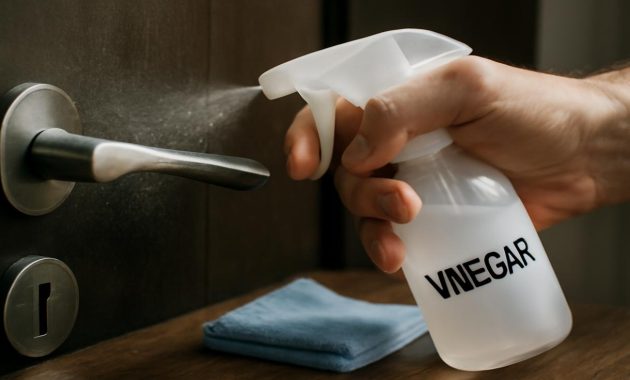
In many households, this is how the ritual goes: bucket of water, splash of vinegar, open the front door wide. The threshold is wiped first—where shoes and street dust cross the line. Then the inside handle, where everyone’s hands land without thinking. Some go further and mist a diluted vinegar spray over the frame and panels, like a blessing written in tiny droplets. The whole thing takes less than five minutes, but carries the emotional weight of something much older, like you’re stepping into a story that began long before you were born.
If you listen closely, you can hear how people talk about it: “It clears the air,” “It keeps bad vibes outside,” “It refreshes the home.” What they don’t realize is how beautifully that language overlaps with what vinegar actually does on a microscopic level. The boundary that we call “energy” often mirrors the simplest, most physical reality: the front door is where the outside world touches your home—and it can get surprisingly dirty.
The Threshold: Where Dirt, People, and Stories Collide
Imagine your front door as a witness. Every day it sees the comings and goings of lives in motion: the grocery bags thumping against it, the palms pressing the handle, the packages leaned beside it, the shoes that used to be on gritty sidewalks now brushing against its threshold. Dust, pollen, pet dander, city soot, insect bodies, microscopic droplets from coughs and conversations—so much of that ends up right at the entrance. If there is an invisible frontier between the chaos outside and the refuge inside, it is drawn right across your doorway.
Cleaning specialists will tell you that the door isn’t just “cosmetic.” It’s a high-contact, high-exposure zone. We touch it with just-washed hands, with hands straight from public transport railings, office keyboards, gym equipment, playgrounds, markets. Children lean on it. Pets rub against it. Guests knock with hands that have their own history of doorknobs, lift buttons, and handshakes. Over time, the front door becomes a sort of microscopic journal of everywhere you’ve been.
So when someone walks up with a bowl of warm water and splashes of vinegar and begins to wipe the panels, the frame, the handle, they’re not just chasing luck. They’re resetting that journal. They’re gently erasing those accumulated fingerprints of the outside world, bringing the door back to neutral. To a visitor, it might look like a quaint ritual. To a cleaning expert, it looks like a practical, low-tech way of managing germs, especially in homes where harsh chemical cleaners aren’t used or are used sparingly.
Still, how much of this is comforting myth and how much of it is measurable benefit? The answer begins with what vinegar actually is: not magic, not holy water, but acetic acid—that unmistakable scent you can feel behind your eyes the second you open the bottle.
What Vinegar Is Really Doing on Your Door
Most household vinegar is around 5% acetic acid in water. That deceptively simple solution has been used for thousands of years: in food, in medicine, and on surfaces. The key lies in what that mild acid does to the microscopic world living comfortably on your door.
On your door handle alone, you’re likely to find a small ecosystem: skin oils, sweat residues, bacteria from different people, maybe traces of respiratory droplets. Vinegar’s acidity can create a hostile environment for many common microbes. While it’s not as powerful as commercial disinfectants and doesn’t kill every kind of germ, it can noticeably reduce the microbial load on smooth surfaces like metal, wood (if sealed), or plastic.
Cleaning specialists often describe vinegar as a “helper” rather than a miracle cure. It loosens mineral deposits from rain splashes and handprints, breaks down soap scum if you use cleaners near the door, softens sticky residues from tape or labels, and cuts through the slightly greasy film that builds up from repeated touching. What we call “a door that feels fresh” often comes down to this: a reduced layer of grime that microbes love to cling to.
The tradition of spraying vinegar doesn’t usually involve precise measuring spoons and scientific dilutions. Instead, it’s more of a rhythm: a dash of vinegar into a spray bottle of water, maybe a touch more “for strength” if it’s been a rough week. Yet many people end up close to what professionals suggest anyway: about a 1:1 or 1:2 mixture of vinegar to water for cleaning handles, frames, and panels that can tolerate mild acidity.
Where the ritual and the reality overlap most clearly is in the feeling afterward. Once the door is wiped down, the air around it smells sharper, lighter. The surface feels smoother under your hand. The slight tackiness or dustiness disappears. That sense of “the door has been reset” is both energetic and entirely physical. What’s fascinating is how neatly an old belief—“vinegar keeps bad things out”—maps onto a modern understanding: it literally lowers the chances that unwanted microbes are passed from the outside world deeper into your home.
The Subtle Science Behind a “Lucky” Door
To understand the hygiene benefit, you don’t need a lab. You just need to picture how germs travel. When someone with a cold coughs into their hand, touches a railing, and then later visits your home, they touch your door handle. Those microbes, too small to see, are now waiting on that metal or wood surface. If someone else immediately touches the same handle and then their face, the journey continues.
Regularly wiping that handle with a vinegar solution interferes with that chain. While it’s not as aggressive as alcohol-based products or bleach, it still disturbs many cell membranes and makes the surface less hospitable overall. Combined with the mechanical action of wiping—physically lifting away dirt and microbes onto the cloth—you’re left with a cleaner, less crowded surface.
Cleaning specialists often point out that consistent, imperfect cleaning beats rare, perfect cleaning. If you spray and wipe your front door with vinegar once or twice a week because you believe it brings luck, you might accidentally be doing a better job managing day-to-day germs than someone who owns a cabinet of harsh chemicals but rarely thinks about the door at all.
From Myth to Method: How People Actually Do It
Sit at a kitchen table with three different elders from three different backgrounds, and you might hear three variations of the same story:
- One sprinkles plain vinegar across the doorstep, then wipes the frame “upward, to invite good things.”
- Another uses vinegar in the mop water and always starts from the front door, “pushing the bad out.”
- A third sprays the inside of the door with a mix of vinegar and a few drops of essential oil “so the house smells welcoming.”
To a cleaning specialist, these methods can be translated into practical routines: regular cleaning of high-contact areas, attention to thresholds where outside contaminants concentrate, and the use of a mild, biodegradable cleaning agent that doesn’t leave harsh residues.
For anyone curious about adopting the ritual with a modern twist, here’s a simple view of how it often looks in real life versus what experts might recommend:
| Aspect | Traditional Practice | Hygiene Perspective |
|---|---|---|
| Frequency | Done on special days, new moons, holidays, or after arguments. | Weekly or bi-weekly cleaning keeps germ levels consistently lower. |
| Mixture | A generous splash of vinegar in water, often estimated by eye. | About 1:1 or 1:2 vinegar to water for general door cleaning. |
| Focus Area | Door frame, threshold, sometimes only the outside surface. | Door handle, lock area, both sides of the door, and the threshold. |
| Intention | Invite luck, block negativity, symbolically “reset” the home. | Reduce germs, remove grime, improve air quality near the entrance. |
| Extras | Prayers, quiet thoughts, or special days of the week. | Soft cloth or microfiber, test first on delicate finishes. |
The deeper you look, the harder it is to separate the “superstition” from the “science.” By making the front door a place of ritual attention, people are unknowingly giving one of the most-touched surfaces in the home the regular care it deserves.
Where Vinegar Works—and Where It Doesn’t
Still, cleaning specialists are quick to set expectations. Vinegar is not a universal disinfectant, and it’s important to know where its powers are limited:
- It’s effective at cutting grease and minerals and reducing many everyday bacteria, but it doesn’t reliably kill all pathogens, especially some stronger viruses and spores.
- It can damage certain finishes: natural stone, some metals, and unsealed wood don’t take kindly to repeated acid exposure.
- It should never be mixed with bleach or strong commercial cleaners—those combinations can release dangerous fumes.
That doesn’t mean the tradition has no place in a modern home. It just means vinegar is best seen as part of a cleaning toolkit, not the entire toolkit. For most front doors—especially painted wood, sealed wood, plastic, or standard metal handles—diluted vinegar is a gentle, effective, and low-cost option that adds both a sensory ritual and a practical clean.
The Emotional Clean: Why It Feels So Good
Ask people why they keep spraying vinegar on the front door even after learning the “real” science, and they’ll often shrug and say something like, “It just feels right.” There’s a psychological layer to the ritual that experts in hygiene quietly respect, even if they don’t talk about luck. The few minutes you spend at the threshold, cloth in hand, are a pause; a deliberate moment of attention directed at the place where your life intersects with the world.
There’s a pattern: major life changes often send people reaching for old rituals. Moving into a new place, coming back after a long trip, starting a new job, ending a relationship, recovering from illness—these are the moments when front doors get scrubbed with more intensity, when vinegar bottles appear from the back of cupboards. It’s as if, in cleaning that one small boundary, we’re quietly telling ourselves: from here on, things will be different. The dust of the old chapter stays outside.
Cleaning specialists may frame it differently—they’ll speak about reducing allergens, keeping high-touch areas maintained, avoiding the buildup of grime that eventually requires harsher solutions. But beneath that language runs the same current: we feel better when the place where we cross into our home feels tended to. A clean door doesn’t just look good; it subtly changes how you walk through it, how welcome you feel, how safe.
There’s also something very human in the sensory experience itself. The coolness of the vinegar-soaked cloth in your hand. The way the sour smell fills the entryway, then softens into something almost refreshing. The visual satisfaction of a handle turning from dull to bright, of marks and smudges disappearing with each pass. These are small, tangible rewards that arrive immediately—a kind of instant feedback loop that says: you did something today that made your space better.
Making Your Own Modern Door Ritual
You don’t have to believe in luck to adopt this practice. You don’t have to recite words or observe special moons. You can simply decide that once a week, or whenever the mood strikes, you’ll give your front door the sort of attention most people reserve for countertops and mirrors.
Fill a small spray bottle with equal parts white vinegar and water. If the sharpness of the smell bothers you, add a few drops of a gentle essential oil, or, better yet, follow up with a quick wipe using plain water. Open the door. Let the light in. Spray the handle, the area around the lock, and the top and sides where dust settles. Wipe slowly, noticing what comes off on the cloth, noticing how your body feels as you go through the motion.
As you do it, you might think about hygiene, about invisible microbes and how easily they travel. Or you might think about the day ahead and the people who will walk through that doorway. You might picture the tough conversations that will pass under that frame, the laughter, the deliveries, the reunions. You might simply enjoy the little sensory pocket of time you’ve carved out—just you, the door, and the crisp scent of vinegar cutting through yesterday’s air.
Call it cleaning. Call it a charm. Call it both. In the end, the tradition of spraying vinegar on the front door sits comfortably at the meeting point of folk wisdom and modern hygiene. It doesn’t have to be perfect to be powerful. It just has to bring you a little closer to the place where you enter your own life, again and again, and remind you that this threshold—this thin strip of space between outside and in—is worth caring for.
FAQ
Does spraying vinegar on the front door really bring luck?
There’s no scientific proof that vinegar itself brings luck. The feeling of luck often comes from the sense of renewal and control people experience when they care for their space. Culturally, the ritual has long been linked to protection and blessings, which can be deeply meaningful on an emotional level.
Is vinegar actually good for cleaning doors and handles?
Yes, in many cases. Diluted white vinegar helps remove grime, oils, and some bacteria from smooth surfaces. It’s not a hospital-grade disinfectant, but it’s an effective everyday cleaner for many painted, plastic, or metal doors and handles.
How often should I clean my front door with vinegar?
Once a week is a good starting point for high-touch areas like the handle and lock, especially during seasons when colds and other illnesses are common. You can clean the whole door less frequently, depending on how exposed it is to weather and dirt.
Can vinegar damage my door?
Vinegar can harm some surfaces, such as natural stone, unsealed wood, and certain metal finishes. Always test a small, hidden area first. If the finish dulls, discolors, or feels rough after drying, switch to a gentler, pH-neutral cleaner.
Should I still use stronger disinfectants sometimes?
In situations where illness is present or risk is higher, stronger disinfectants may be useful on door handles and other high-touch areas. Vinegar is best seen as a regular maintenance cleaner, not a replacement for targeted disinfection when needed.
Why does my entryway smell so strong after using vinegar?
The strong sour smell is the acetic acid evaporating. It usually fades within 15–30 minutes, especially if you open windows or the door to let air circulate. Diluting the vinegar more or following up with a water wipe can also reduce the scent.
Can I mix vinegar with other cleaners for a stronger effect?
Never mix vinegar with bleach or products that contain chlorine or strong chemicals—this can produce dangerous fumes. If you want to use multiple cleaners, use them separately: apply one, rinse or wipe thoroughly, then apply the other if needed.