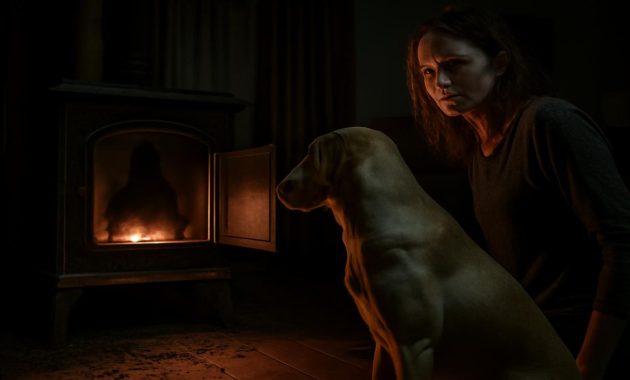
The dog noticed first.
It was the way her shoulders squared and her breathing thinned to a wire. One instant, Molly was dozing in a buttery patch of afternoon light, her nose twitching at invisible currents. The next, she was up—ears pricked, muscles pulling taut as rope—staring at the wood stove as if it had just whispered her name.
The house was so quiet that the tick of the cooling stovepipe sounded like a metronome. Outside, February was folding itself into darkness, the sky bruising to violet beyond the tree line. In the valley, the wind had settled; the chickadees had fallen silent. Her cabin sat in its own small pocket of stillness, halfway up a hill of hemlock and white pine, miles from the nearest paved road. Quiet was the daily weather here. But this was a different kind of quiet, the front-loaded hush of something about to happen.
She sat on the couch with a book spread on her knees, not reading it, not really. The last fire of the afternoon had sunk low—just a bed of coals and a soft orange glow behind the sooty glass of the stove door. The air smelled faintly of creosote and ash, that particular winter tang that seeps into your sweaters and hair. She had lived alone in this cabin long enough to know its vocabulary: the whine of wind in the eaves, the scratch of a mouse exploring the pantry, the thud and roll of ice marching down the metal roof. But the look on Molly’s face—somewhere between alarm and reverence—said this was an unfamiliar word in the lexicon of home.
“What is it, girl?” she asked, but her voice came out thin, too, and Molly did not flick an ear in response. The dog’s gaze was welded to the stove.
Then something moved in the chimney.
The Sound That Didn’t Belong
At first it was only a scuffle, a sound so small it could have been imagination—like the rustle a dry leaf makes when it gives up and lets itself fall to the forest floor. She held her breath. The stove pipe gave a tiny metallic ping as it cooled. Beneath that, another sound rose, layered: a faint scrabbling, then a hollow shuffle, as though someone were dragging a gloved hand along the inside of the chimney.
“Probably a squirrel,” she told herself quietly. Squirrels occasionally tried their luck with the warm dark of the stovepipe. The chimney cap was supposed to keep them out, but nothing in the woods had ever shown much respect for human plans.
Molly’s hackles lifted.
Instinctively, she reached for logic the way a sleepwalker reaches for the bannister. Chimney caps fail. Birds get trapped. Raccoons nest. She could call the wildlife rehab center tomorrow, once the intruder wore itself out or found its way back up. These things happened. They were minor inconveniences, part of the contract you signed when you chose to live in a place where your nearest neighbor was a barred owl.
But the sound that answered her rationalizations was not minor. It was deliberate.
Scrape. Thump. Pause.
She heard weight—real, substantial weight—pressing and shifting above the stove. Molly let out a low, contained growl that seemed to vibrate in her rib cage. The dog took one step closer to the stove door, then another, until her nose was almost touching the hot glass. She didn’t bark; she just stared, a sentinel at some invisible border.
Her mind did a quick, wild zigzag through possibilities. A raccoon. A big raccoon. Maybe several, using the flue as a winter den. Or a fisher, lean and fierce and entirely too clever. Something with claws. Something that might not appreciate being sealed into a metal box with a sleeping human and her dog.
Another thump came, heavier, followed by a faint cascade of soot that whispered down inside the stovepipe. She could almost see it in her mind: black snow spiraling down the dark column, dusting the damper, collecting in the ash bed.
Then came the sigh—a slow, drawn breath of air being displaced by something moving lower through the flue. The draft shifted. The smell in the room changed, too: a rawer edge under the sweet, spent-wood scent. Cold air, wild air, pushing down from the night.
Her scalp prickled. The slow recognition moved through her body like someone turning up a dimmer switch on fear.
When The Forest Walks Inside
There is a moment, when you live alone in the woods, when every romance you’ve told yourself about solitude dissolves like sugar in hot water. For her, it arrived that evening in the shape of a shadow behind the stove glass.
She saw it out of the corner of her eye first: a darker smear against the ember-light, something eclipsing the glow from within. Molly went rigid, tail straight as an exclamation mark. The dog’s paws made tiny scuffs on the floorboards as she planted herself, nails clicking.
“Back,” she whispered, hand automatically reaching for the collar. Molly ignored it, muscles locked. The growl in her throat deepened into a rumble that didn’t quite become sound. It lived under the sound, the way a river lives under ice.
The stove, quiet for nearly an hour, now gave a hollow boom, the steel skin flexing as if knocked from inside. She felt it in the soles of her feet. The ember bed collapsed on itself, sending a brief flutter of sparks up against the glass. They illuminated it for a heartbeat: the smudged curve of fur, the quick flash of an eye, the sudden, frantic twitch of a limb trying to find traction in a space designed for fire, not flesh.
Someone, some wild someone, had just dropped down into her wood stove.
Her mind went dazzlingly blank. The world narrowed to the dog, the stove, the door latch.
It clanked again, that thick, muffled contact of body against metal. She imagined claws on cast iron, the animal’s panic building with every breath of smoke and ash.
“It’s okay,” she found herself saying, though she had no idea whether she was talking to Molly, to whatever was trapped in the stove, or to her own thudding heart. The room felt suddenly too small, the walls pressing in with the weight of the forest.
A smell pushed through the stove’s faint leaks—sharp, musky, impossibly wild. Not skunk, not exactly, but of the same family of unapologetic odors that announce a creature’s existence in no uncertain terms.
“Oh no,” she murmured. “Please don’t be a skunk.”
Her eyes stung. The moment balanced on the thin edge between crisis and comedy. She imagined the story later: how her quiet off-grid evening had been rearranged by whatever had decided her chimney was a perfectly reasonable back door.
The Unlikely Guest Reveals Itself
She inched closer, each floorboard creak feeling absurdly loud. The stove’s glass was streaked with creosote, but the movement behind it was unmistakable now: flailing, turning, the frantic geometry of a trapped creature ricocheting off the limits of its new world.
“Stay,” she told Molly, placing a firm hand on the dog’s back. The command shivered more than she meant it to. Molly, bless her training, stayed. But the tension in her body was a taut cable ready to snap.
She crouched, angling her face to peer through the glass. For a second, her own reflection—wide eyes, hair a dark halo—floated back at her. Then the animal shifted, and its face replaced hers.
Gold eyes. Masked dark fur. A narrow, pointed snout dusted with ash. Tiny, dexterous fingers scrabbling at the firebrick.
“You have got to be kidding me,” she breathed. “A raccoon.”
It stared directly at her, pupils blown wide, chest heaving. In that instant, its wildness and her own humanity felt like two sides of the same coin—both of them caught somewhere they hadn’t entirely planned to be.
It was smaller than she’d expected, more adolescent mischief-maker than hulking chimney demon. But that did not simplify the situation. The stove door was currently the thin glass wall between “startling wildlife encounter” and “uncontrolled disaster inside a very flammable cabin.”
She straightened and forced her thoughts into order, the way you might coax frightened livestock through a gate. Step one: keep it in the stove. Step two: figure out how not to keep it in the stove.
“Okay,” she told Molly, and then, absurdly, the raccoon. “We’re going to think this through.”
The obvious solution was to open the stove, give the raccoon a quick exit route, and step back. But to where? The living room led into a tiny open kitchen and a narrow hall. There was one exterior door, at the front of the cabin, and another in the mudroom by the woodpile. Both were currently closed, draped with heavy curtains against the cold. If she opened the stove door now, the animal’s options would be the couch, the kitchen cabinets, her lap, or a desperate sprint around the small space while ash and soot exploded outward like blackened confetti. None of those seemed ideal for anyone involved.
She backed away, thinking through the problem like a puzzle in one of those field guides she kept by the bed: “What To Do When The Forest Knocks.”
She needed a path. A clear line from the mouth of the stove out into the dark, where the raccoon’s life could continue unburned and her house could, ideally, remain more or less intact.
Drawing A Door For The Wild
She moved quickly now, the jittery, competent rush that comes when fear finds a task. First, she grabbed Molly’s leash from its hook by the door and snapped it onto the dog’s collar. The metal ring chimed like a reassurance. Molly shot her a look that said, in no uncertain terms, We are not done with this situation, but allowed herself to be guided toward the bedroom, away from the stove.
“You’re going to hate me for this,” she whispered, closing Molly in the bedroom with a treat tossed lightly onto the rug as consolation. A muffled protest of claws on wood followed, then the resigned swoosh of the dog circling down onto the bed.
In the sudden alone-ness of the small house, she became hyper-aware of every sound. The raccoon shuffled again, the stove giving another hollow bang as it tested boundaries. Soot smell thickened in the air, mixing with the faint, dusty sweetness of old pine boards.
She yanked on boots, shrugged into her coat, and unlatched the front door. Cold air rushed in, biting her throat with the tannic scent of snow and damp leaf mold. The porch lay in shadow, but beyond, the last light of day clung stubbornly to the horizon, striping the field in shades of blue and iron gray.
Propping the door wide with the heavy boot scraper, she moved to the mudroom. That door, too, she unlatched and hooked open, creating a cross-breeze that made the cabin breathe. The temperature dropped perceptibly; her breath joined the raccoon’s in tiny puffs of cloud.
Back at the stove, she dragged the old wool rug away from the hearth, rolling it like a question mark and shoving it against the couch. Anything flammable—kindling basket, newspapers, a stray mitten—went into a hasty pile by the kitchen counter.
She studied the path she’d created: stove to open front door, a narrow runway of bare floorboards, flanked by furniture and the slow, patient gaze of hundreds of books. It would have to do.
| Step | Action | Why It Matters |
| 1 | Secure pets in a closed room away from the stove. | Prevents chaos, injuries, and more stress for the animal. |
| 2 | Open an exterior door to create a clear exit route. | Gives the intruder a visible, draft-guided path outside. |
| 3 | Move flammable items away from the stove. | Reduces fire risk if embers or soot scatter. |
| 4 | Stand to the side, slowly open the stove door. | Keeps you out of the direct escape path. |
| 5 | Stay calm, quiet, and still as the animal exits. | Less noise and movement means less panic and damage. |
She pulled on a pair of leather work gloves, more for courage than for actual protection, and took her place by the stove. The raccoon was quieter now, curled into itself, chest still shuddering with effort. Ash smeared its face like war paint.
“Okay, friend,” she murmured, fingers closing around the cool metal of the stove latch. “You got yourself in. Let’s see if we can get you out.”
The Moment The Line Breaks
The small click of the latch sounded enormous. She cracked the door—just a sliver at first. A puff of ash ghosted out, carrying with it a hot breath of the raccoon’s fear. The animal flinched, pressing back against the rear wall of the firebox, trying to make itself smaller.
“Easy,” she said, voice low and steady, though her heart tapped out an entirely different rhythm. She opened the door wider, slowly, until it stood like a gaping mouth between the wild and the room where she read books and made tea.
For a fragile beat, nothing moved. The raccoon stayed put, eyes glittering in the dim light. The open door was only potential, not yet a path.
Then the cold night draft found the opening. A ribbon of air poured across the floor, over the hearth, into the stove. It ruffled the raccoon’s fur, carried the complicated story of snow and trees and leaf mold and stars into the metal box. The animal lifted its nose, testing, and something ancient and older than thought flickered on behind its eyes.
With a sudden, explosive grace, it launched.
She flinched sideways, flattening herself against the bookshelf as the animal erupted from the stove, a comet of fur and soot. Ash burst across the room in a dark halo. The raccoon hit the floor, skidding, claws scrabbling for purchase on the wood. For a split second, it turned the wrong way—toward the kitchen—and her breath locked. Then the cold air drafted across its whiskers again, and it pivoted, a perfect, fluid S-turn, and arrowed straight toward the open front door.
Her world narrowed to the streak of its body against the pale rectangle of outside. Paws thudded, a dark tail flashed, and then it was gone—out onto the porch, down the steps in two leaps, into the snow and darkness and noise of its own life, which had nothing to do with wood stoves and dogs and people who read by lamplight.
The silence that followed felt almost as loud as its exit. Ash drifted in the air, settling in slow spirals onto the empty hearth, the rugless floor, the knees of her jeans. The stove gaped open, its interior smeared with the hasty signatures of panicked paws.
Only then did she realize she’d been holding her breath. It stuttered out of her in a laugh that teetered on the edge of hysteria.
“You okay?” she called, voice shaking, to the bedroom door.
Molly answered with a single emphatic bark that managed to contain outrage, concern, and a powerful desire for a full report.
What The Forest Leaves Behind
Later, after she’d closed the doors and let the small cabin refill with its usual measured quiet, after she’d vacuumed ash from the floor and checked the chimney cap with a flashlight from the frosty yard, she sat back on the couch with Molly’s head heavy in her lap.
The dog kept sniffing the air, every so often shooting a suspicious look toward the stove, just in case it decided to produce another raccoon for evening entertainment. Her fur still held a trace of the intruder’s musk, a faint wild punctuation on her otherwise domestic scent of dog and wool blanket and wood smoke.
“You saw it first,” she said, scratching the spot behind Molly’s ear that made one hind leg thump in slow appreciation. “You always do.”
In the stillness that followed, she noticed more acutely than ever how thin the walls between her life and the forest really were. A metal cap on a chimney, a pane of glass, a latch on a door—these were not fortresses so much as suggestions. The wild would cross those lines when it needed to, for shelter or warmth or by mistake.
In the morning, she knew, she would find the raccoon’s tracks stitched across the yard, small hands pressed into the crusted snow, maybe looping back toward the tree line with the meandering confidence of a creature that had survived one more night. She would probably add “check chimney cap every fall” to the handwritten maintenance list on the fridge. She might tell the story to friends, gesturing, laughing, drawing in the air the improbable path from forest to flue to firebox to freedom.
But alone in the soft, late-hour quiet, with Molly breathing slow and deep against her, she felt something else taking root. A new awareness, maybe, of how the house itself was a kind of organism, lungs drawing in air from the woods, exhaling heat and scent back out through cracks and vents. She and the raccoon, for all their startling collision, were residents of the same larger body: the hill, the forest, the night.
She thought of the flash in the raccoon’s eyes when it realized there was a way out—the moment when panic gave way to purpose, when the world rearranged itself from prison to corridor. It was not unlike the quiet revelations of her own life here: the way a problem could feel impossible until she stepped two feet to the left, saw the open door she hadn’t noticed, felt the draft of possibility across her own skin.
Outside, an owl called, low and resonant, its question hanging in the branches. Somewhere down the hill, a twig snapped under the weight of a passing thing. The stove ticked and settled, empty now but smelling faintly of wild musk beneath the days-old ash. The forest, having briefly stepped inside, had gone back to its business.
She closed her eyes and let the thin walls between in and out blur a little, trusting that if the wild ever tried to crawl down her chimney again, a dog’s stillness and a stove’s hollow boom would warn her in time.
FAQs
What should I do if a wild animal gets into my wood stove or chimney?
Stay calm, keep a safe distance, and avoid opening the stove immediately. Secure pets and children in another room, open an exterior door to create a clear exit path, and if possible, contact a local wildlife rehabilitator or animal control for advice. If you choose to let the animal out yourself, stand to the side, open the stove door slowly, and remain quiet and still so the animal can find its way outside.
How can I prevent animals from entering my chimney in the first place?
Install a high-quality chimney cap with sturdy screening and inspect it at least once a year, especially in fall before heating season. Trim overhanging branches that make access easier, and have your chimney cleaned regularly so nesting materials and damage don’t create weak points or inviting cavities.
Is it safe to have a fire if I suspect there’s an animal in the chimney?
No. Never light a fire if you hear or suspect an animal in the chimney or stove. Smoke, heat, and flames can injure or kill the animal and may cause it to become trapped in a way that blocks the flue, increasing the risk of smoke damage or even carbon monoxide buildup in your home.
Can my dog or cat help in situations like this, or should I always separate them?
Pets can be great early-warning systems; they often notice sounds and scents before we do. But once you suspect or confirm an animal is present, it’s safer to separate pets. Wild animals may panic and bite or scratch if they feel cornered, and pets may get hurt in the chaos.
When should I call a professional instead of handling it myself?
If you’re unsure what species is in your chimney or stove, if it appears injured, if it’s a known rabies vector (such as a raccoon, skunk, or bat), or if you don’t have a clear, safe exit route, call a professional. Local wildlife rehabilitators, pest control services, or animal control officers are trained to handle these situations with minimal risk to both people and animals.