The air above the solar farm trembles, as if the light itself is too heavy. Row after row of panels stretch into the haze, neat as planted rice, their dark glass faces tilted toward a pale sun. From a distance, they look like a still, glittering sea. A lone worker, orange helmet catching the light, walks the narrow gravel path between panels, checking connectors, brushing dust from the frames with a cloth that’s already gone gray. It feels like standing inside the future—quiet, humming, impossibly vast.
The Country That Turned Sunlight into an Industry
There is a particular kind of ambition in the way China builds: not slowly, not experimentally, but at a scale that remakes the landscape. That’s how it happened with solar.
In less than two decades, China went from a minor player in clean energy to an almost unimaginable giant. By 2023, Chinese factories were producing more than 80% of the world’s solar panels. Entire cities reoriented themselves around this single industry. Villages watched as farmlands gave way to glass-and-steel factories; university campuses spilled out new engineers like a new kind of harvest.
Inside these factories, the process is both clinical and strangely beautiful. Silicon ingots, sliced like loaves of bread into thin wafers, pass down conveyor belts under bright white lights. Robots lift them with delicate suction cups, silver lines are printed with machine precision, and then the wafers vanish into ovens, laminators, testers. Human workers in clean suits watch screens more than they touch the product. It’s an industrial ballet, choreographed around one goal: make more panels, make them cheaper, make them faster.
For a while, this worked brilliantly. As production soared, prices fell. Solar power, once expensive and niche, became one of the cheapest ways to generate electricity on Earth. Countries from India to Brazil, from Kenya to Germany, rushed to cover their rooftops, deserts, and hillsides in panels stamped “Made in China.”
It felt like a moral victory as much as an economic one. Every new container ship leaving a Chinese port with its cargo of panels meant fewer coal plants, fewer smokestacks, fewer tons of greenhouse gases. Global climate targets, once abstract and unreachable, suddenly looked faintly plausible.
When Success Feels Like a Trap
But there’s a moment in many success stories when the curve bends too steeply. For China’s solar industry, that moment came disguised as triumph: factories running at full tilt, new production lines opening, fresh subsidies, and huge, glittering solar farms rising from deserts and plains.
The problem was invisible at first: overcapacity. China built not just enough factories to meet the world’s solar hunger, but far more than the world could reasonably absorb in the short term. Production capacity kept growing because every part of the system was incentivized to grow—local governments, investors, entrepreneurs, all chasing the same shining opportunity.
By 2023–2024, the numbers told a stranger story. China could produce far more solar panels than the world was actually installing each year. Inventory piled up. Warehouses filled with untouched boxes. Wherever you looked, glass and silicon were waiting for buyers who were already saturated.
Prices reacted in the only way they could: they crashed.
In just a few years, the cost of solar modules dropped to levels that would have sounded like fantasy a decade earlier. Good news for countries trying to decarbonize. Terrible news for the very factories that made it possible. Margins thinned to paper. Some manufacturers started selling panels at or even below their production costs just to keep the machines spinning and workers employed.
What had been a proud national success story began to feel like a trap. China had won the race so decisively that it was now stuck with the prize: an enormous, overbuilt industry undercutting itself into exhaustion.
The Quiet Panic Behind Closed Factory Gates
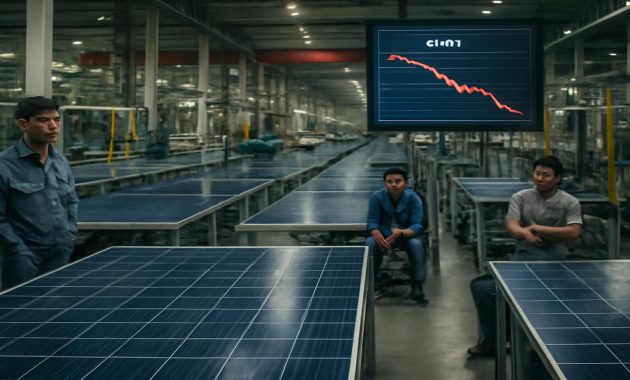
Walk past a solar plant on a weekday morning and you can feel the difference. Where once trucks queued at the gates, engines idling, now there’s a strange quiet. The loading docks echo. A few forklifts move slowly across empty yards, their beeps somehow louder than before.
Inside, a manager sits at a desk coated with charts: demand projections, price forecasts, subsidy schedules. His phone buzzes with news of yet another smaller rival closing its doors. At first, this culling of weaker companies was welcomed. Survival of the fittest, some said. A natural consolidation. But now even bigger factories—the pride of provinces—are starting to look uneasy.
There’s a human story behind every line on those spreadsheets. Workers who left farming villages for the promise of a steady income in the solar boom now find their overtime cut, then their shifts reduced, then—sometimes—their contracts not renewed. Local officials, who once boasted of “leading the world” in green technology, must now worry about unemployment and unfinished industrial parks.
The panic is quiet, but it’s real. It lives in boardrooms and union offices, in late-night conversations between factory owners and local politicians. Everyone can see the paradox: solar panels are the future, but too many panels today could destroy that future for the industries that built it.
A Market That Bent the Sunlight
The global solar market, once hungry and undersupplied, now feels like a table pushed to collapse under the weight of cheap modules. European manufacturers complain they can’t compete with Chinese prices and call for protections. In the United States, tariffs and subsidies reshuffle the deck, attempting to create a domestic solar manufacturing revival in the shadow of Chinese dominance.
Oddly, the world’s drive to decarbonize—urgent, vast, and far from finished—still isn’t enough to soak up all the solar panels China can make. Projects are delayed by bureaucracy, grid constraints, and local politics, not by the lack of cheap hardware. The bottleneck has moved elsewhere, leaving manufacturers stranded with their furious efficiency.
Beating the Drum, Then Turning Down the Volume
The Chinese government, which once cheered on the solar boom, now finds itself in an awkward role: the same hand that pushed the accelerator must now graze the brake.
Officials talk increasingly of “orderly development,” of “high-quality growth,” of discouraging “blind expansion.” Behind those careful phrases lies a simple reality: some factories must close, or at least significantly cut production, if the industry is to survive.
Local governments, however, are not eager to surrender their shiny solar clusters. A plant that closes is more than just lost output; it’s lost tax revenue, social stability, and political prestige. So the national government nudges, designs new rules, tries to steer investment away from yet another layer of basic panel production and toward higher-value areas: advanced cell technologies, energy storage, smart grids, and integrated systems.
From the outside, it might look like contradiction. Why would a country that helped drive down global solar prices now act to shore them up by dialing back production? But inside the system, the logic is clear: an industry that cannibalizes itself is not a strategic asset. It’s a liability.
| Aspect | Early Solar Boom | Current Reality |
|---|---|---|
| Production Capacity | Growing to meet rising global demand | Far exceeds annual installations worldwide |
| Prices | Falling steadily, still profitable | Crashing, margins near zero for many producers |
| Policy Focus in China | Rapid expansion and global market share | Industry consolidation and “orderly” growth |
| Global Impact | Solar becomes dramatically more affordable | Trade tensions, factory closures, strategic recalibration |
Closing or idling factories, then, is less about abandoning solar and more about shaping its next chapter. It’s an attempt to keep the story from ending in a glut of bankruptcies, decayed industrial parks, and wasted expertise.
The Tension Between Planet and Profit
This is where the story grows complicated, even uncomfortable. From the perspective of the planet, ultra-cheap solar panels are a gift. Every time a new wind-swept plateau or desert basin is filled with them, the world’s dependence on coal, oil, and gas takes another small hit. For communities on the frontlines of climate change, a falling price per watt is a quiet miracle.
But from the perspective of the workers who make those panels, there’s another truth: if prices fall too far, their jobs vanish. If entire companies fold under the weight of their own production, the skills, experience, and regional networks they built go with them. Green technology is not just clean electrons; it is also families, mortgages, school fees, and the dull but essential dignity of stable work.
The tension between planetary needs and industrial survival runs like a fault line through the solar story. Environmental advocates might wish for panels to be as cheap as possible, as fast as possible. Industrial planners, meanwhile, need them to be cheap—but not so cheap that the companies making them crumble.
In China, this tension is concentrated and amplified. The country is not only the workshop of the world’s solar transition; it is also a nation with its own domestic climate commitments, its own coal plants to phase down, its own smog-choked cities to clean. Slowing solar production feels, on some level, like slowing the sunrise. But letting the industry burn itself out would be worse.
What Happens After You Fill the World with Panels?
There is another way to look at this moment—not as a crisis, but as a turning point. If basic solar panels have become almost a commodity, then the next frontier lies not in endlessly building more of the same, but in what comes next.
Some of that “next” is technical. New types of solar cells—more efficient, lighter, flexible, able to harvest more of the sun’s spectrum—are already inching out of labs and into pilot lines. Perovskites, tandem cells, bifacial modules: the language itself sounds like science fiction. China wants to move its industry up this ladder, away from being just the lowest-cost supplier and toward being the indispensable innovator.
Some of it is systemic. A world awash in cheap panels doesn’t just need more glass and silicon. It needs better grids to handle surges of midday power. It needs storage—batteries, pumped hydro, new chemistries—to hold sunlight for the hours after dusk. It needs smarter software to predict, balance, and weave all that intermittent power into something as reliable as the old, dirty baseload plants.
And some of it is aesthetic, almost intimate. Once the obvious spaces for solar—the giant farms, the flat factory roofs—are filled, attention turns to the in-between surfaces of daily life. Building-integrated solar in windows and facades. Shimmering panels woven into farmland without blocking crops. Floating arrays on reservoirs that reduce evaporation while generating power. The age of blunt expansion gives way to an age of subtle integration.
For China, pivoting to this new phase requires a different kind of ambition. It’s no longer enough to simply be bigger. The challenge is to be smarter, deeper, more resilient. To prune the tree so it can grow in a healthier shape.
A Future Written in Reflections
Stand again at the edge of a Chinese solar farm at sunset and the panels no longer look like a sea of black. They mirror the sky in shades of gold and bruised purple, each one a small square of stolen daylight slowly slipping away. In those reflections, you can see the outlines of the paradox the country has created.
On one side: a powerful, almost overwhelming contribution to the world’s clean energy transition. Cheaper solar panels have made climate policies more realistic, weakened the grip of fossil fuels, and given countless communities a way to generate their own power.
On the other: a domestic industry caught in its own brilliance, pressed between global gratitude and brutal economics, now being asked to shrink so that it can survive. Factories that were once monuments to progress must now contemplate the dark, unwelcome stillness of idle machinery.
The story is not over. Panels installed today will quietly hum with power for decades. New designs will emerge. Other countries will build their own factories, spurred on by the same dream—and perhaps the same mistakes. And China will keep walking its tightrope: balancing planetary urgency against local realities, steering an industry that grew too fast toward a future that needs it more than ever.
What happens when you produce so much of the future that you threaten to collapse the very system that made it possible? That is the question flickering, like light on glass, across the surface of China’s solar plains.
Frequently Asked Questions
Why did China produce so many solar panels in the first place?
China poured support into solar manufacturing to build a strategic industry, create jobs, dominate a growing global market, and reduce its own reliance on fossil fuels. Generous subsidies, cheap land, easy credit, and strong export demand encouraged companies to expand rapidly, leading to huge production capacity.
How did Chinese solar overproduction drive prices down?
When manufacturing capacity grows faster than actual installations, supply outstrips demand. To keep factories running and maintain cash flow, companies lower prices. Competition intensifies, and firms undercut each other. This cycle pushed global panel prices to record lows, benefiting buyers but squeezing producers’ profits.
Why is China considering closing or consolidating solar factories now?
Many manufacturers face razor-thin or negative profit margins because prices have fallen so far. Overcapacity threatens the financial health of the entire sector. By closing weaker or redundant factories and slowing new basic production, China aims to stabilize prices, protect core companies, and guide the industry toward more advanced technologies.
Is this bad for the global clean energy transition?
In the short term, extremely low prices have been a huge boost to clean energy deployment worldwide. If too many factories shut down at once, prices could rise or supply could tighten slightly. However, China’s goal is not to dismantle solar, but to keep the industry viable over the long term, so it can continue supplying panels at relatively low cost.
Will other countries benefit from China’s solar slowdown?
Potentially. High overcapacity and low prices have made it difficult for manufacturers in Europe, the U.S., and elsewhere to compete. If China reins in production and focuses more on higher-value segments, it might open some breathing space for other countries to build or rebuild their own solar manufacturing bases, especially where they’re supported by local policies and incentives.
Does this mean solar has become too cheap?
For the climate, “too cheap” doesn’t really exist—lower costs speed adoption. But for manufacturers, a point comes where prices don’t cover costs, leading to closures and instability. The current challenge is finding a balance where solar remains affordable for the world while the companies and workers behind it can survive and adapt.
What’s next for China’s solar industry?
China is likely to shift focus from raw volume to higher-quality growth: investing in more efficient solar technologies, expanding energy storage, modernizing power grids, and integrating solar more intelligently into cities, farms, and infrastructure. The age of building factories as fast as possible is giving way to an age of refining and deepening what solar can do.