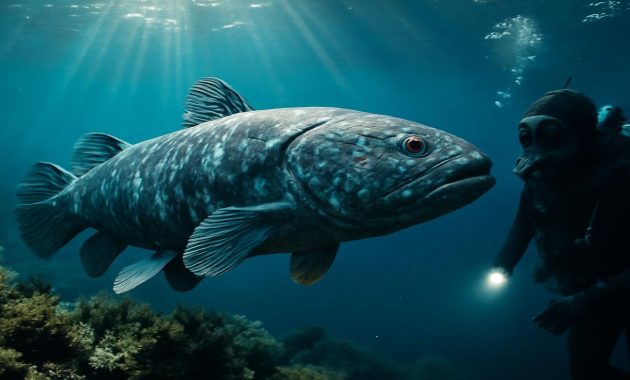
The first thing they saw was an eye—golden, unblinking, the size of a small coin—hovering in the dark like a lantern with a pulse. The beam of the dive light caught it for only a second, but in that second, time broke open. The water stilled. Breaths slowed. And suddenly, every hour of preparation, every kilometer flown, every rumor followed across islands and charts and currents, funneled into this one electric moment: a living fossil had drifted out of myth and into the narrow cone of human light.
Into the Blue Dark of Indonesia
They had been diving for days, moving along the volcanic backbone of Indonesia, an underwater world where continents collide and oceans braid together. French diver and photographer Luc Moreau—sunburned, salt-dusted, and running on little sleep—had come with a small team chasing whispers: local fishers who spoke of “strange old fish” caught in nets then quickly released, and guides who mentioned, almost shyly, a creature that “did not look like any fish we know.”
On charts, the region where they were diving looked like an untidy scribble of islands and submerged ridges. In real life, it felt like the lungs of the ocean. The currents were strong and alive, funneling through steep underwater canyons. Soft corals trembled like nervous hands. Schools of anthias flickered like airborne embers. The air smelled of diesel and drying nets. Onshore, children played along the beach with plastic fins, imitating the visiting divers, while their parents mended lines and glanced at the horizon with the practiced measurement of those who live by tides.
Deeper beneath the surface lay the real reason they’d come. Somewhere beyond the recreational depths, along cold upwellings and shadowy ledges, a small, improbably ancient population of fish was said to endure—a species once thought to have died out with the dinosaurs. Coelacanth. The name itself felt heavy, like a stone pulled from deep water.
For decades, coelacanths had been the subject of documentaries, research papers, and childhood obsessions. The first modern specimen, caught off South Africa in 1938, had stunned biologists. Another population had later been documented near the Comoros Islands, with scattered sightings in Madagascar, South Africa, and Tanzania. More recently, Indonesia had yielded its own reports. But in all that time, divers with cameras had rarely, if ever, met a coelacanth in its world and come back with clear photographs.
“We’re not chasing a monster,” Luc told his team during the first briefing, “we’re chasing a memory that never stopped living.”
The Descent
The day they finally met it, the sea looked almost bored. The surface was quietly ruffled, the color of smoked glass, with a low swell that made the boat roll in a slow, cradle-like rhythm. The sky hung over them in a flat, hazy blue. It could have been any other dive.
The crew moved through familiar motions: checking tanks, calibrating dive computers, clipping on backup lights and cameras. Luc felt the small prickle of nervousness that always arrived before going deep. It wasn’t fear, exactly, but a widening of awareness—as if his body knew that the world he was about to enter operated under different rules.
When they rolled backward into the water, the sea embraced them in a brief, chaotic splash, then closed again with indifference. Sound thinned to a muted roar. Only the hiss of exhaled bubbles and the occasional clink of gear broke the enormous silence.
The first thirty meters of descent were familiar: a gentle fading of color, red turning to rust, then sepia, then vanishing altogether. Past the busy reef, the water turned cooler, emptier. Life thinned out to scattered silhouettes and drifting plankton that glittered like slow motion snow in the dive lights.
At fifty meters, the world became a cathedral of blue-black. The divers’ lamps carved narrow tunnels through the gloom, each beam revealing a fragment of cliff, a dangling sea fan, a shy shrimp retreating into its hole. Beyond the light, there was only suggestion.
They had studied the coelacanths’ known habits: daytime recluses, they favor caves and overhangs along steep volcanic slopes, wedged into cracks where currents bring them a steady drift of food. The divers moved along the face of the reef, scanning every dark pocket, every ledge that could hide something big enough, old enough, improbable enough.
Minutes passed. Air gauges ticked down. Luc’s fingers already felt the familiar cold creeping in through his gloves. He moved slowly, controlling his breathing, trying to keep his heartbeat calm. This was not a place for rushed movements or excited chase. Down here, physics takes its cut from every mistake.
Then, as he swept his lamp along the wall, a shape separated itself from the rock: a broad, lobe-finned body, dappled with pale, irregular spots, suspended motionless just inside the cave’s throat.
The golden eye turned.
A Face from Deep Time
It is one thing to see a coelacanth in a museum, preserved behind glass, color fading from its once-nightlit skin. It is another to meet one alive, its body expressing forms that were already old 200 million years before humans walked upright.
Up close, the fish did not look monstrous. It looked deliberate. Its skin was a deep ink-blue, mottled with scattered white blotches like old moonlight on stone. Rather than thin, fluttering fins, it bore thick, muscular lobes—limb-like, jointed, as if halfway decided between fin and leg. Its tail ended in a curious three-lobed fan, a design abandoned by nearly every modern fish.
But it was the way it moved—or hardly moved—that felt most uncanny. While other fish flick and dart, the coelacanth hung in the water with a grave, measured stillness. Its paired fins rotated like slow oars, creating an eerie, hovering poise. It looked less like it was swimming and more like it was thinking its way through the water.
For a heartbeat, Luc simply stared. All the years he’d spent reading about this animal, seeing grainy photos, watching scientists in documentaries cradle stiff preserved specimens—they folded into nothing next to this living presence. Here it was, not in a textbook, not recalled in a lecture, but breathing the same water as him.
“There,” his guide’s hand-sign spelled out, though he hardly needed the reminder. The coelacanth was the center of gravity now; even the light seemed to bend toward it.
Luc raised his camera, fingers gentle, as though afraid the movement would break the spell. He dialed down the intensity of his strobe to protect the fish’s light-sensitive eyes. The shutter clicked softly, a tiny mechanical heartbeat in the silence of the deep.
Between frames, he simply watched. The animal’s gills pulsed with slow persistence. Its mouth opened and closed, revealing rows of small, pale teeth. On its flank, faint ridges traced the scars of a lineage that had survived at least three major mass extinctions.
Every detail told a story: not one of perfect preservation, but of stubborn adaptation over deep-time scales we struggle to even imagine.
The Living Fossil That Isn’t Frozen in Time
We call the coelacanth a “living fossil,” a phrase that slips easily off the tongue but poorly captures reality. Fossils are snapshots—hard, silenced moments pressed into stone. The coelacanth, by contrast, has never stopped moving. Its ancestors first appeared over 400 million years ago, but this modern species, Latimeria, is no more a frozen relic than we are cavemen in better clothes.
Genetic studies show that coelacanths have changed slowly, yes—but “slow” is not the same as “never.” They have adapted quietly, refining the same basic blueprint that has carried them through dramatic changes in ocean chemistry, temperature, and the arrival and disappearance of whole predator guilds. While continents tore themselves apart and recombined, while forests rose and turned to coal, while mammals shrank and then grew and then took to the seas themselves, the coelacanth held to the deep shadows along steep slopes, surviving by patience and caution.
Calling it a living fossil is a human way of admitting that some designs are resilient beyond our expectations. In a world obsessed with novelty and growth, the coelacanth is a reminder that there is also wisdom in staying put, in occupying a quiet, stable niche, in moving just enough to keep living.
But standing before one in Indonesian water, the language of evolutionary theory feels strangely thin. What Luc experienced instead was a raw, unsorted mix of awe and intimacy—like accidentally overhearing a conversation between the planet’s past and present.
Capturing the Uncapturable
Underwater photography at recreational depths is challenging enough. At the edge of 100 meters, it becomes an intricate, unforgiving choreography. Every extra movement burns precious air and increases decompression obligations. Every wrong setting risks losing a shot you may never get again in your life.
The coelacanth, for its part, ignored the drama. It hovered, pivoted, and slowly rotated its body with the languid grace of something that has all the time in the world. It allowed the divers to approach to within a respectful distance, then slipped further back into the cave’s shadow when their lights washed too bright across its flank.
Working with a mix of natural gloom and controlled strobe, Luc captured frame after frame: the curve of the fish’s scales, the muscular swell of its strange fins, the way the light caught in that calm, fire-gold eye. Every press of the shutter had to be weighed against the mental clock of nitrogen loading and gas supply.
The team had rehearsed this moment in their minds many times, but when it arrived, it was less a technique demonstration and more a dance of trust—between divers and their training, between cameras and careful hands, between humans and a creature that had no idea what any of this meant.
When their computers signaled that the limit had been reached, they backed away. No grand farewell. No last flash. The coelacanth faded back into its alcove. For all its heavy, ancient body, it was astonishingly good at disappearing, at becoming once again just a shadow among many.
The ascent was slow, a ladder of enforced pauses as nitrogen bled from their bodies. As they hovered at deco stops, jellyfish pulsed around them. Tiny transparent crustaceans hitched rides on their exhaled bubbles, surfing them toward the surface. The world above had no idea what had just transpired below.
Indonesia’s Secret Archive of Life
Back on the boat, the first urgent business was simple: breathe. Pull off mask, wipe salt from eyes, gulp warm, humid air. The deck pitched under their feet. The crew swirled around them, asking rapid questions. Luc didn’t answer right away. He was still somewhere in that dim cave, in that silent exchange with an animal older than his imagination.
Only when the camera housings cracked open and the images flickered to life on the tiny screens did the full weight land. There it was: clear, textured, luminous in the artificial light. A coelacanth, in Indonesian water, alive and unbothered, its confident stillness spilling off the pixels.
Word spread quickly among the small island community. The fishers who had once told stories about “old fish with strange fins” crowded in to see the photos. Some of them nodded in quiet confirmation, their faces a complex mix of pride and concern. They had always known their waters held things the outside world rarely saw. Now, that invisible richness was finally visible to others.
Indonesia sits astride the Coral Triangle, a region of extraordinary marine biodiversity. Reefs blaze with color. Muck slopes hide improbable creatures that look like they were assembled from spare parts: frogfish, mimic octopuses, seahorses the size of a grain of rice. In such a theater of eccentricity, the coelacanth adds another layer—not a new discovery in the strictest scientific sense, but a resurfacing, a confirmation, an invitation to look closer.
These deep-water ridges and canyons act like vaults, preserving genetic lines that elsewhere have vanished. The presence of coelacanths here suggests that the story of life in this region runs even deeper than the already dizzying diversity on the reefs. It hints at continuity across geological ages, at survival strategies that predate the very age of coral reefs themselves.
Why This Encounter Matters
For the divers, the experience was personal and visceral. For scientists and conservationists, it was also data—a precious window into the current distribution, habitat, and behavior of a species ranked as critically endangered.
Most of what we know about coelacanths still comes from dead specimens or rare submersible footage. Each new observation in the wild helps refine our understanding of how many may remain, where they prefer to live, and how human activity might be affecting them.
In some parts of their range, coelacanths are most threatened not by targeted fishing, but by accidental bycatch: deep gillnets and longlines set for other species happen to intersect the caves and shelves they favor. In others, the threat is more subtle—changes in deep-water temperature, shifts in currents, or the gradual creep of industrialization into once-remote waters.
What makes this particular sighting so significant is not only the photographs themselves, but the collaboration they reflect. French divers, Indonesian guides, local fishers, and regional scientists all contributed threads of knowledge: stories of odd fish in nets, hunches about promising sites, technical expertise about how to dive safely and ethically to such depths.
In a way, the coelacanth’s reappearance to human eyes is less a solo discovery and more a community moment—a reminder that ocean secrets rarely yield themselves to lone heroes. They surface when many different ways of knowing are taken seriously.
Curiosity, Responsibility, and the Deep Unknown
Seeing a living coelacanth does something subtle to a person. It bends their sense of time. It makes human generations feel smaller, not in a diminishing way, but in a clarifying one.
Here is a creature whose lineage predates flowers, whose ancestors swam in oceans that lapped at the feet of very different mountains, under alien skies. It has persisted through planetary upheavals that could easily have erased it. And now, in the blink of geological time, our species has arrived with nets, noise, climate-altering exhaust, and an insatiable curiosity.
Curiosity is a double-edged fin. It drives us to document, to learn, to protect. It also tempts us into places we’re not always equipped to respect. The challenge, especially with species as rare and slow-living as coelacanths, is to ensure that our hunger to see does not become their undoing.
Dive tourism, if unmanaged, could easily push too close—too many lights, too many exhaled bubbles, too many boats. Deep nets could silently wipe out a hidden population before we even tally its members. Exploration without reflection has a way of turning wonder into absence.
And yet, to ignore these waters, to leave them out of sight and out of mind, is equally dangerous. What we never see, we rarely fight to protect.
The images Luc and his team brought back walk this tightrope. They shine a beam into the deep while carefully shading the most sensitive details: exact coordinates are kept quiet, dive protocols are shared with an emphasis on restraint, not conquest. The coelacanth is not a trophy. It is a living neighbor, one that happens to be much older and more patient than we are.
When the Past Looks Back
Weeks after returning to France, after interviews and data-sharing sessions and the quiet administrative labor of science, Luc found himself returning again and again to one particular frame. In it, the coelacanth floats at a slight angle, its eye perfectly aligned with the camera. There is a strange, coincidental symmetry in the shot: two species facing each other across a gulf of time, each carried here by a chain of ancestors who survived long enough to pass the baton.
We like to imagine evolution as a ladder, with us standing confidently at the top. The coelacanth has other ideas. Its survival suggests that there is no single summit—only a spreading, branching tree, with countless twigs and branches trying their luck in changing weather. Some vanish. Some thrive for a while, then fade. A few, like this blue-flecked fish from the deep, simply endure quietly, holding their place against the pull of extinction with stubborn, almost humble tenacity.
On a planet where human presence now reshapes even the deepest ocean currents and the chemistry of rain, the coelacanth’s continued existence is both a fragile miracle and a test. Are we capable, as a species, of sharing space with beings that neither serve us nor resemble us, whose greatest claim is not utility but persistence?
The stories coming out of Indonesian waters—whispers of old fish, now made visible in shimmering detail—suggest that the answer may depend on how much we’re willing to listen to those whose lives have always been tied to the sea. Local fishers, whose quiet observations guided high-tech expeditions. Indigenous knowledge that notices patterns long before satellite maps confirm them. Scientists and divers who arrive not as conquerors, but as guests.
In the end, a “living fossil” is not just an animal. It is a question posed by the ocean: How much of the past are we willing to let share the future with us?
Somewhere tonight, along a steep, current-swept slope in Indonesia, a coelacanth will back itself into a cave and hang there, fins slowly stirring the dark. It will neither know nor care that, far above, its image glows on screens in houses and laboratories a continent away. It will keep doing what it has always done: breathing, waiting, enduring.
And perhaps that is the most humbling part of all. The ocean’s oldest stories do not need us to be complete. But now that we have glimpsed them, even briefly, we inherit a responsibility: to make sure those stories do not end on our watch.
A Glimpse into Deep Time: Key Facts at a Glance
| Species | Coelacanth (genus Latimeria) |
| Nicknamed | “Living fossil” for its ancient lineage |
| First modern discovery | 1938, off the coast of South Africa |
| Indonesian records | Confirmed since the late 20th century, with rare direct observations |
| Typical depth range | 150–300 meters, often near caves and steep volcanic slopes |
| Conservation status | Critically Endangered (small, localized populations) |
| Main threats | Accidental bycatch, habitat disturbance, deep-water fishing, climate-driven changes |
FAQ
Why is the coelacanth called a “living fossil”?
The coelacanth is called a “living fossil” because its body plan closely resembles fossilized relatives that lived over 300 million years ago. However, the term can be misleading: modern coelacanths have continued to evolve, just more slowly and subtly than many other lineages.
How rare is it for divers to see a coelacanth in the wild?
Extremely rare. Coelacanths usually live at great depths, often beyond typical recreational diving limits, and favor caves and overhangs that are difficult to access safely. Most records come from submersibles or accidental catches, not from direct human encounters on scuba.
Are coelacanths dangerous to humans?
No. Coelacanths are not known to be aggressive toward humans. They are slow-moving, deep-water fish that generally ignore divers when encountered. The real danger lies in the depth and conditions where they live, which require advanced technical diving skills.
How do scientists benefit from these rare underwater photographs?
High-quality images help researchers confirm species identification, study body condition and behavior, and better understand habitat use without harming the animals. When tied to precise, confidential location and depth data, images can contribute to mapping populations and planning conservation measures.
What can be done to protect coelacanth populations?
Key measures include reducing deep-water bycatch through adjusted fishing practices, protecting critical habitats like known cave systems and steep slopes, limiting intrusive deep-diving tourism, and supporting local communities who act as stewards of these waters. Long-term monitoring and international collaboration are also essential.
Can anyone dive to see a coelacanth?
No. Safely reaching coelacanth depths typically requires advanced technical training, specialized equipment, and meticulous planning. Even then, sightings are not guaranteed, and poorly managed attempts could stress the animals or put divers at serious risk. For most people, documentaries, photographs, and museum exhibits are the safest and most ethical way to “meet” a coelacanth.
Why does this Indonesian sighting matter globally?
It confirms that coelacanths still inhabit parts of Indonesia’s deep reefs and highlights the region as a crucial refuge for ancient lineages. This strengthens the global case for protecting deep-sea habitats and reminds us that even in a mapped and monitored world, the oceans still hold living chapters of Earth’s oldest stories.