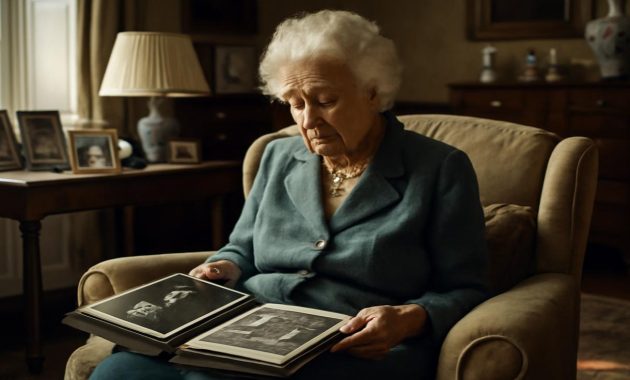
The old black‑and‑white photograph is easy to overlook. A woman in a dark hat, the brim casting a soft shadow over a lined but still-composed face, stares just past the camera as if looking into a world only she can see. Behind her, the cars, the clothes, the city are unmistakably twentieth century. Yet she herself was born in the days of horse‑drawn carriages, when gas lamps still ruled the streets and Europe was a map of monarchies. Her name was Princess Alice, Countess of Athlone—granddaughter of Queen Victoria, witness to three crowned emperors, two world wars, and the slow, dignified fading of an age. She lived well into the 1980s. And somehow, almost nobody remembers her.
The Last Granddaughter of an Empire
Imagine a nursery in Windsor Castle in early spring, 1883: the smell of beeswax polish and coal smoke, the crackle of distant fires, the murmur of footmen in the corridors. In a sunlit room overlooking the grounds, a baby girl blinks at the world for the first time. This is Princess Alice Mary Victoria Augusta Pauline—dainty titles for a child who will live long enough to watch most of the empires in her baby name vanish.
She is born into a dynasty at its very height. Her grandmother, Queen Victoria, still wears the widow’s black she adopted after Prince Albert’s death, but her political shadow stretches from Canada to India, from the Cape to the Pacific. Alice’s father, Prince Leopold, Duke of Albany, is the youngest of Victoria’s sons: clever, frail, plagued by the dangerous inheritance of haemophilia. Her mother, Princess Helena of Waldeck and Pyrmont, brings a touch of German small‑state royalty into the already tangled family web.
There is a certain irony to Alice’s lifespan. When she toddles through the palace corridors, the old courtiers still lower their eyes and bow deeply to “the Queen-Empress.” By the time she dies in 1981, teenagers are listening to new wave music, the Berlin Wall is still standing, and Britain has elected its first female prime minister. Her life starts in the gaslight and ends in the glow of color television.
In family gatherings, Alice is surrounded by people whose portraits will later hang in museums and history books. Edward, the future Edward VII, with his heavy features and carefully waxed moustache. Her cousin Wilhelm, who will grow up to be Kaiser Wilhelm II, is a sturdy, imperious presence. Another cousin, the shy Nicholas of Russia—the future Tsar—moves like a shadow at the edges of rooms. To baby Alice, they are just “Uncle Eddie,” “Willy,” and “Nicky.” To us, they are fractured pieces of a world that will soon come crashing down.
The Princess Who Chose a Quieter Crown
Royal stories usually tilt toward the dramatic: runaway romances, abdications, scandals. Alice’s life is quieter, subtler, and perhaps more revealing. She does not marry a king or an emperor; she marries a soldier. At 20, she weds Prince Alexander of Teck, a cousin on her mother’s side, in a ceremony whose scent would have been roses and incense, warm beeswax and starched linen, rather than revolution or destiny. It is 1904. Europe is still playing at being invincible.
Alexander is part of the Teck branch of the royal family—German in origin, British in service, and hovering in that polite but precarious space between major and minor royalty. He’s the brother of Queen Mary, who will later marry George V, making Alice both cousin and sister‑in‑law to the central royal household. Yet even in that web of connection, she seems to move at a slight diagonal, important but never central, close but always half in shadow.
Still, her married life begins in traditional royal fashion: glittering balls, country house weekends, visits to European courts where uniforms gleam with braids and medals. There are children: a daughter, May, and sons, Rupert and Maurice. Their lives are threaded with small domestic details—a governess complaining about the weather, the smell of wet wool drying by schoolroom fires, the constant, watchful presence of servants.
What changes everything is something completely beyond Alice’s control: war, and a sudden distaste for foreign-sounding names. When the First World War erupts, the British royal family begins to look uneasily at its own reflection. Too many German titles. Too many Tecks, Saxe-Coburgs, Hohenlohes, and Battenbergs. Too much foreignness at a time when the newspapers are screaming about enemy aliens.
In 1917, George V sheds the family’s German name of Saxe-Coburg and Gotha and rebrands them as Windsors. In the same wave of redefinition, Alexander of Teck abandons his princely rank and German styling. He becomes Alexander Cambridge, and is granted the more solidly British title of Earl of Athlone. Alice, once a princess by both birth and marriage, becomes—at least in public life—“Her Royal Highness Princess Alice, Countess of Athlone.” Half housemaid-simple, half fairytale-length.
The transformation is more than symbolic. In that moment, something old quietly crumbles: the idea of royalty as a continent-spanning, intermarried club. Alice, with her new surname and old bloodline, becomes a bridge between models of monarchy: the transnational dynastic family of the nineteenth century, and the modern, carefully rebranded, domestically-facing crown of the twentieth.
Across Oceans: A Royal in the Colonies
While many of her relatives spend their lives in palaces and London drawing rooms, Alice’s story stretches across oceans. Twice, she finds herself at the centre of Britain’s sprawling dominions, not merely as a guest but as a resident symbol of the Crown.
The first posting comes in the 1920s, when her husband is appointed Governor‑General of the Union of South Africa. For most of us, the phrase summons history-book images: dusty official cars, military parades, men in khaki uniforms. But imagine it, instead, through Alice’s eyes.
She steps from the ship into a light quite unlike England’s. The air is drier, richer, scented with dust and flowering shrubs. The birds are louder, the stars at night more aggressively bright. The Athlones’ official residence is filled with the smells of new wood and sun‑heated stone. Outside its gates, however, lies a country already heavy with racial divisions, long before “apartheid” becomes a formal political term.
Alice moves through it with the formal grace expected of a royal representative: opening hospitals, visiting schools, attending stiff receptions where the wine is too warm and the small talk more brittle than crystal. Yet in diaries and recollections, there are hints of a woman genuinely curious about the world she moves through, not merely presiding above it. She visits local communities, takes an interest in social welfare, and meets leaders and citizens far beyond the narrow circle of white politics.
Then, more than a decade later and a world war away, she crosses the Atlantic. In 1940, with Europe under Nazi threat and Britain bracing itself, Alice and her husband are sent to Canada, where he becomes Governor‑General. This time, the stakes are higher. The voyage itself is shadowed by the possibility of torpedoes. The Athlones arrive not just as representatives of the Crown, but as living reminders that the war is personal for the royal family as well.
In Ottawa, the winters are brutal but the welcome is warm. The official residence at Rideau Hall smells of woodsmoke and polish, the snow in the gardens lies in thick, squeaking drifts. Alice spends her days visiting troops, inspecting war work, talking to families who have sent sons and husbands to the front. She brings with her the weight of her lineage—the granddaughter of Queen Victoria, cousin to half the crowned heads now in exile, aunt by marriage to the man whose face stamps the coins in their pockets.
There is something almost cinematic about these scenes: this elderly princess, already in her late fifties, bundled in furs and wool, bracing herself against an Ottawa winter as she steps forward to greet another line of soldiers. Yet beneath the ceremony is a quieter truth: she is watching the final act of the world she was born into. The great dynastic empires of her childhood—Habsburg, Romanov, Hohenzollern—are gone. Only a few thrones remain, smaller, more cautious, less certain of their future.
War, Loss, and a Vanishing Generation
For all its official titles and duties, Alice’s life is also threaded with grief. The first blow strikes when she is still an infant. Her father, Prince Leopold, dies in 1884 after a fall triggers a fatal cerebral haemorrhage, a complication of haemophilia. She will never remember him, only the stories and the photographs: the soft eyes, the slightly hunched posture of a man always aware of his own fragility.
Years later, the First World War will reach into her own household. Her younger son, Prince Maurice, dies in infancy, a quiet tragedy in a family already acquainted with hereditary frailty. Her elder son, Rupert, inherits the dreaded haemophilia; in 1928, a car accident leads to an internal haemorrhage he cannot survive. For a woman raised in the cocoon of palaces and ceremonial duty, grief becomes a constant, unwelcome companion.
Outside the family, too, the world is darkening. Cousins vanish in revolutions and assassinations. The Romanovs are shot in a cellar in Ekaterinburg. The German monarchy collapses into a republic. The Habsburgs, once lords of half of Europe, are reduced to private citizens. Each downfall carries not just political weight, but personal shock: these are people Alice has met across dinner tables and in drawing rooms, people whose childhood laughter once echoed down the same palace corridors as hers.
By the time the Second World War ends, Alice is part of a dwindling group: the last living grandchildren of Queen Victoria. The family that once seemed to span the continent is shrinking year by year, its members reduced to elderly figures on balcony line‑ups and at state funerals. She survives them all. When her first cousin Prince Arthur of Connaught dies in 1942, the pool narrows further. Eventually, she alone carries the title of “last surviving grandchild of Queen Victoria.”
It is a strange sort of distinction, like being the final tree in a once-vast forest. Behind her stand names that once moved armies and redrew maps; ahead of her is a world where those names are increasingly museum labels.
A Life That Outran the Century
To grasp just how far Alice’s life reached, it helps to see it laid out in simple terms. Her story is less a straight line and more a long thread weaving through dramatic changes in British and world history.
| Year | Age | Key Moment |
|---|---|---|
| 1883 | 0 | Born at Windsor Castle, granddaughter of Queen Victoria |
| 1904 | 21 | Marries Prince Alexander of Teck |
| 1917 | 34 | Becomes Countess of Athlone after royal name changes |
| 1924–1930 | 41–47 | Lives in South Africa as viceregal consort |
| 1940–1946 | 57–63 | Serves in wartime Canada as consort to the Governor‑General |
| 1957 | 74 | Becomes last surviving grandchild of Queen Victoria |
| 1981 | 97 | Dies in London, having witnessed almost a century of change |
In between these dates are quieter, more human moments. After her husband’s death in 1957, Alice returns more fully to Britain, an elderly royal aunt in a world that no longer runs on royal timelines. She opens hospitals, attends ceremonies, sits through long speeches in drafty halls. She becomes a familiar, faintly ghostlike figure in newsreel footage: a small, neatly dressed old woman, hat pinned firmly in place, slightly stooped but always impeccably composed.
The younger generations know her as “Aunt Alice,” a living relic of stories their parents only half remember. To Princess Elizabeth, later Queen Elizabeth II, she is both cousin and senior, a reminder that even the longest reign is just one chapter in a very old book. To the public, if they notice her at all, she is yet another hat and handbag in a cluster of royal ladies on a balcony.
Yet consider what lies behind those mild, watchful eyes. She has seen Jack the Ripper in the headlines and men walk on the Moon on television. She was born before the invention of the modern car and lives to see jet flights shrink the distances she once crossed by liner. The girl rocked to sleep beneath oil‑painted ceilings at Windsor dies in a world of concrete tower blocks and humming fluorescent lights.
Why Princess Alice Faded from View
So how does someone with a life like this end up almost forgotten—a footnote rather than a chapter in royal history? Part of the answer lies in the way we tell stories.
We like our royal narratives bold and dramatic. Abdicating kings. Glamorous princesses with tragic ends. Queens who rule for record‑breaking decades. By comparison, Alice offers something gentler: duty without drama, privilege without rebellion, a kind of steady, almost old‑fashioned sense of service that doesn’t demand headlines.
She is not the protagonist of any great constitutional crisis. She does not marry beneath her station or launch a public crusade that redefines the monarchy. Instead, she works quietly within the system she is born into, adapting as it changes—swapping Germanic princely titles for English earldoms, trading palaces for colonial residences, then finally a flat in Kensington Palace for the last years of her life.
There is also the simple fact of chronology. Alice dies in January 1981, in the same year that the world turns its cameras toward a different kind of royal woman: Lady Diana Spencer, the shy young nursery teacher who will marry Prince Charles that summer. The contrast between a nearly 98‑year‑old Victorian granddaughter and a 19‑year‑old soon‑to‑be princess is almost too neat a metaphor for the turning of an era.
The media’s gaze shifts decisively toward youth, glamour, and the new style of emotional, public monarchy that Diana comes to symbolize. In that light, Alice’s long, dutiful, relatively private path through history feels out of step, tuned to a quieter frequency that fewer people are still listening for.
And yet, in her unflashy way, she embodies something essential about the modern British royal story: its ability to persist not only through pageantry, but through sheer, stubborn continuity. She is the living thread that ties the black‑clad figure of Queen Victoria to the color broadcasts of Elizabeth II’s Silver Jubilee; a human bridge between the age of steam and the nearly digital 1980s.
A Quiet Echo in the Modern Imagination
If you ever find yourself wandering through the older galleries of a royal portrait collection, pause when you see a small, dark‑haired girl in late Victorian dress, or an elderly lady in 1950s hats and pearls labeled simply “Princess Alice, Countess of Athlone.” Let your eyes rest on her face a moment longer than the others.
Behind that face lies the rustle of silk skirts at Windsor and the crack of parade‑ground heels in Pretoria; the soft, snowy hush of Ottawa winters and the low murmur of London traffic in a postwar dusk. She has stood beside men and women who shaped history and beside those crushed by it. She waited in drawing rooms while telegrams brought news from fronts and colonies. She watched family trees turn into casualty lists, saw crowns removed not for coronations but for exile.
In the end, perhaps the most moving thing about Princess Alice is not that she was the last grandchild of a famous queen, but that she carried that long, complex inheritance with a kind of unassuming steadiness. No scandal, no great rebellion, no dramatic flourish—just almost a century of turning up where duty asked her to, bearing witness as the world changed around her.
History often remembers the fireworks and forgets the lamplight. Princess Alice was lamplight: constant, modest, casting just enough illumination to remind us that there were real lives, long and intricate, behind the titles and the dates. And in that soft glow, the saga of a forgotten royal quietly becomes one of the most extraordinary timelines of them all.
Frequently Asked Questions
Who was Princess Alice, Countess of Athlone?
Princess Alice (1883–1981) was a granddaughter of Queen Victoria and the last of Victoria’s grandchildren to die. By birth she was a British princess, and by marriage she became the Countess of Athlone, playing prominent viceregal roles in South Africa and Canada.
How was she related to other famous royals?
She was Queen Victoria’s granddaughter through Victoria’s son, Prince Leopold, Duke of Albany. That made her first cousin to figures such as King George V, Kaiser Wilhelm II of Germany, and Tsar Nicholas II of Russia, connecting her to many major royal houses of Europe.
Why did her husband change his name and title?
During the First World War, anti‑German feeling in Britain led the royal family to abandon their Germanic titles. In 1917, Prince Alexander of Teck took the surname Cambridge and the British title Earl of Athlone. Alice then became formally known as Princess Alice, Countess of Athlone.
What roles did Princess Alice play in the British Empire?
She served as viceregal consort in two major dominions. From 1924 to 1930, she lived in South Africa, where her husband was Governor‑General. From 1940 to 1946, she lived in Canada in the same capacity, supporting wartime morale and public life during the Second World War.
Why is Princess Alice not well known today?
Unlike some of her relatives, Alice’s life did not involve high‑profile scandals or constitutional crises. She worked quietly within royal duties, and by the time she died in 1981, media attention was focused on younger, more glamorous royals. As a result, her long, steady life has become a relatively overlooked chapter in royal history.