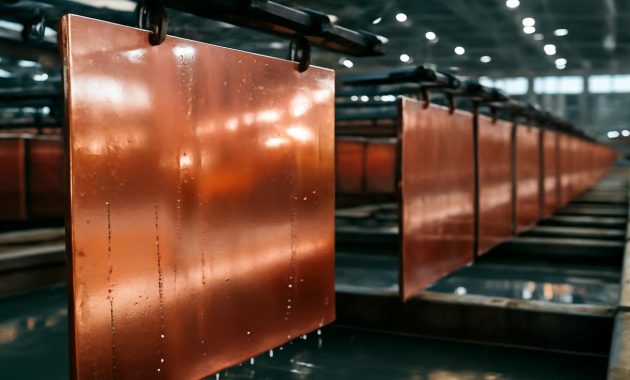
The ship’s horn sounded like a tired animal as it nudged into the port, shouldering through a thin haze of coal dust and sea mist. On deck, coils of copper cathodes – bright, salmon-pink sheets stacked like metal manuscripts – caught the morning light. Somewhere behind the cranes and warehouses, a skyline of smokestacks pulsed and whispered: this is where the world’s wiring gets made. This is also where a quiet truth is hiding in plain sight. While politicians and analysts have spent the last decade worrying about China’s dominance in rare earth elements, another story has been unfolding along these wharves and refineries: copper, the old, reliable metal of wires and motors and grids, now runs increasingly through China’s hands too.
The Metal That Hums Beneath Everything
Slip your phone from your pocket. Set your palm on a wall where a light switch lives, or on the steering wheel of any electric vehicle rolling past. Inside all of this – in the arteries of data centers, offshore wind turbines turning silently in the dawn, transformers humming on forgotten backroads – copper is at work. It doesn’t shout like cobalt or flirt with the headlines like lithium. It’s the workhorse metal, the quiet conductor of the modern world.
Copper hums beneath our feet in buried power lines and stretches above us in thick cables strung between towers. Every time a city decides to swap gas engines for electric buses, or a government approves a new high-speed rail line, the invisible bill includes a staggering appetite for copper. According to industry estimates, the energy transition could double global copper demand in a few decades. It’s the metal that turns grand visions – net-zero, decarbonization, full electrification – into something you can actually plug in.
But there’s a twist in this story. Digging copper out of the ground is only the first act. The ore that leaves a mine in Chile or the Democratic Republic of Congo is still a long way from becoming the silent electricity highway threaded through your apartment walls. Between the raw rock and the finished wire lies a complex, messy, power-hungry act: refining. And that’s where China has quietly taken center stage.
From Rock to Wire: Where the Real Power Hides
Step into a copper refinery – or as close as regulations will let you. The air smells faintly acidic, tinged with something metallic and sour. Long rectangular tanks stretch into the distance, filled with turquoise solutions that reflect the overhead lights. Inside these baths, an invisible choreography of electrons is under way. Slabs of impure “blister” copper hang at one end, pure starter sheets at the other. Turn on the current, and atoms begin to move – impurities drifting away, copper slowly depositing in perfect, gleaming layers.
This is the hidden muscle of the copper industry: smelting and refining. Miners can ship concentrates – the crushed, partially processed ore – across oceans. But it’s the smelters that turn those concentrates into refined copper, the nearly pure metal from which everything else flows. Owning the mines gives you resources. Owning the refineries gives you leverage.
Over the past two decades, China has methodically built one of the greatest smelting and refining networks the world has ever seen. While headlines fixated on the country’s control of rare earths, something broader was happening: a deliberate race to dominate the places where raw materials become usable, high-value products. Copper was central to that plan.
China’s Quiet Copper Ascent
Picture a map of the world at night, cities flaring like electrical constellations. Now imagine another map layered on top – one that shows the flow of copper, not as lines on paper but as pulsing arteries of trade. Mines in South America, Africa, and Australia are the beating hearts, sending out cargo ships loaded with concentrates. Follow those ships, and many of them turn in the same direction: toward China’s coast.
Within a generation, China moved from being a relatively modest player in copper refining to becoming the gravitational center of the entire system. It imports enormous volumes of copper concentrates and scrap from every continent, then refines them in sprawling industrial complexes supported by cheap labor, government-backed financing, and an unrelenting focus on infrastructure.
Today, a striking share of the world’s refined copper – the near-100% pure metal that manufacturers actually need – emerges from Chinese plants. The country has built smelters clustered near ports, power stations, and industrial zones, weaving copper into a broader tapestry that includes aluminum, batteries, and steel. While others saw smelting as dirty, costly, and politically thankless, China treated it as strategic infrastructure – as essential as highways and ports.
That strategic bet is now embedded in the global supply chain. A motor manufacturer in Europe, a cable producer in Southeast Asia, or a turbine factory in North America may never see a Chinese port, yet a quiet fraction of their essential copper has often made a detour through a Chinese refinery before it reaches them as a standardized product.
The Geography of Dependence
In a small trading office in London or Singapore, a dealer stares at a spreadsheet full of numbers that shift like tides: freight rates, treatment charges, London Metal Exchange prices, warehouse inventories. Hidden in those cells is the imprint of a country thousands of miles away.
When mining companies in Peru or Zambia negotiate “treatment and refining charges” for their copper concentrates, the benchmarks are heavily shaped by conditions in China. If Chinese smelters are running hot, hungry for more input, charges go down and miners breathe easier. If those smelters slow, or if regulations tighten, treatment charges rise and margins get squeezed. In this way, China doesn’t just process copper – it silently writes part of the global industry’s rulebook.
The pattern is familiar. For rare earths, China didn’t just dig and refine the ores; it also built the magnet factories, the processing labs, the know-how. For copper, the country has done something similar, though more subtly: building an ecosystem where mines, smelters, manufacturers, and exporters are tightly interlocked. You can bypass a Chinese rare earth supplier if you’re willing to pay more and wait longer. But try rewiring the copper map overnight, and you run up against physics, cost, and time.
Copper, Climate, and the Coming Squeeze
Walk through a wind farm at dusk. Stand directly beneath one of the turbines; listen to the blades whoosh as the sky darkens and the air grows cooler. Inside the towers and nacelles, copper coils and cables quietly turn mechanical motion into something you can charge a phone with. Every new turbine is a small copper monument. So is each electric bus, each new solar farm, each fast-charging station that pops up along a highway.
The energy transition is in many ways a copper transition. Renewable technologies are copper-hungry, sometimes far more so than their fossil-fueled counterparts. More transmission lines to connect windy plains with crowded cities. More electric motors to replace combustion engines. More storage, more microgrids, more everything – and all of it tinged with that familiar reddish gleam.
Yet even before demand surges fully hit, some analysts are already warning of looming copper shortages. New mines take more than a decade to plan, permit, and build. Communities resist open pits and tailings dams. Ore grades are falling in some of the world’s most established regions. In that constrained reality, who controls the choke points – the refineries, the smelters, the final purification steps – matters more each year.
China has placed itself directly at those choke points. If the world is to lay down millions of kilometers of new copper wiring for clean energy, enormous volumes of that metal will, in all likelihood, pass through Chinese-controlled plants. It’s not just about mining rights anymore; it’s about industrial muscle, chemical expertise, and the ability to run enormous facilities at scale and at cost.
Why Refining Shifted East
It’s tempting to think this was inevitable – that as labor was cheaper in Asia, smelting was bound to migrate there. But the story is more layered than that. Copper refining is energy-intensive and environmentally challenging. It produces emissions, slag, and acidic gases that require serious controls. Building and operating a modern smelter demands huge upfront capital, reliable power, and political will to tolerate industrial landscapes that are anything but picturesque.
Many Western countries chose another path. Environmental standards tightened, older plants closed, and new projects often stalled at the intersection of local opposition and high costs. There’s a deep irony here: nations that loudly proclaim their commitment to clean energy outsourced some of the dirtiest steps in making that energy possible.
China, meanwhile, leaned into the problem. It accepted – sometimes to painful environmental consequence – the burden of turning rock into refined metal. Over time, it improved its technology, added scrubbers and filters, and consolidated plants into more efficient giants. The learning curve was steep but transformative. With each ton refined, the country gained experience, pricing influence, and leverage – not just in copper, but across a spectrum of industrial metals.
Today, that choice has crystallized into a kind of quiet dependence. Even countries rich in copper ore frequently ship their concentrates abroad rather than refine them at home. Building their own full-scale processing capacity would mean years of investment and political negotiation, while Chinese smelters already stand ready, waiting by the sea.
A Web of Metals, Tied to One Center
Rare earth elements made the headlines because they sound exotic, their names a roll call of scientific obscurities: neodymium, dysprosium, terbium. Copper, by contrast, is as familiar as a penny in your hand. Yet these markets are part of the same larger tapestry – a web of materials that feed into the same factories, the same climate goals, the same geopolitical anxieties.
In industrial parks across China, copper refineries sit beside aluminum smelters, battery plants, and chemical complexes. Scrap yards feed into smelters; smelters send cathodes to wire producers; wire producers supply global electronics manufacturers. It’s an ecosystem, dense and self-reinforcing. Control one link, and you gain influence. Control many links, and suddenly entire supply chains curve around you like the lines of a magnetic field.
The rest of the world is only beginning to reckon with how deep this influence goes. It’s not just about who digs which metals out of the earth, but who knows how to clean them, shape them, and send them back into the world as precisely engineered components. The knowledge, the infrastructure, the people who can troubleshoot a smelter that’s having a bad week – these are as strategic as the mines themselves.
| Stage in Copper Chain | Typical Location | China’s Role |
|---|---|---|
| Mining (Ore Extraction) | Chile, Peru, DRC, USA, others | Major buyer & financier, limited direct share of global ore |
| Concentrate Production | Near mines worldwide | Key customer; influences treatment charge benchmarks |
| Smelting & Refining | China, a few other industrial hubs | Holds a dominant share of global refined capacity |
| Manufacturing (Wire, Components) | China, East Asia, Europe, North America | Huge domestic base, major exporter of copper products |
Can the World Rebalance the Copper Map?
In boardrooms and ministries from Brussels to Washington to Santiago, a new phrase has taken root: “supply chain resilience.” Once, it might have sounded like consultant-speak. Now it carries the anxiety of something more visceral – the realization that key materials could be weaponized in trade disputes or geopolitical standoffs.
For copper, the options are neither simple nor quick. Building new smelters in countries that currently export concentrates means wrestling with environmental concerns, electricity grids, and multibillion-dollar price tags. It means persuading communities that the promise of jobs and revenue is worth the smoke and risk, even with the cleanest technology available. It also means training a new generation of metallurgists, engineers, and operators – the people who actually run these complicated, cantankerous facilities.
Some nations are taking tentative steps. There is talk of “friend-shoring” – routing more copper through refineries in politically aligned countries – as well as boosting recycling to blunt demand for newly mined ore. But these are long games. Smelters aren’t smartphone factories; you don’t spin them up or down on election cycles.
In the meantime, the world lives in a kind of managed dependence. Even as governments jostle and issue statements about strategic autonomy, traders still book vessels, miners still sign long-term contracts with Chinese smelters, and the slow heartbeat of the copper trade continues: ship in, refine, ship out, repeat.
The Copper Thread in Our Everyday Lives
If all of this still feels abstract, follow a single imagined strand of copper through its journey. It begins as ore in the dust of a high Andean plateau, blasted from the rock in a thunder of explosives. It rattles along conveyor belts, through grinding mills, into flotation tanks where minerals bubble and separate like some alchemist’s brew. It emerges as a concentrate, then is loaded into bulk carriers and sent across the Pacific.
Weeks later, that same copper is lowered into a Chinese smelter – a city of pipes, chimneys, and roar. It passes through furnaces fierce enough to turn stone to orange-glowing liquid, through converters and refining cells, until it cools into neat, heavy plates of almost perfect copper. Those plates ride trucks and trains to a factory where they are drawn into thin, bright wires that gleam like stretched sunlight.
Somewhere else in the world, a worker unpacks a spool of that wire and threads it into an electric motor destined for a wind turbine off the coast of Scotland, or an EV charging station in California, or a new apartment block in Nairobi. By the time the motor spins or the switch clicks, any trace of that copper’s long detour through China is invisible. Yet the journey shaped the price, availability, and timing of the device in your hands.
This is what it means to say that China has become indispensable in copper refining. It’s not about a formal monopoly or a single chokepoint valve that can be turned off. It’s about a deep, practical entanglement: a world that has grown used to thinking of copper as a cheap, abundant background material, while outsourcing much of the messy middle steps to one country.
Living With Interdependence
As dusk settles over that first harbor again, cranes stand like steel giraffes silhouetted against a bruised sky. Another ship noses in, heavy with raw material; another one edges out, stacked with the clean, rectangular promise of refined metal. Workers head home with the tang of sulfur still in their clothes. In the control rooms, operators watch glowing panels that track temperatures and voltages in real time, guardian angels to rivers of molten copper.
We tend to talk about metals in the language of ownership and control – who dominates, who supplies, who depends. Those are real questions, pressing ones in a century that will be shaped by the availability of precisely these materials. But there’s also another way to see it: as a web of interdependence so finely woven that it’s hard to say where one country’s story ends and another’s begins.
China’s ascent in rare earths was a warning bell that rang loudly, jolting governments awake. Its dominance in copper refining is more like the background hum of a power station: always there, easy to forget, impossible to live without. As the world demands more copper to remake its energy systems, that hum will only grow louder.
We can choose to ignore it, to let the ships and smelters and contracts keep moving in the shadows. Or we can look directly at the copper that flows through our walls, our devices, our cities, and ask what kind of system we want to build: where it is refined, at what cost, and under whose quiet, steady hand.
FAQ
Why is copper so important for the energy transition?
Copper is a highly efficient conductor of electricity and heat. Renewable technologies – like wind turbines, solar farms, electric vehicles, and expanded power grids – all need large amounts of copper for wiring, motors, transformers, and connections. As countries electrify transport and build more clean power, copper demand rises sharply.
Is China the biggest producer of copper ore?
No. Countries like Chile, Peru, and the Democratic Republic of Congo are major producers of copper ore. China’s influence is stronger in the next steps: smelting and refining that ore into high-purity copper metal, and then turning it into finished products.
What does it mean that China dominates copper refining?
It means a significant share of the world’s capacity to turn copper concentrates and scrap into refined copper is located in China. Many mining countries export partially processed ore and rely on Chinese smelters to finish the job, giving China substantial pricing power and strategic leverage.
Can other countries quickly build their own copper refineries?
Not quickly. Smelters and refineries are expensive, technically complex, and often controversial due to environmental and energy concerns. Planning, permitting, financing, and building new facilities typically take many years, sometimes over a decade.
How does copper refining affect the environment?
Copper smelting and refining consume large amounts of energy and can produce air pollutants, greenhouse gases, and solid wastes if not properly controlled. Modern plants use filters, scrubbers, and strict management systems to reduce impacts, but the industry still carries a significant environmental footprint.
Is recycling copper a realistic way to reduce dependence on new refining?
Recycling is already an important copper source because the metal can be reused without losing quality. Expanding recycling can ease pressure on mines and smelters, but growing demand from electrification means that, for now, both new mining and large-scale refining will still be needed.
How does this relate to China’s dominance in rare earth elements?
Both stories show a similar strategy: China invested heavily not just in mining, but in processing, refining, and manufacturing capacity. With rare earths, it controls most of the refining and magnet production. With copper, it has built huge smelting and refining capacity. In both cases, the real power lies in controlling the “middle” of the supply chain where raw materials become usable, high-value products.