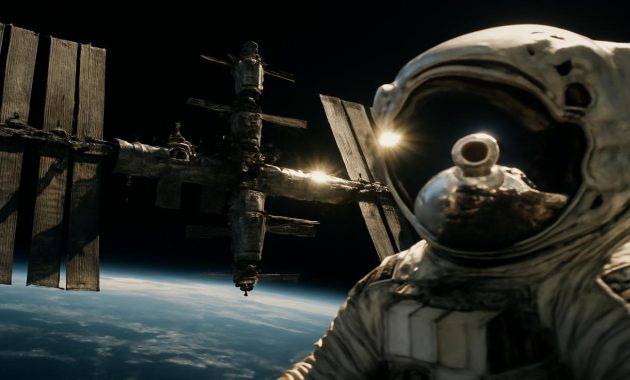
The space station looks fragile from the ground—just a silver cross of sunlight drifting over backyards and city skylines. You can watch it glide across the night, silent and bright, in the time it takes to boil a kettle. It feels timeless, almost eternal, as if it will always be up there, circling the planet like a mechanical moon. But inside NASA, the timer is loudly ticking. The International Space Station is old. Very old, in space years. Its joints creak, its modules show their age, its systems require more coaxing, more maintenance, more caution. And for the first time since the Cold War, humanity is on the verge of having… nothing permanent in orbit at all.
The Station That Was Never Meant to Last This Long
On a cold November morning in 1998, a Russian Proton rocket lit up the Kazakh steppe and hurled a metal cylinder into the sky: Zarya, the very first module of what would become the International Space Station. Back then, the promise was enormous. The station would be a laboratory, a symbol of peace, a stepping stone to the Moon and Mars. It was an engineering experiment, a geopolitical handshake, a bet that space could be something other than a battlefield.
What it was never meant to be… was immortal.
The ISS was designed with an initial life expectancy of roughly 15 years for most of its major components. That marker passed a long time ago. Cycles of funding, repairs, political deals, and astonishingly careful engineering stretched that lifespan first to 2020, then to 2024, and now to at least 2030. Engineers have patched leaks, reinforced systems, replaced modules, tweaked algorithms. They’ve watched microscopic cracks creep across metal like frost, tested the air again and again, listened to the subtle burps and whirs of aging pumps and fans the way a mechanic listens to an old car engine.
From orbit, astronauts see no age. The Earth glows young and blue, storms spiral, city lights burn along coastlines. But inside the station, the years are written into every panel and cable tie. Some of the first-generation hardware has been humming for a quarter of a century in a place where air, water, and sunlight are all artificially caged and carefully rationed.
NASA’s own analyses have concluded the structure can likely be operated safely to 2030, maybe a little beyond. But “likely” is hardly a comforting word when lives and billions of dollars are traveling at 17,500 miles per hour in vacuum. Metal fatigues. Seals stiffen. Solar arrays sag. The ISS is a masterpiece—but it’s a masterpiece on borrowed time.
The Quiet Countdown to a Fiery Goodbye
Someday in the coming decade, if all goes roughly to plan, the station you can see from your backyard will not merely stop working. It will die in a bright, violent streak over the Pacific Ocean—a controlled reentry, timed and targeted, as pieces of its structure vaporize in the atmosphere and whatever remains plummets into remote waters. This end has always been part of the plan. No structure that large can be left to gradually fall out of orbit on its own, a potential hazard to people on the ground or to other satellites.
Inside NASA’s planning documents, the language is careful and technical. Deorbiting. End-of-life disposal. Controlled atmospheric reentry. But strip away the acronyms and charts, and the emotional reality is far more human: an entire era of continuous human presence in low Earth orbit will reach its final page.
Since November 2000, there has always been someone up there. Through wars, recessions, pandemics, political shifts back on the ground—someone has been floating through those narrow Russian corridors, or drifting past the glowing screens of the U.S. laboratory module, or pressing their nose to a small round window to watch the Himalayas roll slowly beneath them.
When that stops, even temporarily, it won’t just be a symbolic loss. It will be a break in a hard-won continuity of research, experience, and habit. Knowing how to live and work in space is a skill, like sailing or flying. It improves with repetition. The ISS has been our daily practice, our friendly orbiting classroom. Without it, much of that practice will move to short, episodic visits on smaller platforms—if those platforms exist in time.
The Replacement Problem
That’s where the pressure comes in. NASA does not want a gap, a dead zone in low Earth orbit with no U.S.-led station. The agency’s roadmap assumes that as ISS winds down, a new generation of privately owned space stations will take its place—a bustling, commercial “low Earth orbit economy” where NASA is just one of many customers buying lab time, crew seats, and data.
On paper, it’s a tidy progression: government-funded infrastructure followed by private industry stepping in once the market is primed. In reality, timelines are tight, costs are high, and space is notoriously unforgiving of optimism.
NASA has awarded contracts and seed money to several companies to develop commercial stations. Designs range from compact, modular platforms to inflatable habitats the size of small office buildings. The names—Orbital Reef, Starlab, Haven-1, and others—sound like something out of a sci-fi novella. But building, launching, and sustaining a new orbital outpost is one of the hardest things humanity knows how to do. It took more than a decade, countless flights, and a coalition of spacefaring nations to assemble the ISS. Expecting private companies to field mature replacements before 2030 is bold, maybe necessary, and definitely risky.
And then, of course, there’s the money. The ISS costs NASA around $3 to 4 billion per year. That’s a huge slice of the human spaceflight budget, and a big reason the agency is determined not to build its own replacement from scratch. The hope is that commercial stations, shared among research institutions, national space agencies, perhaps even tourists and manufacturing startups, will be cheaper for NASA in the long run. But hope and hardware are not the same thing.
Life Aboard a Station That Knows It’s Temporary
Talk to astronauts who have lived aboard the ISS in recent years, and they’ll tell you something interesting. Yes, it’s aging. Yes, sometimes equipment breaks more often than anyone would like. But the real mood is one of reluctant tenderness, not fear. The space station is quirky and cramped and overflowing with cables, but it’s home.
You can picture it: a crew member drifting through Node 2, one hand hooked casually under a rack, the other guiding a laptop with the grace of someone who’s forgotten gravity. There’s a faint whir of fans, the ever-present hum of life support, the occasional metallic creak as the structure responds to sunlight and shadow. Velcro is everywhere. A spoon floats lazily next to a pouch of reheated curry. Someone has taped a family photo to a hatch; someone else has tucked a tiny flag into the corner of a monitor.
Outside, on a spacewalk, another astronaut braces against a handrail and looks down—and there’s the Amazon, or the Sahara, or the jagged snow of Patagonia. Generations of astronauts have described the same sensation: a sudden, aching awareness of Earth’s fragility. The thin blue line of atmosphere looks almost too delicate to be real.
Inside, scientists run experiments that simply can’t happen on the ground: protein crystals growing into intricate, flawless forms; flames curling into perfect spheres; alloys forming in slow, untroubled freefall. Medical studies track how muscles waste and bones weaken without gravity, how fluids shift toward the head, how the human body resists and adapts to this strange environment.
Every one of those experiments feeds into something else—better drugs, better materials, better spacecraft. And, crucially, better habits for life farther out: on the Moon, on Mars, or wherever humanity dares to go next. The ISS is not just a lab; it is a rehearsal space. We have learned how to fix toilets in microgravity, how to perform emergency procedures while upside down, how to keep people more or less sane in a place where you can never go outside without a suit.
Now imagine trying to learn those lessons again from scratch after a long pause, on a smaller, newer station with less redundancy, fewer backup systems, and maybe a more tenuous funding stream. That’s the scenario NASA is trying, desperately, to avoid.
A Race Against Physics and Politics
The ticking clock isn’t just about aging hardware. Space is political, and the ISS is, above all, a political achievement. It is the product of U.S., Russian, European, Japanese, and Canadian cooperation—an alliance so unusual that it has outlasted shifting governments, diplomatic crises, and even the chill of war elsewhere on Earth.
But the strain is visible. Geopolitical tensions have repeatedly raised questions about how long this partnership can remain stable. Each time, cooler heads and practical realities—shared orbits, shared systems, shared history—have kept the station going. Yet everyone knows this arrangement will not last forever.
As NASA looks beyond low Earth orbit—to lunar missions, to the Artemis program, to a future lunar gateway station orbiting the Moon—the question becomes brutally simple: How do you keep all these ambitions afloat at once? Budgets are finite. Engineering talent is finite. Political patience is absolutely finite.
Privatizing low Earth orbit, in theory, frees NASA to point its own rockets and resources outward, to more distant horizons. But the path between theory and practice is narrow. If commercial stations are late—if the promised orbital “business parks” and microgravity factories and tourist suites don’t materialize on schedule—NASA may find itself juggling an aging ISS it can’t safely abandon yet and an unready replacement it doesn’t fully control.
The agency’s internal timelines are already tight, with transition plans that look neat in PowerPoint presentations but bristle with uncertainties. Engineers and program managers quietly wrestle with questions that don’t make for pretty press releases: How do you certify a private station as safe enough for government astronauts? Who pays for emergency repairs? Where is the line between “NASA customer” and “NASA partner” really drawn when lives are at stake?
Who Owns Tomorrow’s Orbit?
Beneath the technical details lies a deeper shift: space is being asked to grow up. The era of purely government-run, flag-planting missions is giving way—unevenly, noisily—to a more commercial, mixed economy. Crew vehicles like SpaceX’s Crew Dragon ferry astronauts to the ISS under contracts that would have sounded like science fiction twenty years ago. Cargo ships arrive with company logos on their fairings. Satellites are launched not just for national prestige or scientific exploration, but for internet coverage, weather tracking, imaging, broadcasting, and profit.
Extending that model to entire space stations is the next logical step. But it raises real questions. What does “commercial” mean in a place where every bolt and oxygen filter must be rigorously tested, where the margin for error is thin and the costs are astronomical? How do you balance shareholder priorities with the slow, meticulous demands of science? Who gets to decide which experiments fly, which nations get access, which emergencies justify a rescue?
NASA, understandably, doesn’t want to lose the expertise and influence it has built over decades. It wants to shape these future stations, not merely rent a corner desk inside them. So the agency is weaving itself into the fabric of these private designs from the start, providing money, requirements, oversight, and hard-earned wisdom written in the checklists of thousands of successful or nearly-disastrous space operations.
Still, the fear lingers: what if private stations, once built, see NASA less as a partner and more as a customer who can be outbid? What if orbital rent spikes? What if an accident erodes public confidence, leading to cuts that hurt everyone? There is no past precedent for this landscape. We are, yet again, trailblazing.
Meanwhile, the World Watches the Sky
Down on Earth, most people do not follow NASA budget hearings or read transition strategy documents. They simply know that the ISS is “up there,” and that it’s a point of quiet pride that humans live in space at all. They get a shiver of wonder when their phone alerts them that the station will pass overhead in ten minutes. Families stand on porches or sidewalks, necks craned, pointing at the bright fast-moving dot.
That small communion—millions of strangers, all looking up at the same rushing point of light—is easy to underestimate. In an era of fractured attention, the ISS is one of the few things still capable of gathering us, silently, into the same moment.
Schools build projects around it. Students plant seeds that have spent time on the station. Cameras aboard stream live views of the Earth, mesmerizing in their simplicity: just clouds, land, ocean, and the gentle curve of the horizon. You can tune in on a lunch break and watch as the world spins slowly beneath solar panels and antennae.
When the station is gone, something will be missing from the sky. New stations will rise, of course. Some may be slicker, newer, more spacious. They may have roomy viewing domes, better internet, better coffee machines. They may host tourists alongside career astronauts, their interiors decorated less like a submarine and more like a tech company’s offsite retreat. But that first great experiment in shared orbit—the one built by former rivals, assembled piece by piece over decades—will not be replicated.
A Timeline Written in Metal and Momentum
To understand how sharply the clock is ticking, it helps to lay out the situation in simple form. Below is a distilled snapshot of where things stand, as plans evolve and orbits decay:
| Item | Status / Target | Key Concern |
|---|---|---|
| ISS Operational Life | Approved to at least 2030 | Aging hardware, rising maintenance risk |
| Commercial Station Readiness | Concepts & early development underway | Tight schedule to be operational before ISS retirement |
| NASA’s Role | Transitioning from owner-operator to anchor customer | Maintaining influence, safety, and access for science |
| International Partners | Evaluating future participation in commercial platforms | Balancing geopolitics with shared scientific goals |
| Risk of a Gap in Orbit | Real, if commercial stations are delayed | Loss of continuous human presence and research in LEO |
Each row of that table is a quiet source of pressure bearing down on NASA. The agency has to keep astronauts safe on an aging station, help birth successors it does not fully control, retain international partnerships, and reassure the public that all this change is not a retreat but an evolution.
It’s a balancing act being performed on a knife-edge of schedule and physics. Orbits decay whether budgets are passed or not. Metal ages whether Congress is in session or not. Launch windows do not negotiate.
Why This Transition Matters More Than It Seems
It would be easy to frame the story of the ISS simply as a tale of old hardware making way for new. That’s how technology works, after all. Computers get replaced, airplanes are retired, even telescopes eventually run out of coolant or lose their sharpness. But the ISS is more than hardware. It is a cultural object, a shared project, an experiment in how we cooperate when the survival of everyone aboard depends on it.
If NASA manages this transition well—if commercial stations are online in time, if international partners find fair and fruitful roles within them, if safety is maintained and science thrives—then the story of the ISS will be seen as a prologue, not a high-water mark. We will look back at that spindly, crowded station and see the early sketches of a spacefaring civilization.
If the transition goes poorly—if there is a long gap, if trust in spaceflight is shaken, if costs balloon and access shrinks—then the ISS will be remembered instead as a peak we briefly reached and then stepped down from, distracted or unwilling to sustain the climb.
NASA knows which version of the story it wants history to tell. That’s why the pressure is mounting now, in meeting rooms and design reviews, in hushed technical debates and blunt political conversations. The agency is trying to do something as subtle as it is difficult: to end an era without ending the momentum that era created.
Meanwhile, the station keeps circling. Every ninety minutes, day to night to day again. Every orbit, someone aboard glances down at the planet and feels, perhaps, that mix of awe and worry that defines this moment. We built a home in space. We learned to live there. Now, as that first home ages toward its inevitable end, we have to prove—to ourselves as much as to the vacuum outside—that we can build new ones, and that we will not simply close the hatch and come quietly back down.
Frequently Asked Questions
Why can’t we just keep using the International Space Station indefinitely?
The ISS was never designed to last forever. Its structure and systems experience constant thermal cycling, radiation exposure, and mechanical stress. Over time, metal fatigues, seals weaken, and maintenance becomes more complex and risky. At some point, the cost and danger of keeping it running outweigh the benefits, and a controlled deorbit becomes the safest option.
When is the ISS expected to be retired?
Current plans support ISS operations until at least 2030. However, that date is not a hard cutoff; it reflects engineering assessments, budget realities, and international agreements. The actual retirement will depend on station health, safety analyses, and how quickly viable commercial replacements are ready.
What will replace the ISS?
NASA is banking on a new generation of commercially owned and operated space stations in low Earth orbit. Several companies are developing concepts and early hardware, with the idea that NASA and other customers will rent space for research, technology development, and crew habitation instead of owning the stations outright.
Could there be a gap with no permanent human presence in low Earth orbit?
Yes, that risk is real. If the ISS must be retired before commercial stations are fully operational and certified as safe, there could be a period where no long-term orbital outpost is available. NASA is working to avoid this by overlapping ISS operations with the first commercial platforms, but schedules in spaceflight are notoriously difficult to hold.
Why is NASA shifting to commercial stations instead of building another ISS?
Cost and strategy. Building and operating another ISS-class government station would be enormously expensive and would tie up budgets that NASA wants to direct toward deep-space exploration, such as Moon and Mars missions. By supporting commercial stations and becoming a paying customer, NASA hopes to reduce long-term costs and stimulate a broader space economy, while still maintaining access to orbit for science and training.