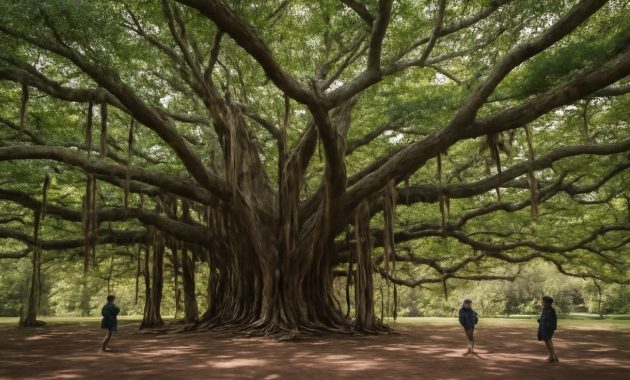
The first time you see it, your brain refuses to cooperate. Your eyes insist you are looking at a forest: a dense tangle of trunks, a canopy spreading like a green sea, birds flickering from branch to branch. But someone beside you, maybe a local farmer with sun-cracked hands, says quietly, “That’s one tree.” You laugh, because of course it isn’t. No single tree can be 8,500 square metres wide, twenty metres tall, and deliver eighty thousand fruits in a single harvest. And yet, as you walk closer and feel the subtle continuity of the bark beneath your fingers, as you trace how the branches knit into a single living body, disbelief begins to loosen its grip.
The Forest That Is Really One Giant Being
There is a particular kind of stillness under this tree. Not silence—never silence—but a rounded, cushioned quiet, like the world has drawn its breath and is holding it in calm admiration. The air is thick with scent: ripe sweetness from fallen fruit, the deep green fragrance of leaves, a faint earthiness rising from the shaded soil. If you stand in the middle and spin slowly, you see only trunks and low branches, looping and arching and re-rooting themselves into the ground.
From above—maybe from a drone’s-eye view—the whole organism looks like a vast, living cloud pressed flat against the earth: 8,500 square metres of leaf and branch, an emerald footprint so large it could swallow an entire village square, a small stadium, or several city blocks. The crown stretches outward instead of upward, preferring to spread, to claim horizontal space, to fold itself over the land like a sheltering hand.
Each season, it produces a staggering bounty: up to 80,000 fruits in a single harvest. Imagine the sound of that season: soft thuds of fruit dropping, hands rustling in the leaves, voices calling across the shade, baskets filling and refilling. It’s not just a tree at that point—it is a harvest machine, a marketplace, a family treasury, a living pantry rooted in the soil.
The Strange Architecture of a Giant
When you walk beneath its canopy, something curious happens to your sense of scale. The world feels slightly rearranged, as if you have stepped into a story where the old rules don’t quite apply. You look around and see what seem to be dozens, even hundreds, of individual trees. Thick trunks twist upward, each one several arms wide. Some lean into each other, some stand solitary, some spiral around their own shadows.
But look closer. Trace the bark with your hand. Notice the way the surface texture doesn’t quite “reset” from trunk to trunk. The pattern continues—slightly different as it grows older or younger, but somehow familiar, like a repeated theme in a long song. Many of these “trunks” began life as branches, reaching outward until, weighted by their own persistence, they bent down, pressed into the soil, and took root. The branch becomes root, the root becomes trunk, the trunk becomes another point in the same vast, living web.
The whole organism is one genetic individual. Somewhere, centuries ago, it sprouted as a single stem, no taller than your shin. Over time, it chose expansion over height, connection over isolation. It discovered a trick written quietly in its DNA: the capacity to turn horizontal branches into new vertical support columns. Each time a branch touches the ground and roots itself, the tree effectively extends its body. It’s like watching a slow-motion, botanical version of a city growing outward, adding neighborhoods and districts, but all governed by the same shared “mind.”
Stand back far enough and that’s what this tree resembles: a living city. Old “districts” at the core show thick, gnarled bark and heavy limbs. Newer “suburbs” toward the edges are slimmer, brighter, more flexible. Everything is connected through veins of sap, invisible currents of water and sugar and chemical messages. Under the soil, roots weave and knot, exchanging nutrients, storing memories of drought and storm. Above, thousands of leaves share the same sunlight, the same instructions whispered up from below.
The Numbers Behind the Wonder
It’s easy to get lost in the poetry of it, but there’s a hard, almost unbelievable mathematics to this tree as well. The figures alone read like mythology:
| Feature | Approximate Value |
|---|---|
| Canopy area | 8,500 m² (about 1.2 football fields) |
| Average height | Up to 20 metres |
| Fruits per harvest | Around 80,000 fruits |
| Age (estimated) | Several centuries |
| Genetic identity | Single organism (one tree) |
Those eighty thousand fruits are not just a statistic. They are meals, trade goods, stories told by grandparents under the evening sky while fingers peel and slice. They are evidence of an organism that has learned, across long seasons, how to thrive at scale.
Life Under the Canopy
Spend a full day under this tree, from early morning to night, and you will start to understand how many small lives orbit it. At dawn, when the light is thin and nearly blue, birds begin the first tentative notes of their songs from somewhere within the green roof. Insects wake in the folds of bark, in the cradles of young leaves, in the hidden labyrinth between soil and roots. Dew clings to everything, tiny mirrors catching the pale light.
Walk along the outer edge of the canopy and the world shifts like stepping across a border. Outside, the sun can be harsh, the ground baked and bright. Inside, the shade is soft, patterned with leaf-shadow, and the temperature drops noticeably. The soil feels damp, cooler under your fingertips. It smells of slow decay and constant renewal, a blend of fallen leaves, fruit skins, and rainwater that has lingered long enough to pick up the tree’s scent.
The idea of “inside” and “outside” becomes quite literal here. This tree encloses space, defines a room made of branches instead of walls. Children race between the trunks as if they are pillars in a great hall. Families spread woven mats on the dirt to rest and talk. Market days might unfold beneath these leaves: baskets of fruit, piles of herbs, the soft murmur of bargaining. The tree is not just a background for human life; it is a host, a building, a provider.
You may notice paths worn into the ground, subtle trails marking where feet most often fall: to a favorite gathering spot, to a trunk that bears a particular scar or carving, to a low branch perfect for sitting and thinking. With each passing year, as the tree expands, the paths adjust. It’s as if the humans and the tree are quietly negotiating space together: here, a branch bends a little higher to let a path through; there, a path skirts around an especially vigorous new column of wood rising from the soil.
The Rhythm of Fruiting Season
Fruiting season is when the tree becomes loud with possibility. The air fills with the smell of ripeness—a sweetness that clings to your clothes and skin. At certain times of day, ripe fruits drop from the canopy with a soft, satisfying thump, like nature’s own heartbeat marking the hours. Collectors listen for that sound. They move through the dappled light with woven baskets, their eyes scanning the ground, their ears tuned to the tiniest rustle above.
Up close, each fruit carries its own small weight of wonder: a skin textured by sun and rain, a hue deepened over weeks of invisible chemistry. Multiplied by tens of thousands, these little miracles become something else entirely: a harvest capable of feeding families, supporting trade, and anchoring an entire local economy for part of the year. The tree’s sheer abundance reshapes human routines: festivals timed with the first fruits, quiet gratitude at the season’s peak, and a shared sense of anticipation as the next cycle approaches.
A Tree That Thinks in Centuries
This tree’s story is measured not in years, but in generations. When it first emerged from the soil, the world around it looked very different. Different hands tended the surrounding land. Different languages rose and fell beneath its shade. Different storms battered its young branches. And yet it adapted, season after season, turning hardship into muscle—deeper roots reaching for hidden water, thicker bark shielding tender tissue from heat and wind.
Trees, as living beings, keep a kind of memory etched into their bodies. Droughts are recorded in the tight spacing of growth rings. A year of plenty swells the wood in generous bands. A lightning strike scars the bark but may leave the inner structure intact, a reminder and a lesson. When you press your palm against one of its trunks, you are touching a biography written in sap and cellulose, one that has never been interrupted since that first seed woke up in the dark.
Because this organism grows not just upward but outward, its memory stretches across space as well as time. The ancient heartwood near the center holds the oldest stories. The younger trunks farther out are children of those stories, carrying the same genetic script but expressing it in a slightly different world. In a sense, walking from the center of the canopy to its edge is like traveling from deep history into the present, one step at a time.
Resilience Woven into Wood
Part of what makes such a giant possible is its resilience. By constantly rooting new trunks, the tree builds redundancy into its own body. If one section suffers damage—perhaps a storm tears through or disease scars a cluster of branches—the greater organism can compensate. Nutrients reroute through alternate channels. New shoots push up to fill a gap in the canopy. The tree absorbs the blow and keeps expanding, like a living system that has rehearsed survival for centuries.
That kind of resilience offers a quiet lesson. We tend to imagine strength as height, as visible dominance. But here, strength looks like cooperation between countless parts, like the willingness to spread risk, like patience. The tree reminds us that enduring systems—whether forests, communities, or cultures—often rely more on connection than on sheer size.
How One Tree Can Reshape a Landscape
Stand at a distance where you can see this organism as a whole, and you notice something subtle but powerful: the land around it is different because it exists. The soil beneath the canopy is cooler and moister than the open ground beyond. Leaves fall year after year, building a rich layer of organic matter that feeds fungi, insects, and microbes. Small seedlings of other plants sprout in the safety of this protected microclimate. Birds carry seeds from far away, dropping them into this haven of filtered light and reliable moisture.
In this way, a single tree becomes an ecosystem engineer. It doesn’t just survive in its environment—it remodels it. Rain that might have crashed directly onto the ground, eroding and compacting the soil, is broken into a million gentle droplets as it passes through the canopy. Wind is slowed, its harshness softened. Temperature extremes are moderated. On blistering days, the air under the tree feels like a sigh of relief. On cold nights, the accumulated heat of the day lingers a little longer here.
The effect ripples outward into human life. Nearby fields may benefit from improved soil structure and moisture. Livestock rest in the shade at midday, their breathing slow and steady. People plan their work and rest around the comfort the tree offers, the same way city dwellers might orient their days around a central plaza or park.
Food, Culture, and the Shared Harvest
The fruits, of course, are the most visible gift. But they are more than food; they are culture pressed into edible form. Recipes evolve around them. Sweets, preserves, drinks—each community finds its own way to transform the harvest. Stories gather around the tree too: tales of the first person to taste its fruit, legends about how it came to be so large, childhood memories of climbing low branches and returning home with sticky fingers and a guilty grin.
Because the harvest is so abundant, sharing becomes almost inevitable. You give baskets to neighbors, trade for things you lack, gift them to visitors as a sign of welcome. The tree encourages generosity simply by being more productive than any one person or family could ever fully use. In that way, it nudges social rhythms toward mutual aid and reciprocity.
What This Giant Teaches Us About Oneness
It’s easy in everyday life to think in fragments: this tree, that field, my house, your house, separate entities lined up side by side. But standing under a living being that looks like many trees yet is undeniably one, something shifts in the mind. You begin to see how boundaries blur in nature, how what looks like “many” can actually be “one” expressing itself in different places.
The giant tree is a mirror for other hidden unities. A forest, for instance, can behave like a single organism, with trees linked by underground fungal networks trading nutrients and warnings. A coral reef appears as a crowd of individuals but functions as an interconnected community. Even a human city, from high above, pulses like a living lung, expanding and contracting with daily rhythms.
Here, though, the lesson is made physically clear. You can walk from trunk to trunk and know—because scientists have tested its DNA—that all of it is the same being. The supposed “separate” trees are really just repeated gestures by one ancient life form, reaching outward in all directions, finding new footholds in the soil.
Looking Again at the Ordinary Tree
After encountering such a giant, ordinary trees look different. That young sapling on a city sidewalk, that lone shade tree by a farmhouse, even the small potted plant on a balcony—they all hint at possibilities. What would they become if given centuries, space, safety? How many secrets of growth and adaptation do they hold, even in miniature?
The giant tree gently insists that we rethink scale and time. It reminds us that the world is full of slow miracles happening at the speed of seasons rather than seconds. It invites us to touch bark more often, to notice the weight of a single leaf in the palm, to wonder what stories are being silently written inside every trunk we pass.
Frequently Asked Questions
Is this really just one tree and not many trees growing together?
Yes. What looks like a small forest is actually one genetic individual. Tests on its DNA show that all the trunks and branches belong to the same organism, formed as branches grow outward, touch the ground, and root to become new supporting trunks.
How can a single tree cover 8,500 m²?
Instead of growing mainly upward, this tree grows outward. Its branches gradually bend toward the ground. When they touch the soil, they develop roots and become new vertical columns, allowing the canopy to spread over a vast area while remaining one continuous body.
How high is the tree if it is so wide?
Despite its enormous spread, the tree reaches a relatively modest height of about 20 metres. Its strategy favors horizontal expansion and stability over towering height, helping it withstand storms and environmental stress.
How can it produce 80,000 fruits in a single harvest?
The sheer size of the canopy, with countless branches and flowering points, allows for extraordinary fruit production. Each season, when conditions are right, this huge surface area is covered in blossoms that ripen into tens of thousands of fruits.
Why is this tree important for its local environment?
It acts as a mini-ecosystem and climate moderator. The tree provides shade, stabilizes and enriches the soil, shelters wildlife, and offers food and income to local communities. Its presence can influence temperature, moisture, and biodiversity across the surrounding landscape.
What can we learn from a tree like this?
It highlights the power of connection, patience, and resilience. By growing through many interconnected trunks, the tree spreads risk and adapts to change. It reminds us that strength often comes from networks and long-term cooperation, not just from size or speed.