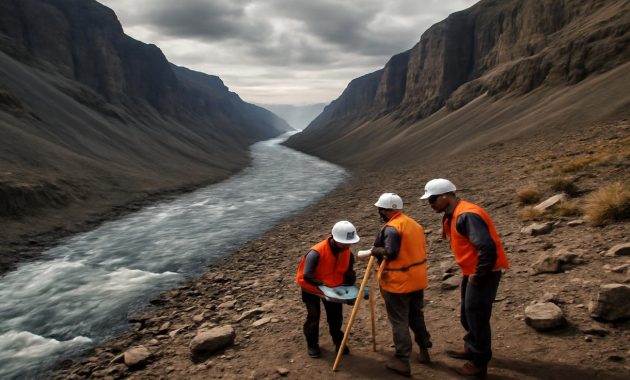
The first thing you notice is that your brain refuses to cooperate. The river is right there, curling through the valley like a ribbon of glass, and every instinct you’ve ever had about gravity says the same thing: water flows downhill. It has to. And yet, as you stand on the overlook with the wind pushing against your jacket and the smell of wet earth in your nose, your eyes insist on telling you a different story.
It looks like the river is climbing.
Not just meandering. Not just taking a lazy bend. It appears to be working against gravity, gliding upward along a gentle, impossible slope—like a film being played in reverse. You blink. You look again. You check the tree line, the rocks, the road in the distance, anything that can give your sense of direction something solid to grab onto. Nothing helps. The water still appears to be flowing uphill, as calmly as if it hadn’t just thrown several centuries of basic physics into question.
You aren’t the first person to be confused by this river. Local hikers whisper about it as if it’s a rumor, something half believed and half joked about: the river that climbs, the stretch of water that doesn’t care what gravity wants. Tour guides bring visitors to this spot with a little smile, knowing what’s coming when the group steps out of the van and their eyes adjust to the view. And recently, geologists—usually the last people to be seduced by visual tricks—have been coming here too, armed with GPS units, laser levels, and a pile of questions that start with a single stunned reaction:
“That can’t be right.”
When Scientists Meet a River That Misbehaves
The first geologist to make a serious fuss about this stretch of river—tucked into a quiet corner of the United States that locals would prefer I didn’t name too precisely—wasn’t expecting to find anything sensational. They were mapping river gradients for an erosion study, the sort of work that involves long days, muddy boots, and a lot of careful, repetitive measurements. It’s the kind of job that rarely ends up on the news.
But when the early survey data came in, something didn’t add up. The segment of river the team had just measured appeared to gain elevation while the water still flowed in the same direction. In simple terms, the downstream point sat several feet higher than the upstream point—at least, that’s what the instruments seemed to say.
There are two kinds of silence in a field camp: the comfortable kind, when everyone is too tired to talk; and the bristling kind, when the data on the screen disagree with the laws of nature. This was the second kind.
They double-checked everything. The GPS units. The calibration. The benchmarks used to establish elevation. They re-ran the transect. They ran it again. Gravity, stubbornly, refused to be caught in the act of misbehaving.
Then someone said what everyone else was already thinking: “Is it possible we’re standing in some kind of optical illusion?”
The idea wasn’t as far-fetched as it sounds. The world has a handful of “gravity hills” and “mystery spots,” places where cars seem to roll uphill and water looks like it’s flowing in the wrong direction. Tourists visit them, videos circulate online, and the explanations usually hinge on perspective tricks—sloping horizons, hidden gradients, and a landscape that conspires to mislead human eyes.
Most of those places are road pullouts or tourist traps, not active river channels. But this stretch of water had that same uncanny look. A low ridgeline to the north. A tilted forest edge. A distant highway that slants just enough to warp your sense of level. All the ingredients of a visual mirage, stirred into a live, moving river.
The Day the River Was Put on Trial
To sort myth from physics, the team turned the valley into a temporary laboratory. On a clear fall morning, they laid out survey rods along the bank, bright white against the brown grasses and driftwood. A differential GPS system—accurate to within a couple of centimeters—tracked every reading. They marked tree trunks with fluorescent tape, set up a laser level, and began building a precise profile of the river’s slope.
The air smelled like leaf mold and cold water. Somewhere upstream, a kingfisher rattled. The river went about its business, oblivious to the attention.
Here’s roughly what they found when they turned the valley into columns and numbers:
| Measurement Point | Distance from Upstream Reference | Elevation (m) | Observed Water Flow Direction |
|---|---|---|---|
| Point A (Upstream) | 0 m | 214.6 | Downstream |
| Point B (Mid-Reach) | 80 m | 214.1 | Downstream |
| Point C (Visual “Uphill” Section) | 160 m | 213.7 | Downstream |
| Point D (Downstream) | 240 m | 213.2 | Downstream |
On paper, the river behaved exactly as it should. Over roughly 240 meters, the water surface dropped about a meter and a half—gentle, but still undeniably downhill. The instruments left no room for debate. Gravity was doing its job.
So why did everyone’s eyes insist on seeing the opposite?
The Landscape That Lies to You
To understand why this river appears to flow uphill, you have to stop staring at the water and pay attention to everything around it.
Stand there long enough, and you notice oddities. The distant ridgeline isn’t level—it rises just enough on one side to trick your brain into using it as a crooked horizon. A fence in a nearby pasture leans slightly but consistently, following the true slope of the land while your eyes interpret it as “straight.” The meander of the river happens to align with a subtle rise in the valley floor, and the overall perspective compresses distance in a way that fakes an uphill climb.
Our brains, amazing as they are, are lazy about certain things. They love shortcuts—especially visual ones. When you look across a landscape, your mind quickly assembles a guess about “level” based on big, obvious lines: treetops, ridges, roads, the far horizon. If those reference lines are tilted, everything else gets skewed with them. You quietly “correct” what you see without realizing you’re doing it.
Geologists here started calling it a “false slope,” a place where the valley’s geometry gangs up on your senses. The water isn’t fighting gravity; your brain is fighting geometry.
And yet, there’s more to the story than a clever optical trick.
Where Rocks, Time, and Water Complicate the Plot
The reason this river can pull off such a convincing illusion is rooted in an older, slower drama: the long, grinding rearrangement of the land itself.
This valley didn’t always look like this. Millions of years ago, before there was a strange little river to argue about, there were layers of rock stacked like a geological layer cake—sedimentary beds laid down in ancient seas, later shoved and tilted by tectonic forces. Some layers were hard and resistant; others were soft and easily carved by water.
Over time, the river cut into those layers, naturally chasing the softer rock. Where the underlying rock was weak, the river sank deeper, making steeper sections and small rapids. Where it hit tougher rock, the channel flattened, slowed, and sometimes spread out. This patchwork of varying resistance sculpted a river that doesn’t descend in a neat, even line—it drops, pauses, glides, and drops again.
Now add another layer of complexity: the weight of vanished ice. During the last Ice Age, glaciers and thick ice sheets pushed and pressed on the continent’s crust. When all that ice melted away, the land slowly began to rebound, like a mattress regaining its shape after someone stands up. The rebound wasn’t perfectly uniform. Some areas lifted a little faster; others lagged behind. Over thousands of years, river gradients subtly changed—just enough that in certain places the channel looks almost flat, even though the water is still sliding downhill.
In this particular valley, the perfect combination of factors lined up: a very gentle slope, stubborn bedrock shaping the channel, and a skewed horizon that tricks your sense of level. You end up with a river that’s technically obeying every law of physics while visually breaking all the rules.
It’s not gravity that’s weird here. It’s us.
The Moment the Mystery “Clicked”
One of the geologists on the project described a moment that felt almost like a magic trick being revealed. They were standing knee-deep in the river, setting a staff gauge, water tugging at their waders. From that low angle—eyes nearly level with the water’s surface—the illusion snapped. The flow suddenly looked right. The uphill climb disappeared. Everything made sense.
But the second they climbed back to the overlook, the lie returned. From that higher vantage point, the river once again seemed to crawl uphill, unbothered by gravity, stubborn as a dream you can’t quite logic your way out of.
“It’s like the landscape is gaslighting you,” one researcher said later, laughing.
What “Uphill Rivers” Teach Us About Seeing
It might be tempting to shrug and call this a quirky roadside attraction with a scientific footnote: neat illusion, mystery solved, everyone go home. But the story doesn’t end there, because illusions like this poke at something more fundamental—our trust in our own senses.
We like to imagine that seeing is believing, that our eyes are reliable reporters and the world is mostly straightforward. But landscapes like this river remind us that perception is a negotiation, not a photograph. Our brains are constantly filtering, simplifying, and guessing, turning a complex three-dimensional world into something we can navigate without going mad.
Most of the time, that system works beautifully. Sometimes, though, a valley like this one slips through the cracks.
For the geologists, this river became more than an oddity; it was a teaching tool. They began bringing students here not just to talk about gradient and erosion, but to talk about the quiet arrogance of the human eye. On the bank, they’d ask the group to vote: who thinks the river is higher here or there? Which way is level? Then they’d pull out the instruments and let the data do the talking.
The disconnect between what you feel in your gut and what the numbers show on the screen hits like a small, necessary humiliation. The kind science is built on.
Why Geologists Were Surprised Anyway
You might wonder why geologists—who know all about gravity hills and optical illusions—were so enthralled by this case. The answer lies in how rare it is to see the effect played out in a dynamic system like a river, where you can watch the flow in real time instead of staring at a parked car or a tilted fence.
Rivers are constantly telling a story about force and resistance, gravity and friction. They carve canyons, move mountains, rearrange sand grains one careful millimeter at a time. To see one apparently defy gravity, even for a moment, is like watching a familiar friend suddenly speak in a language you don’t understand.
Even after the measurements confirmed what physics demanded, there was still a kind of awe among the scientists. Not awe at broken rules, but at the delicate precision of the illusion. At how perfectly the land had to bend and tilt and align to pull off this trick. At the idea that a river, shaped by millions of years of earthly forces, could end up in exactly the right pose to fool the evolved pattern-recognition software inside a human skull.
Would You Still Believe Your Eyes After Standing Here?
Imagine walking the bank yourself. The mud is soft underfoot, studded with the imprint of deer hooves and raccoon tracks. The air carries a chilled, metallic tang from the water. You pick up a stick and toss it into the current. It drifts in the direction your brain insists is “up.” You watch it, hypnotized, feeling the dissonance spread through your chest like a slow, incredulous laugh.
You know now that the instruments say otherwise. You know, intellectually, that the water is sliding downhill, obeying the same gravity that keeps your boots anchored to the bank. But knowledge doesn’t fully erase the feeling. Your eyes still tug you toward the lie.
This is the strange thing about understanding: it doesn’t always overwrite instinct. Sometimes, it just gives you a new way to appreciate how wrong you can be.
For the scientists who’ve come here, that’s the real lesson. Not that a river might secretly climb uphill, but that our certainty is flimsy, provisional, and—at times—deeply, beautifully incorrect.
The Real Reason the River “Flows Uphill”
When all the measurements, models, and head-scratching conversations were stacked together, the reason behind the uphill river turned out to be a quiet convergence of ordinary things:
- A very gentle, but still real, downhill slope.
- Ancient rock layers guiding the river’s path in subtle ways.
- The lingering imprint of glacial rebound shaping the landscape’s larger tilt.
- A horizon that’s not truly level, thanks to an uneven ridgeline.
- Foreground lines—roads, fences, tree rows—that your brain misreads as straight, then uses as a false reference.
Each ingredient by itself is normal. Together, they form a perfect storm of misperception—a place where the river never actually breaks the rules, but looks, to our fallible senses, like it’s rewriting them.
In that way, the mystery is both solved and deepened. Gravity remains intact. The universe still makes sense. But our place in that universe—as observers, as interpreters—feels a little more humble.
And maybe that’s the best part of standing by this particular river. You come for a paradox—a river that might flow uphill—and you leave with something quieter but more enduring: a renewed respect for the gap between the world as it is and the world as we see it.
Next time you watch water slide past your boots, you might wonder, at least for a moment, what lies your eyes are telling you—and what deeper stories the land is patiently waiting to share with anyone willing to measure instead of merely look.
Frequently Asked Questions
Does this river actually flow uphill?
No. Precise measurements show that the river flows downhill, as gravity demands. The “uphill” appearance is a visual illusion created by the surrounding landscape and a slightly tilted horizon.
Is this the only place where water appears to flow uphill?
Not entirely. Around the world, there are several “gravity hills” where water, cars, or balls seem to roll uphill. What makes this site unusual is that the effect appears along a natural river rather than a road or a constructed channel.
Has anyone proven the illusion scientifically?
Yes. Geologists and surveyors have used differential GPS, laser levels, and detailed topographic profiles to confirm that the water surface consistently slopes downhill, even where it appears to climb.
Is gravity weaker or different in this area?
No. Gravity here behaves normally. The illusion doesn’t involve any change in physical laws; it’s entirely due to how our brains interpret visual cues in a complex landscape.
Can visitors see the effect easily in person?
Yes. From certain vantage points, the illusion is striking and immediate—sticks, foam, and leaves in the water all seem to drift “uphill.” From lower or different angles, however, the effect can disappear quickly.
What geological processes helped create this illusion?
A combination of gently sloping terrain, variations in underlying rock hardness, long-term crustal rebound after glaciation, and the alignment of ridges and man-made features together shape both the river’s path and the deceptive perspective.
What does this tell us about science and perception?
It highlights that our senses, especially vision, can be deeply misleading in certain settings. Science advances not by trusting first impressions, but by testing them with careful measurement, skepticism, and repeatable evidence.