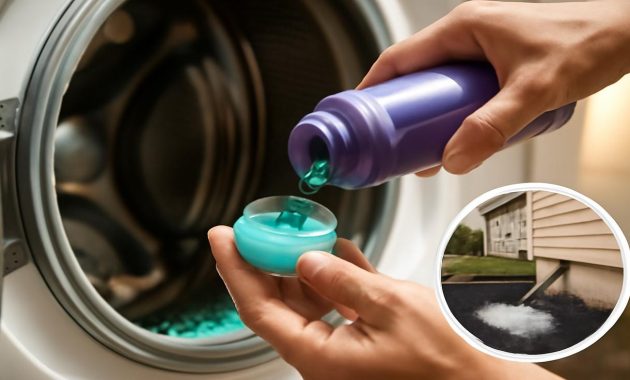
The first time I smelled it, I thought someone had baked vanilla cupcakes in the communal laundry room. It was nine in the evening, a Tuesday, the hour of sensible people and their sensible spin cycles. The hallway on my floor usually smelled like damp socks and boiled broccoli from someone’s dinner. But that night, the air was thick and sweet, like a perfume ad had exploded in the stairwell.
As I pushed open the laundry room door, the scent hit me full-force. Not the light, clean smell of soap and cotton. No—this was something else. It had layers: tropical fruit, white musk, a weird hint of coconut sunscreen and flowers that have never existed in nature. It rolled out of the machines in warm waves, coating the walls, sneaking under doorways, pressing itself into every crack of the old building.
At first, I loved it. Who doesn’t want their clothes to smell like a five-star spa or a luxury hotel? I imagined pulling on a T-shirt that smelled like this invisible vacation and going about my day in a scented cloud. Whoever invented this detergent, or pod, or softener, or secret potion, I thought, deserves a medal.
Then my eyes started to sting.
The trick that changed the hallway
The woman responsible for the scent—though I didn’t know it yet—lived two doors down. You could tell which was her apartment even with your eyes closed. The fragrance that began in the laundry room settled into the hallway, then crept under her door, then billowed back out, like it had decided to take up permanent residence.
“It’s just this one trick,” she finally told me a few weeks later, when we rode the elevator down together, both holding laundry baskets. “I saw it online. You add scent boosters and softener and a little extra detergent. Clothes come out super soft and smell incredible. Like, people actually comment on it.”
She said it with the bright certainty of someone who has discovered fire. Or at least discovered the washing machine equivalent: the secret step, the hack, the shortcut you’d never think of on your own. Not one product, but three. Triple fragrance. Triple the promise that nothing in your life would ever smell “ordinary” again.
“Sometimes I put a bit more if it’s a heavy load,” she added casually. “The instructions are just guidelines, you know?”
Behind her, the doors slid open onto the basement hallway. The air there smelled like a duty-free shop and a chemical plant had merged and decided to specialize in “fresh meadow.”
When clean becomes a cloud
Once you notice it, you can’t stop noticing it: how modern laundry has become less about cleaning and more about scenting. There are beads that promise “12 weeks of freshness,” capsules with “scent lock technology,” softeners that claim “nonstop fragrance.” The language is almost military. It’s not enough for clothes to be clean; they must also wage an ongoing war against the possibility of smelling like anything real—sweat, wool, rain, your own body.
The laundry aisle is now a perfume counter, and our washing machines are the diffusers.
That “one trick” spreading through social media—use more products, in more combinations, in larger quantities than the bottle suggests—is tailor-made for this culture. It offers a feeling of control: no matter how gross the gym locker room, how cramped the public transport, how stale the office air, you will radiate “Ocean Breeze Twilight Blossom Escape” from every thread you wear.
There’s a catch, of course. There’s always a catch when the smell in front of you is stronger than the story behind it.
The hidden cost of that heavenly smell
The first thing I noticed was my neighbour on the other side of the laundry room wall—a quiet guy with a window full of herbs in mismatched pots—cracking open his door when the machines were running. Sometimes he’d stand there barefoot, leaning in the frame, like he needed fresh air after walking through his own living room.
“Does your apartment smell like that too?” he asked me once, gesturing toward the hallway, where the spring-floral-linen-musk-fantasy was working overtime. “I can taste it.”
He wasn’t exaggerating. Certain fragrance molecules are intense enough that they ride air currents and cling to surfaces. That’s part of their magic and their marketing appeal: your towels smell “fresh” a week later because the scent doesn’t easily let go. But for some people, that persistence isn’t a charming quirk; it’s a problem. Headaches. Scratchy throats. Itchy skin where a T-shirt seam rubs against the neck. A general feeling that the air has become crowded with something invisible and pushy.
Most of these scented boosters, softeners, and liquids are cocktails of synthetic compounds. The exact recipes are kept secret—protected as “proprietary fragrance blends.” On the label, it usually just says “fragrance.” One word standing in for dozens, sometimes hundreds, of ingredients.
Among them can be substances like phthalates (used to make scents last longer), synthetic musks, and other volatile organic compounds (VOCs). Once you pour them into your machine, they don’t simply vanish when you press “start.” What doesn’t lodge in your clothes goes somewhere else.
It goes into the water. It goes into the air vent. It goes outside.
From laundry room to river bend
Picture the path of a single over-scented load. The drum fills. The water swirls. Detergent, softener, bright blue beads dissolve into the mix and wrap themselves around your clothes. Then, when the rinse cycle drains, that same water—now flavored with your laundry cocktail—flows out of the machine and into your home’s pipes.
From there, it joins everything else flushed away from every other apartment and house in your building, tumbles through the sewer system, and finally arrives at a treatment plant—if your community has one.
Wastewater treatment is a marvel, but it wasn’t designed with every modern chemical in mind. Some fragrance ingredients slip through largely unchanged. They survive the filters, outlast the bacteria that munch on organic waste, and make their way back into rivers, lakes, and coastal waters.
Fish and invertebrates, unlike us, can’t step out of the room when the air or water feels off. They live inside whatever we send downstream. Studies have found synthetic musks and other fragrance compounds in the bodies of aquatic animals and in river sediments, even kilometers away from obvious pollution sources. In those worlds, your laundry day is not abstract. It is a measurable presence.
Back in the building, not all of the scent goes down the drain. A portion is released into the air whenever the machine vents, whenever the dryer runs, whenever you open the door and pull out a steaming pile of ultrafragranced towels. The steam drifts down the street, over balconies, across courtyards.
If you have ever walked through your neighborhood on a clear morning and suddenly passed through a ghost of “clean laundry smell” with no house in sight, you have felt this traveling cloud. It lingers between trees and parked cars, briefly overpowering the smell of leaves or rain or city dust.
When neighbours start to notice
In my building, it began as a private grumble. People mentioned it in small, awkward ways: “Wow, someone really likes their softener,” or “I couldn’t smell my coffee this morning over the hallway.” It seemed petty to complain about something marketed as fresh and clean. Who wants to be that neighbor—the one who objects to laundry?
Then the notes began to appear.
One on the laundry room door: Please consider using less scented products. Some of us are sensitive to fragrance. Thank you!
Another on the noticeboard by the mailboxes: Friendly reminder: laundry products go into our shared air and water. Let’s keep our building breathable for everyone.
A week later, someone else added a smaller, sharper note underneath: Also, the whole hallway smells like a department store. Dial it back.
Suddenly, the “one trick” that made one person’s clothes smell divine was starring in a building-wide conversation about health, comfort, and—quietly—pollution. People with allergies and asthma started to speak up more boldly. One parent mentioned their kid’s eczema flaring when they walked through the hallway after washing day. Another neighbor said she couldn’t open her window on Tuesdays because the vent below it exhaled “too much fake flower.”
The woman with the triple-fragrance routine was stunned. “I honestly thought I was being considerate,” she told me on the stairs one day, her basket piled high with folded T-shirts fragrant enough to be detected half a flight away. “Like, I didn’t want my clothes to smell like cooking or sweat on the bus. I thought smelling nice was polite.”
That’s the strange thing about this whole story. At its heart, the trick comes from a familiar, human place: wanting not to offend anyone. Wanting your presence in a crowded world to be a little bubble of pleasantness. Wanting to control something about how people experience you—if not your jokes or your timing or your haircut, then at least the scent of your sweater.
No ad says, “Drown your neighbours’ lungs in lilac musk.” They say: “Smell confident. Smell fresh. Smell like not-a-human, not-animal, not-earth thing.” A fantasy. In our private machines, in our own apartments, it feels so small, that extra scoop or extra capful. A drop in the ocean.
Except it’s not just you doing it. The trick spreads. It goes viral. Millions of washing machines begin churning out invisible clouds and scented streams. Those drops become a tide.
A different kind of luxury
One evening, long after the notes and the elevator chats and the small building drama, I stood in my kitchen with a pile of laundry and did something I never imagined: I sniffed my detergent like a suspicious animal.
It was a standard bottle, the kind I’d grabbed on autopilot for years. On the label: rolling green hills, wildflowers, a sky so blue it might as well be painted. “Mountain Spring.” In microscopic type: ingredients I didn’t recognize, and the catch-all “fragrance.” Suddenly, what mattered more than the promise of alpine freshness was the simple question: What am I releasing into this place I live, and into the river half a mile away?
So I did a small experiment. I cut the recommended dose in half. I skipped softener altogether. I washed a mixed load: shirts, towels, socks that had seen better days. When I pulled them out, something unusual happened.
They smelled… like almost nothing.
Not bad. Not musty. Just faintly of soap and fabric and the sun-warmed metal of the drying rack. When I wore one of the shirts the next day, I caught a whiff of myself on the subway and, for the first time in a long time, I wasn’t smelling a chemical story layered on top of reality. I was just smelling the fact that I exist, that I move, that I am a person in a body that does body things—sweats, breathes, lives.
It felt, strangely, like a kind of luxury. Not the hotel lobby fantasy of designer fragrance, but the quieter extravagance of stepping onto the balcony after rain and being able to smell actual wet pavement and leaves because nothing in my home was competing with it.
Soon I learned other small tricks that felt less like hacks and more like an act of belonging to the world instead of standing apart from it:
- Washing with cool water when possible, so less energy is burned for every load.
- Letting clothes air-dry near a window when I had time, so they picked up that faint, subtle “outside” smell.
- Using fragrance-free detergent for most loads, and reserving the scented stuff for rare items that really needed it—if at all.
- Letting clean laundry actually dry fully before stuffing it into cupboards, to prevent the mustiness people often drown in perfume.
None of it felt heroic. It felt oddly like stepping back into a rhythm that had always been there, buried under marketing slogans and shiny beads in neon colors.
A quiet table for the senses
We like to think of these choices as abstract or moral, but they’re also intensely sensory. They reshape how your home smells, how your street smells, how your socks feel on your skin after a long day.
Here’s a simple snapshot of how two different laundry “tricks” play out in everyday life—not in theory, but in the air you breathe and the water whispering under your feet:
| Laundry Habit | Short-Term Feeling | Long-Term Ripple |
|---|---|---|
| “One trick” overload – extra detergent, softener, and scent boosters | Clothes smell intensely perfumed; hallway carries a strong, lingering scent | More chemicals in shared air and wastewater; higher risk of irritation for neighbours and wildlife |
| Measured use – following labels, low- or unscented products, no softener most days | Clothes smell clean but subtle; home air stays calmer and less “busy” | Less fragrance pollution; easier on sensitive lungs, skin, and the rivers downstream |
It’s not a battle between people who like “nice smells” and people who don’t. It’s a question about volume, about dose, about how far our private desires should echo into the shared spaces we move through together.
Choosing how far your laundry travels
There is a particular night in late summer, when the windows in my building are tilted open and someone is cooking with garlic three floors down, when I can smell a faint hint of actual jasmine from the neglected shrub outside the entryway. A bus sighs to a stop at the corner. Someone laughs on the sidewalk. Somewhere, a washing machine is humming.
I still think, now and then, about my neighbour and her devotion to scent. About her belief that she was being kind by making her clothes smell like a promise of cleanliness you could recognize from across the room. I also think about the herb-growing guy next to the laundry room, breathing shallow little sips of air as he walked through that cloud.
In the end, the “one washing machine trick” that matters most may not be an extra scoop of anything. It might be the simple act of asking a pair of questions before your finger presses the “start” button:
How far do I want this smell to travel?
And who, or what, will have to live inside it when it gets there?
Because your laundry doesn’t end when the machine stops spinning. It keeps unfolding—into your neighbor’s hallway, into your city’s air, into the water slipping around the stones where minnows sleep. You can still have clothes that feel clean and comforting, that carry the quiet scent of your own life, without demanding that everything and everyone around you joins in the performance.
Maybe the real luxury now is not to smell like a commercial, but to leave enough space in the air for the low, wild perfumes of the world: wet soil after rain, pine bark warming in the sun, the faint salt of your own skin, here and gone again, like a tide that knows exactly when to withdraw.
Frequently Asked Questions
Does using more detergent and scent boosters actually clean clothes better?
Not usually. Washing machines and detergents are designed to work at specific concentrations. Using more than recommended can leave residue on fabrics and inside the machine, making clothes feel coated rather than clean and sometimes even trapping odors.
Are scented laundry products really harmful to the environment?
Many fragrance ingredients are synthetic chemicals that can persist in water and accumulate in wildlife. Wastewater treatment plants don’t always remove them completely, so they can end up in rivers, lakes, and coastal areas, contributing to chemical pollution.
Why do some people react so strongly to laundry fragrances?
People with asthma, allergies, migraines, or chemical sensitivities can react to airborne fragrance compounds, even at low levels. Symptoms may include headaches, breathing difficulties, skin irritation, or general discomfort when exposed to strong or persistent scents.
How can I make my laundry smell pleasant without overusing chemicals?
Use the recommended amount of a mild or fragrance-free detergent, avoid routine use of softeners and scent boosters, let clothes dry fully in fresh air when possible, and wash garments promptly if they’ve been damp for a long time. Subtle cleanliness tends to be more comfortable and sustainable than overpowering perfume.
Is “fragrance-free” better than “unscented”?
Often, yes. “Fragrance-free” usually means no fragrance ingredients were added. “Unscented” products may still contain masking fragrances to cover up the smell of other ingredients. If you’re trying to reduce chemical exposure or avoid strong scents, “fragrance-free” is typically the safer choice.