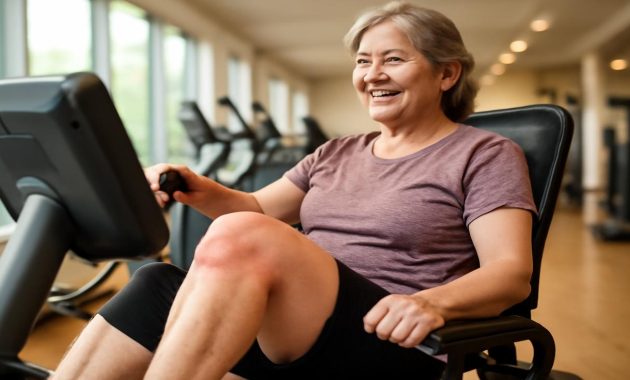
The rain had chased almost everyone else off the trail. Only a few stubborn walkers remained—jackets zipped, shoulders hunched, shoes squelching quietly with each step. Ellie was one of them. She stood at the trailhead, staring at the path as if it were an exam she hadn’t studied for. Her right knee throbbed with a familiar dullness, the kind that whispered, Remember what happened last time? She used to run here. She used to fly. Now, she hesitated over whether she could simply walk without regretting it that night.
When Your Knees Rewrite the Rules
Ellie’s story is not unusual. Maybe it’s yours, too, in some version. One day, your knees decide they’ve had enough of your plans. The stairs talk back. The sofa becomes a little too comfortable. You start to measure distance not in miles or minutes, but in how bad it will hurt later.
Well-meaning friends rush in with advice. “You should swim! It’s so gentle on the joints.” Swimming is wonderful—if you like the smell of chlorine, have access to a pool, and enjoy changing in a cold locker room under fluorescent lights. Others say, “Try Pilates! Great for your core and posture.” And they’re right too, but it can demand certain ranges of motion and positions that your knee might not happily agree to, at least not right now.
So what if you’re not a water person, and the idea of a studio full of mirrors and reformer machines makes your knee ache in anticipation? What if getting stronger, healthier, more mobile could happen somewhere simpler, quieter, more familiar—maybe even next to that same rain-slicked trail where you used to run?
The answer might surprise you in its simplicity. For most people with knee pain, the most underrated, beautifully adaptable activity isn’t swimming, and it isn’t Pilates.
It’s walking.
The Comeback of an Underrated Activity
Walking doesn’t have a marketing team. It’s not glamorous. No one posts proud social media updates that say, “Crushed a 23-minute walk!” And yet, for many people with cranky knees, it is exactly the movement that can begin to restore strength, soothe stiffness, and gently rebuild trust in the body.
Think of walking as the oldest agreement between your body and the world. Heel meets ground. Weight shifts. Muscles rise to the occasion. Your heart responds. Your breath adjusts. This is movement at its most honest—no equipment required, no monthly membership, no complicated choreography.
If your first reaction is, “Walk? With these knees?” you’re not alone. The image of walking as a solution can feel almost offensive when every step has become a negotiation. But the magic isn’t in simply walking more. It’s in walking differently—more slowly, more intentionally, with more attention and less ambition.
A thoughtfully structured walking routine can be tuned like an instrument: duration, pace, surface, footwear, and even the story you tell yourself about pain can all be dialed up or down. For knees that protest, walking doesn’t have to mean forcing them to endure. It can mean inviting them to participate.
The Slow, Kind Science of Walking with Knee Pain
On paper, the idea sounds almost too convenient. How could something as plain as walking compete with the sleek efficiency of Pilates or the buoyant lightness of swimming? But your knees care less about aesthetics and more about load, alignment, and consistency.
When you walk—with good form, at a pace your body approves of—you’re offering your knees a series of small, manageable challenges. Each step signals to the cartilage, ligaments, muscles, and tendons: We are still being used. We still matter. Adapt.
Gentle, repeated loading often helps cartilage stay nourished through the flow of joint fluid. Muscles surrounding the knee—quadriceps, hamstrings, calves, even glutes—learn to share the workload instead of handing it all to your poor joint. Over time, those micro-challenges can translate into macro-changes: less stiffness, more support, and maybe most importantly—more confidence.
There’s also the forest-level perspective: your heart, lungs, and brain adore walking. It improves circulation, supports better sleep, steadies mood, and strengthens your sense of connection to places and people. Swimming and Pilates can absolutely offer these too—but walking places them outdoors, in real time, under whichever sky you happen to live beneath.
Listening to the Knee’s Language
Before you lace up and march out, there’s one crucial shift: you have to start listening to your knee as if it’s a conversation partner, not an obstacle. Pain isn’t simply an alarm—it’s a language.
There’s the sharp, sudden, “Stop now” kind of pain: a stabbing or catching that lands like a red light. That’s your body telling you that something is not okay with that movement or intensity level.
Then there’s the dull, tired ache that settles in like an unwelcome guest a few hours after activity. This is more of a yellow light—information. It may mean the walk was a bit long, the hill too steep, or the pace just a hair ambitious. Not a disaster, but a useful note for next time.
And then there’s mild discomfort that comes and goes while you move, staying tolerable, not escalating, maybe 3–4 out of 10 at most. For many people with chronic knee pain, this level of sensation can be safe, even necessary, for progress. The goal isn’t absolute silence from your knee; it’s a stable, respectful dialogue.
Designing a Walk Your Knee Can Trust
Ellie didn’t start by disappearing for an hour-long walk on that wet trail. She started in her neighborhood, on the flattest route she could find, in the shoes she trusted most. Her first walk was 10 minutes. Then 12. Then 15. The real win wasn’t distance; it was that her knee didn’t feel punished.
You can craft your own walking “prescription” the same way—personalized, adjustable, and forgiving.
Small, Specific, and Soften the Edges
Instead of deciding, “I’ll walk every day,” try shaping your plan like this:
- Start duration: Choose a time that feels almost too easy—5, 8, or 10 minutes.
- Surface: Begin on the friendliest ground you can find. Flat sidewalks, smooth park paths, or even an indoor hallway. Save hills and trails for later.
- Footwear: Supportive shoes with cushioning and a stable heel matter more than brand names. Your knees often appreciate anything that reduces harsh impact.
- Frequency: Aim for 3–4 walks per week to start, leaving rest days or lighter-movement days between.
- Progression rule: If your knee feels okay during and within 24 hours afterward, you can add 2–5 minutes to your next walk.
That’s it. Not dramatic. Not heroic. But sustainable—and sustainability is the quiet secret behind stronger, calmer knees.
Below is a sample progression plan many people find helpful. You can move slower or faster depending on how your knee responds.
| Week | Target Walk Duration | Sessions per Week | Notes for Your Knee |
|---|---|---|---|
| 1 | 8–10 minutes | 3 | Stick to flat surfaces, comfortable pace, track how your knee feels 2–24 hours later. |
| 2 | 10–12 minutes | 3–4 | If pain stays mild and stable, add a couple of minutes to 1–2 walks. |
| 3 | 12–15 minutes | 4 | Experiment with very gentle slopes if your knee feels ready. |
| 4 | 15–20 minutes | 4 | If pain flares above a 4/10, roll back by a few minutes next time. |
Remember, this is not a race. If you stay at Week 1 for three weeks because your knee insists, that’s not failure. That’s tailoring.
How to Walk So Your Knees Don’t Hate You
The way you move during your walk matters as much as how long you walk. Picture two versions of yourself: one rushing, shoulders tense, steps pounding; the other moving as if they had all the time in the world, slightly taller through the spine, feet placing themselves gently. The second version will almost always have the happier knees.
Form, Pace, and the Art of Paying Attention
As you walk, try playing with these small adjustments:
- Shorten your stride: Over-striding—reaching too far forward with your foot—can increase the braking forces at your knee. Let your feet land closer beneath your hips.
- Soften your landing: Imagine your feet as if they were landing on slightly muddy ground, needing to be quiet and controlled rather than heavy and loud.
- Use your arms: A relaxed, natural arm swing can help your body rotate gently and spread work through your trunk instead of dumping it into your knees.
- Stand tall, not rigid: Think of your spine gently lengthening upward, but keep your chest soft and your jaw unclenched. Rigidity often makes pain worse.
- Let pace serve your knee: If walking faster makes your knee complain, deliberately slow it down. The goal isn’t speed; it’s cooperation.
Sometimes, it helps to give the mind a simple anchor. Count four steps as you inhale, four as you exhale. Notice three colors you can see. Feel the difference underfoot between sidewalk, grass, gravel. Your awareness becomes part of the medicine—bringing you out of anxious prediction and back into the reality of this particular step, right now.
When Walking Becomes More Than Exercise
On a late autumn morning, Ellie moved down that same trail she had once run along. Her pace was modest, almost shy. Leaves, half-rotten and rain-soaked, released that earthy, sweet smell of decay that only appears in these in-between seasons. Her knee still spoke to her—never quite silent—but it no longer shouted. It commented, and she listened.
Somewhere along the way, walking had stopped being just her Plan B workout. It became her way of checking in with her body, and with herself. How tight are my shoulders today? How does my breathing sound? Did I rush breakfast? Did I drink any water? Am I carrying the entire day’s tension in my jaw?
This is one of walking’s quiet gifts for people with knee pain: it can re-tune your awareness. Where intense exercise can sometimes feel like a battle—push harder, power through—walking can feel like a truce. You are moving, but not at war. You’re allowed to be gentle and still be strong.
And somewhere in that consistency, your brain learns a new story. You are not just the person with “bad knees” anymore. You are the person who still moves—for 8 minutes, or 15, or 25. Who still notices the change in the light between morning and evening. Who still occupies the world beyond your living room.
Beyond the Trail: Tiny Supports That Make a Big Difference
Walking might be the main character, but it has a supporting cast. These small, simple practices can make your walking habit more enjoyable for your knees:
- Warm-up rituals: Before you head out, try 2–3 minutes of easy ankle circles, gentle leg swings holding onto a chair, or marching in place. Wake the joints slowly.
- Compression or support: Some people feel better with a soft knee sleeve or wrap. It won’t fix the cause of pain, but it can provide a sense of stability.
- Strength snacks: A few times per week, after your walk, add 5 minutes of gentle strength moves—mini-squats to a chair, wall sits, calf raises while holding a countertop. Stronger leg muscles often mean happier knees.
- Recovery cues: After your walk, notice: does gentle stretching, a warm shower, or a brief rest improve your knee’s mood? Build those into your routine.
- Check-ins with a pro: If you’re unsure, a session or two with a physical therapist can help you personalize your gait, pace, and strengthening plan.
These are not grand gestures. They’re the kind of quiet detail work that lets the main story—your walks—unfold more smoothly.
You Don’t Have to Love Swimming or Pilates
It’s easy to feel guilty if the standard “joint-friendly” exercises don’t fit your life. Maybe the pool is too far, or the schedule is impossible. Maybe Pilates classes feel intimidating, or your knee complains during certain positions. That doesn’t mean you’re doomed to a sedentary life.
You are allowed to choose the movement that you will actually do, in the world you actually live in, with the body you actually have. Walking is remarkably forgiving in that way. It can happen at dawn or dusk, on city streets or quiet rural lanes, alone with your thoughts or side by side with a friend who walks at your pace.
For many people with knee pain, it becomes not just the “best” activity on paper, but the most realistic one in practice—the one that stitches itself, step by step, into an ordinary day. Neither swimsuit nor Pilates mat required.
On that rainy day, Ellie didn’t run. She didn’t need to. She walked, listening, adjusting, breathing. Somewhere between the first hesitant steps and the moment she returned to her car, she realized that her knee hadn’t been an enemy to conquer. It had been a teacher, insisting that she move differently, more gently, more honestly.
And with every careful, present step you take, you have the same chance—to relearn what movement can feel like when it’s not about punishment or perfection, but simply about being here, in this body, in this moment, still moving forward.
Frequently Asked Questions
Is walking really safe if I have knee osteoarthritis?
For most people with mild to moderate knee osteoarthritis, appropriately paced walking is not only safe but beneficial. It can reduce stiffness, support joint nutrition, and strengthen muscles that protect the joint. The key is to start with short, manageable walks, monitor your pain during and for 24 hours afterward, and adjust time or pace if pain spikes. If you have severe arthritis or sudden swelling, checking with a healthcare professional before starting is wise.
What if my knee hurts during the walk—should I stop immediately?
If the pain is sharp, sudden, or makes your knee feel unstable, stop and rest, and seek medical advice if it doesn’t settle. If the discomfort is mild and stays fairly steady (doesn’t climb rapidly), you can often continue at a slower pace or shorten the walk. Use the next day’s sensations as feedback to adjust your duration and intensity.
Is treadmill walking better than outdoor walking for knee pain?
Both can work. Treadmills offer a predictable, flat surface and allow precise control over speed and incline, which some knees appreciate. Outdoor walking adds variety, fresh air, and mental benefits. If your knee is sensitive, starting on a treadmill or very smooth outdoor surfaces can help; over time, you can mix both based on comfort and preference.
How important are shoes for walking with knee pain?
Very important. Supportive, well-cushioned shoes that fit your foot shape can reduce impact and improve alignment from the ground up. Look for shoes with a stable heel, good arch support (if you need it), and enough room in the toe box. If your shoes are old and worn, replacing them can sometimes noticeably improve knee comfort.
Can I combine walking with other activities if I don’t enjoy doing just one thing?
Absolutely. Many people blend walking with gentle strength training, yoga, or even occasional swimming or Pilates when available. Walking can be your foundation—the reliable, accessible movement you return to—while other activities rotate in when your schedule, mood, and knee all agree. The best routine is the one you enjoy enough to keep returning to, step by step.