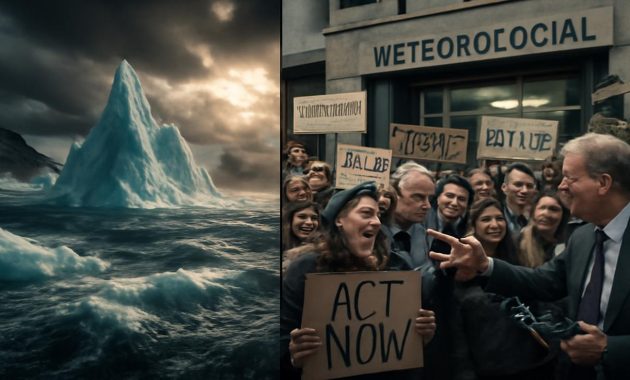
On a dim February morning, a blue-gray light hangs over the North Atlantic as if the sun has overslept. In a cramped office thousands of miles away, a meteorologist jolts upright in his chair, blinking at a monitor that refuses to make sense. The numbers are wrong—so wrong that his first instinct is to blame a glitch. Sea ice in the Arctic is not just low; it’s vanishing at a time of year when it should be locked tight in winter’s grip. The air above the pole is pulsing with warmth. It looks less like late winter and more like the early stages of spring.
He zooms out on the map. The crimson swirls of temperature anomalies—colors used to show where the atmosphere is warmer than usual—have swollen into an almost unbroken red crown around the top of the world. He’s seen worrying trends before, but this is different. This looks like the Arctic has stepped off the script, walked right out of the models that were supposed to keep us oriented in a warming world.
Within hours, screenshots of similar maps are circling group chats, Slack channels, and private social media threads used by weather scientists. A familiar mix of curiosity and dread starts to build. Did someone mis-code a parameter? Has a satellite feed gone haywire? Or is this the moment many of them have privately feared—the point where “unprecedented” becomes every February’s new normal, and our climate models stop being guidebooks and start looking like wishful thinking?
The Day the Maps Stopped Making Sense
In early February, when the polar night still clings to the high Arctic, meteorologists expect cold that feels almost absolute—air temperatures low enough to freeze exposed skin in minutes, sea ice tightening its seasonal grip over dark waters. That’s the baseline. That’s the world as they’ve known it.
This year, the screens told a different story, and they told it loudly. In some regions, the air hovering over the Arctic was more than 20°C warmer than the historical average. Places that should have been locked at -30°C were flirting with temperatures closer to the freezing point. Satellite images showed sea ice extent lingering near record lows for the time of year, edges fraying, leads of dark open water slicing into the white.
At first, many meteorologists responded the way they always do—with methodical skepticism. Check the data source. Cross-reference with another satellite. Compare with ground stations. But as the confirmations stacked up—independent models, different agencies, multiple observation systems all singing the same dissonant tune—skepticism gave way to a seeping unease.
On public platforms, some scientists began to post the maps with uncharacteristically blunt captions. “This is not normal,” one wrote. Another called it “deeply alarming.” A third, known for understatement, simply said, “We’re in new territory here.” The language, for once, mirrored what many were feeling inside: a sense that a threshold had been quietly crossed.
The outrage didn’t explode all at once. It spread in ripples. First among researchers who had long warned that the Arctic was unraveling faster than our models predicted. Then among meteorologists fielding frantic media requests, trying to compress years of nuanced science into eight-second soundbites. And finally among ordinary people scrolling through feeds, wondering why their mild winter storms and mud-season Februaries were being traced back to a far-off ocean of ice they’d never see.
Listening to the Arctic’s Uneasy Pulse
There is a particular silence to the high Arctic in winter—a silence so complete it can feel like an extra pressure in your ears. Yet, in that silence, the planet’s climate system is constantly talking. The thickness of sea ice. The temperature of the polar stratosphere. The speed of the polar jet stream snaking above the hemisphere like a restless ribbon. All of it is data; all of it is signal.
For decades, climate models have translated those signals into projections—forecasts of what our world might look like if we keep burning fossil fuels at today’s pace, or slow down, or stop short. These models are not crystal balls, but they’ve been remarkably good at the big-picture trends. Yes, the planet will warm. Yes, the Arctic will warm faster. Yes, ice will retreat. Yes, extremes will rise.
But standing in the glow of their monitors this February, many meteorologists felt something they don’t like to feel: surprise. Not at the direction of change, but at its speed and its intensity.
In recent years, winter sea ice has shown troubling behavior—failing to recover fully at the end of the melt season, thinning from below as warmer Atlantic and Pacific waters creep under it, fracturing more easily. But the early-February indicators now flickering across dashboards suggested something more like a step change than a slow slide. Heat was reaching into layers of the atmosphere that usually remain chilled. Weather patterns were holding in place for days or weeks, locked by blocky, stubborn high-pressure ridges that funneled warm air toward the pole again and again.
Some of the data was so extreme that, in internal discussions, a few scientists joked darkly about their models “breaking.” Others stopped joking altogether.
| Indicator | Historic Expectation (Early Feb) | Recent Observations |
|---|---|---|
| Arctic air temperature | Bitter cold, deep below freezing | Widespread warmth, up to 15–20°C above average in some areas |
| Sea ice extent | Approaching seasonal maximum, stable and compact | Near record lows, edges broken, more open water than expected |
| Sea ice thickness | Dominated by multi‑year, thicker ice | Thinner, younger ice that fractures and melts more easily |
| Jet stream behavior | More stable, tighter polar circulation | Wavier, slower patterns that can lock in extremes |
All of it adds up to a new kind of tension in the atmosphere—a background hum of instability that can amplify storms, weirdly warm spells, and out-of-season events. If it were music, you might not notice the melody changing at first. But you’d feel the bassline growing louder, more insistent, pushing the whole song into a darker key.
When the Models Become the Story
To most people, “climate model” sounds abstract, even dull. To the meteorologists now grappling with these Arctic shocks, it’s anything but. Models are their instruments—the meticulously crafted simulations of physics and chemistry that let them test futures before they arrive. They are built from equations describing how air, water, and energy move through the system. They’re tuned using decades of observations.
For years, there has been a quiet split in the climate community. One camp pointed to models and said: the danger is huge, but we largely understand it. Another camp, often working closer to the poles or deep in the oceans, looked at the same models and said: they may still be underestimating how fast and how strangely things can change.
The Arctic has always been a stress test for those models. It is a place of feedback loops—a region where one change triggers another, then another. Lose some sea ice and suddenly the dark ocean absorbs more sunlight, warming the water, melting more ice, and so on. Warm the air and you alter the structure of clouds, the humidity, the snowfall, the way heat is transported. Small miscalculations can turn into big surprises.
Now, in the glow of these unsettling February readings, that long-simmering debate is returning with new urgency. If we have underestimated the Arctic’s capacity for sudden shifts, what else might we be underestimating? The strength of future heatwaves? The pace of sea-level rise? The frequency of rare but devastating storms?
This isn’t an argument about whether climate change is real. That ship sailed long ago. It’s about whether our navigational charts are detailed enough for the kind of rough water we seem to be entering. And it’s about the lives, economies, and cities that are being planned today using those charts.
A particularly thorny question hovers over the models like a low cloud: are they underplaying the risk of tipping points—those moments when a system shifts abruptly from one state to another, like a chair tipping backward after leaning just a little too far? The Arctic sea ice system, the Greenland ice sheet, the great ocean currents that move heat around the planet—each may have its own thresholds. Cross them, and the change might be rapid, dramatic, and hard to reverse.
Why “Dangerously Wrong” Strikes a Nerve
When some meteorologists began to suggest, in cautious but clear language, that climate models might be “dangerously wrong” about the Arctic, a wave of anger followed—not from climate deniers, but from people who had trusted those models as the foundation of policy and hope.
Dangerously wrong doesn’t mean useless. It means that if we’re underestimating high-risk futures—ice loss happening decades earlier than projected, feedbacks kicking in faster—then our plans for adaptation and mitigation may be too timid, too slow, or too narrow in focus. It means that infrastructure designed for “once-in-a-century” floods may see those floods arrive every decade. It means coastal communities may find that the safe buffer they thought they had against rising seas is shrinking more swiftly than anyone promised.
There is also a deep emotional layer to this outrage. Many people have done the responsible thing—they’ve read, they’ve recycled, they’ve voted, they’ve reduced emissions where they can. And yet, as the data from the top of the world pours in, it can feel as though the target is moving, receding, slipping out of reach. The finish line shifts, the rules of the game change mid-play.
For scientists themselves, “dangerously wrong” cuts another way. They have spent their careers building and defending these models in the face of political and ideological attacks. To admit that the models may be missing some of the most unsettling possibilities feels, to some, like giving ammunition to those who want to dismiss climate science entirely. But the alternative—silence in the face of mounting evidence—is worse.
The Weather at Your Window, Written in Polar Ice
If all of this still feels remote—a drama unfolding on an invisible stage of ice and equations—step outside for a moment, wherever you are. Feel the air on your skin. The Arctic lives there too.
The polar region acts like the planet’s thermostat, helping regulate the flow of heat between the equator and the poles. When that thermostat is thrown off, the ripples extend far beyond the Arctic Circle. A warmer, less stable pole can weaken and twist the jet stream, the river of wind high above that steers weather systems. When the jet stream slows and loops, weather gets stuck. Regions can bake under prolonged heatwaves, or drown under stalled storm systems, or shiver through sudden blasts of Arctic cold sent south in broken, wavering pulses.
That strangely warm winter you’re living through, where bulbs poke through wet soil months early, or your favorite skating pond refuses to freeze thick enough to trust—the Arctic breathes in that air. Those floods that seem to come now every few years instead of every few decades—those, too, are part of the same broad rearrangement of energy in the Earth system.
Meteorologists, staring at their February charts, are not just worrying about abstract patterns over ice. They are, in a sense, looking at the preface to weather stories that will be lived out in farms and suburbs, coastal villages and inland towns. The Arctic is not a victim suffering alone at the edge of the map; it is an amplifier.
When its rhythms go offbeat, the rest of the song—the seasons, the storms, the gentle rains and rare blizzards—changes with it.
Outrage, Grief, and the Work Still Left
It’s tempting to frame this moment as a revelation—that suddenly, in a single early February, we discovered the Arctic is racing toward uncharted territory and the models might not keep up. But the truth is more uncomfortable: this moment is a culmination. Scientists have warned for decades that changes in the Arctic would be among the swiftest and most dramatic on Earth. Indigenous communities who live in the far north have been saying, for years, that the seasons no longer behave like the ones their grandparents knew.
What’s different now is not the existence of the warning, but its intensity and its undeniability. The visual punch of those crimson maps. The stubborn consistency of record-breaking warmth. The way “unusual” has become “typical” and then has kept on going, marching beyond even the boldest expectations.
Outrage, in this context, is not just anger at being misled. It is also a form of grief—for the sea ice that once stretched, unbroken, to the horizon; for the walrus hauled out on overcrowded beaches; for the coastal homes slumping into thawing permafrost; for the farmers far to the south trying to read a sky that doesn’t play by the old rules.
Yet outrage can also sharpen into something else: insistence. An insistence that our models keep evolving, that our policies catch up, that we acknowledge uncertainty not as an excuse for inaction but as a reason to move faster and with greater care. An insistence that we prepare for a range of futures, including the more extreme ones, instead of betting everything on the mildest curves in the model ensemble.
In quiet moments, some meteorologists admit they are tired—tired of sounding the alarm, tired of being told they are exaggerating when they feel, in fact, that they may not be saying enough. Others, especially younger scientists, speak of a fierce determination to make the models better, more responsive to the whispers and shouts coming from the Arctic.
The uncharted territory we are entering is not just physical. It is moral and political, technological and psychological. How do you plan a city, a power grid, a food system, for a world in which the safety rails of historic climate are fading? How do you stay hopeful without being naive, honest without being paralyzed?
Standing at the Edge of the Map
In that office where the day began with a jolt, the meteorologist leans back in his chair as the winter light shifts slightly outside his window. The numbers on his screen have not changed. The Arctic is still unnervingly warm. The ice is still distressingly thin and scattered. The models are still, in some profound sense, trying to catch up with the reality they hoped would arrive more slowly.
He knows he will spend the coming weeks and months sorting through this, line by line—testing, refining, running new simulations, arguing late into the evening with colleagues on the other side of the world. He knows that for most people, this will blur into a constant background hum of “record warmth” and “unprecedented loss,” words repeated so often they begin to dull at the edges.
But for now, he sits with the weight of it. The knowledge that we are, in our lifetimes, walking past the edge of the map our ancestors knew—the relatively stable climate in which agriculture was born, in which our cities rose, in which our stories about snow and spring and harvest took shape.
The Arctic, in all its fragile, shimmering strangeness, is writing new lines on that map. The models will race to keep up. The rest of us will live inside the consequences.
The outrage you feel, the anxiety that creeps in when you see those red-smeared maps and read phrases like “uncharted territory” or “dangerously wrong,” is not misplaced. It is a sign that you understand, perhaps more deeply than you wanted to, that the future is arriving faster than the forecasts promised.
But in that discomfort lies a choice. We can treat this as a story already written, a tragedy playing out above a distant ocean of ice. Or we can recognize it as an urgent draft—one we still have the power to edit, with every ton of carbon we don’t burn, every community we help adapt, every policy we insist on that takes the physics seriously.
The Arctic is speaking loudly now. The question is whether we allow that voice to be just another scroll in our feed—or whether we let it rearrange, in some small but real way, how we live on this warming, restless Earth.
Frequently Asked Questions
Is this early February Arctic warmth just a natural fluctuation?
Natural variability always affects the Arctic from year to year, but the background trend is unmistakable. The region has been warming about four times faster than the global average. The recent extreme warmth sits on top of that long-term trend and pushes well beyond what past natural swings have produced, which is why so many meteorologists are alarmed.
Does this mean climate models are useless?
No. Climate models have been broadly accurate about the direction and magnitude of global warming. The concern is that in certain regions and for specific processes—like rapid Arctic sea ice loss or feedback loops—they may be underestimating how quickly extremes can emerge. They are still essential tools, but they must be continually improved and interpreted with caution.
How can changes in the Arctic affect weather where I live?
The Arctic helps regulate the jet stream, a band of strong winds high in the atmosphere that guides storms. As the Arctic warms, the temperature contrast between the pole and the equator can weaken and distort the jet stream, leading to more persistent weather patterns—longer heatwaves, prolonged rain events, or repeated cold outbreaks in some regions.
Are we close to an “ice-free” Arctic?
Scientists define an ice-free Arctic as one where sea ice extent at the end of summer drops below about one million square kilometers. Many projections suggest this is likely within the next few decades, even under moderate emissions scenarios. The recent wintertime anomalies highlight how fragile the ice cover already is and raise concerns that these timelines could shorten.
What can be done in response to these alarming Arctic signals?
Two types of action are critical. First, rapid cuts in greenhouse gas emissions to limit further warming and reduce the risk of crossing dangerous tipping points. Second, accelerated adaptation planning—upgrading infrastructure, revising flood and heat risk maps, protecting vulnerable communities—based on a realistic range of climate outcomes, including more extreme ones than older models might have suggested.