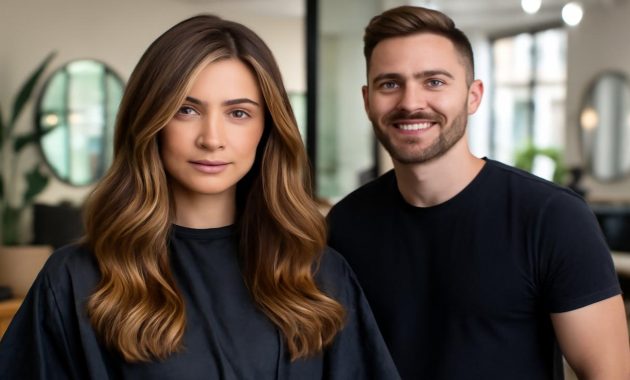
The first thing you notice isn’t the color—it’s the light. It moves when she moves, a pale ribbon that slides along the curve of her hair like a sunbeam slipping across a floor. Not chunky stripes. Not that soft, beachy melt everyone’s been asking for the last ten years. This is sharper, cleaner, almost architectural. In the salon mirror, the stylist grins, lowers the blow-dryer, and the whole room leans in at once. “That,” someone whispers from the next chair, “is Light Line.”
From Soft Blur to Sharp Beam: Why Balayage Is Stepping Aside
For what feels like forever, balayage has been the reigning queen of hair color. We learned its language by heart: hand-painted, blended, sun-kissed, low maintenance. We wore it to beach weddings, to job interviews, to slow Sunday brunches with iced lattes sweating on the table. It was easy, flattering, forgiving.
Then something shifted.
Maybe it started on runways where models strode out with perfectly placed slivers of brightness that didn’t blur, they sliced. Maybe it was the wave of graphic eyeliner and razor-sharp nail art, or the return of tailored suiting after years of loungewear. Whatever the reason, our eyes began to crave contrast again—structure, precision, intention.
Enter Light Line coloring: the spring–summer 2026 answer to hair color that still feels sunlit, but with a point of view. Where balayage is watercolor, Light Line is fine-tip pen. Instead of a hazy cloud of highlights, you get deliberate ribbons of light, often starting higher, cutting through the hair with a subtle but unmistakable direction. It’s not chunky 2000s streaks; it’s measured, sleek, and incredibly modern.
You see it first when someone turns their head. A slim, luminous band tracks the movement, catching window light, street light, late afternoon gold. It creates the illusion that the hair itself is throwing light into the room. You don’t quite register “color” so much as “glow.”
What Exactly Is Light Line Coloring?
Imagine standing in a room at golden hour. The sun slices in through blinds, painting bright horizontal lines on everything—your wall, your arm, your coffee cup. Now imagine that effect translated into hair: controlled rays of brightness moving in harmony with your cut and natural shade.
That’s the heart of Light Line coloring.
Instead of painting wide, diffused panels as with balayage, colorists use narrower sections, often in consistent placement patterns that echo your haircut. These “light lines” are usually:
- Strategically placed to frame the face or follow the shape of layers
- More defined than balayage but softer and thinner than traditional chunky highlights
- Blended at the root just enough to avoid harsh grow-out lines, but without losing their crisp identity
Think of it as the difference between fog and a sunbeam. Balayage gives that overall atmospheric haze of light. Light Line concentrates it. The brightness tracks along specific paths in your hair, so when you twist it into a bun or sweep it behind your ears, the lines rearrange, almost like light refractions in water.
The look is especially hypnotic in motion. On straight hair, the lines feel like sleek rail tracks of color. On waves and curls, they break into moving flashes, weaving in and out of the texture. And because the sections are thoughtfully placed, you never get that accidental tiger-stripe look—just clean direction and shimmer.
The Subtle Science Behind the Glow
Colorists working with Light Line placement talk about it almost like lighting design. Instead of asking, “Where do you want to be lighter?” they ask, “Where do you want people’s eyes to travel?” The idea is to create movement and focal points—along the cheekbones, near the jaw, through the ends that graze your collarbone.
Often, the base color is left closer to natural, or deepened slightly for contrast. Then the light lines are woven on top, like very delicate neon tubes laid across a darker backdrop. This contrast is what makes Light Line feel so distinctly new, especially for spring and summer: bright, yes, but not washed out.
Why Light Line Is the Spring–Summer 2026 Obsession
By the time the first warm winds of 2026 roll in, you can already spot it: café patios full of glossy ponytails glinting with tailored streaks, subway cars where every third head has that telltale ribbon of light arching over the ear or sweeping across a fringe. Social feeds fill with near-identical caption moments—“Not balayage, Light Line!”—as if everyone wants to draw a line under the old era and name this new one.
What’s driving the obsession? It comes down to a mix of emotional and practical reasons that feel very… 2026.
We Want Intentional, Not Overdone
The last few years nudged many of us toward a more thoughtful relationship with beauty. Fewer products, but better ones. Less impulse, more intention. Light Line fits that energy perfectly. It doesn’t scream, “I spent eight hours in a salon.” It whispers, “This was designed.”
Where heavy highlighting can sometimes feel loud and balayage can feel almost invisible on certain hair, Light Line sits in a sweet spot. Its presence is undeniable, but there’s nothing chaotic about it. You look colored, not processed. Edited, not filtered.
It Loves Sunlight (And Screens)
Spring and summer are seasons of contrast: shade and glare, cool interiors and hot sidewalks, sunlit brunch plates and dim bar corners. Light Line coloring is built for this kind of shifting light. Outside, the bright ribbons ignite, catching direct sun and turning almost metallic at certain angles. Indoors, they become softer, more like reflections than color.
It’s also unfairly photogenic. On camera, those precise streaks map out your hair’s movement, creating shape even in slightly blurry photos or grainy stories. Instead of a flat curtain of color, the hair has direction, depth, and, yes, lines that give it form. It’s the sort of detail that makes a simple ponytail suddenly look editorial in a front-facing selfie.
It Works with the Cuts We’re Wearing Now
Light Line coloring seems to have arrived in perfect sync with the haircuts dominating spring–summer 2026: elbow-grazing straight cuts with blunt ends, shaggy mid-length layers, soft-wolf hybrids, and the strong, cheek-defining bobs that have quietly replaced the lob.
These cuts love structure. A single bright band skimming the jaw can sharpen a bob into something cinematic. A few light lines placed through the mid-lengths of a layered cut can carve movement where the eye might otherwise get lost. On long hair, a chain of subtle lines descending through the lengths keeps it from reading as one heavy block.
How Light Line Compares to Balayage and Traditional Highlights
To really feel how new this trend is, it helps to lay it next to what we already know. Below is a simple comparison you can glance at on your phone while sitting in your stylist’s chair, latte in hand, trying to articulate what you want.
| Technique | Visual Effect | Best For |
|---|---|---|
| Balayage | Soft, diffused, sun-melted color with blurred transitions | Low-maintenance, beachy, natural looks |
| Traditional Highlights | Evenly spaced, all-over brightness, often from root to tip | Maximum lightness, classic blonde transformations |
| Light Line Coloring | Deliberate ribbons of brightness that track movement and shape | Modern, tailored dimension with intentional contrast |
Think of Light Line as the intersection between these worlds. You still get blending at the roots and a softer grow-out than classic foils, but the result isn’t a gradient—it’s a pattern.
Maintenance: Easier Than It Looks
Because Light Line doesn’t rely on a super bright root or a heavy saturation of color, regrowth tends to be forgiving. You can stretch appointments further than with traditional full-head highlights, and in many cases, similar to or only slightly more often than balayage.
Most people can refresh their Light Line every 10–14 weeks, with the option for a gloss or toner in between if they want to tweak the tone—cool it down, warm it up, or add that soft champagne sheen that looks so good in summer sunset photos.
Choosing Your Light Lines: Shade, Placement, and Personality
The magic of Light Line is that it never looks identical on two heads. The bones of the technique might be the same, but your natural color, cut, and style habits change everything. So when you walk into the salon asking for it, you’re really asking for a collaboration.
For Brunettes: Smoky, Honey, or Espresso-Bright
On darker hair, Light Line can feel almost cinematic. Picture deep espresso lengths with cedar-toned lines that only reveal themselves when you twist your hair into a low knot. Or long chocolate hair with thin caramel bands that flash when you tuck it behind one ear.
Cool brunettes might lean into smoky mocha or muted beige lines, while warmer brunettes can go for honey or soft amber. The key is not going too bright too fast—those sharp stripes of blonde against dark brown are more early-2000s than 2026. This year, it’s all about slight elevation: two or three levels lighter than your base, not six.
For Blondes: Clean Light, Not Over-Light
Blondes get to use Light Line as a way to add structure back into hair that might have become a bit too uniform over time. Instead of more bleach everywhere, you can ask your colorist to deepen parts of your base just a touch, then run precise pale lines where you want the eye to travel—usually around the face, across the top layer, and through the ends.
The result is a more sculpted blonde that still feels bright but less “one-note.” Scandinavian-inspired beige, pearl, and soft lemon tones are huge for spring–summer 2026, especially when they show up as linear accents rather than a full saturation.
For Redheads: Ember Lines and Copper Threads
Red hair and Light Line coloring are a surprisingly perfect match. Think copper lengths with fiery amber strands flaring through the top layer, or rich auburn with soft cinnamon lines sweeping across the fringe.
Because reds already catch the light so dramatically, adding line-based brightness takes that natural effect and amplifies it into something stage-worthy without tilting into costume territory. The goal is to look like you’re permanently standing near a window, late in the day, with sun grazing just a few strands at a time.
How to Ask Your Stylist for Light Line (Without Bringing a Textbook)
Walking into the salon with a brand-new trend name can feel risky. What if they haven’t heard of it? What if you end up with old-school streaks and a broken heart? The good news: you don’t need a technical vocabulary—just a clear vision and a few key phrases.
Words and Phrases That Help
Try describing Light Line in everyday language like this:
- “I want defined ribbons of light, not soft all-over blending.”
- “More linear brightness that follows my haircut, not a gradient that fades out.”
- “I’d love specific streaks that you actually see move when I move, but still look polished, not chunky.”
- “I want my natural color visible between the highlights so the bright pieces really stand out.”
Then, talk about placement like you’re plotting light sources on a stage:
- “I want light near my face to brighten my features.”
- “Can we run a few lines through the top layers so my ponytail still shows the color?”
- “When my hair is waved, I want the bright pieces to weave in and out, not form one big block.”
Bring photos, absolutely, but also bring honesty: how often you really come in for maintenance, how much styling you actually do, and whether you’re okay with visible contrast.
Living with Light Line: Care, Styling, and the Everyday Glow
Once the color is done, you step out of the salon and into the real world: morning alarms, quick showers, rushed buns before video calls. The good news is that Light Line coloring is designed to look intentional even with minimal styling.
At-Home Care That Keeps the Lines Crisp
You don’t need a bathroom full of products to keep Light Line looking fresh, but a few smart choices go a long way:
- A gentle, color-safe shampoo and conditioner: to keep tone from fading or going brassy.
- Weekly or biweekly mask: to maintain shine so the light can reflect properly off those bright ribbons.
- Heat protectant: because nothing dulls those lines faster than repeated, unprotected heat styling.
If your color leans cool—ash, beige, pearl—you might use a purple or blue-toning product occasionally. If it leans warm—honey, copper, amber—you’ll focus more on moisture and shine than heavy toning.
Styling: Let the Lines Do the Work
The quiet joy of Light Line coloring is how good it looks with the simplest styles. A few examples:
- Loose air-dried texture: The lines break and reform as the hair dries, giving a relaxed but still “done” feel.
- Low knot or messy bun: Bright pieces surface in unexpected places, like glimpses of light under a half-closed door.
- Sleek straight hair: Lines become almost graphic, echoing the clean silhouettes dominating spring–summer wardrobes.
- Soft S-waves: Possibly the most flattering combo—each bend in the hair reveals a new flash of brightness.
In a season built around outdoor plans, last-minute evenings, and bare shoulders, this kind of easy, built-in drama feels like a quiet luxury. Your hair becomes another source of light in every photo, every reflection, every passing window.
FAQs About Light Line Coloring
Is Light Line coloring damaging to hair?
Any lightening process involves some level of stress on the hair, but Light Line tends to focus on specific sections rather than the entire head. With a skilled colorist, proper products, and reasonable lift levels, the technique can be gentler than full-head highlighting. Always be honest about your hair history so your colorist can adjust the formula and processing time.
Can Light Line work on very dark or previously colored hair?
Yes, but it may require more subtle lightening or multiple sessions, especially if your hair is very dark or has layers of previous color. On deep bases, Light Line often looks most modern when the contrast is moderate—think rich chocolate with warm coffee or chestnut lines—rather than extreme blonde streaks.
How long does Light Line coloring typically last?
Most people can comfortably go 10–14 weeks between major appointments, depending on how fast their hair grows and how much contrast they choose. You may want a gloss or toner around the halfway point to refresh the tone, especially after a sun-heavy summer.
Is Light Line suitable for curly and coily hair?
Absolutely. On curls and coils, Light Line creates beautiful, shifting flashes of brightness that wrap around each curve. The key is working with a colorist experienced in textured hair so the placement respects your curl pattern and shrinkage, ensuring the lines land where you actually see them in day-to-day styling.
Can I transition my existing balayage into Light Line?
Yes. In fact, balayage makes a great starting point. Your colorist can deepen some areas to restore contrast, then add more defined bright sections in targeted places—around the face, through specific layers, or across the fringe—turning a soft wash of color into a more directional, Light Line-inspired look without a full overhaul.