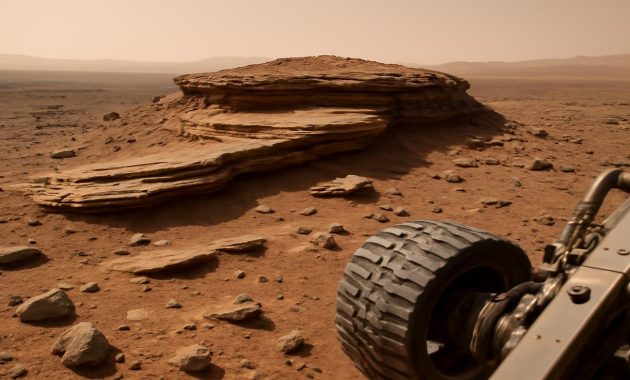
The story starts with a whisper of dust on another world. Not with a crash of rockets or the fanfare of launch day, but with a faint tremor on a rust-red plain, a smudge of cloud drifting over an alien horizon, and the quiet clicking of instruments inside a robot that will never come home. Mars, from far away, is a steady point of orange light. Up close, through the lenses and sensors of NASA’s rovers, it is something else entirely: restless, surprising, and—if the latest data are to be believed—no longer willing to pretend it has always been dead.
The Day the Numbers Wouldn’t Behave
It started, as these things often do, with something that did not fit.
Inside a control room on Earth, long after the first cheers of landing had faded, engineers and planetary scientists were doing the unglamorous work: combing through raw data packets trickling in from a lonely rover parked on an ancient Martian basin. On the big screens, Mars looked as it always did—sepia-toned slopes, scattered stones, a thin pastel sky. Calm. Predictable.
But under the surface, in the numbers the rover was pulling out of the dust and rock, something was misbehaving. The atmospheric sensors aboard Curiosity had already raised quiet eyebrows by showing methane spikes that appeared and vanished like ghostly campfire smoke. Perseverance, for its part, was teasing out strange signatures from layered sediments in Jezero Crater—sediments that looked suspiciously like they had once settled in calm water.
The expectation was straightforward: an old, cold world, long past its prime. Mars was supposed to be a fossil, the geological equivalent of a faded photograph. Instead, the chemistry twitched. Gases fluctuated. Subtle seasonal patterns emerged, then repeated. And in lab after lab, on screens from Pasadena to Paris, scientists kept asking the same uneasy question: what, exactly, is Mars still doing?
Reading the Red Planet’s Diary
Mars does not hand over its secrets easily. To make it speak, NASA’s rovers have had to turn into geologists, chemists, meteorologists, and time travelers all at once. Their tools are simple in concept and astonishing in precision: drills that nibble into rocks, lasers that vaporize tiny targets, spectrometers that read light like a barcode.
When Curiosity rolled into Gale Crater in 2012, the crater floor looked like rubble left by an angry planet. But in the scratches of rock and lines of sediment, a story emerged. Pebbles that were too round, as if they had been tumbled by water. Layers of mudstone, stacked like pages, which could only form at the bottom of a long-lived lake. Minerals—clays and sulfates—that generally need water not just once, but for a long time.
Perseverance, landing in 2021, seemed almost unfairly lucky. Jezero Crater is the kind of place planetary scientists draw on napkins. From orbit, it shows the elegant curl of an ancient river delta, frozen mid-fan like a fossilized hand. On the ground, the rover found what the satellite images had whispered: sediments arranged the way rivers and deltas do their work, grain by grain, flow by flow. There were coarse deposits where currents once rushed, finer silt where water slowed into a lake. For a moment, it was easy to look at the panoramic images and forget: this is another planet.
One of Perseverance’s main missions is simple in wording and enormous in implication: “search for signs of ancient life.” Not microbes alive today, but the fingerprints of something that may have stirred billions of years ago, when Mars was warmer, wetter, and less lonely. It is equipped to notice patterns in chemistry—the way carbon sits in a rock, the shapes that minerals take when biology has nudged them into being.
The Table That Changed the Conversation
In meetings and papers, the data began to be organized the way scientists calm their nerves: in tables, in cross-checked lists, in side-by-side comparisons of “what we see” versus “what could possibly cause it.” One internal summary, later echoed in articles, looked a bit like this:
| Observation | Non-biological Explanation | Biological Explanation |
|---|---|---|
| Ancient lake and river delta structures | Purely physical erosion and sedimentation in water | Habitats once suitable for microbial life |
| Clay and sulfate minerals in layered rocks | Long-term interaction of rock and water | Long-lived environments where life could persist |
| Seasonal methane variations in the atmosphere | Slow release from subsurface clathrates or rock reactions | Possible byproduct of subsurface microbial activity |
| Organic molecules in Martian rocks | Abiotic organic chemistry, delivered or formed by impacts | Preserved fragments of ancient biological material |
| Subtle textural and chemical patterns in sediments | Complex but inorganic mineral processes | Potential microbially-influenced structures |
Line by line, column by column, the scientific community did what it always does: it tried to kill the most exciting interpretation first. Methane? Maybe it’s geological—serpentinization, where water reacting with rock produces hydrogen that meets carbon. Organic molecules in rocks? These can form without life, through chemistry that runs on energy from sun and impacts. Layered sediments? Rivers and lakes do not need cells to exist.
And yet, when the dust settled—and dust always settles, on Mars and in science—one thing was left standing: the picture of Mars as a planet that, for a generous slice of its early history, checked every box on the habitability list. Not just water, but stable water. Not just rocks, but the right minerals. Not just chemistry, but complex organic molecules and energy sources that life, as we know it, could have happily exploited.
The One Explanation We Can’t Escape
The rovers have not found life on Mars. That’s the statement NASA repeats carefully, like a mantra, because the word “life” is dynamite. There are no fossilized fish in the rover images, no obvious microbial mats waving from Martian ponds. There are data points, probabilities, and stories inferred from stone.
But here is where the narrative tightens. As the data have piled up—Gale’s lake beds, Jezero’s delta, methane’s shy flicker, organics stubbornly hanging on in rocks blasted by radiation—one broad, overarching conclusion has become almost impossible to argue away:
Mars was once a habitable world.
Not “possibly,” not “in some exotic edge-case way,” but in a manner that, from everything Curiosity and Perseverance have shown, looks disconcertingly familiar. Billions of years ago, standing in Gale or Jezero, you might have seen a sky with clouds, rivers cutting through basalt, a lake spreading out to the horizon. You would have breathed nothing—the air was still thin and hostile—but you would have recognized the choreography of water and sediment, the moods of a living landscape.
Habitability is not life. But if you are willing to accept the humble assumption that the laws of nature are consistent, another line follows. Earth and Mars formed from the same cosmic ingredients, at nearly the same time, in the same general neighborhood of the Sun. On Earth, as soon as conditions allowed, life appears in the geological record with almost suspicious speed. Within a few hundred million years of the planet cooling enough to host oceans, something started metabolizing, replicating, evolving.
On Mars, the rovers have now painted a portrait of conditions that, during that same early window, were dramatically similar to Earth’s in all the ways that matter for simple life. Water. Energy. Chemistry. Time.
Given that, the only explanation that fits both sets of evidence—Earth’s exuberant habitability and Mars’s quiet but persistent hints—is this: either the universe is staggeringly perverse, granting two neighboring worlds prime conditions while only one ever sprouted life… or Mars, too, once hosted something living, at least briefly.
Scientists will not put it this bluntly in official press releases. They will speak of “high habitability potential” and “non-exclusive abiotic explanations.” But in private, over coffee at conferences, the question is no longer “was Mars ever capable of supporting life?” That, thanks to the rovers, is settled. The question has shifted to something bolder: “if life could have existed there, how could it possibly have failed to start?”
The Ghosts Beneath the Dust
Picture, for a moment, Mars not as it is, but as the rovers tell us it was. The air is thicker, cushioning ancient winds. Dark basaltic highlands feed minerals into broad, shallow lakes. Rivers braid and re-braid, leaving sandbars like scars across the landscape. Volcanoes vent heat. Hydrothermal systems lace the crust with chemical gradients, the perfect playgrounds for primitive metabolisms.
On Earth, environments like these are hotbeds of microbial life even now. Around hydrothermal vents, in alkaline springs, in lake sediments, we find organisms that regard “hostile” as a challenge, not a description. They feast on chemical imbalance: hydrogen here, carbon dioxide there, iron and sulfur and energy all around.
On Mars, we do not yet see their direct fossils—but we do see their stage. Some rocks drilled by Curiosity boast mineral assemblages that, on Earth, are closely linked to aqueous, habitable settings. Perseverance’s instruments have picked up organic molecules in deltaic sediments, guarded from radiation by layers of rock. These organics could be entirely abiotic, yes. But if one is honest, their stubborn presence is like a set of parentheses left open in a sentence: you feel the missing closing phrase.
The methane measurements are equally haunting. Methane in the atmosphere should be fragile, broken down by sunlight over relatively short timescales. Yet Curiosity has detected tiny, variable amounts that seem to rise and fall with the seasons. The numbers are small, maddeningly uncertain, and could be explained by slow geological seepage—or by a biosphere faded to embers, a handful of microbes deep underground, exhaling into the cold.
No single result forces the conclusion of life. But together, they push us into a corner. Planets with long-standing liquid water, organic chemistry, and energy gradients are not rare cosmic accidents; they are likely the rule, not the exception. On one such world, right next door, we now know these conditions held for hundreds of millions of years. The parsimonious, almost embarrassingly straightforward explanation is that life at least tried to take root there.
What the Rovers Really Proved
Strip away the romance and red sunsets, and the core finding from Curiosity and Perseverance is stark: barring truly contrived scenarios, early Mars was not a barren rock. It was biologically plausible in a way that leaves very little wiggle room. NASA’s careful phrasing—“past habitability”—is, in its understatement, volcanic.
It means that if we rewound the solar system clock and watched it again from the beginning, we would see two infant planets side by side, both wearing thin blue veils of atmosphere, both with liquid water running across their faces, both seeded by comets and meteorites bearing organic molecules. On one, life definitely appears. On the other, we now know, everything life needed was laid out like a well-set table.
Which brings us to the “one possible explanation” that the rover data leave us with, if we’re honest about the patterns we see both on Earth and Mars: life is not a miracle unique to one planet; it is a natural outcome when conditions allow.
We may never know exactly what stirred in those ancient Martian lakes. The record may be too eroded, the fossils too faint. It is entirely possible that, when future missions bring Perseverance’s carefully cached samples back to Earth, we will find only ambiguous chemistry—traces that can be argued over for decades. But even then, the deep conclusion stands.
A cosmos that produces two habitable neighbors and only one with life is logically possible. It is just vanishingly implausible when we consider how quickly life emerged on Earth once the stage was set, and how stubbornly it clings to every niche available. The more the rovers show us that Mars had the same stage, the more that lonely-Earth scenario begins to feel like insisting a forest, given rain and soil and sunlight, might somehow produce only one tree.
Waiting for the Core Sample That Changes Everything
Somewhere in Jezero, Perseverance is drilling. Each core it extracts is a time capsule, sealed in a slender cylinder, tucked into its body like seeds waiting for a future harvest. In the coming decade, if all goes according to an audacious interplanetary relay plan, those cores will launch off Mars in a tiny rocket, be captured in orbit, and ferried back to Earth.
In super-clean terrestrial labs, we will finally be able to do the kind of analyses no rover, however heroic, can manage: counting isotopes with exquisite precision, hunting for subtle patterns in carbon that, on Earth, are the unmistakable fingerprints of biology. We will look at the fine textures of sediments under electron microscopes, searching for shapes and arrangements that chemical processes alone rarely make.
The irony is that while we wait for those samples, the conceptual die is already cast. We are not waiting to discover whether Mars was once habitable; that verdict is in. We are waiting for the degree of confirmation that life actually took Mars up on the offer.
If we find clear biosignatures, it will feel like a revolution, but it will also feel strangely inevitable. The rovers have already tilted the universe in that direction. If we do not find them, it will not be a comforting return to a safely lifeless cosmos. It will be a puzzle so deep that it forces us to reconsider something profound about how life begins—or about how it ends.
Frequently Asked Questions
Did NASA’s rovers discover life on Mars?
No. Neither Curiosity nor Perseverance has discovered direct evidence of life on Mars. What they have found are strong indicators that ancient Mars was habitable—it had liquid water, key chemicals, and energy sources that could have supported microbial life.
What is the “one possible explanation” suggested by the data?
The cumulative rover data make it very hard to argue that Earth is uniquely suited for life. The simplest explanation is that life is a natural consequence of habitable conditions, not a rare miracle—and that early Mars likely hosted life, at least briefly, when conditions were right.
Why are methane detections on Mars so important?
Methane is unstable in Mars’ atmosphere and should break down relatively quickly. Its presence, especially when it varies with the seasons, suggests there is an active source. This could be geological processes or, more speculatively, subsurface microbes. The rovers cannot yet distinguish between these possibilities.
What has Perseverance found in Jezero Crater?
Perseverance has confirmed that Jezero Crater once hosted a river-fed lake, with layered delta deposits formed in water. It has detected organic molecules in some rocks and identified minerals associated with long-term water activity—all pointing to a past environment that was favorable for life.
When will we know for sure if Mars once had life?
The best chance will come from the Mars Sample Return campaign, planned to bring Perseverance’s rock cores back to Earth in the 2030s. Those samples will be examined with powerful lab instruments, giving us far more detailed information than rover-based tools can provide. Even then, the answer may be nuanced rather than a simple yes or no.
Could there still be life on Mars today?
Possibly, but if so, it would almost certainly be microscopic and hidden underground, where liquid water might persist and radiation is weaker. The rovers are not equipped to drill deep enough to access such habitats directly; future missions would be needed to search for extant subsurface life.
Why is Mars so dry and cold now if it was once habitable?
Mars lost much of its atmosphere over billions of years, likely stripped away by the solar wind after the planet’s magnetic field weakened. With a thinner atmosphere, surface pressure and temperatures dropped, causing most surface water to disappear—either escaping to space, freezing in the ground and poles, or becoming locked in minerals.