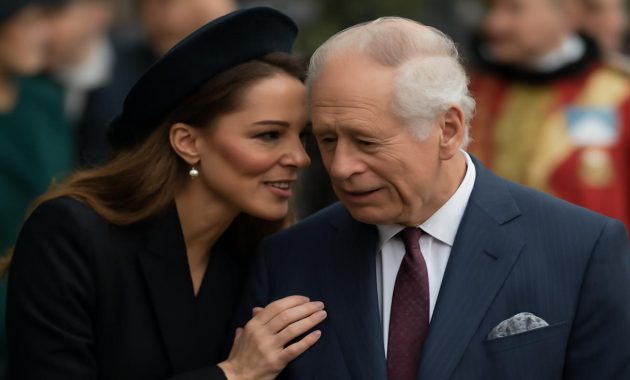
The room was quiet in that familiar royal way—full, but somehow hushed—when Kate Middleton stepped forward and did something no one quite expected. It was subtle. Quick. The sort of gesture that, on replay, suddenly seems loud with meaning. Cameras caught it, eyes widened, and social feeds lit up. Kate, the Princess of Wales, had just broken royal protocol with King Charles III—but not in defiance. In tenderness.
A Gesture That Spoke Louder Than Words
It didn’t happen on a balcony or in a heavily choreographed photo call, but in one of those liminal royal moments—between duty and downtime, between official poses and natural reactions. King Charles III stood nearby, dressed in his customary muted tones, his expression caught somewhere between composure and the constant fatigue of a man carrying an entire institution on his shoulders.
Kate moved toward him, her dress whispering softly against the polished floor. The air in the room felt dense with ceremony, with expectation, with that peculiar stiffness that often follows the royals like a shadow. And then she did it: a simple, human gesture. A hand reaching briefly for his arm. A gentle touch on his back as she leaned in. A quiet, almost private moment of reassurance played out in front of the world.
For a family defined by rules—how to stand, when to speak, where to look—that small act rang out like a bell. Protocol, after all, is not merely a list of dos and don’ts. It is a language. And Kate had just chosen a different word.
The Quiet Codes of Royal Protocol
The British monarchy exists beneath a thin glass dome of ritual. The rules may not always be written and laminated, but they are deeply ingrained. No one touches the monarch casually. Deference is built into distance: the bowed head, the gloved handshake, the carefully managed proximity. The King, like the Queen before him, is held slightly apart—even by his own family, at least when the cameras are watching.
So when the Princess of Wales appears to step outside those unwritten rules, it feels more than symbolic. It is not scandalous, exactly, but it is surprising. The royal household has long lived by a careful choreography, where every angle is considered, every glance weighed. Traditionally, even those bound to the monarch by blood operate under a quiet restraint in public.
But Kate has always walked a thin line between tradition and something much more modern. She curtsies when expected, follows dress codes with serene precision, and still finds ways to slide humanity into the frame—a comforting hand on a child, a spontaneous laugh that breaks through the solemnity of a ceremony, a quick reassuring touch to her husband’s back. This time, though, the gesture wasn’t aimed at William or at her children. It was for the King.
In that moment, protocol bent just slightly, like a branch in a soft wind, and the world was allowed to see what lives beneath the surface of titles: an aging father-in-law, a daughter-in-law stepping forward—not as a subject, but as support.
A Relationship Forged in Unlikely Weather
Kate did not marry into a calm family. She walked straight into a monarchy still haunted by ghosts, still learning how to survive in an age of relentless scrutiny. The shadow of Princess Diana lingered, the complicated history between Charles and the press still pulsed beneath every headline. When Kate and William married in 2011, she became, almost overnight, the future of the royal brand—a soft-spoken, steady presence in a world that thrives on spectacle.
It would have been easy for a wall to grow between Kate and her father-in-law. Their paths, at least on paper, were quite different. He was born into this life, shaped and confined by it from the start. She stepped into it from the outside, bringing with her the memory of middle-class normalcy, of supermarket runs and school drop-offs, of parents whose names were not accompanied by formal announcements. Yet, in the slow passing of years, they seemed to find each other in the middle ground.
There were joint engagements, shared smiles, and small, meaningful overlaps in their causes. King Charles, long before he wore the crown, cared deeply about the environment, about heritage, about sustainable living. Kate, in her own way, took up thoughtful causes too—early childhood, mental health, the subtle threads that hold families together. Not the flashy, headline-hungry issues, but the quiet ones, the ones that sink under the skin and stay there.
Behind the palace walls, the two reportedly grew close. Not in the gossip-column sense of whispered drama, but in the gentler sense of mutual respect. The King, who had spent much of his life under a magnifying glass, seemed to find in Kate someone who understood the tightrope he walked. She, in turn, found in him not just a monarch, but a man who had weathered storms she would spend the rest of her life learning to navigate.
When a Touch Becomes a Statement
So why did this one gesture—this light touch, this breaking of protocol—strike such a chord? Because of timing. Because of context. Because of everything we know, and everything we only guess, about what is happening behind the palace façade.
The monarchy feels more fragile these days. The headlines are less about golden jubilees and sparkling tiaras and more about fractured relationships, health concerns, and a modern public that is questioning the point of it all. King Charles III took the throne at a moment of great risk: a new era, but also a testing one. Every move is measured against the past, every decision weighed against the question of whether this ancient institution can still justify its place in the world.
In that climate, a simple gesture between Kate and Charles reads differently. It doesn’t look like rebellion. It looks like care. It suggests something that protocol alone can’t express: that the King is not alone on the stage he now must stand upon. That beside the rigid framework of duty, there is a warmer, softer net of family holding him up.
When Kate reached out, whether it was to guide him through a crowded room, to steady him on a step, or simply to show wordless support, it was as though she stepped outside of her role for a heartbeat and into something older and more instinctive. It was the kind of touch you might see in any family—between a daughter and a father, or between two people who have learned to trust each other’s presence.
It also offers a sharp counter-image to some of the more fractured storylines swirling around the House of Windsor. Where conflict and distance often dominate the narrative, this moment whispered the opposite: solidarity, warmth, and the willingness to bend stiff rules in the name of human connection.
The Changing Language of the Crown
Royal protocol has always been a kind of armor. It keeps emotion at bay, turns human beings into symbols, and preserves the mystique that has allowed the monarchy to endure. But armor, if never removed, can turn into a cage. The modern era has not been kind to public figures who refuse to show vulnerability, who cling too tightly to the polished version of themselves. Audiences, especially younger generations, grow impatient with artifice.
Kensington and Buckingham Palace have both been forced to learn this lesson in real time. We now see more informal photographs, more candid videos, more attempts to show the royals as “relatable” without letting the curtain fall entirely. The carefully posed family portraits are now interspersed with images of muddy boots, dogs on walks, laughter between formal events.
Within that shift, Kate’s gesture toward King Charles feels like an evolution rather than a rupture. It does not abandon tradition; it seasons it. It suggests that the crown no longer has to be held at arm’s length, that the monarch is not only a figurehead, but a person who might sometimes need a steadying hand.
In nature, ecosystems survive by adapting. A tree that never bends will splinter under enough wind. A river that cannot alter its course will overflow and damage the very soil that nourishes it. Institutions, too, either evolve or fossilize. In their small, almost imperceptible ways, people like Kate are helping the monarchy sway instead of shatter.
A Moment That Resonated Beyond the Palace
Part of the reason this episode resonated so widely is because so many saw in it a familiar dynamic: the younger generation stepping in to support the older one. The child, or in this case the daughter-in-law, becoming a quiet guardian in public. It is a cycle as ancient as family itself—only this time, it unfolded beneath the glare of global attention.
The sound of cameras clicking is relentless in royal spaces. Lights reflect off polished glass and heritage wallpaper. The air is heavy with perfume, with expectation, with the invisible pressure of history. Moving through that kind of space requires more than poise; it demands a strange kind of emotional weatherproofing.
And yet, within that almost suffocating atmosphere, this brief human moment broke through like a shaft of sunlight through the clouds. It reminded people watching at home—on their couches, in cramped apartments, on crowded trains staring at their phones—that even within the palace, people still reach for each other when things get complicated or overwhelming.
The royal family is often photographed side by side, but not always emotionally shoulder to shoulder. This was one of those rare instances when the emotional alignment seemed visible. The future Queen leaning in, not behind; the current King accepting, not recoiling. It looked, in its unassuming way, like partnership.
Reading the Signals: What It Suggests About Their Bond
Of course, no one outside their private circle really knows the full complexity of the relationship between Kate and King Charles. But public behavior leaves clues. Over the years, their interactions have taken on a particular rhythm: shared jokes at engagements, thoughtful glances, an ease that speaks of familiarity rather than formality.
He is said to admire her steadiness, her instinctive understanding of the public’s mood, her ability to be both accessible and dignified. She, in turn, appears to appreciate his decades-long commitment to causes that have only recently become fashionable—sustainability, conservation, organic farming, heritage preservation.
Their bond is also threaded with something else: shared pressure. Both of them know, more intimately than most, what it means to have a life narrated by strangers. They know what it costs a person to have every misstep archived forever, every expression dissected. They carry, in different ways, the weight of being symbols as well as flesh and blood. That kind of experience is isolating. It can also be a quiet glue.
So when Kate reached out and broke through the ceremonial bubble, it was likely not a spontaneous act born in a vacuum. It was the product of years of gradually built trust. A relationship that has shifted from formal to familiar, from carefully kept distance to an open, if still restrained, affection.
A Snapshot of the Monarchy’s Possible Future
If you look at that moment closely, it becomes more than a touching scene. It becomes a forecast. One day, perhaps not as far off as it feels, the crown will move again—from Charles to William. When that happens, Kate will not only be the Queen Consort; she will be one of the chief architects of how the monarchy presents itself to a new generation entirely.
The values embedded in small gestures today will likely shape larger decisions tomorrow. A willingness to relax certain social distances, to let the public see the humanity beneath the regalia, could become the royal family’s most powerful survival tool. Not through slick campaigns or rebranding exercises, but through consistent, subtle choices that reframe what it means to be royal.
Imagine future ceremonies where the awe of tradition is still present, but so is the natural ease of a family moving through the world together. Imagine a King and Queen who are not only admired at a distance, but quietly known for the way they visibly care for one another, for their children, even for an aging father once at the center of it all.
In this sense, Kate’s protocol-breaking gesture is both deeply personal and quietly political. It suggests, even wordlessly, the kind of monarchy she and William may eventually lead: less untouchable, more recognizably human. The crown, in this vision, does not erase the person beneath it; it frames them, in all their relatable fragility.
A Small Moment, A Long Echo
History books are rarely written around a touch of the hand or a glance across a room. They prefer battles and bills, coronations and abdications. Yet the currents that reshape institutions often begin with far smaller ripples—tiny, almost invisible breaks in long-standing patterns.
This is one of those ripples. It won’t change laws or rewrite constitutions, but it will linger in the public imagination as a symbol of something shifting. A King who allows his daughter-in-law to blur the margins of protocol. A Princess who feels secure enough in her role to prioritize compassion over rigid decorum. A royal family that, in fits and starts, is learning to live not above the people, but among them.
In that soft, fleeting gesture, you can almost hear the old world and the new negotiating their terms. The carriage wheels still roll, the trumpets still sound, but somewhere within the drumbeat of tradition, another rhythm has begun to emerge—quieter, more intimate, and distinctly human.
And it all comes down to this: in a room thick with history, Kate Middleton reached out to King Charles III, and he let her. For a second, the crown seemed lighter, not because duty mattered less, but because connection mattered more.
At a Glance: The Gesture and Its Meaning
| Aspect | Details |
|---|---|
| Who | Princess of Wales (Kate Middleton) and King Charles III |
| What Happened | Kate made a brief, affectionate physical gesture toward the King, stepping beyond typical royal protocol. |
| Why It Matters | Signals a warm, trusting relationship and reflects a softening of strict royal formality. |
| Symbolism | Shows support for the King, hints at a more human, emotionally open monarchy. |
| Broader Impact | Offers a glimpse of how Kate and William may shape the future royal image—traditional yet more personal. |
FAQ
Did Kate Middleton really break royal protocol with King Charles III?
Yes, in the sense that she stepped outside the usual, very careful public distance maintained around the monarch. Casual, affectionate touch toward the sovereign is not typically part of royal protocol, especially in public settings where cameras are present.
Why is physical contact with the monarch considered breaking protocol?
Royal protocol is built around preserving the mystique and symbolic status of the monarch. That has traditionally meant limiting casual physical contact, even from close family members, during formal appearances. Any touch that feels spontaneous or intimate can therefore be seen as bending those unwritten rules.
What does this gesture tell us about Kate’s relationship with King Charles?
It suggests warmth, familiarity, and trust. Kate felt comfortable enough to offer a brief, reassuring touch, and the King appeared to accept it naturally. That hints at a bond that goes beyond formality—more like that of a supportive, close-knit family than a strictly hierarchical institution.
Is the royal family becoming more relaxed about protocol in general?
Gradually, yes. While core traditions remain intact, younger royals like William and Kate have introduced a more approachable style—more candid moments, warmer interactions, and a slight softening of rigid rules when it helps them connect with the public or with each other.
Could this moment influence how the monarchy behaves in the future?
In a subtle way, it already has. Small public gestures like this become reference points for how far the boundaries can gently stretch. As William and Kate move closer to the throne, their instinct to balance dignity with visible humanity may shape how future royal engagements, ceremonies, and relationships are presented.