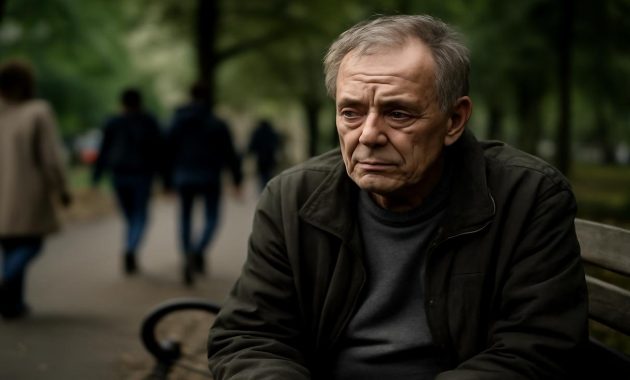
The first time it really hit me, I was standing between the cereal aisle and the dairy case, holding a basket that suddenly felt heavier than my own bones. A teenager in a red vest brushed past me with a restocking cart, the metal edge grazing my hip. He didn’t look up, didn’t mumble “sorry,” didn’t even seem to notice there was a person in front of him. I stepped back, reflexively, and heard myself say, softly, “Excuse me.” My voice landed somewhere between the humming refrigerators and the clatter of plastic crates and vanished. No echo. No response. I might as well have been mist.
The Slow Fade From Center Stage
“I’m 65 and I feel invisible in public.” The words sound dramatic when you say them out loud, but invisibility doesn’t arrive all at once. It’s a slow fade, a dimming of the lights around you while the world’s brightness seems to shift elsewhere.
It starts with tiny things, so small you almost laugh them off. The server at the café who looks at your daughter while taking the order, even though you’re the one paying. The shop assistant who calls you “young lady” with a wink, as if the joke softens the fact that she’s not actually seeing you at all—just a stereotype wrapped in sensible shoes and thinning hair.
You notice it in conversations, too. You’re halfway through a story at a family dinner, words moving steady and warm, and someone across the table changes the subject. The thread you were holding drops between your hands. No one picks it up. They don’t mean to be unkind; they simply forget you were speaking. You lean back in your chair, smile, and let the noise wash over you. Inside, a small voice whispers, Am I still here?
The Emotional Weather of Being Overlooked
Invisibility is not just about who looks away; it’s also about the weather inside your chest. There’s a humidity of unspoken hurt, a low-pressure system of loneliness that drifts in and lingers.
At 65, your emotions are not fragile—they’re well-worn and well-earned. You’ve buried friends, raised children, survived losses, reveled in joy. You’ve adapted to new technologies, new social rules, new ways of being human in a fast-shifting world. You’ve learned resilience the hard way. And yet this particular feeling—being brushed aside in public spaces—can cut deeper than most people think.
There’s a sharp sting when strangers speak louder to you as if age has somehow switched off your comprehension. There’s a bruised spot in your heart when people talk over you in line, literally stepping in front as if your place in the queue is optional. And then there’s the quiet ache: the man who lets the door slam behind him without holding it, the cashier who never makes eye contact, the doctor who talks at your chart instead of at your face.
The emotional weight of all this isn’t about politeness alone. It’s about value. Every little dismissal, each moment of being passed by or passed over, sends a subtle message: You don’t count as much anymore. After enough repetitions, it starts to sink beneath the skin. You begin to internalize the role that society has written for you—the faded extra in the background, not the protagonist.
The Stories Our Culture Tells About Aging
Behind the feeling of invisibility is a wall of stories that our culture tells—sometimes loudly, often quietly—about what it means to grow older. Walk through a mall, scroll through social media, flip through TV channels: youth is everywhere. Smooth faces, quick movements, breathless promises of “forever young.” Aging, on the other hand, is mostly shown as a problem to fix, a decline to resist, something to “fight.”
You rarely see a woman of 65 front and center in an advertisement unless it’s for medication, insurance, or a retirement plan that shows her sitting on a bench, staring at a sunset like her life has conveniently narrowed down to quiet contemplation. You rarely see an older man portrayed as anything other than a wise background character, a grandpa with a gentle chuckle and little else going on.
These stories are not neutral. They seep into everyone’s expectations—others’ and your own. If the only images of your age group are people slowing down, fading out, or stepping aside, then you start to unconsciously act that way too. You make yourself smaller in crowded spaces. You hesitate before offering an opinion, even when you know you’re right. You expect to be overlooked, and sometimes you preempt it by withdrawing.
That’s the emotional reason behind the feeling of invisibility: it isn’t imagined. It’s a collision between the reality of your vibrant inner life and the shallow cultural script handed to you about what someone “your age” is supposed to be. Your body might have slowed a little, but your mind is a crowded sky of memories, desires, ideas. The world only sees the wrinkles; you feel the constellations.
The Moment You Realize It’s Not Just You
One of the most startling things about feeling invisible is how personal it feels. You assume it must be something about your clothes, your posture, the way you move. You wonder if you’re not speaking clearly enough, smiling enough, trying enough. Shame sneaks in on quiet feet.
Then you talk to a friend over coffee—a friend your age—and you see her eyes light up with recognition. “That happens to you too?” she asks, leaning in. She tells you about a bus driver who overlooked her at the stop. About younger colleagues who explain basic things to her as if she’d never turned on a computer. About feeling like a ghost at her own birthday party while the kids and grandkids animatedly talk to one another, barely pausing to ask her anything real.
Soon, you’re swapping stories not as isolated incidents, but as threads in a shared tapestry. You begin to understand that the sensation of erasure is not just your private wound; it’s a pattern cutting across many lives, especially for women, but for men as well. The discomfort in your chest grows a new shape—less self-blame, more quiet outrage, more clarity.
That realization is both painful and liberating. Painful, because it means something is broken in the way we move together through public space. Liberating, because if it’s not a personal failing, maybe it’s something that can be named, challenged, and changed.
The Gap Between Inner Age and Outer Perception
Ask most people in their sixties how old they feel inside, and the answers will surprise you. Forty, maybe. Thirty-five on a good day. There’s often a stubborn core of youth that doesn’t line up with the reflection in the mirror. You still love loud music on road trips. You still feel a little thrill when someone flirts with you, even lightly. You still get curious about new places, new books, new recipes, new trails. Inside, there is a pulse of becoming, not just a catalog of what has already been.
But out in the world, strangers read your age like a summary instead of a chapter break. They see only what they expect: slower, weaker, less sharp, less important. That mismatch—the vibrant inner self versus the flattening outer gaze—is where a lot of the hurt lives. You are constantly asked to live in someone else’s flat sketch of who you are.
It’s like being a full-color painting hung in a hallway where everyone rushes past and glances only long enough to say, “Ah yes, an old painting,” without noticing the intricate details, the stories in the brushstrokes, the way light moves across the canvas differently every day.
What Invisibility Looks Like, Moment by Moment
Invisibility isn’t abstract. It shows up in ordinary places with ordinary faces. You can almost map it across a day.
| Everyday Scene | How Invisibility Appears | Emotional Impact |
|---|---|---|
| At the café counter | Barista speaks mainly to the younger person beside you | Subtle sting, sense of being “background” |
| On public transport | People avoid eye contact, no one offers a seat even when you’re unsteady | Feeling unworthy of care or consideration |
| In a store | Staff walk by you to help younger shoppers first | Frustration, quiet resignation, self-doubt |
| Family gathering | Your stories are interrupted or dismissed as “old tales” | Loneliness, a sense of being sidelined in your own family |
| At the doctor’s office | Healthcare staff talk about you instead of to you | Loss of agency, feeling reduced to a diagnosis |
Any one of these moments might seem minor to an outsider. But they add up, like drops of water slowly hollowing out stone. Day after day, your sense of belonging erodes just a little more.
The Hidden Grief Beneath the Surface
Sometimes the emotion you’re wrestling with isn’t just frustration—it’s grief. Not only for youth itself, but for visibility, for being treated as a full human in public spaces. You miss the days when heads turned as you entered a room, when your opinion carried obvious weight in conversations, when strangers flirted lightly instead of looking through you.
There is grief for the body that moved without protest, for the time when people assumed your life was building toward something, not gently winding down. But at 65, you may feel that you’re not winding down at all—you’re shifting, evolving, editing. You’re still making sense of yourself. The pain comes from living a dynamic, open-ended life in a culture that views your age as the final chapter, already written.
Naming this as grief matters. It validates that the hurt is real—not just vanity, not just oversensitivity. You are mourning a way of being seen, a kind of interpersonal light that has faded through no choice of your own.
Reclaiming Presence in a World That Looks Away
If the emotional reason behind feeling invisible is a combination of cultural stories, daily micro-erasures, and a deep mismatch between who you are and how you’re seen, then what does reclaiming your presence look like?
It doesn’t mean forcing the world to return to how it treated you at 25. It means insisting—gently but firmly—that your existence now is not a lesser version, but a different and equally valid one. It means practicing visibility from the inside out, even in small acts.
Sometimes it’s as simple as holding your ground in the grocery store aisle, meeting the eyes of the person who almost runs you over with their cart, and saying, clearly, “I’m standing here.” It might mean letting your voice be heard when a server ignores you: “Actually, I’ll order for myself.” Not with aggression, but with the steady reminder that you occupy space, too.
Reclaiming presence can also be unexpectedly creative. Wearing the bright scarf, the bold earrings, the hat that makes you stand a bit taller. Taking the class you always wanted to take. Joining a hiking group, a book club, a choir filled with people of mixed ages. The point is not to perform youth, but to inhabit your current self so fully that your energy contradicts the script written for your age.
Finding Mirrors That Reflect You Accurately
Part of healing from the emotional toll of invisibility is finding better mirrors—people and places that actually see you. Friends who still ask, “What are you excited about these days?” instead of only, “How’s your health?” Communities where age is an asset, not a punchline.
These might be formal groups, like volunteer organizations or creative workshops, or informal circles that form around shared passions—birdwatching at dawn, neighborhood gardening, late-afternoon swims. Environments where your stories are welcomed, your questions are taken seriously, your laughter is contagious.
The more you live in these spaces, the more clearly you remember: the problem is not that you’ve become less real, but that certain parts of the world have stopped looking closely. Surrounded by accurate mirrors, you can carry that sense of self into the other, harsher spaces, like a secret flame cupped in your hands.
A Quiet Revolution, One Acknowledging Glance at a Time
There’s a subtle revolution in choosing not to disappear, even when the culture around you seems eager for you to slip quietly into the background. It doesn’t require speeches or campaigns—though those help. Sometimes it’s as modest as looking another older person in the eye on the sidewalk and offering a nod that says, I see you. We’re still here.
If you’re younger and reading this, you’re not excluded from this story; you’re deeply woven into it. Every time you make a little extra space in your awareness for the older person in line ahead of you, every time you listen a bit longer to a story instead of glancing at your phone, you’re rewriting the script. When you talk with older people instead of around them, you’re quietly pushing back against a culture that equates worth with wrinkle-free skin and fast walking.
And if you’re 65, or 70, or 80, and feeling that soft sting of invisibility in public, it may help to remember this: your internal world hasn’t gone anywhere. The richness is still there—the layered memories, the sharp humor, the fears, the small late-blooming dreams. You carry entire landscapes inside you that younger people haven’t yet had time to grow.
In the end, the emotional reason behind feeling invisible is that there’s a gap between how deeply you exist and how shallowly the world is often willing to see you. Bridging that gap won’t happen overnight. But each time you assert your presence, each time you honor your own feelings instead of minimizing them, each time you meet someone else’s eyes with recognition, you’re quietly insisting on a truth that no culture can erase:
You are still here. Not faded. Not background. A full, vivid life, walking through a world that is slowly learning to look up and notice.
Frequently Asked Questions
Why do I feel more “invisible” now than I did at 55?
Often, the early 60s are when cultural expectations about aging start to press harder. Retirement, health changes, or children leaving home can shift how others perceive you—and how you see yourself. The world may start categorizing you as “old,” even if you don’t feel that way inside, which creates a painful mismatch.
Is this feeling of invisibility just in my head?
No. While personal mood and self-esteem play a role, many older adults report similar experiences of being ignored, talked over, or underestimated. These are real social patterns, influenced by ageism and cultural glorification of youth, not just imagination.
Does everyone feel invisible as they age?
Not everyone, and not all the time. But many people—especially women—describe a noticeable shift in how they’re treated in public spaces after midlife. Personality, location, health, race, and gender all affect how strongly this is felt, but it’s a common theme.
What can I do in the moment when I feel overlooked?
Small, clear actions can help: speak up calmly (“I’m next in line,” or “I’d like to finish what I was saying”), make eye contact, hold your physical ground rather than automatically stepping aside. These simple assertions can remind others—and yourself—that you deserve to be acknowledged.
How can younger people help older adults feel more seen?
Start with attention and respect. Listen without rushing. Ask genuine questions beyond health or family. Make room for older voices in conversations, decision-making, and social spaces. And notice the older people around you in everyday life—offer a greeting, a held door, or just a moment of recognition instead of looking past them.