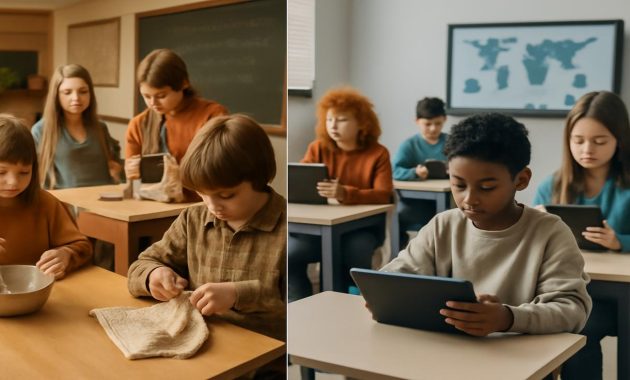
If you grew up in the 1960s or 1970s, you might sometimes feel as if you came from a different planet, not just a different decade. The world you remember—the clack of typewriter keys, the snap of a screen door, the hum of a box fan in an open window—seems to have slipped quietly into sepia. Yet what’s most startling isn’t that the appliances and hairstyles are gone. It’s that so many of the life lessons you were handed, almost casually, have quietly disappeared from the way we teach children today.
The Classroom Before Computers
Walk back, in your mind, into an elementary school in 1968. The hallway smells of floor wax and chalk. Coats hang heavy on metal hooks. The classroom is a patchwork of wooden desks, each scarred by pencil marks and the occasional carved initials. There’s a globe in the corner, the oceans a deep, mysterious blue, and a row of dog-eared textbooks balanced on a shelf that always seems a little too small.
The teacher, maybe with a beehive hairdo or a narrow tie and ink-smudged fingers, writes on the chalkboard. When the bell rings, you rise not at the soft chime of a digital tone, but at the clang of something that sounds like it belongs in a factory. Learning then was slow and physical. You flipped pages, sharpened pencils, folded paper notes into intricate shapes. You copied things by hand not because it was quaint, but because there was no other way.
No one called it “character education” yet, and there were no colorful posters explaining “growth mindset” or “emotional regulation.” Instead, life lessons slid into your days through small routines and unspoken expectations. You were not just being taught math and reading; you were being trained in a different way of moving through the world—one that modern classrooms, humming with tablets and standardized tests, rarely have time or space for.
The Vanishing Art of Doing Hard Things
One lesson that anchored those years was simple, almost blunt: some things are hard, and you do them anyway.
In the 60s and 70s, difficulty wasn’t automatically treated as a sign that something had gone wrong. Long division, diagramming sentences, memorizing multiplication tables—these tasks were supposed to feel difficult. The expectation was that you would wrestle with them, erasing holes in the paper if necessary, until the work was done. “Stick with it” was not a slogan; it was the air you breathed.
This attitude extended beyond the classroom. Lawn mowing in the heat. Shoveling snow before school. Raking leaves until your arms ached. Helping move furniture, paint a fence, or wash a mountain of dishes after a family gathering. Adults rarely knelt to your eye level to ask how you felt about your chores. They assumed you would feel tired, bored, maybe annoyed—and that none of those feelings were reason enough to stop.
It wasn’t that your feelings didn’t matter; they simply weren’t placed at the center of every decision. The world seemed to operate on a quiet equation: effort came first, feelings sorted themselves out later. Through repetition, you learned that being uncomfortable didn’t mean you were incapable, and that you could survive boredom, fatigue, even mild embarrassment—and come out the other side a little stronger.
Today, in a culture of instant feedback and frictionless interfaces, that particular muscle—the one that pushes through discomfort—doesn’t get the same workout. Assignments are broken into smaller pieces. Difficult emotions are quickly named, soothed, and accommodated. There’s wisdom in that, especially for kids facing real trauma or anxiety. But something else has faded: that lived-in sense that hard things are not a sign to retreat, but an invitation to grow up.
The Old Lessons in a New Light
When older generations say “kids these days have it too easy,” they’re rarely talking about global uncertainty, climate change, or social pressures—today’s kids face plenty of those. What they often miss is the gritty, everyday proving ground that once taught perseverance long before motivational speakers tried to bottle it into keynotes and slogans.
In the 1960s and 70s, you learned that life would not rearrange itself to be convenient. You adapted to the world, not the other way around. That lesson doesn’t show up in a modern curriculum guide, but you can still feel it in your bones whenever something in your life requires patience, stubbornness, and doing the right thing even when no one’s watching.
Freedom, Boundaries, and the Lost Practice of Roaming
Step outside that old school and picture the neighborhood of your childhood. No tracking apps. No “find my phone.” Parents often knew roughly where you were, but not precisely. You headed out on a summer morning, maybe with a flimsy sandwich bag of snacks, and came home at dinner, sunburned and thirsty, dust in your socks and a new story to tell.
Your childhood territory might have been a vacant lot, a stand of scraggly trees, a creek, the railroad tracks, a wide alley, or just a crooked sidewalk that invited hopscotch chalk. Those spaces were training grounds for judgment and risk. Who would you play with? How far would you go? How close to the water, the tracks, the edge, would you allow yourself to wander?
Adults gave you boundaries—“be home by dark,” “stay off that road,” “don’t go into that house”—but inside those flexible fences, you were largely on your own. No one was filling every hour with scheduled enrichment. No one was watching from the car, texting check-ins, or following you from a drone’s eye view. Freedom and danger existed as twin presences in the same bright afternoon.
That unsupervised time came with its own curriculum. You learned to read situations: which kids were trouble, when a game was getting too rough, when it was time to leave. You negotiated arguments without adult referees. You figured out how to get unstuck when your bike chain slipped or how to improvise a bandage from a torn T-shirt. Independence wasn’t just symbolic; it was physical and practical.
| Life Lesson | Common in 60s–70s Childhood | How It Looks Today |
|---|---|---|
| Do hard things without shortcuts | Manual chores, memorization, paper research in libraries | More digital aids, step-by-step scaffolding, faster workarounds |
| Roam and self-manage risk | Unsupervised outdoor play, bikes as freedom machines | Organized activities, parental tracking, limited roaming radius |
| Wait your turn and cope with boredom | Lines, long car rides, slow TV schedules | On-demand entertainment, devices filling every pause |
| Respect tools, people, and shared spaces | Shop class, home economics, strict classroom rules | Safety messages, but fewer hands-on, consequence-based lessons |
| Accept that life isn’t always fair | Limited negotiation, “that’s the rule” closure | More dialogue and flexibility, but also more appeals and bargaining |
In many places today, childhood looks and feels different. Playdates are structured. Sports practices often replace informal games. Parents sit on the sidelines, ready with water bottles, snacks, and—if needed—interventions. The risks kids face online are real, but so is the loss of that slow, analog roaming that taught past generations how to weigh danger against curiosity.
The Disappearing Lessons of Respect and Restraint
There was another, quieter thread woven through those mid-century childhoods: an unspoken code of respect and restraint. You might have thought your teachers were strict or your parents unbending, but their expectations were usually crystal clear.
You stood when an adult entered a room in some homes. You said “sir” or “ma’am” whether you felt like it or not. You didn’t call teachers by their first names, and talking back in class was a serious gamble. At the dinner table, interrupting the adults’ conversation made you instantly aware of your own smallness in the room.
This formal respect sometimes shaded into fear, and not all of it was healthy. Corporal punishment, humiliation, and rigid obedience did real damage. Many people who grew up then carry memories of shame and fear they would never want to pass on. But nestled within those harsher elements was a lesson that still has value: the world does not owe you constant attention, and you are not always the main character.
In those decades, you learned to listen more than you spoke when adults were talking. You learned to wait. You learned that not every feeling needed to be broadcast, not every disagreement needed to be voiced. There was room for private thought, for holding your tongue, for choosing patience over instant expression.
From “Be Seen, Not Heard” to “Use Your Voice”
Today, we encourage children to speak up, to self-advocate, to share their feelings. That shift is, in many ways, an enormous step forward. Kids find it easier now to tell adults when something is wrong—to report bullying, to name unfairness, to reveal abuse. That is necessary and good.
Yet in turning the volume up on expression, we may have turned down some of the old lessons about timing, restraint, and humility. The idea that you might sometimes choose silence over reaction, or that you might listen to understand rather than to respond, has lost ground in a culture of constant posting, commenting, and reacting.
Older lessons about respect weren’t perfect, but they did cultivate a particular inner posture: you were part of a larger whole. It’s a posture that’s harder to teach in a world where every device and algorithm is tuned to treat you like the center of the universe.
The Lost Education of Hands and Home
Think about the classes that filled out a typical school week in the 60s or 70s: shop class, home economics, basic car maintenance, typing on heavy machines that clacked and rang. You might have burned a pan of muffins or drilled a crooked hole; you might have sewn a lopsided apron you never wore again. But you learned that the physical world had rules you had to respect—gravity, sharp edges, hot surfaces, spinning blades.
These were not just vocational skills for those who “weren’t academic.” They were quiet messengers of self-reliance. You were expected to be at least minimally capable: to sew on a button, cook a simple meal, patch a wall, read a measuring tape. Even if you forgot the specifics, you carried forward a sense that you could learn new physical skills when needed, that tasks around the home were not undignified or beneath you.
At home, that education continued. Saturday mornings were for chores: dusting, sweeping, hanging laundry on a line, polishing shoes, washing windows until they squeaked. Maybe you resented it then; maybe you grumbled and dragged your feet. But the expectation was rarely in question. The house needed care, and you were part of the solution.
In many modern schools, those hands-on classes have been cut to make room for test preparation and technology. Many homes operate at such frantic speeds that it feels easier for adults to do everything themselves rather than teach kids how. Food appears from boxes and apps. Clothing arrives pre-hemmed. Devices replace skills that once demanded practice.
In that shift, we’ve lost something subtler than recipes or tool-use. We’ve lost the steady message, repeated in every clumsy attempt: your hands are capable, and you share responsibility for the spaces you live in.
Why These Old Lessons Still Matter
It’s easy to romanticize the past, to wrap those decades in soft-focus nostalgia. It’s also easy to condemn them for their blind spots—inequality, rigid gender roles, silenced voices. Both views are true in their own way. The 1960s and 70s were complicated, messy, alive with change and contradiction.
But when older adults say, almost wistfully, “We were taught things kids don’t learn anymore,” they’re often reaching for these intangible lessons: perseverance without praise, independence with risk, respect with restraint, capability with your own hands. These weren’t formal subjects. No one handed you a worksheet titled “How to Do Hard Things When No One Is Watching.” They lived inside the rhythm of the day, the texture of chores, the tone of a teacher’s voice, the wide-open space of a summer afternoon where no one knew exactly where you were.
Those lessons can be revived, gently and wisely, without recreating the harms of the past. You can invite kids today into small experiences of boredom, risk, responsibility, and contribution. You can tell them stories of your own younger self—how you got lost and found your way, failed a test and survived, burned dinner and learned to cook something better next time.
Because in the end, the most enduring curriculum is not written down. It’s lived. And while the technologies and timelines have changed, the human heart is not as different as it seems. Children still need to discover that they are stronger than they think, more capable than they fear, and more deeply connected to others than any screen can show.
If you grew up in the 60s or 70s, those quiet, vanished lessons are still inside you. They rise up whenever you roll up your sleeves instead of complaining, whenever you fix instead of throw away, whenever you listen before you speak, whenever you give a child just enough space to struggle and succeed on their own.
They are, in many ways, the most valuable inheritance of your generation—not a set of facts, but a way of facing the world. And while they may no longer be printed in modern textbooks, they can still be passed on, one story, one patient moment, one small act of trust at a time.
Frequently Asked Questions
Were the life lessons from the 60s and 70s really better than what kids learn today?
They were different, not universally better. Many older lessons about perseverance, independence, and practical skills had real value. At the same time, today’s emphasis on mental health, inclusion, and student voice is an important improvement. The ideal is to combine the best of both eras.
Can these “old-fashioned” lessons be taught without bringing back harsh discipline?
Yes. You can keep kindness and emotional awareness while still expecting kids to do hard things, help with chores, wait their turn, and solve some problems on their own. The key difference is explaining the “why” behind expectations and avoiding shame or fear as motivators.
How can parents today bring back some of these lessons in a modern context?
Start small: give kids unsupervised playtime within safe limits, involve them in household tasks, let them experience boredom without immediately offering screens, and encourage them to attempt difficult tasks before stepping in to help. Share your own stories of struggle and resilience.
Do schools have room to teach these life lessons anymore?
Time is tight in many schools, but the lessons can be woven into everyday routines—group projects, classroom jobs, long-term assignments, outdoor time, and discussions about responsibility and respect. It’s less about adding a new subject and more about how existing time is used.
Is it fair to expect kids to be as independent as children were in the 60s and 70s?
The world has changed, and some dangers are more visible now. Full replication isn’t realistic or always safe. But even within modern limits, children can be given more responsibility, more unstructured time, and more chances to make decisions without constant adult direction. The goal isn’t to copy the past, but to recover its most valuable lessons.