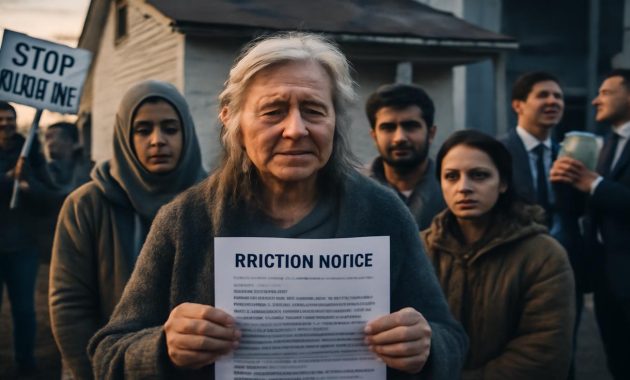
The last time anyone saw the ivy on her front porch, it was curling around cardboard suitcases and plastic shopping bags—everything four human beings owned, pressed into flimsy handles that cut into their palms. The house itself looked the way most houses do after a long life: a little peeled at the edges, a little slumped in the middle, as if it had exhaled after seventy years of holding its breath. Neighbors had grown used to the sound of her voice drifting across the hedges—calling to the mailman, laughing with the kids next door, humming along to crackling old records on Sunday afternoons.
Now, there was only the thump of boots on the wooden steps, the low murmur of officials with clipboards, and a single, short, breaking sound when the woman on the porch—white hair pinned up in a hurry, cardigan half-buttoned—realized they were serious. They were taking her house. Not tomorrow. Not in a month. Today.
Her name is Marta, though the talk shows would come to call her “the Grandmother With Too Much Heart” and pundits, with a mix of admiration and contempt, would label her “the bleeding-heart granny.” She hadn’t expected to become a national symbol. She just thought the empty rooms in her house were too loud.
How War Found Its Way to a Quiet Street
The war was, at first, a distant flicker on the television in Marta’s living room—maps shaded red and blue, grainy footage of apartment blocks coughing smoke into colorless skies, anchors talking over each other in that taut, adrenaline-fueled cadence they use when nobody really understands what’s happening. In the mornings, she’d water the geraniums and listen with one ear, as if the war was a storm they’d forecast but would never quite reach her town.
Then the station wagon pulled up across the street one March afternoon. Four people stepped out, each one wearing the same hollow, dazed expression. A young mother with a jacket that wasn’t warm enough for late winter. Two children who flinched at the sound of a passing motorcycle. A grandfather in a suit that had once been sharp but now sagged at the shoulders and elbows, like it had absorbed too much waiting in border lines.
They stood on the sidewalk holding a paper with an address that clearly wasn’t here. The driver, an overworked volunteer with a cracked phone screen and three more families to deliver, waved an apologetic hand and pulled away.
Marta watched from her kitchen window as they turned in slow circles, squinting at street signs. She could see the older man’s hands trembling around the paper; the little girl’s ponytail was lopsided, her hair tie barely clinging. The boy had on two different socks and no coat.
Some people will say what she did next was foolish. Irresponsible. Dangerous. Maybe it was all of those things. It was also something much simpler.
She opened her front door and called out, “Come in. Just come in. We’ll sort the rest out later.”
The House That Became a Harbor
That first night, every sense in the house seemed heightened. The smell of potato soup thick with garlic and onion. The hiss of water in the old pipes as she drew extra baths. The nervous rustle of unfamiliar bodies moving carefully, respectfully, in too-small borrowed slippers. The language barrier made sentences stumble, so they spoke with hands and eyebrows and smiles. The children learned the dog’s name first.
By the end of the week, the front room held makeshift beds: a mattress dragged from the spare room, a camping mat from the attic, a nest of blankets for the kids to burrow in. The coffee table disappeared under a scatter of documents: temporary IDs, folded maps, bus timetables printed in a language none of them fully understood. Every corner of the house testified to lives interrupted and hastily mended.
Marta watched them the way old gardeners watch new seedlings—hopeful, protective, quietly outraged at the late frost that had nearly killed them. She turned the thermostat up a little higher, pretended not to notice when the children added too much sugar to their tea, left an extra bar of chocolate on the kitchen table with a note: “For sharing. Or not.”
News of her guests traveled faster than she’d imagined. First the neighbors, then the church, then the local donation group. Soon, plastic bags of clothes appeared on her doorstep like offerings. A crate of mandarins. A pair of children’s boots “too small for ours now, but maybe they’ll fit yours.”
Those early weeks had the bittersweet glow of a community waking up to its better self. People spoke softly on the bus about “that grandma always taking someone in.” The local paper ran a tender piece with a photo of her on the stoop between the two children, all three squinting into the pale spring sun, the ivy curling overhead like a benediction.
But war, as it turns out, isn’t just about bombs and broken buildings far away. It has a way of seeping into mortgage contracts, gentrifying neighborhoods, and spreadsheets on the polished desks of people who will never meet the ones made homeless by their decisions.
The Invisible Ledgers Behind the Kindness
On paper, the system looked compassionate. The government promised swift accommodation for refugees. Emergency grants. Fast-tracked approvals. A coordinated network of NGOs, agencies, and property owners. It all sounded tidy, almost elegant, in the announcements. But behind the podiums, a different story was being drawn up in quiet meetings.
Investors with portfolios instead of porches began watching the news not with dread, but with calculation. Where catastrophe blooms, they’ve learned, there is almost always money to be made. Entire blocks of “underutilized housing stock,” shuttered hotels, and aging apartment towers suddenly looked like opportunities. Not to shelter—at least, not in the way Marta understood shelter—but to profit.
Her street, worth little attention during all the quiet, unremarkable decades of her life, found itself inside a red circle on a city planner’s map. Close enough to the new business district to attract high rents. Old enough homes to buy cheaply from “motivated sellers.” Good bones, they said. Great upside potential.
Meanwhile, volunteers who had spent nights matching families with spare rooms were being told to “transition to formal pathways.” That meant contracts. That meant regulations. It also meant someone else was stepping in between host and guest, turning solidarity into a line item.
| Type of Shelter | Who Pays | Average Monthly Cost Per Person | Who Profits |
|---|---|---|---|
| Spare rooms in private homes (like Marta’s) | Hosts (often subsidizing from their own pockets) | Low to none | Nobody, except the common good |
| Government-leased apartments | Public funds | Medium–high | Private landlords and intermediaries |
| Privately-owned “emergency housing” blocks | Public funds & NGOs | High | Real estate funds, often offshore |
In this new landscape, people like Marta were both celebrated and sidelined. The government liked their stories, but not their unpredictability. Money likes systems it can model. It prefers contracts to casseroles.
The Visit With the Clipboards
The knock on her door came on a Thursday, between the kettle boiling and the washing machine finishing its spin. Two officials in neat coats, their expressions carefully neutral, stood on the porch. One held a folder stuffed with papers; the other carried a tablet glowing blue in the morning light.
“Good morning, Mrs. Novak,” the taller one said. “We’re here regarding the people you have staying with you.”
Her first instinct was panic. Had she forgotten a form? Overstayed some invisible limit? She felt suddenly shy about the mess behind her—the shoes piled by the door, the school drawings taped to the hallway wall, the overworked coat rack leaning under the weight of too many borrowed jackets.
They assured her she’d done nothing wrong. The tone they used was the same one nurses use to talk you through a painful injection.
There was, they explained, a new program. Her guests could be offered “proper accommodation”—their words—in a recently “refurbished complex” on the edge of the city. Centralized services. Integrated support. It all sounded so reasonable as they recited it.
“We’re regularizing placements,” the woman with the tablet said. “For everyone’s safety.”
Marta looked at the children peering from the hallway, their hands still sticky with jam from breakfast. She thought of the way the little girl had started helping her water the plants each morning, learning the names of each one in halting syllables. She thought of the grandfather, who now insisted on fixing anything broken in the house as “rent”—a loose cabinet hinge, a wobbly chair leg, the flickering kitchen light.
“They are safe here,” she said quietly.
The officials exchanged a glance. This was the moment the script changed.
“There is also the matter of your property, Mrs. Novak,” the man added. “We’ve reviewed your mortgage and the arrears. There are… options available to you under the current emergency regulations.”
The word “arrears” cracked through the air like a dry branch. She felt that old, creeping shame. The winter before the war, her heating bills had climbed; the small pension hadn’t. She’d skipped payments, promising herself she would catch up. Then the roof had started leaking.
“Under these regulations,” he continued, smoothing the top page of his folder, “properties in strategic corridors can be reallocated if the owners are unable to maintain them.”
It took a few minutes for the meaning to settle. Her house, the one she’d been born in, raised children in, buried a husband from—it was now in a “strategic corridor.” The humming quiet street had become a corridor. Her memories, apparently, were inefficient use of space.
They used the word “reallocated,” but what they meant was taken.
Speculators at the Edges of the Story
If you follow the threads backward from that porch—past the clipboard, past the folder, past the mortgage clause—it leads you to boardrooms far from Marta’s geraniums. To investors who had noticed the emergency legislation and commissioned reports with titles like “Post-Conflict Urban Revitalization Opportunities.” To glossy presentations where the city was reframed not as a place people lived but as a grid of assets and risks.
In those rooms, the war was a chart showing supply and demand. A slide deck of “pressure on housing stock.” A chance to buy up distressed properties, particularly in “up-and-coming zones” where new infrastructure plans were being quietly sketched. Her neighborhood was one such zone.
The emergency laws made it easier. Houses like hers—old, a little neglected, technically in breach of this or that regulation—could be flagged. If their owners had debts, even small ones, they were vulnerable. All you had to do was wait until the right moral cover arrived. Housing refugees, it turned out, was the perfect fig leaf.
Developers would sign contracts to provide “emergency accommodation” in large converted buildings, backed by guaranteed public funds. Stable income, low vacancy, minimal risk. At the same time, they’d attend quiet auctions for homes deemed “non-compliant” under the new rules. The same emergency that opened the public purse to them could also pry old doors off their hinges.
On talk shows, they would later say they were “stepping up where the state and individual goodwill could not keep pace.” They would stress words like scalable and sustainable. They would avoid mentioning the returns sections of their prospectuses.
A Nation Split Between Stories
Once word got out that an elderly woman had lost her home months after housing refugees there “for free,” the country erupted. Not because it was an entirely unique case—the quiet truth is there were others—but because Marta’s story contained every fracture in one small frame.
The first wave of reaction was fury. Social media lit up with messages: “She gave everything and they threw her out,” “Is this what we do to our own?” Crowdfunding pages sprang up overnight, raising tens of thousands in a matter of days. People who had never met her wrote that they would easily have forgiven a missed mortgage payment or two if it meant preserving such clear, living kindness.
Then came the countercurrent. Certain columnists sneered at “emotional blackmail.” They pointed out the letter of the law: she had fallen behind on payments; emergency regulations were explicit. Rules are rules. They muttered about “sentimentalism being weaponized.” Some even suggested that she had been naïve to “collect strays” instead of looking after her own financial security.
Televised debates pitted “security experts” against “humanitarian advocates.” Words like exploitation and sovereignty hissed through studio air. One side spoke of national interests and market functionality; the other asked, voice shaking, what kind of nation functions by punishing its most generous.
Refugees, caught squarely in the middle, watched themselves turned into chess pieces in an argument they did not choose. Some were told not to “abuse hospitality.” Others were urged to speak out against what had happened to Marta. It was as if the whole country had wandered into her front room and started rearranging the furniture to suit their rhetoric.
The most painful voices, perhaps, came from people just like her—pensioners with spare rooms, cash-strapped families who had opened their doors. They called radio shows and asked, quiet and practical, a question beneath all the shouting: “If I help, could this happen to me too?”
What Her House Meant, and What Its Loss Revealed
The day they left, the refugees helped her pack. The children carried out boxes labeled with her looping handwriting: WINTER CLOTHES, KITCHEN, BOOKS. The young mother kept saying “sorry” for not being able to do more, as if the whole mess were some small accident she’d caused. The grandfather stayed behind in the empty living room for a long time, hand on the wallpaper as if memorizing its texture.
Outside on the sidewalk, a neighbor tried to hug her and ended up clinging. The moving truck idled nearby. Across the street, a white SUV slid briefly into view—tinted windows, a real estate company logo small and discreet near the back. It paused, then rolled on. Someone, somewhere, had already counted this house into their projections.
Later, in the tiny one-room unit the city found for her—“temporary, until we sort something more permanent”—she would run her hand over the unfamiliar windowsill and feel the absence of the ivy. She would dream of the creak on the third stair. She would wake disoriented, not by sirens or explosions, but by quiet.
Her guests were moved to the “refurbished complex” with its fluorescent hallways and biometric entry. On paper, their situation had improved. The kids had a playground. The mother had access to onsite translators. The grandfather could attend physiotherapy on Tuesdays. It was, in many ways, better—except for the constant sense that every kindness here had a price, tallied somewhere she could not see.
Years from now, when the war has moved on to the history textbooks and the investors have flipped their properties again, it’s possible nobody will remember the exact clauses that took Marta’s house. But the feeling that the system turned its sharpest edges not on the cynical, but on the generous—that will linger.
What We Choose to Value in a Time of Ruin
In the national argument that followed, experts drew graphs and wrote reports. They debated whether emergency laws had been too broad, whether speculative capital had been given too free a hand, whether safeguards for vulnerable homeowners had been an afterthought. Committees were formed. Hearings were held. Everyone agreed, in a muted, careful way, that “lessons must be learned.”
But beneath policy tweaks lies a quieter reckoning. A country is not just its GDP or its housing stock; it is the stories it chooses to honor. Do we tell our children that the woman who opened her door in a crisis was foolish for risking what little she had? Or do we say that a decent society should have moved mountains to protect her precisely because she did what we wish more of us would do?
The answer is not simple. There are real constraints, real budgets, real frictions in any attempt to house thousands suddenly uprooted by war. Private capital is often faster to build than public systems. Some of the developers who stepped in surely did so with a mix of conscience and calculation, as humans often do.
Yet there is a line—and we know, viscerally, when it has been crossed. It is somewhere between taking a reasonable return for a real service and quietly designing a system where people like Marta are nudged off their porches so that balance sheets can swell. It is the difference between using emergency laws to shelter the homeless and using them to harvest the homes of the precarious.
If we listen closely, the story of one grandmother and one house asks something uncomfortable of all of us: Whose risk are we willing to socialize, and whose losses are we willing to accept as “unfortunate but necessary”? The investors were protected from vacancy and market swings. The banks were shielded from default. The agencies had full waiting lists to prove their efficiency. The only person left without a cushion was the woman who had, for a brief shining window of time, been the safety net for four strangers.
Maybe the real measure of a nation in wartime is not how loudly it condemns distant violence, but how gently it treats those who respond to that violence with open doors and extra place settings at the table. Whether it can design systems that harness, rather than punish, the wild, unprofitable instinct to say, “Come in. Just come in. We’ll sort the rest out later.”
FAQ
Why did Marta lose her home if she was helping refugees?
She lost her home because she had fallen behind on her mortgage and emergency housing regulations made it easier for authorities and financial institutions to repossess “strategic” properties. Her act of hosting refugees did not cause the loss directly, but it exposed how vulnerable she already was inside a system that prioritized financial and redevelopment interests over protecting generous, low-income homeowners.
Did the refugees cause or contribute to her eviction?
No. The refugees were not responsible for her eviction. They were simply people in need who accepted her help. The decision to take her home was made by institutions applying emergency rules, influenced by broader market and political pressures, not by the actions of the guests she sheltered.
How are speculators profiting from wartime housing needs?
Speculators buy distressed or undervalued properties in areas targeted for redevelopment, then secure government contracts to provide “emergency housing” at guaranteed rates. Public money covers high rents or management fees, turning human displacement into a predictable revenue stream, while owners like Marta, who offer housing out of solidarity, receive little or no structural protection.
Could this kind of situation happen in other countries?
Yes. Wherever emergency powers, weak tenant or homeowner protections, and strong speculative markets overlap, similar abuses can occur. The combination of crisis, rapid policy changes, and large public spending often creates openings for opportunistic investors unless there are clear safeguards for vulnerable residents and transparent oversight.
What could be done differently to protect people like Marta?
Governments could introduce emergency protections for low-income homeowners who host refugees, such as mortgage relief, tax credits, or legal shields against foreclosure during the crisis. Public housing initiatives could be prioritized over speculative contracts, and regulations could limit profiteering on emergency accommodation while rewarding and supporting grassroots solidarity instead of sidelining it.