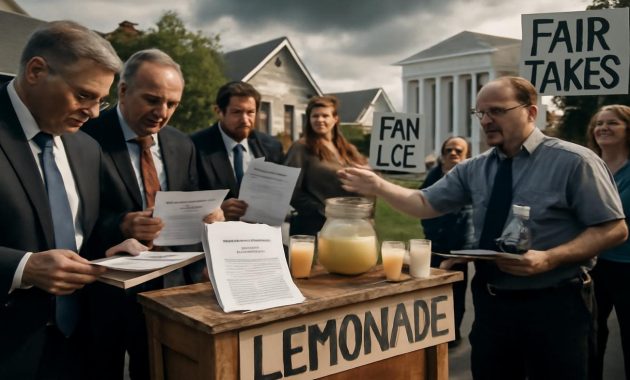
The first thing anyone noticed was the sign. A sheet of printer paper taped to a wobbly card table on Ashwood Lane, the blue marker letters tilting uphill as if they were running out of breath: “LEMONADE 50¢ – FRESH!!” Below it, a plastic pitcher sweated in the July heat, ice cubes clinking like tiny bells every time the ten-year-old behind the table stirred it with exaggerated seriousness.
Her name was Maddie, and by 10:15 a.m. she had already done the kind of business that makes a kid feel invincible and a parent quietly proud. Cars slowed. Dogs tugged their leashes toward the table. Neighbors fished coins from their pockets and made a show of dropping them into the little tin labeled “PAY HERE :)”. It was the kind of Saturday scene that makes a suburb feel like a place time forgot—in a good way.
It was also, as it turned out, the beginning of a Supreme Court case.
Summer, Sugar, and a Perfectly Ordinary Law
The air that day carried the thick, almost visible shimmer of midsummer. Lawns hummed with sprinklers. Somewhere a radio played a pop song you couldn’t escape that year; every minivan that rolled past seemed to have it faintly echoing inside. Maddie’s mother, Karen, sat on the porch steps with a paperback and a glass of iced tea, watching her daughter’s world expand one paper cup at a time.
By noon, the table was busy enough that Maddie had invented a job title for herself: “CEO & Chief Pourer.” She said it to every new customer, grinning, the way kids try on grown-up words like costumes. She had matching friendship bracelets on both wrists and a tiny notebook where she marked down each sale with a careful tally mark, counting in soft whispers.
At 12:17 p.m., a white compact SUV rolled to the curb. The air conditioning thrummed loudly as the driver’s side window slid down with the faint electric sigh that would, later, be quoted verbatim in sworn testimony.
“Hi there,” the woman said, smiling. “Health Department.”
She held up a laminated badge. To Maddie, it might as well have been a pirate’s medallion. To Karen, it was a sudden, sharp chill slicing through the warmth of the day.
“We had a complaint,” the inspector explained, still smiling. “Are you operating a food or beverage service without a permit?” Her tone walked that thin adult line between friendly and rehearsed; she had clearly said this before, many times, to other people.
Karen blinked. “She’s ten,” she said, as if that was, in itself, a legal defense.
The inspector’s smile thinned just slightly. “I understand, ma’am. But city ordinance requires a temporary vendor permit for any sale of food or drink to the public. It’s considered a form of micro-enterprise. I’m going to need you to shut this down until you obtain the proper license.”
Maddie watched the exchange with the frozen half-smile of a kid who knows some important adult thing is happening but can’t quite decode it. Around them, the street continued its slow summer drift—cars passing, birds chattering, a weed trimmer whining three houses down. The world did not tilt on its axis. But inside the little radius of that card table, something shifted.
A Quiet Complaint on a Quiet Street
The complaint, bluntly put, had come from three doors down. If you asked him, weeks later, Mr. Halpern would insist he didn’t mean to cause a “national incident.” He was, he said, running a legitimate business. His coffee shop on the corner—Ashwood Grounds—was barely three years old and still clawing its way into the black. He paid for licenses, inspections, taxes. He had just hired his first part-time employee and was still waking up at 4 a.m. to handle baking himself.
“You can’t have two sets of rules,” he told a local reporter, squinting into the camera. “One for people who file paperwork and one for people who don’t, just because the second group happens to be adorable.”
On the day of the shutdown, however, it wasn’t cameras. It was just a short email typed between customers, addressed to a generic city inbox: “Unlicensed beverage sales taking place on Ashwood Lane. Please advise/enforce.” Ten words that would become evidence, reproduced in briefs and news articles and, eventually, history books.
When the inspector packed up the lemonade stand—politely, apologetically, but decisively—Karen’s irritation hardened into something else. It wasn’t just the humiliation of having your kid’s first entrepreneurial adventure turned into a minor public spectacle. It was the feeling of being told that a card table and some lemons made you a participant in a system you’d never agreed to.
“She’s just a kid,” Karen repeated, but quieter now, to no one in particular, as she folded the sign and poured the remaining lemonade down the kitchen sink. Behind her, Maddie hovered with her notebook, eyes bright with the kind of grief that is too new to understand its own size.
That night, after Maddie had gone to bed, the neighborhood group chat lit up. Screens glowed in darkened living rooms while sprinklers ticked outside. Someone had posted a blurry photo of the inspector’s SUV, captioned: “They SHUT DOWN MADDIE’S LEMONADE STAND. Over PERMITS. Are you kidding me?”
Within minutes, the suburbs of Ashwood Lane were divided into two camps, each equally certain they represented common sense.
The Great Ashwood Divide
On one side: the Free Market Parents. They invoked bootstrap stories like family heirlooms. They talked about how mowing lawns and selling cookies had taught them responsibility, how the first business transaction shapes a kid’s relationship to money and risk. They posted nostalgic photos of their own childhood stands, sun-faded Polaroids and scanned 35mm prints, the edges curled as if from the heat of all those remembered summers.
“If my kid can’t sell lemonade without a permit,” one father wrote, “we’ve lost our minds.”
On the other side: the Absolute Equality Advocates. They were not, as their neighbors sometimes muttered, “anti-lemonade.” They were, they insisted, anti-exception. Rules, they argued, only meant anything if they applied to everyone—kids, adults, corporations, the guy selling bacon-wrapped hot dogs outside the stadium, the Girl Scouts with their cookie tables. A micro-enterprise is still an enterprise. A dollar is still a dollar.
“Tell that to the immigrant woman with a tamales cart who gets fined every month,” wrote one neighbor, whose sister ran a small catering business. “Are we saying children of the middle class get a pass, but she doesn’t? That’s not cute. That’s structural bias wrapped in nostalgia.”
The conversation might have stayed at the level of group-chat barbs and PTA-meeting glares if not for one thing: Karen was a paralegal. And her older brother, whom she called that night in a tone that made him put down his wine glass and step out onto his city balcony, was a constitutional lawyer.
From Card Table to Courthouse
What started as a rant over speakerphone—“They cited her like she was running a food truck! She’s ten, Daniel!”—began, over the next few days, to calcify into something more structured. Daniel asked for copies of the citation. He pulled up the town ordinances. The phrase that caught his eye, glowing on his laptop screen at 1:12 a.m., was “micro-enterprise activity.”
The law, updated quietly two years earlier, defined it as “any ongoing or temporary commercial activity producing goods or services for monetary exchange, regardless of scale.” It had been pushed through in the wake of a budget shortfall, part of a broader effort to capture what a consultant’s report called “the shadow economy of small-scale entrepreneurship.” It wasn’t about kids, at least not directly. It was about food trucks, pop-up markets, home-based bakers—the patchwork ways people were scrambling to make rent and fill gaps left by disappearing nine-to-five jobs.
But the wording didn’t distinguish. A lemonade stand and a mobile espresso bar were, on paper, the same: micro-entrepreneurship that owed its pound of flesh to the regulatory machine.
Within a week, a local civil liberties group had heard about Maddie’s case. “It’s a perfect storm,” their director told Daniel over coffee. “You’ve got overreach into private, family-governed spaces. You’ve got selective enforcement issues. And you’ve got a ten-year-old with a handwritten sign. This is the kind of story that cuts straight through legal jargon and lands in people’s guts.”
By the time summer tipped into August, a lawsuit had been filed: Maddie’s parents, with support from the civil liberties group, versus the City of Ashwood. At its heart was a deceptively simple question: Can the state treat every act of selling as equally taxable and regulatable, no matter who is doing it and why?
The Numbers No One Agreed On
As the case moved from neighborhood gossip to local news to national curiosity, statistics began to swirl like dust motes in the sunlight of the debate. Different groups lobbed different numbers, each one chosen to make a point.
In one widely shared community meeting, a city analyst presented a slide that—once captured on phones—spread everywhere:
| Type of Activity | Estimated Annual Revenue per Operator | Estimated Annual Tax/Permit Potential |
|---|---|---|
| Child-run lemonade stand | $50–$150 | $0–$10 |
| Home-based baker (unlicensed) | $3,000–$8,000 | $250–$700 |
| Independent food cart | $12,000–$25,000 | $900–$2,100 |
| Small café (like Ashwood Grounds) | $90,000–$250,000 | $7,000–$25,000 |
For the city, these numbers proved their point: taken together, micro-enterprises represented a significant pool of untapped revenue and potential public-health risk. You couldn’t carve out exceptions without encouraging what one official called “regulatory arbitrage”—everyone claiming to be “just small” to dodge the rules.
For Karen and her supporters, the same table looked like a confession. The revenue from children’s stands was a rounding error. The idea of sending inspectors into cul-de-sacs to wring $10 from kids’ cardboard-box cash drawers seemed absurd, even cruel. Somewhere between the food carts and the lemonade stands, they argued, there had to be a line drawn not just in law, but in values.
Front Yards, Front Lines
As the lawsuit worked its way through the courts, Ashwood Lane became less like a quiet street and more like a slow-moving protest march. On Saturdays, two different scenes played out, sometimes within sight of each other.
On one corner: a cluster of card tables manned by kids, their parents standing nearby with folded arms and carefully neutral expressions. LEMONADE, read the signs. BROWNIES. BEADS. The parents had consulted with Daniel. The stands were “symbolic demonstrations,” the money suggested donations. They existed in that weird liminal space where expression and commerce blur.
On another corner, outside Ashwood Grounds, supporters of strict enforcement sipped cold brew and held their own kind of vigil. They pointed out the café’s posted health-inspection grade. They talked about foodborne illnesses, about the kid down the street with a severe allergy and parents who needed to know exactly what was in every cookie.
In between, neighbors navigated a new social minefield. Accept lemonade from a kid’s stand and you were assumed to be anti-regulation. Buy your iced coffee exclusively from Ashwood Grounds and someone might raise an eyebrow at the next book club meeting. A place that had once bonded over shared lawn equipment and snowblower tips now hashed out the philosophical architecture of fairness over trash cans and mailboxes.
The conflict wasn’t really about lemons or permits. It was about three words that refused to peacefully coexist: freedom, fairness, and trust.
Micro-Entrepreneurship on Trial
By the time Maddie v. City of Ashwood reached the Supreme Court, the phrase “micro-entrepreneurship taxes” had become a kind of cultural Rorschach test. To some, it signaled sanity: a way to ensure that everyone who participated in the economy, even in tiny ways, chipped in something to maintain the collective systems they relied on—roads, inspectors, hospitals. To others, it was shorthand for a kind of creeping bureaucratic suspicion, a presumption that any act of initiative must be met with paperwork and penalties.
Inside the marble halls, the arguments were surgical and bloodless—citations, precedents, footnotes stacked like carefully balanced stones. But if you listened past the Latin and the legalese, you could still hear the echoes of Ashwood Lane: the slap of flip-flops, the hiss of a sprinkler, the clink of ice in a plastic pitcher.
One side argued that allowing exemptions for children’s ventures would create loopholes and invite abuse: adults could hide behind kids to bypass regulations, or communities might enforce rules selectively in ways that mirrored existing inequalities. Imagine, they said, the unlicensed taco stand run by a teenager on one side of town getting raided, while the lemonade stands in affluent suburbs remained untouched because, culturally, we coded one as entrepreneurial and the other as “cute.”
The other side responded that the law already tolerated thresholds and gray areas—a minimum income below which you didn’t file taxes, a limit to how much you could sell at a yard sale without needing a business license. Childhood, they argued, should itself be a threshold. Kids’ micro-enterprises were more like play than like commerce. They were a kind of hands-on civics lesson in risk, reward, and negotiation, not an untapped tax base.
In one particularly quoted moment, a justice leaned forward and asked, “If a six-year-old sells three cups of lemonade to her grandparents in the front yard, is that taxable commercial activity?” The city’s lawyer hesitated just a fraction too long. “Under a literal reading, yes,” he said. The courtroom rustled, a soft ripple of discomfort.
The Decision That Changed the Driveway
The ruling, when it came, was narrow but seismic. The Court held that while states and cities could regulate micro-enterprises, they had to recognize a “zone of de minimis childhood commerce”—a mouthful of a phrase that boiled down to this: below a certain scale and within certain contexts, what kids did with card tables and colored markers was different in kind, not just in degree, from what adults did with food trucks and LLCs.
The majority opinion drew a line around three factors: age, scale, and duration. Children below a set age, earning below a low annual cap, and operating only occasionally on private property with parental oversight, could not be required to obtain permits or pay micro-enterprise taxes. Anything beyond that—regular operation, higher revenue, public spaces—could be regulated in ways that aimed for equity and safety.
The Court was careful to emphasize that this did not mean kids’ ventures were above basic health and safety laws. Contaminated lemonade that made someone sick would still be a problem. Discriminatory “no grown-ups allowed” signs would still be subject to civil rights scrutiny. But the presumption shifted: the state had to justify intruding into a child’s front-yard business, not the other way around.
The dissent worried this created new ambiguities, new lines to police. But the majority returned, again and again, to something that happened long before this case: the long tradition in American life of letting kids experiment with small-scale enterprise as a form of learning. “The law,” one justice wrote, “should not confuse a child’s first taste of agency with a taxable economic unit.”
On Ashwood Lane, the decision came through on phones and radios on a breezy day the following June. Someone set off a single, slightly sad firework at 3 p.m. Maddie, now eleven and a half and taller, dragged out the same folding table. This time, the sign was printed on bright cardstock, the letters evenly spaced, her handwriting steadier.
“Suggested donation: 50¢ per cup,” it read. “Learning about business. Supreme Court says this is OK.”
Across the street, the lights were on at Ashwood Grounds. Mr. Halpern stood in the doorway, arms folded. For a long minute he watched the line form at the lemonade table—neighbors, kids, one of the mail carriers. Then he disappeared inside and returned with a metal pitcher beaded with condensation.
“You’re going to need more ice,” he said, setting it down. “On the house.”
There would still be arguments in Ashwood, of course. There always are. About zoning and school funding, about leaf-blower noise and short-term rentals. But on that afternoon, the street exhaled. The law had reached into the suburb and, for once, drawn a line that many could live with—even if they arrived there by very different mental routes.
Later, as the sun slid toward the tree line and mosquitoes began their quiet patrol, Maddie flipped through her notebook. She’d made forty-three dollars, which felt like a fortune. She’d also learned a new word: “micro-entrepreneurship.” It sounded huge, like something that happened in glass towers downtown, not on cracked driveway concrete under a sun-bleached umbrella.
“Am I a micro-entrepreneur?” she asked her mother, half-joking, half-awed.
Karen thought of the city ordinances and the glossy briefs, the late-night strategy calls and the op-eds, the way a single plastic pitcher had become a vessel for so many people’s fears and hopes about what kind of country they lived in.
“You’re a kid selling lemonade,” she said finally. “And that’s exactly what you should be.”
Frequently Asked Questions
What are “micro-entrepreneurship taxes”?
Micro-entrepreneurship taxes are local or state taxes and fees applied to very small-scale business activities—like street vending, home-based bakeries, or mobile food carts. They often include licensing costs, permit fees, and sometimes specialized sales taxes aiming to bring informal or small-scale economic activity into the regulated system.
Why would a child’s lemonade stand be affected by these rules?
In many places, older regulations never distinguished between a child’s stand and any other food or beverage vendor. If the law defines “commercial activity” broadly and doesn’t include age, scale, or revenue thresholds, even a casual lemonade stand can technically fall under the same rules as a café or food truck.
Did the Supreme Court ruling mean kids’ stands are completely unregulated?
No. The ruling in the story created a protected zone for small, occasional, child-run ventures on private property, exempting them from permits and micro-entrepreneurship taxes. But basic health, safety, and anti-discrimination laws would still apply, especially if someone is harmed or clearly treated unfairly.
How does this affect fairness for adult small-business owners?
The decision tried to balance fairness by tying exemptions to strict limits on age, revenue, and frequency. The idea is that once an operation looks and behaves like a regular business—especially if it competes with licensed businesses—it should follow similar rules. The exemption is for learning and play, not for adults hiding commercial activity behind children.
Could this kind of conflict really reach the Supreme Court?
Yes, in principle. Seemingly small disputes often rise to higher courts when they raise broader constitutional questions—like equal treatment, due process, or the limits of state power over private life. While this narrative blends fiction with realistic legal dynamics, the underlying tensions about micro-enterprises, regulation, and fairness are very much real in many communities.