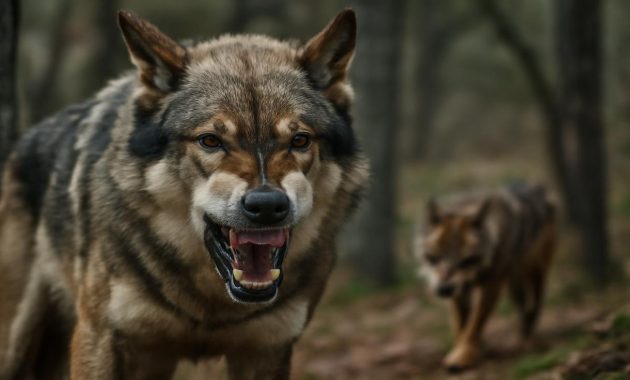
The first time I saw the photo, I thought it was a trick of the light. The animal stood at the edge of a Galician pine forest, its outline wavering in the late afternoon haze: too big for a wolf, too thick-necked for a dog, with shoulders like a small bear and hind legs that didn’t quite match the rest of the body. Its fur was a patchwork of grey, beige, and charcoal, its yellow eyes fixed on the camera trap with an eerie calm. It looked like something that had slipped through a crack between worlds—half familiar, half wrong. A caption beneath the image read: “Suspected wolf–dog hybrid. Weight estimated: 60–70 kg.”
The Giant That Shouldn’t Exist
A few weeks later I am standing where that animal once stood, boots sunk in damp soil, the air sharp with the smell of wet bark and wild thyme. The forest is quiet in that peculiar way that means it is listening back. A biologist named Marta walks ahead of me, her orange field vest bright against the olive gloom, pointing out tracks at our feet.
“Here,” she says, crouching. “Wolf. Pure.”
In the mud, the print is delicate and neat, the toes arched slightly inward. A wild elegance. A few meters away she stops again, this time with a frown.
“And here… probably hybrid. See the size? See the spread? It’s heavier, broader. No wolf in this region should be this big.”
The track beside her boot is enormous—closer to the paw of a large German shepherd, but with the wandering, exploratory pattern of a wild animal rather than a domestic one. Somewhere between these two sets of prints lies a story that is suddenly unsettling ecologists across the Iberian Peninsula: the rise of giant wolf–dog hybrids, and what that might mean for the future of the Iberian wolf.
“We’re not talking about the odd accident anymore,” Marta says as we walk on. “We’re talking about something that, if we ignore it, could slowly erase one of the most iconic predators of southern Europe.”
The Iberian Wolf’s Fragile Comeback
To understand why these hybrids are causing such alarm, you have to understand just how precarious the survival of the Iberian wolf already is. This wolf—Canis lupus signatus—isn’t just a generic European wolf that happens to live in Spain and Portugal. It is smaller, more lightly built, with distinctive dark bands across its front legs and a pale muzzle. Its ecology has been shaped by centuries of coexistence with shepherds, oak woodlands, scrub forests, and rugged mountains. It is, in many ways, as much a part of the Iberian landscape as cork oaks and stone terraces.
But its story is written in scars. In the mid-20th century, large carnivores were considered enemies of progress. Wolf bounties, poison, and systematic persecution drove them out of most of their historical territory. By the 1970s, Iberian wolves had disappeared from much of central and southern Spain and were hanging on in the northwestern mountains, in fragmented, beleaguered pockets.
Since then, thanks to legal protection in Portugal and, more recently, in Spain, the Iberian wolf has begun a slow, cautious recovery. Packs have recolonized some old ranges, and public attitudes, while still tense, have shifted slightly away from extermination. Yet this comeback is fragile—held together by thin threads of habitat, shifting political winds, and the uneasy truce between conservationists and rural communities.
Now another threat has arrived: not bullet, snare, or poison, but something far more insidious. It looks like a wolf. It moves like a wolf. It howls—but not quite like one. And it carries in its genes the power to dilute, distort, and ultimately replace the Iberian wolf itself.
When the Village Dog Meets the Forest Ghost
Hybridization between wolves and dogs is not, in itself, a new phenomenon. Where wild and domestic cousins live side by side, boundaries sometimes blur. A wandering shepherd dog in heat, a dispersing young wolf drawn to the scent of opportunity—nature is not a strict gatekeeper. Evolution is built on mixing and reshuffling.
What worries experts now is the scale, the pattern, and the timing of this mixing. In some regions of northern Portugal and western Spain, field researchers report a growing number of animals that appear “off-type”: larger than typical Iberian wolves, with odd coat colors, thicker heads, and behavior that is bolder around human settlements. Camera traps reveal individuals that do not fit the usual profile, while genetic tests in certain study areas are beginning to show increasing traces of dog ancestry.
The reasons are multiple, and human-made. Rural abandonment has left ghost villages scattered across the countryside. As people moved to cities, many left their dogs behind—unsterilized, free-ranging, loosely fed. These dogs roam between farms and wildlands, forming feral groups or shadowing human infrastructure: rubbish dumps, roadsides, open landfills. They are neither fully wild nor genuinely domestic. They are, however, very available partners for wolves whose territories are being squeezed by roads, wind farms, and agriculture.
“We’ve changed the rules of the game,” says Luís, a carnivore ecologist based in northern Portugal. We sit on a low stone wall overlooking a mosaic of small fields divided by stone fences and bramble thickets. “Fifty years ago, you had fewer free-ranging dogs, more shepherds always with their flocks, a different relationship between people and animals. Now you have empty countryside, abandoned livestock, and dogs multiplying unchecked. The hybridization pressure has increased dramatically.”
At first glance, some might shrug. A wolf–dog hybrid is still a canid, still a predator, still filling a similar ecological niche. But conservation biology draws a hard line between species and their domestic relatives for a reason. When enough dog genes seep into a small, isolated wolf population, you risk losing the very identity—and the hard-won adaptations—that define that wild animal.
A Predator Rewritten From the Inside Out
The dangers of uncontrolled hybridization are subtle, like a slow leak in a dam. They do not arrive all at once with a thunderclap; they creep in, generation by generation.
Domestic dogs, shaped by thousands of years of artificial selection, carry genetic baggage that is perfectly suited to living with humans—but not necessarily to surviving in the wild. Traits like reduced fear of people, altered stress responses, and changes in reproductive cycles can spread into wolf populations through repeated backcrossing. Over time, wolves may become bolder around villages, more likely to scavenge or raid livestock, or less efficient at hunting wary wild prey. That, in turn, fuels conflict with farmers, which leads inevitably to more persecution.
There’s also the matter of sheer size. In some hybrid hotspots, researchers are observing animals significantly heavier than typical Iberian wolves. Domestic breeds like mastiffs, German shepherds, or even large hunting dogs can contribute genes for massive body frames and thick muscle. A 60–70 kg hybrid is not just a curiosity—it is an ecological wildcard. Such an animal might take larger prey more frequently, compete differently with other carnivores, or interact more forcefully with livestock. Its impact on the ecosystem could diverge sharply from that of a true Iberian wolf.
Then there is identity. Conservation is not only about numbers; it is about preserving the living heritage of wild forms. The Iberian wolf is a distinct piece of evolutionary history—its genes shaped by the mountains of León, the heaths of Galicia, the scrublands of northern Portugal. To let that genetic lineage vanish under a tide of dog ancestry is to accept the quiet extinction of a unique branch of life, even if, on the surface, “wolf-like” animals continue to roam the hills.
“If we don’t address this now,” Marta tells me as we pause beside a small stream, “we risk ending up with something that looks vaguely like a wolf but isn’t really a wolf anymore. It’s like painting over an old mural until the original art is gone.”
The Science of Seeing the Invisible
The trouble with hybrids is that they don’t come with warning labels. Some are obvious: odd coat colors, floppy ears, strange body proportions. Others look almost indistinguishable from wild wolves to the naked eye. Distinguishing a pure wolf from a wolf–dog hybrid often requires a combination of field experience, camera trap data, and, increasingly, genetic analysis.
In small labs tucked into universities and conservation centers across Iberia, technicians are quietly decoding the problem. From scat samples, hair caught on fences, or tissue collected from roadkills, they extract DNA and scan it for telltale markers—segments of the genome that say “dog” or “wolf.” When the results come in, patterns emerge: a suspected hybrid zone here, an isolated pack with high dog ancestry there, a seemingly pure population hanging on in a remote mountain range.
These data are then laid over maps of land use, dog density, livestock presence, and road networks. Slowly, a picture forms: hybridization isn’t evenly spread. It tends to flare up where wolf territories overlap heavily with clusters of unowned or poorly managed dogs, especially in areas of degraded habitat or near human infrastructure.
To help clarify the stakes, some researchers use simple summary tables when talking to local officials and land managers:
| Aspect | Iberian Wolf | Wolf–Dog Hybrid (Typical) |
|---|---|---|
| Body size | Medium, agile (30–40 kg) | Often larger, bulkier (up to 60–70 kg) |
| Behavior near humans | Generally wary, avoids close contact | Can be bolder, more habituated |
| Diet tendencies | Wild prey, occasional livestock | More scavenging, higher livestock interest |
| Conservation value | High – native genetic lineage | Low – dilutes wild gene pool |
It is a quiet revolution in how we see wildlife—not with binoculars, but with sequencers and spreadsheets. And it poses a difficult question: once you identify a hybrid, what do you do about it?
Experts Call for Action—But What Kind?
In recent years, a growing chorus of ecologists, geneticists, and conservation NGOs has begun to raise the alarm. Reports, workshops, and policy briefs circulate in both Spain and Portugal, all circling the same conclusion: if authorities do not act decisively, hybridization could undermine decades of effort to protect the Iberian wolf.
Yet the word “action” hides a thicket of dilemmas. Some options are clear enough, at least on paper. One major front is dog management. Experts urge stricter regulations and real enforcement around free-ranging dogs: mandatory identification and sterilization, controls on breeding, and serious attention to feral dog populations. Reduce the pool of potential mates, they argue, and you reduce the hybridization pressure on wolves.
Another front is habitat. Wolves pushed into marginal or heavily humanized areas are more likely to encounter dogs. Protecting and restoring continuous tracts of wild land, with enough prey and room for wolves to maintain stable territories, lessens the likelihood of risky encounters at the edges of villages.
Then comes the hardest, most controversial piece: what to do about existing hybrids. Some scientists advocate for the selective removal of confirmed hybrids and of wolf packs with very high dog ancestry, at least in critical core areas where genetically pure populations survive. Others caution that lethal control, especially of animals that look like wolves, could reignite public hostility and undo the fragile social tolerance wolves currently enjoy.
“This is where conservation stops being abstract,” Luís says quietly. “You’re not just protecting ‘wolves’ as an idea. You are making decisions about individual animals that exist in the world right now, some of which did not ask to be born hybrids. It’s morally complicated—but doing nothing is also a decision, with consequences.”
Between Science, Shepherds, and Stories
In the end, this is not only a biological issue. It is a cultural one. The Iberian wolf lives in the human imagination as much as in forests and mountains. It prowls children’s stories, old songs, and family legends about lost sheep and nighttime howls. Among older shepherds, you still hear the grudging respect that comes from generations of face-to-face encounters: the wolf as rival, neighbor, shadow.
Hybrids unsettle that story. They blur the line between the ancient forest ghost and the modern village dog. For some farmers, a giant wolf–dog that raids a corral feels like proof that conservation has gone wrong, that “these are no longer the wolves we knew.” For urban animal lovers, the idea of removing hybrids can sound cruel, because the boundary between wild and domestic seems, from a distance, theoretical.
Yet culture can also be a resource. In some mountain communities, traditional livestock-guarding practices—using big mastiff dogs, night enclosures, communal herding—still persist. These practices not only protect flocks from predation; they also shape how dogs move, reproduce, and interact with wildlife. Reviving and supporting such systems could help limit free-ranging, unneutered dogs wandering alone into the forest.
When I speak with a middle-aged shepherd named Joaquín, leaning on his staff beside a small flock of sheep, he shrugs at the term “hybrid” but understands the core of the issue instinctively.
“A house dog is a house dog,” he says. “If nobody cares for it, it goes looking for trouble. A wolf is a wolf. We learned to live with the wolf. But a half-wolf that isn’t afraid of people? That’s different. That’s when things get messy.”
His words linger in the cool evening air as the bells on his sheep chime softly. Science has its own language for such concerns—behavioral shifts, conflict potential, genetic swamping—but on this hillside, it all collapses into one simple idea: some boundaries matter.
Standing at the Edge of the Future
Back in the forest, the light is failing. Birds fall silent one by one, and a faint wind stirs the dry leaves. Somewhere far off, beyond the ridge, a dog barks in a village. For a moment, I listen for an answer—a long, thin wolf howl threading through the dusk. The forest offers only the rustle of a branch and the distant hum of a road.
The story of the giant hybrid animal and the Iberian wolf is still being written. It is not a story about monsters, or villains, or a single dramatic turning point. It is about how thousands of small human decisions—about dogs, land, roads, and villages—ripple outward into the DNA of a wild predator.
Experts call for action because they can see where the lines on the graph are heading. If hybridization continues unchecked, the Iberian wolf may survive in name but fade in substance, replaced by something broader, heavier, more domesticated at the genetic core. If we respond with care, foresight, and a willingness to tackle the messy work of dog management, habitat protection, and community dialogue, there is still time to keep the wolf’s lineage intact.
In that sense, the strange giant hybrid haunting camera traps and local rumors is more than a biological anomaly. It is a mirror held up to us. It asks how seriously we take the idea of wildness—not as a postcard image, but as a living, evolving set of relationships that we can either guard or let unravel. It asks whether we are content with an imitation of a wolf, or whether we are willing to defend the real thing, in all its wary, untamed, and inconvenient glory.
Somewhere, right now, under the same wide Iberian sky, a pure wolf moves silently through broom and heather, nose low, pads whispering against the earth. A few valleys away, a heavier animal of mixed blood follows a different path, drawn by the smell of chickens and refuse at the edge of a village. Between them lies a choice we have not yet fully made—and a future we are already shaping.
Frequently Asked Questions
What exactly is a wolf–dog hybrid?
A wolf–dog hybrid is an animal born from mating between a wild wolf and a domestic dog, or from later generations where hybrids breed back with wolves or dogs. Genetically, these animals carry a mix of wolf and dog DNA, which can influence their behavior, body size, and ecology.
Why are hybrids considered a threat to the Iberian wolf?
Hybrids can dilute the unique genetic makeup of the Iberian wolf, potentially altering its behavior, reducing its fitness in the wild, and changing how it interacts with humans and prey. Over time, repeated hybridization can lead to “genetic swamping,” where the original wild lineage is replaced by mixed-ancestry animals.
Are these giant hybrids more dangerous to people?
There is no clear evidence that hybrids specifically target humans, but they may be bolder around settlements and more prone to scavenging or livestock attacks, especially if they inherit reduced fear of humans from domestic dogs. This can increase conflict with rural communities.
How do scientists identify a hybrid?
Researchers use a combination of field observations, camera trap images, and genetic analyses. While some hybrids look visibly different, many can only be reliably identified by DNA testing from scat, hair, or tissue samples that reveal both dog and wolf ancestry.
What actions are experts recommending right now?
Specialists call for better management of free-ranging and feral dogs (including sterilization and identification), protection and restoration of suitable wolf habitat, and, in some sensitive areas, the careful removal of confirmed hybrids or heavily introgressed packs. They also emphasize involving local communities in decisions to ensure long-term coexistence.